

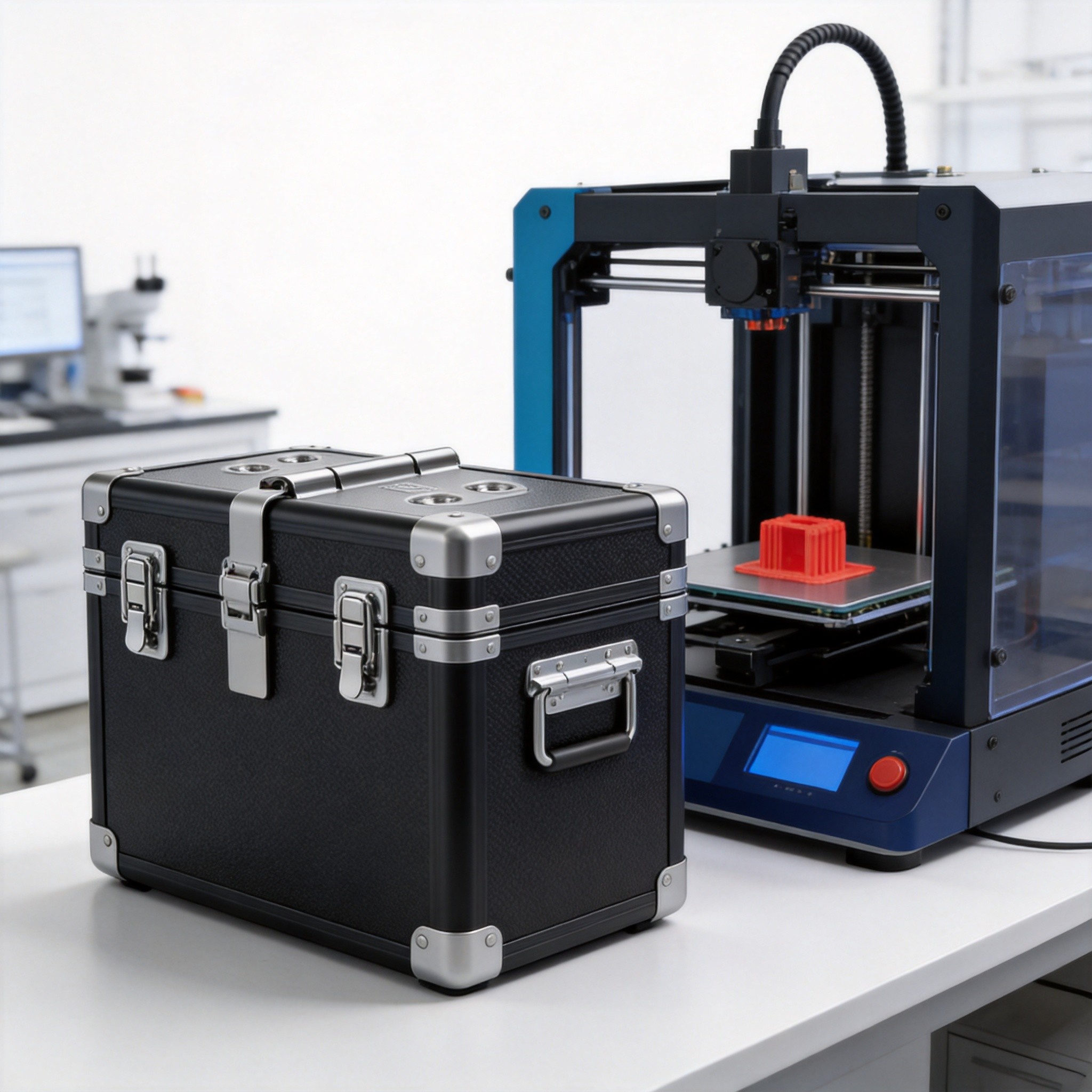
3D Printing and Prototyping Equipment Case Hardware Precision Solutions for Additive Manufacturing
Applicable Buyers: 3D printer enclosure manufacturers | Prototyping lab equipment builders | Additive manufacturing case fabricators | Resin storage case producers | Cleanroom equipment case OEMs
Key finding: 3D printing equipment cases require precision-aligned hardware to maintain print quality and equipment protection. Continuous piano hinges (8001 series) provide alignment accuracy for enclosures over 500mm, while compression latches (5301-112K, 45kg) and spring-loaded toggle latches (5102-88-1, 55kg) offer vibration-free closure for sensitive additive manufacturing equipment. SUS304 stainless steel is the baseline material for resin vapor resistance.
Additive manufacturing equipment demands case hardware that holds alignment within fractions of a millimeter. 3D printers, resin storage units, and prototyping enclosures all require hinges, latches, and handles engineered for stability, vibration resistance, and clean-room compatibility. The right hardware protects both the machine and the print.
Precision-Aligned Hinges for 3D Printer Enclosures
3D printer enclosures serve one purpose: maintain a stable thermal and structural environment. Any misalignment between the lid and the base lets heat escape, lets dust in, and warps the print zone. Continuous piano hinges deliver the alignment accuracy these enclosures demand.
The NRH 8001 series continuous hinge runs the full length of the enclosure edge. A single 1800mm hinge distributes load evenly across every mounting point. No single screw carries the full weight. No gap opens at the seam. The 8001-1800-50-1.5, built from SUS201 stainless steel at 1.5mm plate thickness, holds the lid flush under repeated open-close cycles. This hinge spans 50mm in width with mounting holes spaced at 60mm centers, giving installers consistent fastening points along the entire length.
Shorter enclosures use the 8201 series butt hinge. The 8201-50, machined from SUS304 stainless steel with a bright finish, handles a 10kg load per hinge. For small resin storage cases with lightweight lids, this is the right fit. Install two hinges on a case under 400mm wide and the lid stays true.
Support hinges add another dimension. The 8131-70, a 90-degree stay hinge in chrome-plated steel, holds the enclosure lid open at a fixed angle. Print operators need both hands free when loading filament or cleaning the build plate. A stay hinge eliminates the need to prop the lid with one hand while working with the other. The 8131-70 supports 10kg at the 90-degree position.
Key hinge selection factors for 3D printing cases:
- Alignment precision: Continuous hinges eliminate single-point deflection. Use them on any enclosure over 500mm wide.
- Thermal stability: Stainless steel hinges resist thermal cycling. SUS304 and SUS201 maintain dimensional stability from -20C to +200C.
- Corrosion resistance: Resin vapors and cleaning solvents corrode zinc-alloy hardware. Stainless steel is the baseline material choice.
Vibration-Free Latches for Sensitive Equipment
3D printers operate with moving gantries, vibrating stepper motors, and rapid axis changes. A loose latch rattles. A rattling latch transfers vibration to the frame. Vibration in the frame shows up on the print surface as Z-band artifacts and layer shifts. Latch selection directly affects print quality.
Compression latches solve this problem by applying constant preload between the lid and the base. The 5301-112K compression latch pulls the lid down with a 45kg clamping force. The cam mechanism rotates to lock, compressing the gasket and eliminating play between the two halves of the case. This latch uses an iron body with nickel-plated finish and features a bent hook for 90-degree installation. It is suitable for resin storage cases that must seal against both vibration and fume leakage.
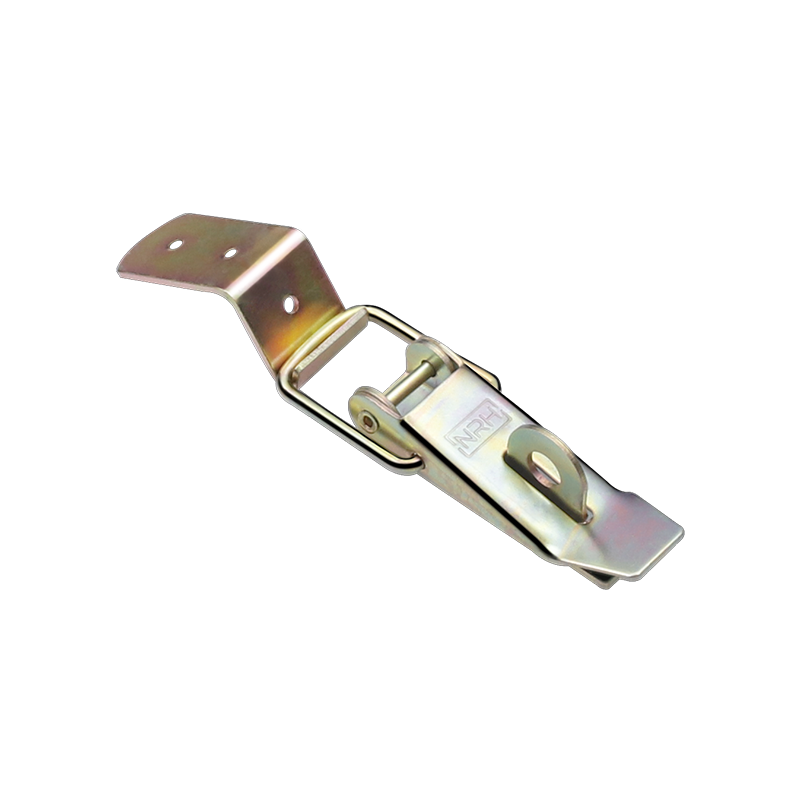
5301-112K compression latch, iron/nickel-plated, 119g, 45kg load, 90-degree bent hook mounting
| Parameter | 5301-112K |
|---|---|
| Material | Iron / Nickel-plated |
| Finish | Nickel-plated |
| Weight | 119g |
| Load Capacity | 45kg |
| Spring | None |
| Installation | 90-degree bent hook mounting |
| Application | Resin storage, sealed enclosures |
Spring-loaded toggle latches offer a different approach. The 5102-88-1 in SUS304 with vibratory grinding finish delivers 55kg load capacity. The spring-loaded mechanism provides consistent clamping force while the bent hook design enables 90-degree installation on case walls. For large 3D printer transport cases with heavy lids, this latch provides balanced closure without torque bias.
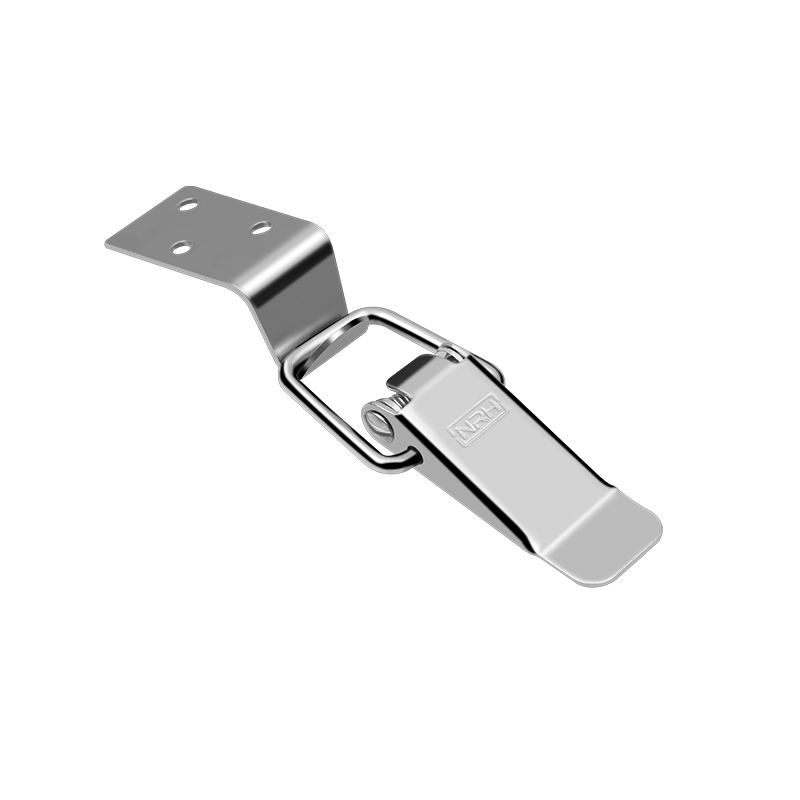
5102-88-1-S04-ZG, spring-loaded toggle latch, SUS304, 79g, 55kg load, 90-degree bent hook mounting
| Parameter | 5102-88-1-S04-ZG |
|---|---|
| Material | SUS304 Stainless Steel |
| Finish | Vibratory Grinding (ZG) |
| Weight | 79g |
| Load Capacity | 55kg |
| Spring | Built-in spring |
| Installation | 90-degree bent hook mounting |
| Application | Printer transport cases, heavy lids |
The 5101-96 spring-loaded slide latch in SUS304 with vibratory grinding finish delivers a tensile load rating of 392N at 90g. The double-hook design distributes clamping force across two points, reducing stress concentration on the case wall.
Draw latches handle lighter loads with quick-release convenience. The 5201-106 adjustable draw latch, rated at 35kg, fits resin bottle storage cases and filament spool enclosures. The wire-loop mechanism hooks and pulls in a single motion. Technicians working in fast-paced prototyping labs need one-handed operation.
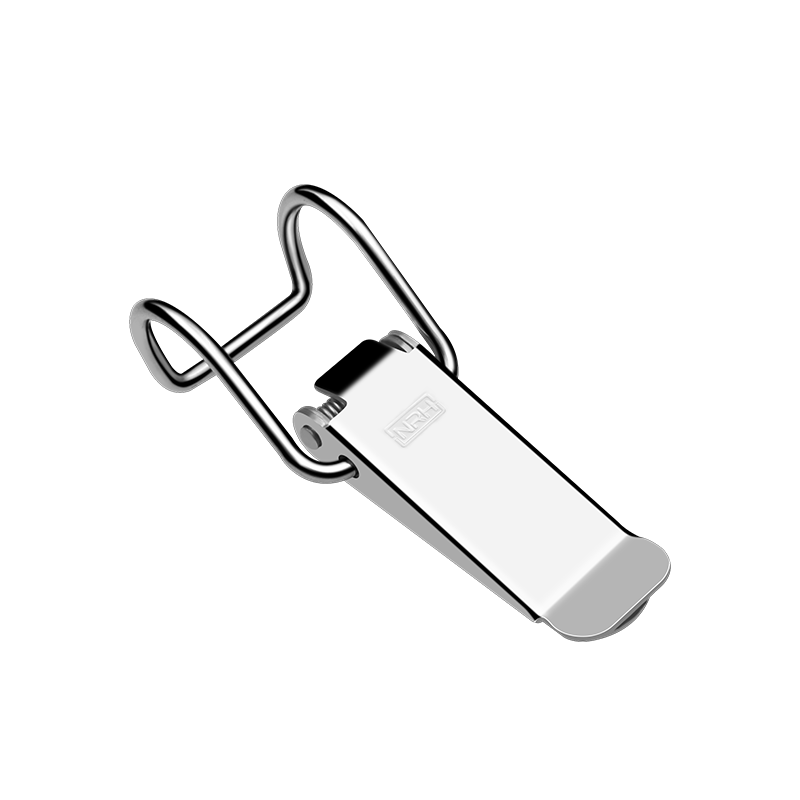
5201-106, draw latch, 35kg load, quick-release mechanism
Latch selection matrix for additive manufacturing cases:
| Application | Latch Type | Model | Load Rating |
|---|---|---|---|
| Resin storage (sealed) | Compression | 5301-112K | 45kg |
| Printer transport (large lid) | Spring Toggle | 5102-88-1 | 55kg |
| Filament enclosure (quick access) | Draw | 5201-106 | 35kg |
| Instrument access panel | Spring Slide | 5101-96 | 392N |
Clean-Surface Handles for Transport and Access
3D printing equipment moves between workstations, trade shows, and client sites. Every handle on the case must carry the load without snagging on cables, catching on rack edges, or protruding into workspace clearance zones. Clean-surface handle design is a functional requirement, not an aesthetic preference.
Recessed handles sit flush with the case surface when not in use. The 4101-132 in SUS304 stainless steel carries 60kg. Its folding U-grip tucks into a rectangular pocket, leaving a smooth external surface. Drag a case through a crowded lab without catching on anything. The 4101-160 in chrome-plated steel increases the load rating to 80kg for heavier printer transport cases. Both models install with four countersunk screws from inside the case, leaving no exposed fastener heads on the exterior.
Folding spring handles provide automatic return. The 4201-100, a SUS304 stainless steel spring handle rated at 25kg, snaps flat when released. For filament spool cases and resin bottle carriers that get opened dozens of times per shift, the auto-return feature keeps the handle out of the way between uses.
U-handle and bridge-handle designs offer a fixed grip for cases that stay stationary but need a firm carrying point. The 4301-100 bridge handle in SUS304 vibratory-grind finish supports 50kg. Mount two on a large prototyping enclosure and two people can lift and move a 100kg payload.
Handle material matters in additive manufacturing environments:
- SUS304 stainless steel: The default choice. Resists resin fumes, IPA splashes, and thermal cycling. Bright or vibratory-grind finishes shed contaminants.
- Chrome-plated steel: Higher load capacity at lower cost. The chrome layer resists corrosion from ambient humidity. Avoid direct contact with aggressive solvents.
- Black oxide finishes (BK2/BK4): Reduce visual glare in darkened print rooms. Functional when operators monitor prints under UV light.
Corner Protection and Structural Reinforcement
Transport cases for 3D printers absorb impacts during loading, shipping, and field deployment. Corner protectors distribute impact energy across a wider area and prevent case deformation that can misalign the internal frame. Misaligned frames shift the printer’s gantry position, and a shifted gantry produces dimensional errors in every printed part.
The 7201-50 3D box corner in chrome-plated steel wraps three faces of the case edge. At 45 grams per unit, four corners add under 200 grams to the total case weight while increasing drop resistance at the most vulnerable points. For lighter prototyping cases, the 7301-45 flat corner at 23 grams provides edge reinforcement without adding bulk.
Case locks secure the enclosure during transport. The 6101-108K butterfly lock with keyed cylinder delivers 392N tensile load. For resin storage cases that must remain sealed to prevent UV exposure and fume leakage, a locking latch is both a security and a safety requirement. The 6306-85 latch lock pushes the tensile rating to 588N, suitable for heavy industrial transport cases carrying production-grade printers.
Selection Guide: Hardware for 3D Printing and Prototyping Cases
Use this decision framework to match hardware to your specific case application.
Step 1: Define the case function.
- Transport case (frequent moves): Prioritize weight, flush handles, and high-impact corner protectors.
- Stationary enclosure (lab deployment): Prioritize thermal seals, stay hinges, and compression latches.
- Resin storage (sealed): Prioritize compression latches, gasket compatibility, and SUS304 corrosion resistance.
Step 2: Calculate loads.
- Lid weight determines hinge count and type. Add 30% safety margin above calculated load.
- Latch count depends on case width. Install one latch per 400mm of case width.
- Handle count follows the two-person lift rule: any case over 25kg needs at least two handles.
Step 3: Choose materials based on environment.
- Resin exposure: SUS304 minimum. SUS316 for prolonged chemical contact.
- Temperature cycling: Stainless steel throughout. Avoid zinc alloys above 80C.
- UV-sensitive resin storage: Black oxide finishes block UV reflection inside the case.
Step 4: Verify dimensional compatibility.
- Measure case wall thickness. Recessed handles require specific pocket depths. The 4101-132 needs a minimum wall thickness of 1.5mm on steel or 3mm on aluminum.
- Check hinge pin diameter against case material. The 8001 series uses a 5mm pin. Confirm your material can accept this hole size without wall failure.
- Validate latch travel distance against gasket compression range. Compression latches must compress the gasket fully before reaching the locked position.
What Happens If You Choose Wrong?
- Using chrome-plated steel hinges in resin vapor environments: Resin vapors contain acrylic monomers and photoinitiators that corrode chrome plating at the edges. Within 6-12 months, the plating fails and the steel rusts. Specify SUS304 stainless steel for resin exposure.
- Choosing standard draw latches for vibration-sensitive equipment: Draw latches rely on spring tension that can loosen under continuous vibration. The 3D printer’s stepper motors create low-frequency vibration that works latches loose over time. Specify compression latches with mechanical preload for stationary enclosures.
- Using non-recessed handles on transport cases: Protruding handles snag on cables, rack edges, and adjacent equipment during loading. They can catch on door frames and cause the case to drop. Recessed handles eliminate this risk.
- Installing insufficient corner protection: A dropped printer case without corner protectors transfers impact energy directly to the frame. Frame deformation misaligns the gantry, causing dimensional errors in every subsequent print. Corner protectors absorb impact and preserve alignment.
Application Summary
3D printing and prototyping equipment cases demand hardware that maintains alignment, resists vibration, and withstands chemical exposure. SUS304 stainless steel provides the corrosion resistance essential for resin vapor environments. Continuous piano hinges (8001 series) deliver alignment accuracy for enclosures over 500mm. Compression latches (5301-112K, 45kg) and spring-loaded toggle latches (5102-88-1, 55kg) offer vibration-free closure for sensitive additive manufacturing equipment.
Key selection factors for 3D printing case hardware include:
- Alignment precision: Continuous piano hinges maintain lid alignment and gasket seal integrity
- Vibration resistance: Compression latches and spring-loaded toggle latches prevent vibration-induced loosening
- Corrosion resistance: SUS304 stainless steel for resin vapor exposure
- Clean surface design: Recessed handles eliminate snag hazards and simplify cleaning
- Impact protection: Corner protectors absorb drops and preserve frame alignment
Recommended for similar applications: This hardware selection guide is also applicable to resin storage cabinets, filament dry boxes, cleanroom equipment enclosures, and any additive manufacturing or prototyping case requiring precision alignment and vibration resistance.
Frequently Asked Questions
Q: What hinge type works best for a 3D printer enclosure that opens daily?
Data answer: Continuous piano hinges (8001 series) distribute wear across the full length. They outlast butt hinges in high-cycle applications by eliminating single-point stress.
Q: Do compression latches maintain seal pressure over time?
Data answer: Yes. The cam mechanism in the 5301-112K applies consistent 45kg clamping force. Unlike draw latches that rely on spring tension, compression latches hold their preload through mechanical lock.
Q: Can recessed handles carry a 50kg 3D printer?
Data answer: The 4101-132 is rated for 60kg. Use two handles for balanced lifting. The 4101-160 extends this to 80kg per handle for heavier payloads.
Q: Why choose stainless steel over chrome-plated steel for resin cases?
Data answer: Resin vapors contain acrylic monomers and photoinitiators that corrode chrome plating at the edges. SUS304 stainless steel resists this chemical exposure without surface degradation.
Q: What is the load capacity of the 5102-88-1 latch?
Data answer: The 5102-88-1-S04-ZG has a 55kg load capacity with a built-in spring mechanism and 90-degree bent hook mounting. It is constructed from SUS304 stainless steel with vibratory grinding finish and weighs 79g.
Q: What is the difference between the 5301-112K and 5102-88-1 latches?
Data answer: The 5301-112K is a compression latch (45kg, 119g, iron/nickel-plated, no spring) that applies preload for sealed enclosures. The 5102-88-1 is a spring-loaded toggle latch (55kg, 79g, SUS304, built-in spring) that provides consistent clamping force for transport cases. Both feature 90-degree bent hook mounting.
Q: How many compression latches does a 600mm-wide resin storage case need?
Data answer: Two compression latches. Position them at 1/4 and 3/4 of the case width. This spacing compresses the gasket evenly and prevents bowing at the center.
Q: What is the expected service life of stainless steel hardware in 3D printing environments?
Data answer: SUS304 hardware typically lasts 5 to 10 years in 3D printing environments. The primary failure mode is mechanical wear at hinge pivot points and latch engagement surfaces, not corrosion. Lubricating hinge pins every 6 to 12 months extends service life.
Need help choosing the right hardware for your 3D printing or prototyping case? Contact our technical team for specification support and sample requests.
Contact Information:
- TEL and WhatsApp and WeChat: +86 180 1797 5137
- E-MAIL: nrh-gz@nrh.cn
- ADD: Room 1703-1704, Zhongji Mansion, 819 Yinxiang Road, Nanxiang Town, Jiading District, Shanghai, China