

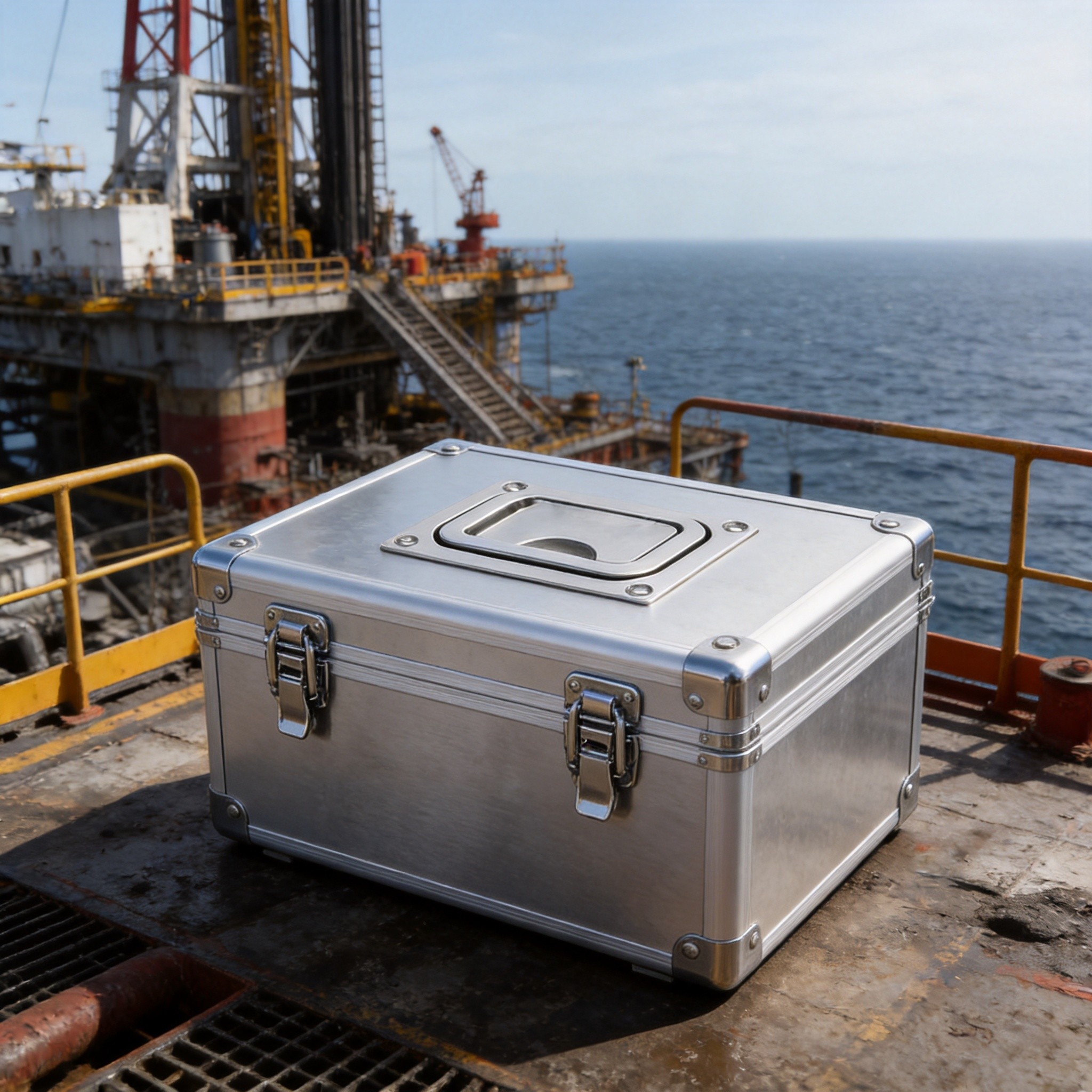
Oil and Gas Field Equipment Case Hardware Explosion-Proof and Corrosion-Resistant Solutions
Applicable Buyers: Oil and gas equipment case manufacturers | Offshore platform enclosure builders | Industrial instrument case fabricators | Explosion-proof enclosure OEMs | Energy sector hardware procurement specialists
Key finding: Oil and gas environments attack standard case hardware through salt spray, hydrogen sulfide, extreme temperatures, and explosive atmospheres. SUS316 stainless steel provides the corrosion resistance needed for offshore and coastal installations, while SUS304 suits onshore dry-climate applications. Austenitic stainless steel hardware is inherently non-sparking, making it suitable for Zone 2 and Class I Division 2 hazardous areas when used within properly rated enclosures.
Oil and gas environments attack standard case hardware from every direction – salt spray, hydrogen sulfide, extreme temperatures, and explosive atmospheres. Hardware that corrodes or sparks on a rig or offshore platform creates both safety hazards and unplanned downtime. This guide covers the materials, design criteria, and product selections that perform in the field.
Why Standard Hardware Fails in Oil and Gas Environments
Carbon steel and zinc-alloy hardware dominate general-purpose enclosures. In oil and gas service, those materials break down fast. Saltwater exposure accelerates galvanic corrosion on plated surfaces. H2S-rich wellhead environments cause sulfide stress cracking in high-strength steels. Ambient temperatures on desert drilling sites can exceed 55C, while offshore North Sea installations drop below -20C. Thermal cycling loosens threaded connections and fatigues latch springs.
The result: latches seize, hinges bind, and lock cylinders jam. A seized latch on an explosion-proof enclosure means technicians cannot access critical instrumentation on schedule. A corroded hinge on an offshore junction box allows the door to swing open in rough seas, exposing energized terminals to saltwater.
Regulatory frameworks reinforce the need for purpose-built hardware. IEC 60079 and NEC Article 500 define hazardous-area classifications that dictate what hardware may be used in Zone 1, Zone 2, Class I Division 1, and Class I Division 2 locations. Hardware that produces sparks – through impact, friction, or static discharge – is prohibited in these zones. NORSOK M-501 and ISO 12944 impose specific corrosion-protection grades for offshore installations.
Corrosion-Resistant Materials: SUS316 vs SUS304
Austenitic stainless steel is the baseline material for oil and gas case hardware. Two grades dominate: SUS304 and SUS316. The difference comes down to molybdenum.
SUS304 (18% chromium, 8% nickel) resists atmospheric corrosion and mild chemical exposure. It works well for onshore enclosures away from direct saltwater contact. The 5101-96 spring-loaded slide latch in SUS304 with vibratory grinding finish delivers a tensile load rating of 392N at 90g. This latch features a double-hook design that distributes clamping force across two points, reducing stress concentration on the case wall.
SUS316 adds 2-3% molybdenum to the alloy. That single change raises pitting resistance equivalency (PRE) from roughly 19 to 24. In practical terms, SUS316 withstands chloride-induced pitting in marine atmospheres where SUS304 develops visible rust within 6-12 months. The same latch design in SUS316 maintains the 392N tensile specification.
For offshore and coastal installations, SUS316 is the correct default. The cost premium over SUS304 typically runs 15-25%, but the extended service life and reduced maintenance intervals deliver a lower total cost of ownership. Onshore facilities in dry or temperate climates can use SUS304 with confidence.
Surface finish also matters. Vibratory grinding (ZG) produces a uniform, low-profile texture that minimizes crevice-corrosion initiation sites compared with rougher finishes. Electropolished surfaces offer the highest corrosion resistance but carry a cost premium suited to subsea or splash-zone applications.
SUS316 stainless steel latches on an offshore explosion-proof enclosure – corrosion resistance in a saltwater environment
Non-Sparking and Explosion-Proof Hardware Options
In hazardous areas, hardware must not become an ignition source. Austenitic stainless steel is inherently non-sparking because it does not produce impact sparks when struck against carbon steel or itself. This makes SUS304 and SUS316 hardware acceptable for Zone 2 and Class I Division 2 locations when the enclosure design itself carries the appropriate Ex rating.
Key selection criteria for explosion-proof enclosure hardware:
- Material: Austenitic stainless steel (SUS304/SUS316) or copper-alloy alternatives. Avoid carbon steel, zinc alloy, and aluminum in spark-sensitive zones.
- Locking mechanism: Choose latch designs that cam into a locked position without sliding friction. Spring-loaded slide latches (5101 series) meet this requirement. Sliding-bolt designs can generate friction sparks and are unsuitable for Zone 1.
- Gasket compression: Explosion-proof enclosures require a verified gasket seal. Adjustable latches with over-center geometry apply consistent clamping force across the gasket perimeter, maintaining flame-path integrity.
- Ground continuity: Hinges and latches must maintain electrical bonding between the enclosure door and body. Stainless steel hardware provides reliable conductivity without corrosion-induced resistance buildup.
Spring latches in SUS316 deserve specific attention for hazardous-area use. The 5103-70K spring latch delivers a tensile load capacity of 1500N at 35g. The spring mechanism secures the latch in both open and closed positions, preventing accidental door opening from vibration – a common failure mode on vibrating compressor skids and drilling platforms.
Heavy-Duty Hinges and Latches for Field Instrument Cases
Field instrument cases – analyzers, flow computers, RTU enclosures – live on pipe racks, wellheads, and platform walkways. They take physical abuse from tools, weather, and daily access cycles. Hardware selection for these cases prioritizes load capacity and durability.
Latches for High-Vibration Service
L-type latches (5102 series) provide high single-latch load capacity. The SUS316 variant, 5102-88-1, supports 55kg per latch. On a 30kg instrument case door, two L-type latches deliver a 3.7:1 safety margin against vibration-induced opening.
Draw latches (5201 series) offer adjustable clamping force, which compensates for gasket compression set over time. This adjustability extends enclosure sealing life from months to years in continuous-service applications. The 5201-106 adjustable draw latch, rated at 35kg, features a wire-loop mechanism that hooks and pulls in a single motion.
Case Locks for Security and Tamper Evidence
Locked enclosures prevent unauthorized access to calibrated instrumentation. The 6306 series case locks in SUS304 deliver 588N tensile resistance with a key-locking mechanism. For Zone 2 applications where the lock body must be non-sparking, the stainless steel construction eliminates the spark risk that plated carbon steel locks carry.
Hinges That Endure Continuous Cycling
Instrument case doors on drilling rigs may open and close 10-20 times per shift. Hinge pins must resist wear and maintain alignment. The 8201-50 short hinge in SUS304 with bright finish carries 10kg per hinge at 52g. For heavier doors or high-cycle applications, continuous piano hinges (8001 series) distribute load along the full door edge, eliminating stress concentration at individual hinge points.
Selection Guide: Matching Hardware to Oil and Gas Service Conditions
| Service Condition | Material | Hardware Type | Recommended Series |
|---|---|---|---|
| Offshore / splash zone | SUS316 | Spring slide latch, L-type latch | 5101, 5102 |
| Onshore / dry climate | SUS304 | Draw latch, case lock, short hinge | 5201, 6306, 8201 |
| Zone 1 / Class I Div 1 | SUS316 | Cam-action compression latch | Contact NRH for custom configuration |
| Zone 2 / Class I Div 2 | SUS304 or SUS316 | Spring slide latch, spring latch | 5101, 5103 |
| High-vibration skid | SUS316 | L-type latch + continuous hinge | 5102, 8001 |
| Security-critical enclosure | SUS304 | Case lock with cylinder | 6306 |
| H2S sour service | SUS316 | All hardware in SUS316, ZG finish | Full SUS316 lineup |
Three decision points drive hardware selection in oil and gas: corrosion severity, hazardous-area classification, and mechanical load. Address corrosion first (SUS316 for marine/H2S, SUS304 for dry onshore). Then verify the hardware meets spark-prevention requirements for the area classification. Finally, confirm the latch or hinge carries sufficient load capacity with a safety margin of at least 2:1 for vibration applications.
What Happens If You Choose Wrong?
- Using SUS304 hardware in offshore saltwater environments: SUS304 lacks the molybdenum needed to resist chloride-induced pitting. Visible rust appears within 6-12 months. Within 24 months, latch mechanisms seize and hinges bind. Specify SUS316 for marine and coastal installations.
- Using carbon steel latches in Zone 2 hazardous areas: Carbon steel can produce impact sparks when the latch snaps shut. In explosive atmospheres, this creates an ignition risk. Austenitic stainless steel is the safe, compliant material for hazardous-area applications.
- Installing insufficient latches on explosion-proof doors: Uneven gasket compression creates leak paths that compromise flame-path integrity. A 400mm x 300mm door with a flat gasket typically needs two latches. Larger doors may require three or four. Consult your enclosure manufacturer for specific requirements.
- Choosing sliding-bolt latches for Zone 1 locations: Sliding-bolt designs can generate friction sparks. Specify cam-action latches that lock without sliding friction for Zone 1 and Class I Division 1 applications.
- Using zinc-plated hardware in H2S service: Hydrogen sulfide causes sulfide stress cracking in high-strength steels and accelerates corrosion of zinc plating. SUS316 stainless steel is the minimum acceptable material for sour service environments.
Application Summary
Oil and gas field equipment demands hardware that resists corrosion, prevents ignition, and maintains mechanical integrity under extreme conditions. SUS316 stainless steel provides the corrosion resistance essential for marine and H2S environments. SUS304 suits onshore dry-climate applications where saltwater exposure is not a factor. Austenitic stainless steel is inherently non-sparking, making it suitable for Zone 2 and Class I Division 2 hazardous areas when used within properly rated enclosures.
Key selection factors for oil and gas case hardware include:
- Corrosion resistance: SUS316 for offshore/marine/H2S; SUS304 for onshore/dry climates
- Non-sparking material: Austenitic stainless steel for hazardous-area applications
- Cam-action locking: Avoid sliding-bolt designs that generate friction sparks
- Gasket compression: Ensure even clamping force across the full gasket perimeter
- Vibration resistance: L-type latches with 2:1 safety margin for high-vibration service
- Load capacity: Match hinge and latch ratings to enclosure door weight and access frequency
Recommended for similar applications: This hardware selection guide is also applicable to offshore platform instrument enclosures, onshore wellhead control panels, pipeline RTU cabinets, and any oil and gas equipment case requiring corrosion-resistant, non-sparking hardware with explosion-proof compatibility.
Frequently Asked Questions
Q: Is SUS316 hardware required for all offshore oil and gas enclosures?
Data answer: No. SUS316 is the recommended default for splash-zone and exposed locations. Enclosures inside climate-controlled modules may use SUS304 if the atmospheric corrosion category (ISO 12944 C2 or lower) supports it. Verify with your coating surveyor.
Q: Can standard carbon-steel latches be used in Zone 2 areas?
Data answer: Not recommended. Carbon steel can produce impact sparks when the latch snaps shut. Austenitic stainless steel is the safe, compliant material for Zone 2 and Class I Division 2 applications.
Q: What is the difference between SUS304 and SUS316 for oil and gas applications?
Data answer: SUS316 adds 2-3% molybdenum, raising pitting resistance from PRE 19 to 24. This provides significantly better resistance to chloride-induced pitting in saltwater and H2S environments. SUS304 is suitable for dry onshore applications; SUS316 is required for offshore and coastal installations.
Q: Are NRH products certified for ATEX or IECEx zones?
Data answer: NRH supplies case hardware components, not complete Ex-certified assemblies. The hardware material and design are suitable for use in Ex enclosures, but the overall enclosure must carry its own ATEX or IECEx certification from the enclosure manufacturer. NRH products are manufactured in ISO 9001-certified facilities.
Q: What gasket compression force do spring latches provide?
Data answer: Spring latches in the 5103-70K series deliver up to 1500N tensile load capacity. Actual gasket compression depends on latch geometry, gasket material, and the number of latches per door. Consult your enclosure gasket supplier for required compression pressure.
Q: What is the service temperature range for SUS316 latches?
Data answer: SUS316 austenitic stainless steel maintains mechanical properties from approximately -196C to +870C. For case hardware applications, the practical range is limited by gasket material – typically -40C to +120C for silicone or EPDM gaskets.
Q: How many latches should an explosion-proof enclosure door have?
Data answer: Depends on door size and gasket type. A 400mm x 300mm door with a flat gasket typically needs two latches for even compression. Larger doors or doors with multi-track gaskets may require three or four. Uneven compression creates leak paths that compromise flame-proof integrity.
Q: Can SUS304 and SUS316 hardware be mixed on the same enclosure?
Data answer: Technically yes, but galvanic potential difference between the two alloys is minimal in atmospheric service. In immersed or splash-zone conditions, avoid mixing to prevent preferential corrosion of the SUS304 components. Use SUS316 throughout for marine installations.
Need help choosing the right hardware for your oil and gas application? Contact our technical team for material recommendations and load-capacity calculations tailored to your specific service conditions.
Contact Information:
- TEL and WhatsApp and WeChat: +86 180 1797 5137
- E-MAIL: nrh-gz@nrh.cn
- ADD: Room 1703-1704, Zhongji Mansion, 819 Yinxiang Road, Nanxiang Town, Jiading District, Shanghai, China