

Why Electrical Enclosures Need Specialized Hardware for Power and Control Applications
Applicable Buyers
Electrical panel manufacturers, power distribution system integrators, fire alarm equipment producers, and control cabinet fabricators sourcing enclosure hardware for indoor and semi-outdoor installations.
Key Finding
A power distribution box and a fire alarm controller require fundamentally different hardware – the first prioritizes keyed access control and corrosion resistance, while the second demands non-conductive grip surfaces for operator safety. Specifying the wrong type creates shock hazards or access failures.
We see this on nearly every electrical enclosure RFQ: someone specs the same latch they use on a server rack for a 400V power distribution box. After reviewing hardware configurations for power and control enclosures across dozens of projects, one thing stands out – the hardware that works on a mild indoor panel will fail on a high-voltage cabinet, and the handle that is fine on a server rack is a liability on fire alarm equipment. Electrical enclosures have their own set of demands: non-conductive grip surfaces, keyed access control, compact footprints that do not crowd DIN rail space, and corrosion resistance that matches the installation environment.
This article walks through two real configurations – a power distribution box with SUS304 keyed toggle latches and a fire alarm controller with a PVC rubber handle – and explains why each choice matters. If you are specifying hardware for electrical, power, or control enclosures, the details here will save you a round of re-specification.
Why Electrical Enclosures Need Specialized Hardware
Electrical enclosures are not generic boxes. The hardware on a power distribution panel has to survive conditions that a standard IT enclosure never sees. Here is what drives the selection:
Non-conductive requirements. On any enclosure that houses live busbar or high-voltage components, a metal handle is not just inconvenient – it is a safety hazard. If a fault energizes the cabinet skin, grabbing a steel handle becomes a shock risk. Rubber and PVC handles solve this. They provide an insulating barrier between the operator and the enclosure surface. For fire alarm controllers and similar safety equipment, this is not optional. It is expected.
Keyed access control. High-voltage cabinets and power distribution boxes need restricted access. Not just to prevent tampering, but to meet code requirements for controlled entry. A toggle latch with a built-in key lock does two things: it secures the panel door under vibration, and it limits opening to authorized personnel. You cannot get that from a standard squeeze latch or a slip-on clamp.
Compact footprints. Electrical enclosures are often shallow – 120mm, 140mm, maybe 200mm deep. The hardware has to fit within that envelope without interfering with internal components. A 63mm-wide toggle latch fits on a 300mm panel face with room for three units across. A 120mm industrial latch would eat half that space and leave no room for knockouts or cable glands.
Indoor vs. outdoor corrosion demands. Indoor electrical rooms are climate-controlled. The hardware does not face salt spray or UV. A zinc-plated latch is fine. But move that same enclosure to an outdoor transformer pad, a coastal substation, or a chemical plant, and you need SUS304 minimum – with a vibratory finish that holds up to extended salt spray exposure per ASTM B117. The cost difference is real. The failure cost of getting it wrong is bigger.
What Happens If You Choose Wrong
A metal handle on a fire alarm panel becomes a shock hazard during a ground fault. A non-keyed latch on a high-voltage distribution box allows unauthorized access to live parts – a code violation and a safety risk. Under-specifying corrosion resistance leads to rusted latches that seize or fail to close properly within 18-24 months in humid environments.
Case 45 – Power Distribution Box: SUS304 Keyed Toggle Latches
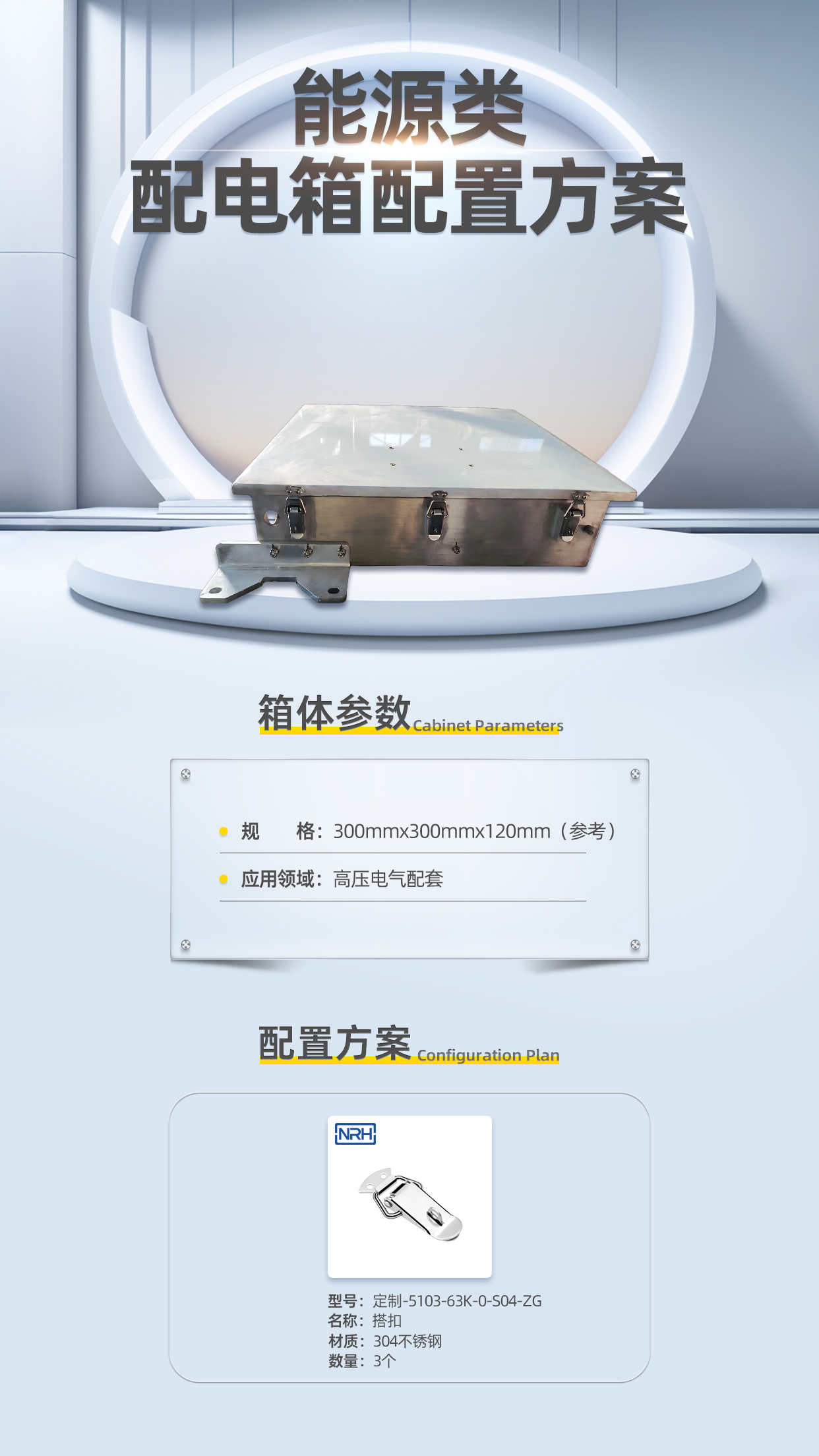
Case 45: Power distribution box (300x300x120mm) with three SUS304 keyed toggle latches
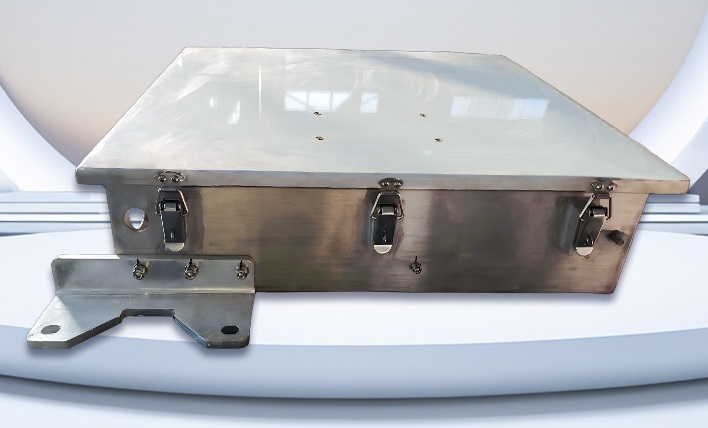
This is a compact power distribution box, roughly 300x300x120mm, designed for high-voltage electrical applications. Three toggle latches secure the front panel. Let us look at the configuration:
| Item | Model | Material | Qty |
|---|---|---|---|
| Toggle Latch with Key Lock | 5103-63K-0-S04-ZG | SUS304 | 3 |
Why This Configuration Works
SUS304 for high-voltage environments. Our salt spray data shows SUS304 with vibratory finish (ZG) holds up to extended ASTM B117 testing. That is more than enough for indoor electrical rooms, and it covers semi-outdoor installations like transformer enclosures with partial weather protection. Compare that to FE-ZL (zinc plating) for indoor use, or FE-CR (chrome) for slightly more demanding conditions. If your power distribution box sits in a humid electrical room or a semi-sheltered outdoor location, SUS304 is the right call. Not because it is overkill – because the margin matters when you are three years into service and the zinc-plated alternative is already showing white rust.
Key lock for access control. The 63K in the model number means keyed lock. On a high-voltage distribution box, you do not want anyone with a flathead screwdriver opening the panel. The key lock serves dual purpose: it keeps the door secured under vibration (power equipment vibrates) and it restricts access to qualified personnel. This is a common requirement in IEC 61439 switchgear assemblies and similar standards that mandate controlled access to live parts.
63mm width – compact enough for three across. The 5103 series sits at 63mm wide. On a 300mm panel, three latches fit with comfortable spacing. You get even clamping pressure across the door gasket, which maintains the enclosure’s IP rating. One latch in the center may cause uneven gasket compression or potential door distortion. Two latches at the edges would leave the middle unsealed. Three gives you a proper seal line. The compact footprint is what makes this possible.
Vibratory finish (ZG) – not just cosmetic. The vibratory finish on SUS304 is not just for appearance. It smooths micro-surface irregularities that can become corrosion initiation points. In electrical rooms with condensation cycles, this matters. A polished surface sheds moisture better than a raw stamped surface with tool marks. Our test data consistently shows ZG-finished SUS304 outperforming equivalent non-finished parts in extended salt spray testing.
Case 11 – Fire Alarm Power Controller: PVC Rubber Handle
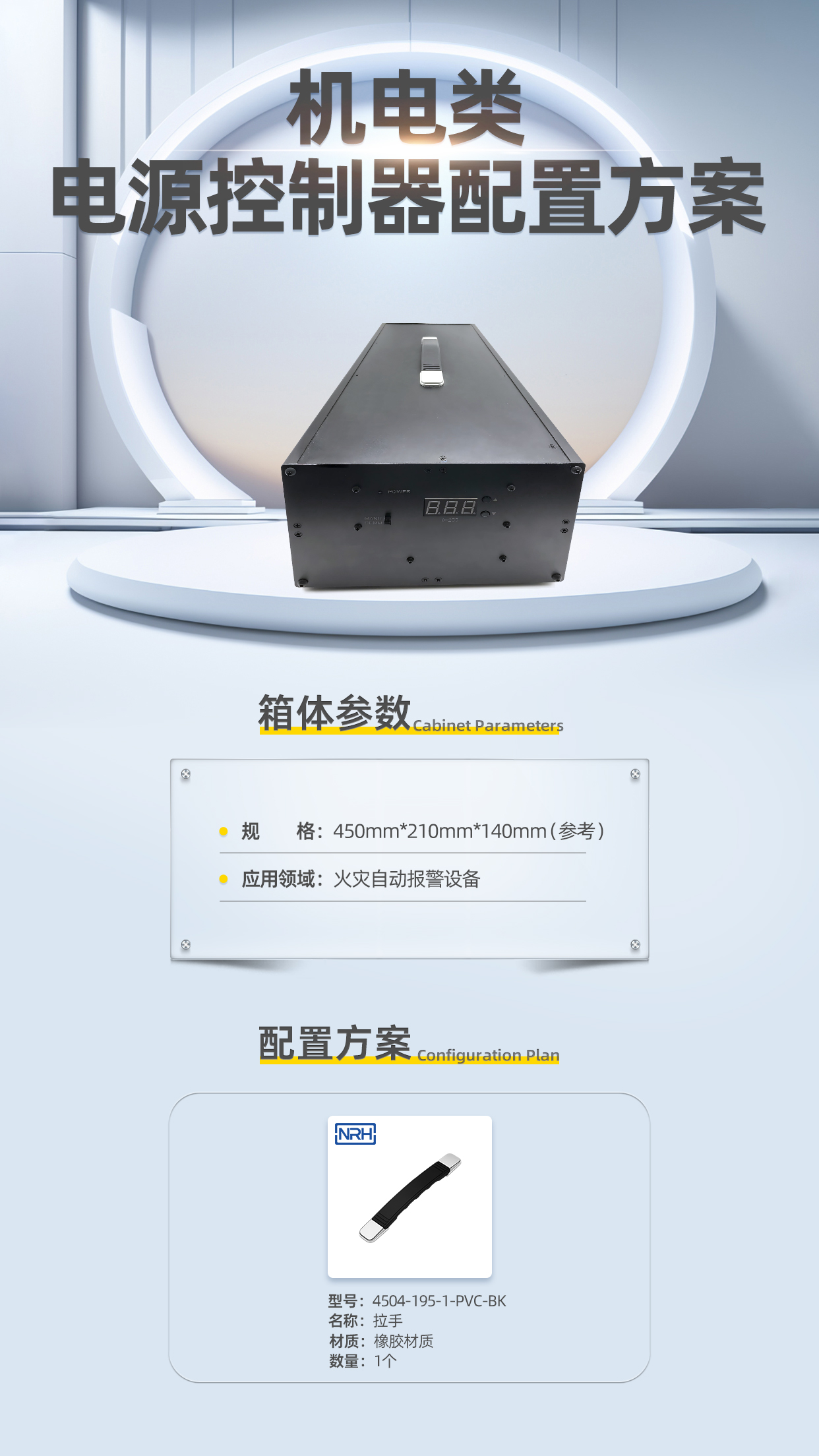
Case 11: Fire alarm power controller (450x210x140mm) with PVC rubber handle
This fire alarm power controller measures roughly 450x210x140mm. It is a safety-critical enclosure – fire detection and alarm systems are life-safety equipment. One handle, one choice, no room for error.
| Item | Model | Material | Qty |
|---|---|---|---|
| Rubber Handle | 4504-195-1-PVC-BK | PVC (Rubber) | 1 |
Why a PVC Rubber Handle – Not Metal
Non-conductive grip. Non-negotiable. Fire alarm controllers sit in buildings where fault conditions can energize the enclosure. A ground fault, a wiring error during maintenance, a surge event – any of these can put voltage on the cabinet. If an operator grabs a metal handle during a fault, they are in the circuit. PVC rubber is inherently insulating. The 4504 series uses a rubber overmold on a steel core for structural strength, but the grip surface is fully insulated. That is why you see rubber and PVC handles on virtually all life-safety electrical enclosures.
Comfort during emergencies. This sounds secondary until you think about it. Fire alarm panels get opened under stress – during an active alarm, during system testing, during troubleshooting at 2 AM. A 195mm rubber handle gives you a full-hand grip. You can pull the door open fast, with gloves on, without fumbling. A small metal pull tab does not give you that. In a life-safety context, operability under stress is a design requirement, not a nice-to-have.
One handle on a 450mm panel. The 4504-195 at 195mm handle length is sized right for a 450mm-wide enclosure. One handle centered on the door gives adequate grip and pull force. The door likely uses hinges and internal latching rather than external toggle latches – common for fire alarm controllers where the front panel needs to look clean and tamper-resistant. The handle is for pulling the door open, not for locking it. Locking is handled separately, usually with a cylinder lock in the door itself.
Black PVC – blends with enclosure aesthetics. Fire alarm controllers are specified equipment. They sit in corridors, lobbies, and mechanical rooms where they are visible. A black PVC handle on a beige or gray enclosure is standard and expected. It does not call attention to itself. It looks like it belongs. That is a small thing, but it matters for acceptance by architects and building engineers who care about visual consistency in life-safety equipment.
Two-Case Comparison: Keyed Metal Latch vs. Non-Conductive Rubber Handle
| Factor | Case 45 – Power Distribution Box | Case 11 – Fire Alarm Controller |
|---|---|---|
| Primary Function | Secure door + restrict access | Provide safe grip for door opening |
| Hardware Type | Toggle latch with key lock (5103-63K) | PVC rubber handle (4504-195-1) |
| Material | SUS304 stainless steel | PVC/rubber over steel core |
| Corrosion Resistance | Extended salt spray per ASTM B117 (ZG finish) | N/A – indoor-only application |
| Conductivity | Conductive (metal body) – acceptable due to keyed access and controlled environment | Non-conductive grip surface – required for life-safety equipment |
| Access Control | Built-in key lock | None (separate door lock) |
| Quantity | 3 latches (even clamp pressure) | 1 handle (single-point pull) |
| Enclosure Depth | 120mm (shallow – compact latch essential) | 140mm (handle profile fits easily) |
| Installation Environment | Indoor / semi-outdoor electrical rooms | Indoor – commercial and institutional buildings |
| Safety Priority | Prevent unauthorized access to live parts | Prevent shock during fault conditions |
Bottom line: these two configurations solve different problems. Case 45 is about securing access to a high-voltage enclosure. The keyed SUS304 latch keeps unauthorized people out and keeps the door sealed under vibration. Case 11 is about safe operation of a life-safety panel. The PVC handle ensures that even during a fault, the operator can grab the door without becoming a path to ground. Both are correct for their application. Neither would work well in the other’s place – a metal latch on a fire alarm panel is a shock hazard, and a rubber handle on a high-voltage distribution box does not provide access control.
Product Specifications
5103-63K-0-S04-ZG – Keyed Toggle Latch
This is a spring-loaded toggle latch with a built-in key lock, designed for securing electrical enclosure doors. The latch uses a mechanical over-center locking mechanism that applies consistent clamping force when closed. The key cylinder locks the latch in the closed position, preventing vibration from backing off the latch over time.
| Parameter | Specification |
|---|---|
| Model | 5103-63K-0-S04-ZG |
| Type | Toggle Latch with Key Lock |
| Material | SUS304 Stainless Steel |
| Finish | Vibratory (ZG) |
| Width | 63mm |
| Key Lock | Included (63K variant) |
| Corrosion Resistance | Extended salt spray per ASTM B117 (verified from NRH product specification drawings) |
| Application | Power distribution boxes, switchgear, high-voltage enclosures |
4504-195-1-PVC-BK – PVC Rubber Handle
This is a strap-style handle with a PVC rubber grip over a steel core. The handle provides a non-conductive grip surface for operators opening electrical enclosures that may become energized during fault conditions. The 195mm grip length accommodates a full-hand pull.
| Parameter | Specification |
|---|---|
| Model | 4504-195-1-PVC-BK |
| Type | Rubber Strap Handle |
| Grip Material | PVC Rubber (insulating) |
| Core Material | Steel |
| Handle Length | 195mm |
| Color | Black (BK) |
| Conductivity | Non-conductive grip surface (verified from NRH product specification drawings) |
| Application | Fire alarm controllers, life-safety panels, control equipment |
Selection Considerations for Electrical Enclosure Hardware
After specifying hardware for electrical enclosures across multiple projects, here are the decision points we come back to every time:
1. Does the enclosure house live parts above 50V?
If yes, non-conductive grip surfaces are mandatory for any handle the operator touches during normal operation. This is where rubber/PVC handles (45 series) are the right choice. For enclosures where the hardware does not present a shock path – or where the latch body is recessed into a grounded panel – metal latches are acceptable.
2. Is restricted access required?
High-voltage enclosures, switchgear, and power distribution boxes typically need keyed access per IEC 61439 or local electrical codes. The 5103-63K series with built-in key lock handles this in a single component. If your enclosure uses a separate cylinder lock for the door, you can use standard (non-keyed) toggle latches or handles.
3. Indoor, semi-outdoor, or outdoor?
This drives your material and finish selection more than anything else. Indoor dry locations: zinc-plated steel is adequate. Semi-outdoor (covered but exposed to humidity and temperature swings): SUS304 with ZG finish. Full outdoor or coastal: SUS304 minimum, or SUS316 for severe marine environments. The cost step from zinc-plated to SUS304 is real, but the service life difference is measured in years, not months.
4. How many latch points does the door need?
Small panels (under 300mm) can often use a single latch with a heavy-duty catch. Medium panels (300-500mm) typically need two or three latch points for even gasket compression. Large cabinet doors (600mm and above) need at least three, sometimes four. Uneven compression leads to IP rating failures at the gasket line. Count your latches based on door span, not budget.
5. What is the enclosure depth?
Shallow enclosures (100-150mm) limit your hardware options. The latch or handle needs to fit within the door profile without protruding into the internal component space. Compact toggle latches like the 5103 series (63mm width) are designed for this. If you have a deeper cabinet (300mm+), you have more options, including larger draw latches and multi-point systems.
6. Is vibration a factor?
Power equipment vibrates. Transformers hum. Contactors chatter. Over time, that vibration backs off unsecured latches. A keyed toggle latch locks in the closed position – the key cylinder physically prevents the latch from vibrating open. If you are using standard squeeze latches on a vibrating enclosure, expect service calls for doors that will not stay shut. Add a secondary latch or upgrade to a keyed design.
Installation Guide
Tools Required
- Phillips screwdriver (for mounting screws)
- Flathead screwdriver (for latch adjustment)
- Measuring tape or ruler
- Marker or pencil (for marking hole positions)
- Drill with appropriate bits (if mounting holes are not pre-drilled)
- Level (to ensure straight alignment)
Installation Steps for Toggle Latches (5103 Series)
- Position the latch. Place the latch on the door face at the desired location. For a 300mm panel with three latches, space them evenly – typically at 75mm, 150mm, and 225mm from the edge.
- Mark mounting holes. Use a marker to trace the mounting hole positions through the latch base.
- Drill pilot holes. If holes are not pre-drilled, drill pilot holes at the marked positions. Use a bit size appropriate for the mounting screws provided.
- Secure the latch base. Attach the latch base to the door using the provided mounting screws. Do not fully tighten until all screws are started.
- Align and tighten. Check alignment with a level, then tighten all screws evenly.
- Install the catch. Mount the catch plate on the enclosure frame, aligned with the latch hook. Close the door and test engagement. Adjust catch position if needed.
- Test the key lock. Insert the key and verify that the lock cylinder engages and disengages smoothly. The latch should not open when locked.
Installation Steps for Rubber Handles (4504 Series)
- Position the handle. Center the handle on the door face. For a 450mm panel, center the 195mm handle so it is equidistant from both edges.
- Mark mounting holes. Trace the mounting hole positions through the handle bracket.
- Drill pilot holes. Drill pilot holes at the marked positions.
- Secure the handle. Attach the handle using the provided mounting screws. Tighten evenly.
- Test the grip. Pull the handle to verify secure attachment and comfortable grip.
Mounting Options Comparison
| Hardware | Mounting Method | Hardware Included | Typical Install Time |
|---|---|---|---|
| 5103 Toggle Latch | Screw-mounted base + catch plate | Mounting screws, catch plate | 5-8 min per latch |
| 4504 Rubber Handle | Screw-mounted bracket | Mounting screws | 3-5 min per handle |
Key Takeaways
- Power distribution boxes need keyed toggle latches for access control and vibration resistance. SUS304 with vibratory finish provides excellent corrosion protection for indoor and semi-outdoor installations.
- Fire alarm controllers require non-conductive PVC or rubber handles to eliminate shock risk during fault conditions – metal handles are a safety hazard on life-safety equipment.
- Compact hardware footprints (63mm toggle latches) are essential for shallow electrical enclosures where internal DIN rail space is limited.
- Three latch points on a 300mm panel provide even gasket compression – fewer latches risk IP rating failures due to uneven sealing.
- Material selection drives service life: zinc-plated steel suits indoor dry locations; SUS304 is required for humid or semi-outdoor environments.
- Keyed latches solve two problems at once – they restrict access to authorized personnel and prevent vibration-induced opening.
Frequently Asked Questions
Why use SUS304 instead of SUS316 for electrical enclosure latches?
SUS304 with vibratory finish provides excellent salt spray resistance per ASTM B117, which covers most indoor and semi-outdoor electrical installations. SUS316 adds molybdenum for superior chloride resistance and is worth the cost premium only in severe coastal or chemical environments. For the majority of power distribution and control enclosures, SUS304 is sufficient and more cost-effective.
Can I use a metal handle on a fire alarm controller?
You can, but you should not. Fire alarm controllers are life-safety equipment. During a fault condition, the enclosure can become energized. A metal handle provides a conductive path to the operator. PVC and rubber handles insulate the grip surface. Most specifiers and inspectors expect non-conductive hardware on fire alarm and life-safety panels. Using metal creates a liability issue even if the local code does not explicitly require it.
How many toggle latches does a power distribution box door need?
It depends on the door span. Up to 300mm: one heavy-duty latch may suffice. 300-500mm: two to three latches for even compression. Over 500mm: three to four minimum. The goal is consistent gasket compression along the entire door seal. Under-clamping leads to IP rating failures; over-clamping with too few points warps the door.
What does the ZG finish designation mean on SUS304 hardware?
ZG indicates a vibratory finish applied to SUS304 stainless steel. This process smooths surface micro-irregularities left by stamping and forming, which improves both corrosion resistance and aesthetic consistency. Verified from NRH product specification drawings, ZG-finished SUS304 consistently outperforms non-finished SUS304 parts in extended salt spray testing.
Are PVC handles rated for outdoor use?
PVC and rubber handles are primarily designed for indoor applications. UV exposure degrades PVC over extended periods, causing fading, cracking, and loss of elasticity. For outdoor enclosures, consider UV-stabilized rubber compounds or stainless steel handles with appropriate finish. If a non-conductive grip is required outdoors, verify the handle material’s UV resistance rating – contact manufacturer for rated values.
What is the difference between the 5103 and 5103K toggle latch series?
The 5103 is a standard toggle latch. The 5103K (or 63K designation within the series) includes a built-in key lock. The key lock provides both security – restricting access to authorized personnel – and vibration resistance, since the locked cylinder prevents the latch from opening under vibration. For high-voltage enclosures where controlled access is required, the K variant is the appropriate choice.
How do I determine the right handle length for my enclosure?
Handle length should be proportional to the door width and the expected pull force. For enclosures up to 300mm wide, a compact handle (100-150mm) is typically sufficient. For 300-500mm enclosures, a 195mm handle like the 4504-195-1 provides a comfortable full-hand grip. Larger enclosures may warrant longer handles or two-handle configurations. The key is ensuring the operator can open the door without excessive force or awkward grip positions – especially important for safety equipment that may be operated under stress.
Can toggle latches maintain an IP rating on electrical enclosures?
Yes, when properly specified and installed. Toggle latches apply clamping force that compresses the door gasket evenly. The number and placement of latches must create uniform compression along the full gasket perimeter. One latch on a 400mm door will not maintain IP65 because the gasket will be uncompressed at the edges. Three latches on the same door will. The latch itself does not provide the seal – the gasket does. The latch provides the clamping force to keep the gasket compressed.
Need Help Choosing?
Specifying hardware for electrical enclosures means balancing safety, access control, corrosion resistance, and space constraints. The wrong latch or handle creates problems that show up months after installation – corrosion, shock risks, IP failures, or doors that will not stay closed under vibration.
We have configured hardware for power distribution boxes, fire alarm controllers, motor control centers, and switchgear assemblies. If you need help matching hardware to your enclosure requirements, reach out.
Email: nrh-gz@nrh.cn
WhatsApp: +86 180 1797 5137
NRH Box Hardware
Room 1703-1704, Zhongji Building, No. 819 Yinxiang Road, Nanxiang Town, Jiading District, Shanghai, China