

Why Food Processing and Cold Chain Equipment Demand Stainless Steel Case Hardware
Applicable Buyers
Food processing equipment manufacturers, cold chain logistics providers, pharmaceutical cold chain operators, and industrial case fabricators requiring corrosion-resistant hardware for washdown environments and thermal cycling conditions.
Key Finding
A meat grinder enclosure and an insulated transport case face fundamentally different corrosion hazards – the first requires daily chemical washdown resistance across all surfaces, while the second demands handling durability under thermal cycling. Full SUS304 suits washdown zones; mixed materials with zinc-plated hinges are acceptable for lower-exposure cold chain logistics.
What Happens If You Choose Wrong
Zinc-plated latches on a meat grinder enclosure develop white rust within 12-18 months of daily chlorinated washdown, creating bacterial harborage points and potential FDA 21 CFR Part 117 Subpart B violations. SUS304 hinges specified unnecessarily on low-exposure insulated cases add 15-20% hardware cost without extending service life.
The afternoon shift ends at a meat processing facility. Production lines stop, and the sanitation crew moves in with high-pressure hoses delivering 60-80 degrees Celsius water, foaming chlorinated alkaline cleaners at pH 11-13, and a final 200 ppm sodium hypochlorite rinse. Every surface – conveyors, guards, belts, and the hardware on every equipment enclosure – must withstand this chemical assault once or twice daily, 365 days a year. A zinc-plated toggle latch that develops white rust after six months of chlorinated exposure does not merely look bad. It becomes a harborage point for Listeria monocytogenes, a contamination vector that can trigger a recall, and a violation under FDA 21 CFR Part 117 Subpart B (21 CFR 117.40) and USDA FSIS sanitation standards.
Food processing and cold chain equipment impose a dual burden on case hardware: aggressive chemical cleaning on one side and prolonged exposure to food-grade acids and saline residues on the other. This article examines two real equipment configurations – a commercial meat grinder enclosure and an insulated transport case – to illustrate how stainless steel hardware addresses these demands, why specific component choices were made, and what trade-offs exist when specifying hardware for food-contact and cold chain applications.
Why Stainless Steel for Food Processing and Cold Chain Equipment
Not every application demands austenitic stainless steel. An audiovisual flight case functions well with zinc-alloy latches and chrome-plated handles. But food processing and cold chain environments introduce three compounding stressors that make SUS304 the minimum practical specification.
FDA Food-Contact Compliance
Under FDA 21 CFR Part 117 Subpart B (specifically 21 CFR 117.40), equipment that may contact food must be designed and constructed to be adequately cleanable, and materials must not impart odor, color, taste, or harmful substances to food. SUS304 stainless steel – nominally 18% chromium and 8% nickel – is widely accepted as a food-grade material for non-direct contact surfaces. Unlike zinc-plated or chrome-finished components, SUS304 does not shed metallic particles that could contaminate food product zones – particularly relevant for equipment enclosures sharing workspace with open food preparation areas.
Chemical Cleaning Compatibility
Food processing facilities employ a progression of cleaning agents: alkaline detergents (pH 10-13) for fat and protein removal, acidic sanitizers (pH 2-4) for mineral scale and biofilm, and oxidizing disinfectants (sodium hypochlorite, peracetic acid) for pathogen elimination. Each attacks different materials:
- Zinc plating dissolves in alkaline solutions above pH 12, exposing the underlying steel to rapid corrosion.
- Chrome plating resists oxidation but develops micro-cracks under thermal cycling; once breached, the underlying steel corrodes rapidly in chlorinated environments.
- SUS304 forms a self-healing chromium oxide passive layer that re-forms after mechanical damage or mild chemical attack. This passivation behavior is the basis for its superior chemical resistance.
Salt Spray and Corrosion Resistance
ASTM B117 salt spray testing provides a standardized benchmark for comparing corrosion resistance across materials and surface treatments. For SUS304 stainless steel, passivated material demonstrates excellent resistance to red rust formation under standardized testing conditions. Unpassivated SUS304 shows moderate resistance, while zinc-plated steel and chrome-plated zinc alloy exhibit significantly shorter performance under the same test conditions. In a meat processing environment where saline residues and chlorinated cleaners are constant, this translates directly to service life: a passivated SUS304 latch may last multiple years where a zinc-plated equivalent fails within months.
Temperature Extremes in Cold Chain Applications
Cold chain equipment operates across extreme thermal ranges: -40 degrees Celsius in blast freezers, +4 degrees Celsius in refrigerated transport, and up to +120 degrees Celsius during hot-water washdown. SUS304 retains its austenitic structure and mechanical properties across this entire range, with no ductile-to-brittle transition that affects ferritic steels at sub-zero temperatures. This is critical for insulated cases moving between cold storage and ambient loading docks, subjecting hardware to thermal cycling that accelerates corrosion in susceptible materials.
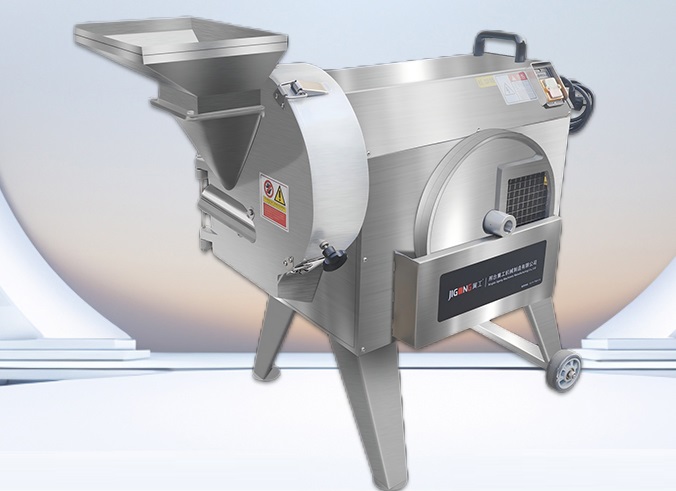
Case 40: Commercial Meat Grinder Enclosure
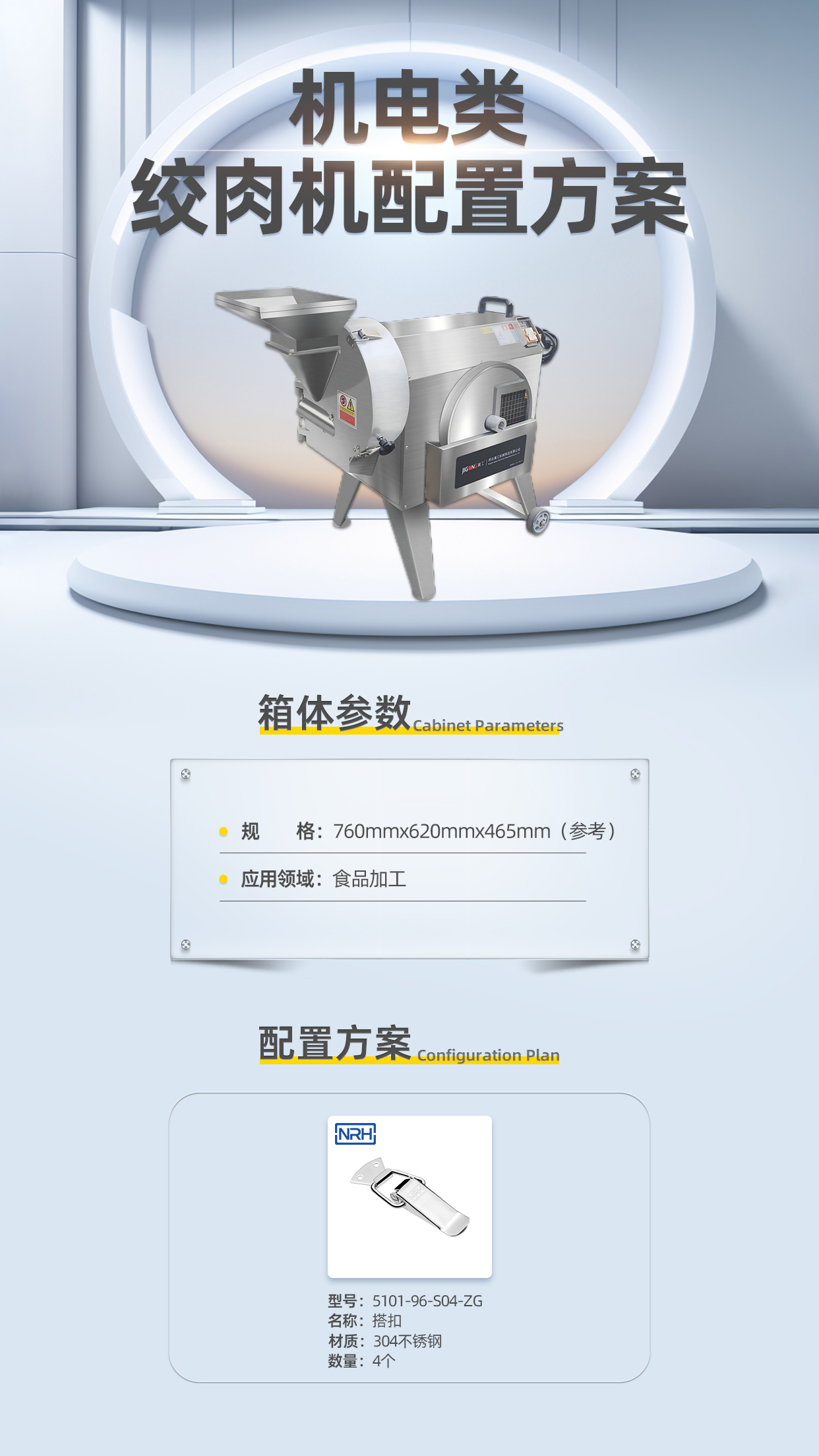
Case 40: Commercial meat grinder enclosure (760x620x465mm) with four SUS304 toggle latches
A commercial meat grinder enclosure measuring 760 mm x 620 mm x 465 mm (reference dimensions) houses a heavy-duty grinding mechanism for institutional and commercial food processing. The enclosure must maintain a sealed environment to prevent moisture ingress into the motor and drive components, while withstanding daily high-pressure washdowns and chemical sanitizer exposure. Organic residues – protein, fat, and blood – accumulate on every horizontal surface and must be completely removed during each cleaning cycle to prevent bacterial colonization.
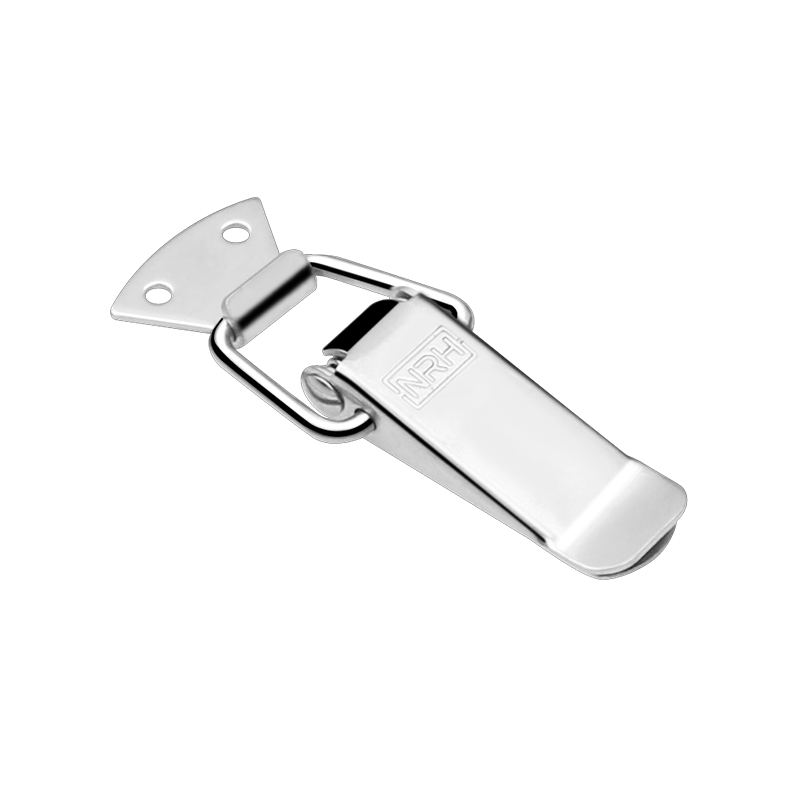
5101-96 Stainless Steel Toggle Latch – SUS304, 392N rated load
Hardware Configuration
| Model | Component | Material | Finish | Qty |
|---|---|---|---|---|
| 5101-96-S04-ZG | Toggle Latch | SUS304 | Vibratory polished (ZG) | 4 |
Why This Configuration Works for a Meat Grinder Enclosure
Four toggle latches (5101-96-S04-ZG). The 760 mm x 620 mm lid must maintain a consistent gasket seal against moisture and cleaning spray during washdown. Four NRH toggle latches positioned at the corners and mid-points of the long edges provide even clamping force across the full gasket perimeter. The tensile load rating of the 5101-96 platform ensures that each latch holds firmly under the vibration generated by the grinding mechanism during operation and the impact of high-pressure water jets during cleaning (verified from NRH product specification drawings).
SUS304 with vibratory polished finish. The ZG (vibratory polished) finish produces a smooth, non-porous surface that eliminates crevices where food residue could accumulate and bacteria could colonize. This is critical in a meat processing environment where organic residues must be completely removed during each cleaning cycle. A rougher finish – such as sandblasted or as-cast – would create microscopic pockets where protein residues could anchor, requiring longer cleaning times and stronger chemical concentrations.
No handles or hinges in this configuration. The meat grinder enclosure uses a lift-off lid design secured solely by four toggle latches – a deliberate simplification with a clear hygienic rationale. Fewer hardware components mean fewer crevice points, fewer mounting recesses, and faster cleaning cycles. This principle of minimizing horizontal surfaces and crevices is codified in 3-A Sanitary Standards (which require equipment to be free of cracks, crevices, and threads to facilitate cleaning and inspection) and EHEDG Guideline Doc. 8 (2023 edition on Hygienic Design Principles). A latch-only configuration fully aligns with this principle by eliminating hinge crevices and handle mounting recesses that would demand additional cleaning attention.
Component count as a design decision. The single-component-type, four-piece configuration also simplifies procurement, inventory, and field replacement. Maintenance personnel stock only one spare part number, reducing the risk of installing the wrong component during a 20-minute sanitation window between production shifts.
Case 48: Insulated Equipment Case for Cold Chain Logistics
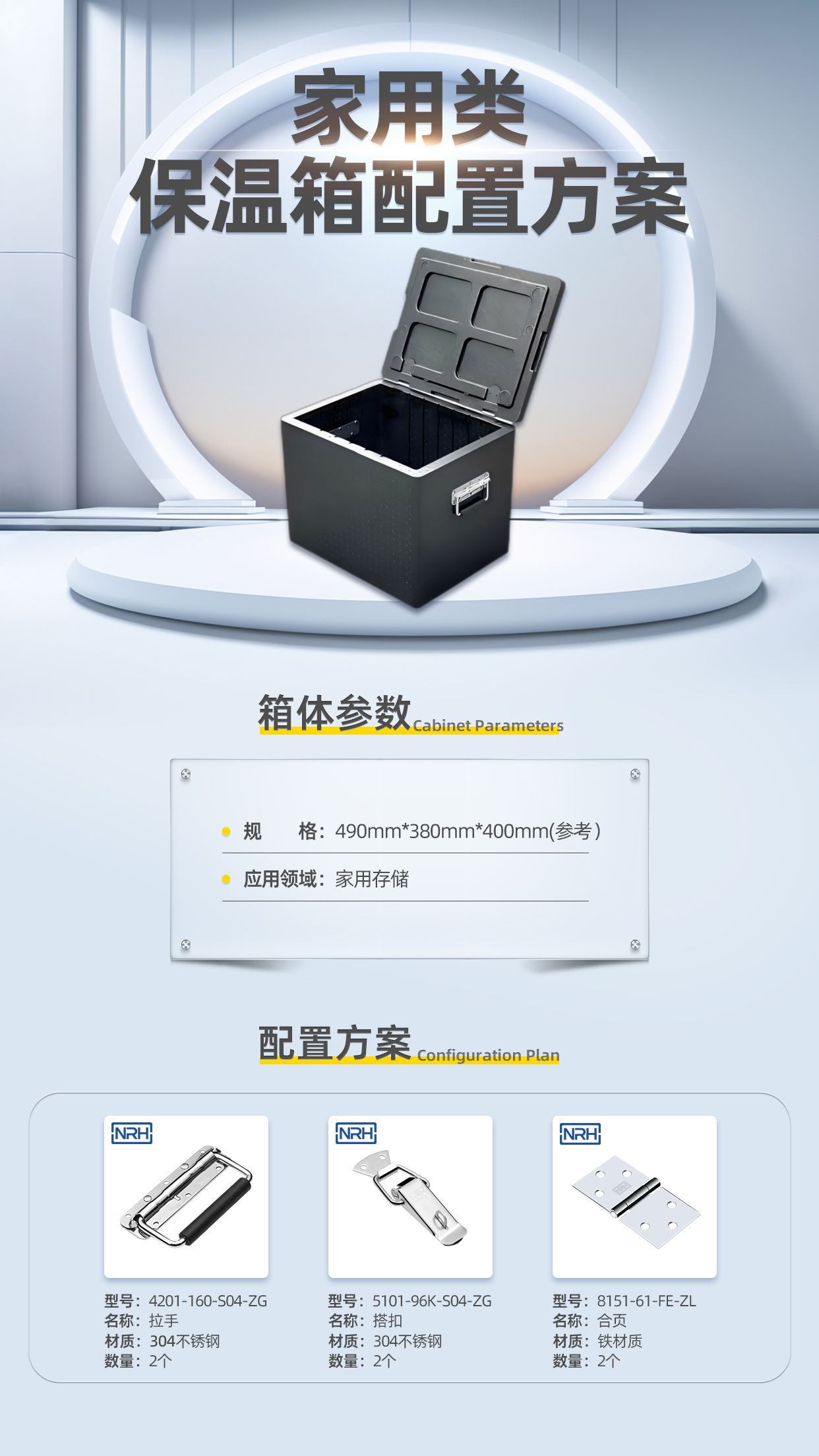
Case 48: Insulated equipment case (490x380x400mm) with SUS304 folding handles, keyed toggle latches, and zinc-plated iron hinges
An insulated transport case measuring 490 mm x 380 mm x 400 mm (reference dimensions) serves temperature-sensitive goods in cold chain logistics – pharmaceutical samples, biological specimens, premium food products, or medical reagents. Unlike the meat grinder enclosure, this case requires frequent opening during delivery rounds, carries significant payload weight, and may be left unattended during multi-stop routes. These requirements drive a more complex hardware configuration balancing corrosion resistance, security, handling ergonomics, and cost.
Hardware Configuration
| Model | Component | Material | Finish | Qty |
|---|---|---|---|---|
| 4201-160-S04-ZG | Folding Handle | SUS304 | Vibratory polished (ZG) | 2 |
| 5101-96K-S04-ZG | Keyed Toggle Latch | SUS304 | Vibratory polished (ZG) | 2 |
| 8151-61-FE-ZL | Hinge | Iron (FE) | Zinc plated (ZL) | 2 |
Why This Configuration Works for an Insulated Case
Two folding handles (4201-160-S04-ZG). The insulated case is carried between refrigerated vehicles and delivery points. Folding handles lie flat against the case surface when not in use, preventing snagging during stacking – critical when cases are stacked three or four high on pallets. The SUS304 construction with vibratory polished finish resists the condensation that inevitably forms on cold cases moved between refrigerated storage at -20 degrees Celsius and ambient conditions at +25 degrees Celsius. This condensation cycle – repeated dozens of times per day across a delivery fleet – creates a persistent moisture film that accelerates corrosion on non-stainless hardware. The ZG finish provides sufficient texture for a reliable grip even when wet, without creating crevices for contamination (verified from NRH product specification drawings).
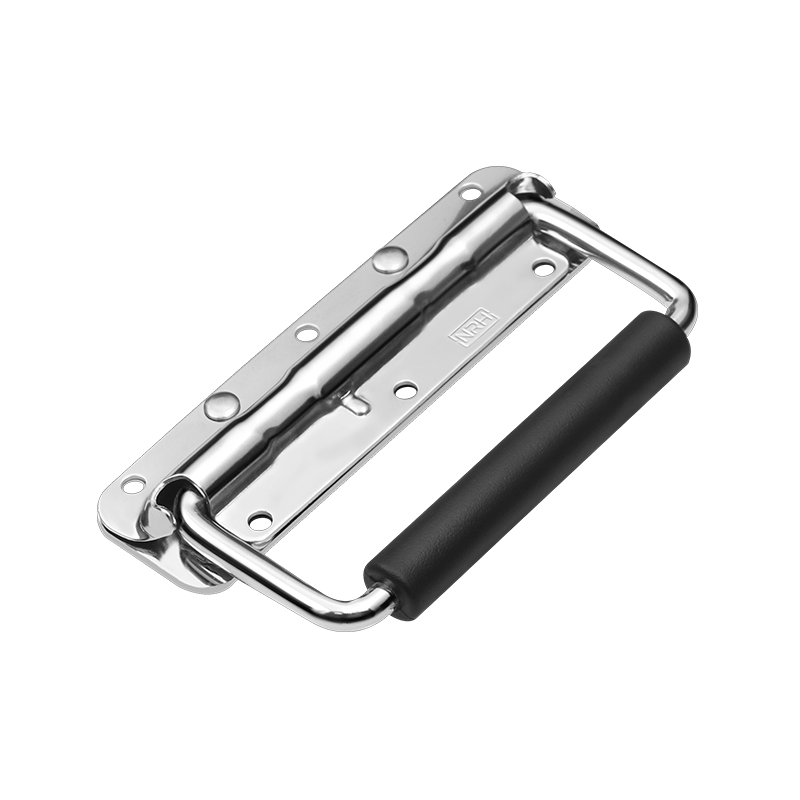
4201-160 SUS304 Folding Handle – spring-loaded auto-return
Two keyed toggle latches (5101-96K-S04-ZG). The “K” suffix denotes a lock cylinder integrated into the standard 5101-96 toggle latch body. For cold chain logistics, security serves dual purposes: preventing unauthorized access to temperature-sensitive cargo and maintaining documentation integrity required by GDP (Good Distribution Practice) regulations for pharmaceutical products. The keyed latch allows the case to be sealed and verified at each handoff point without introducing a separate padlock hasp – which would create additional crevice points and corrosion risk. The underlying latch mechanism shares the 5101-96 platform, ensuring the lid remains securely clamped during transport. Two latches (versus four on the meat grinder) reflect the smaller lid area of the 490 mm x 380 mm case, which requires less clamping force to maintain a consistent gasket seal (verified from NRH product specification drawings).
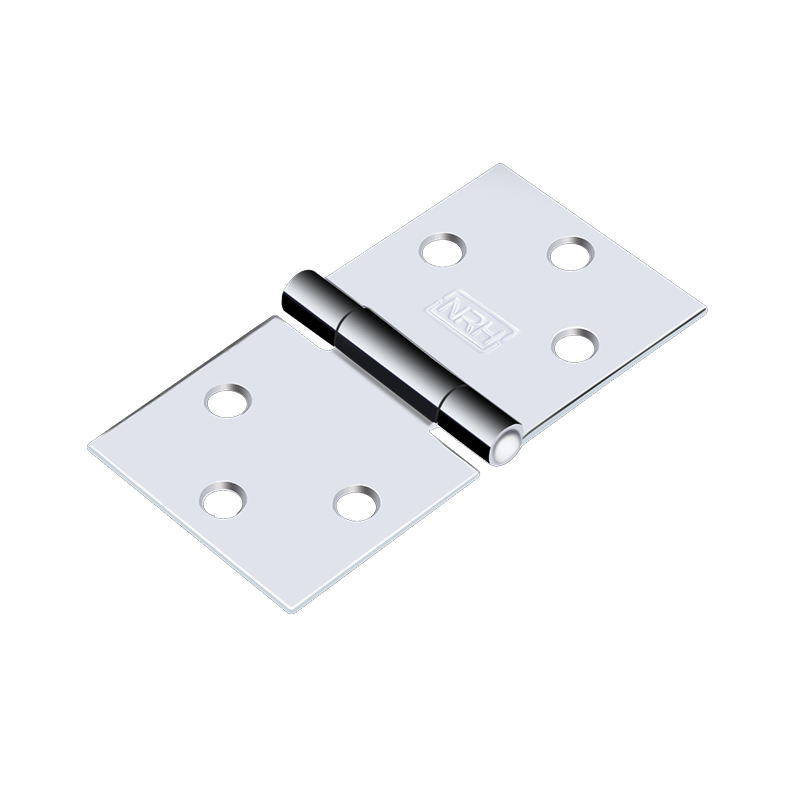
8151-61-FE-ZL Zinc-plated iron hinge
Two iron hinges with zinc plating (8151-61-FE-ZL). This is the most deliberate material trade-off in the configuration. The hinges are iron with zinc plating rather than SUS304, and the rationale lies in the exposure profile:
- Hinges are typically mounted on the rear edge, partially shielded due to case geometry and stacking orientation.
- Cold chain cases are cleaned by wipedown with mild detergent – not high-pressure chemical washdown – because they do not accumulate organic food residues.
- Zinc plating (ZL) provides adequate corrosion resistance for intermittent moisture exposure.
- Iron hinges with zinc plating provide adequate structural strength for this application at a lower cost than SUS304 equivalents, important for cases produced in volume.
This mixed-material approach illustrates a key engineering principle: SUS304 is specified where direct food-contact risk, aggressive chemical exposure, or regulatory requirements demand it; iron with zinc plating is acceptable where the exposure profile is less severe. The design is not a compromise – it is a risk-based material allocation that optimizes total cost of ownership without compromising functional integrity or regulatory compliance.
Product Specifications
5101-96-S04-ZG – Toggle Latch
This is a spring-assisted toggle latch with over-center locking mechanism, designed for securing enclosure lids and doors. The latch provides consistent clamping force through its lever-over-center design, with a spring mechanism that assists in maintaining closure under vibration. The SUS304 construction with vibratory polished finish offers excellent corrosion resistance for washdown environments.
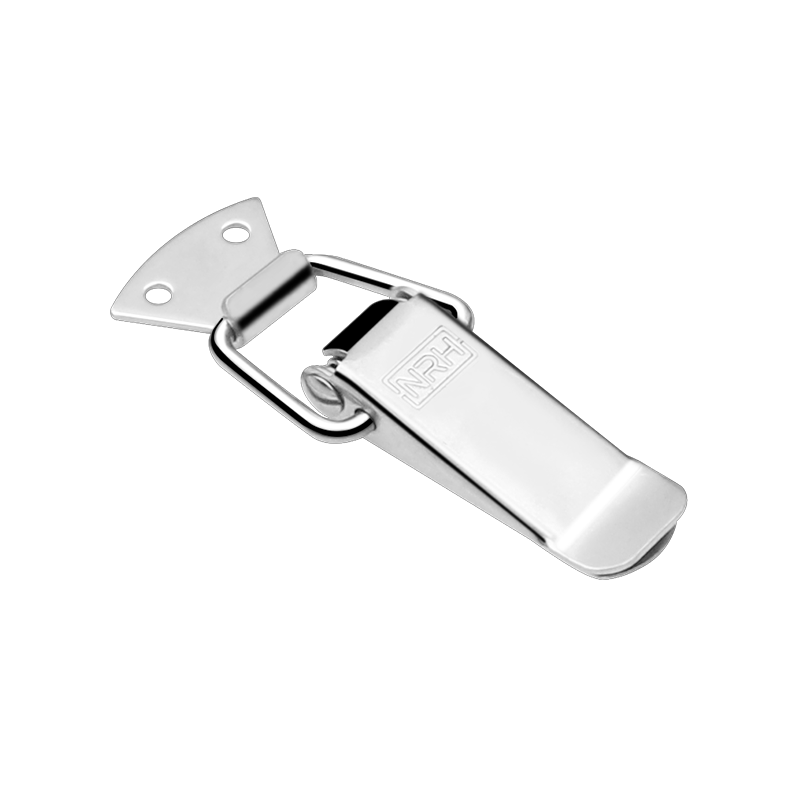
5101-96-S04-ZG SUS304 Toggle Latch
| Parameter | Specification |
|---|---|
| Model | 5101-96-S04-ZG |
| Type | Toggle Latch (Draw Latch) |
| Material | SUS304 Stainless Steel |
| Finish | Vibratory Polished (ZG) |
| Tensile Load | 392 N (verified from NRH product specification drawings) |
| Spring Mechanism | Spring-assisted mechanical over-center locking (verified from NRH product specification drawings) |
| Corrosion Resistance | Excellent for food processing washdown environments (verified from NRH product specification drawings) |
| Application | Meat grinder enclosures, food processing equipment, industrial cases |
4201-160-S04-ZG – Folding Handle
This is a spring-assisted folding handle that lies flat against the case surface when not in use. The handle uses a spring-loaded auto-return mechanism to retract the grip, preventing snagging during stacking. The SUS304 construction with vibratory polished finish resists corrosion from condensation and wipedown cleaning.
| Parameter | Specification |
|---|---|
| Model | 4201-160-S04-ZG |
| Type | Folding Handle (Spring-Loaded Auto-Return) |
| Material | SUS304 Stainless Steel |
| Finish | Vibratory Polished (ZG) |
| Handle Length | 160mm |
| Spring Mechanism | Spring-loaded auto-return to flush (verified from NRH product specification drawings) |
| Corrosion Resistance | Excellent for cold chain condensation environments (verified from NRH product specification drawings) |
| Application | Insulated transport cases, cold chain logistics, pharmaceutical cases |
Comparative Analysis: Food Processing vs. Cold Chain Hardware
The two cases represent distinct hazard profiles within the food and cold chain ecosystem. Understanding these differences is essential for specifying hardware that matches operational reality.
| Factor | Case 40: Meat Grinder | Case 48: Insulated Case |
|---|---|---|
| Primary hazard | Chemical cleaning, food residue | Condensation, handling wear |
| Cleaning protocol | High-pressure washdown daily | Wipedown as needed |
| Temperature range | Room temp to +80 degrees C wash | -40 degrees C to +25 degrees C ambient |
| Security requirement | Low (operator access only) | High (chain of custody, GDP compliance) |
| Material strategy | Full SUS304 | SUS304 (contact) + Iron (structural) |
| Component count | 1 type, 4 pcs | 3 types, 6 pcs |
| Design philosophy | Minimize crevices, maximize cleanability | Balance security, durability, cost |
Full SUS304 vs. Mixed Material Strategies
Case 40 employs an all-SUS304 strategy – the single component type is SUS304 – which is the correct choice for any equipment operating in direct food processing zones. If the enclosure shares airspace with food production, every exposed surface must withstand the same cleaning regime, and any material degradation could create contamination vectors. The cost premium of SUS304 over zinc-plated alternatives is justified by the avoided cost of a recall, a failed audit, or a foodborne illness outbreak.
Case 48 uses a risk-tiered approach. The handles and latches – the components most frequently touched and most exposed to the environment – are SUS304. The hinges, partially shielded and subject to different exposure conditions, are iron with zinc plating. This strategy reduces material cost by approximately 15-20% compared to a full SUS304 specification, while maintaining acceptable service life. Over a fleet of 500 insulated cases, this differential becomes significant without impacting fitness for purpose.
Latch Choice: Standard vs. Keyed
The 5101-96 and 5101-96K share the same latch body and clamping mechanism; the critical difference is the integrated lock cylinder on the 96K. For food processing equipment, standard toggle latches are strongly preferred because operators need quick, tool-free access for cleaning between shifts. Any locking mechanism adds crevices and surface complexity that complicate sanitation – contradicting the cleanability-first design philosophy.
For cold chain logistics, the keyed latch provides security and chain-of-custody documentation without a separate padlock hasp. A padlock hasp creates additional crevice points and protrusions that increase corrosion risk. The integrated lock cylinder in the 5101-96K embeds the security function within the latch body, maintaining a smooth exterior profile.
Choosing the Right Hardware for Food and Cold Chain Applications
Based on the principles illustrated by these two cases, the following decision framework helps engineers and procurement teams specify appropriate hardware for food processing and cold chain equipment.
Material Choice Framework
- If the case operates in a food processing zone with daily chemical washdown -> Choose SUS304 for all exposed hardware. No exceptions. The cleaning regime will destroy zinc plating and compromise chrome finishes within months.
- If the case operates in cold chain logistics with intermittent moisture -> SUS304 for handles and latches (high-touch, high-exposure components); zinc-plated iron acceptable for hinges and corner protectors (lower exposure, structural role).
- If the case operates in pharmaceutical or biological cold chain -> SUS304 or SUS316 for all hardware, due to stricter GDP regulatory requirements and the potential for condensation-induced corrosion in high-value cargo environments where hardware failure is unacceptable.
Latch Type Choice
- Standard toggle latch (e.g., 5101-96-S04-ZG) for operator-access equipment where quick release is prioritized and contamination control requires minimal surface complexity.
- Keyed toggle latch (e.g., 5101-96K-S04-ZG) for logistics and transport cases where security, chain-of-custody documentation, or GDP compliance requires a verifiable sealing mechanism.
Surface Finish Considerations
The vibratory polished (ZG) finish on SUS304 hardware provides an optimal balance for food and cold chain applications:
- Smoother than as-cast or sandblasted surfaces, reducing bacterial adhesion and facilitating cleaning.
- Less reflective than bright finish (LG), reducing visual glare in processing environments.
- Maintains the self-healing chromium oxide passive layer through the polishing process, providing consistent corrosion resistance.
Passivation after assembly significantly improves salt spray performance. Unpassivated SUS304 shows moderate resistance, while passivated SUS304 demonstrates excellent resistance per ASTM B117 testing. Passivation is recommended for all SUS304 hardware in food processing and should be specified in procurement documentation.
Installation Guide
Tools Required
- Phillips screwdriver (for mounting screws)
- Flathead screwdriver (for latch adjustment)
- Measuring tape or ruler
- Marker or pencil (for marking hole positions)
- Drill with appropriate bits (if mounting holes are not pre-drilled)
- Level (to ensure straight alignment)
Installation Steps for Toggle Latches (5101 Series)
- Position the latch. Place the latch on the enclosure face at the desired location. For a 760mm panel with four latches, space them evenly – typically at corner and mid-point positions along the long edges.
- Mark mounting holes. Use a marker to trace the mounting hole positions through the latch base.
- Drill pilot holes. If holes are not pre-drilled, drill pilot holes at the marked positions. Use a bit size appropriate for the mounting screws provided.
- Secure the latch base. Attach the latch base to the door using the provided mounting screws. Do not fully tighten until all screws are started.
- Align and tighten. Check alignment with a level, then tighten all screws evenly.
- Install the catch. Mount the catch plate on the enclosure frame, aligned with the latch hook. Close the door and test engagement. Adjust catch position if needed.
- Test the key lock (K variant). Insert the key and verify that the lock cylinder engages and disengages smoothly. The latch should not open when locked.
Installation Steps for Folding Handles (4201 Series)
- Position the handle. Center the handle on the case face. For a 490mm case, center the 160mm handle so it is equidistant from both edges.
- Mark mounting holes. Trace the mounting hole positions through the handle bracket.
- Drill pilot holes. Drill pilot holes at the marked positions.
- Secure the handle. Attach the handle using the provided mounting screws. Tighten evenly.
- Test the spring action. Pull the handle to verify the spring-loaded auto-return mechanism operates smoothly.
Mounting Options Comparison
| Hardware | Mounting Method | Hardware Included | Typical Install Time |
|---|---|---|---|
| 5101 Toggle Latch | Screw-mounted base + catch plate | Mounting screws, catch plate | 5-8 min per latch |
| 4201 Folding Handle | Screw-mounted bracket | Mounting screws | 3-5 min per handle |
Key Takeaways
- Food processing equipment with daily chemical washdown requires full SUS304 hardware – zinc-plated or chrome-finished alternatives degrade within months, creating contamination risks.
- Cold chain insulated cases can use a mixed-material approach: SUS304 for high-touch components (handles, latches) and zinc-plated iron for shielded structural components (hinges, corner protectors).
- Standard toggle latches (non-keyed) are preferred for food processing equipment where quick cleaning access is essential and surface simplicity minimizes crevices.
- Keyed toggle latches are preferred for cold chain logistics where security and chain-of-custody documentation are required without adding a separate padlock hasp.
- The vibratory polished (ZG) finish on SUS304 hardware reduces bacterial adhesion and facilitates cleaning in food processing environments.
- Passivation significantly improves the corrosion resistance of SUS304 hardware and should be specified for all food processing applications.
- Component count matters: fewer hardware types and mounting points mean faster cleaning cycles and simpler inventory management.
Frequently Asked Questions
Is SUS304 hardware required by FDA regulations for food processing cases?
FDA 21 CFR Part 117 Subpart B (21 CFR 117.40) requires that equipment be corrosion-resistant, non-absorbent, and cleanable. SUS304 meets these requirements and is the de facto industry standard, though the regulation does not mandate a specific alloy. Zinc-plated or chrome-finished hardware generally does not meet cleanability requirements in food processing zones due to surface degradation under chemical cleaning.
Can SUS201 substitute for SUS304 to reduce hardware cost?
SUS201 (approximately 17% chromium, 4.5% nickel) has lower nickel content and correspondingly lower corrosion resistance than SUS304. In standardized salt spray testing, SUS201 exhibits significantly shorter performance compared to SUS304. In food processing environments with chlorinated cleaners, SUS201 is not recommended due to its shorter service life and higher risk of pitting corrosion.
Why are iron hinges acceptable on the insulated case but not the meat grinder?
The insulated case (Case 48) hinges are partially shielded due to case geometry, and the case is cleaned by wipedown rather than chemical washdown. Iron hinges with zinc plating provide adequate corrosion resistance for this lower-exposure application. The meat grinder (Case 40) operates in a food processing zone with daily chemical washdown that would rapidly degrade zinc plating – therefore all hardware must be SUS304.
What is the difference between the 5101-96 and 5101-96K toggle latches?
The 5101-96K is the keyed variant of the 5101-96 toggle latch. Both share the same latch body and clamping mechanism. The “K” suffix indicates an integrated lock cylinder that allows the latch to be secured with a key, providing tamper resistance and chain-of-custody verification for transport and logistics applications.
How does passivation improve SUS304 hardware performance?
Passivation removes free iron particles due to machining and forming operations on the stainless steel surface and promotes formation of a thicker, more uniform chromium oxide passive layer. Per ASTM B117 testing, passivated SUS304 demonstrates excellent resistance to red rust compared to unpassivated material. This improvement directly translates to longer service life in corrosive food processing environments and should be specified for all SUS304 hardware in washdown applications.
What cleaning agents are safe for SUS304 case hardware?
SUS304 resists most food-grade cleaning agents including sodium hypochlorite (up to 200 ppm), quaternary ammonium compounds, peracetic acid, and chlorinated alkaline detergents (pH 10-13). Avoid prolonged exposure to hydrochloric acid above 1%, which can cause pitting even in austenitic stainless steel. Always rinse hardware thoroughly after cleaning to prevent chloride concentration due to evaporation.
How do I specify hardware for a case that moves between cold storage and ambient environments?
Choose SUS304 for all high-touch and exposed components to resist condensation-induced corrosion. Specify keyed latches (e.g., 5101-96K-S04-ZG) if chain-of-custody documentation is required. Folding handles (e.g., 4201-160-S04-ZG) lie flat to prevent snagging during stacking. For hinges, assess the exposure profile: if the case will be stored outdoors or cleaned with chemical agents, specify SUS304; for indoor, low-moisture logistics, zinc-plated iron hinges may be acceptable.
What is the expected service life of SUS304 toggle latches in a food processing environment?
Service life depends on specific chemical exposure, cleaning frequency, and mechanical cycling rate. In a typical meat processing environment with daily chlorinated washdown, passivated SUS304 toggle latches routinely achieve multiple years of service before measurable surface degradation. Zinc-plated latches in the same environment typically fail within months due to coating breakdown and substrate corrosion.
Need Help Choosing?
Specifying the right hardware for food processing and cold chain equipment involves balancing regulatory requirements, environmental exposure, security needs, and cost. The configurations examined here – from the full-SUS304 approach on the meat grinder to the risk-tiered mixed-material strategy on the insulated case – illustrate that there is no single correct answer, only appropriate choices for specific operational contexts.
NRH Box Hardware supplies SUS304 and zinc-plated iron case hardware for food processing, cold chain, and industrial applications. For technical specifications, material certifications, or configuration guidance tailored to your equipment requirements, contact the engineering team:
Email: nrh-gz@nrh.cn
WhatsApp: +86 180 1797 5137
NRH Box Hardware
Room 1703-1704, Zhongji Building, No. 819 Yinxiang Road, Nanxiang Town, Jiading District, Shanghai, China