

What Is a Toggle Latch? The Over-Center Fastener for Secure Enclosure Closure
A toggle latch – also known as a draw latch, over-center fastener, or tension latch – is a mechanical fastening device that securely closes and fastens lids, doors, and panels while allowing for quick and convenient access when reopened. It is one of the most widely used latch types in industrial enclosures, transport cases, and equipment housings.
Unlike spring pin latches that rely on direct spring compression, a toggle latch uses a lever-and-linkage system with a calibrated cam action. When the handle is flipped past its center point, the linkage pulls the two surfaces together with mechanical advantage, creating a strong, reliable clamping force that locks the latch firmly in place. This over-center action ensures that the latch remains securely closed even under vibration and shock loads.
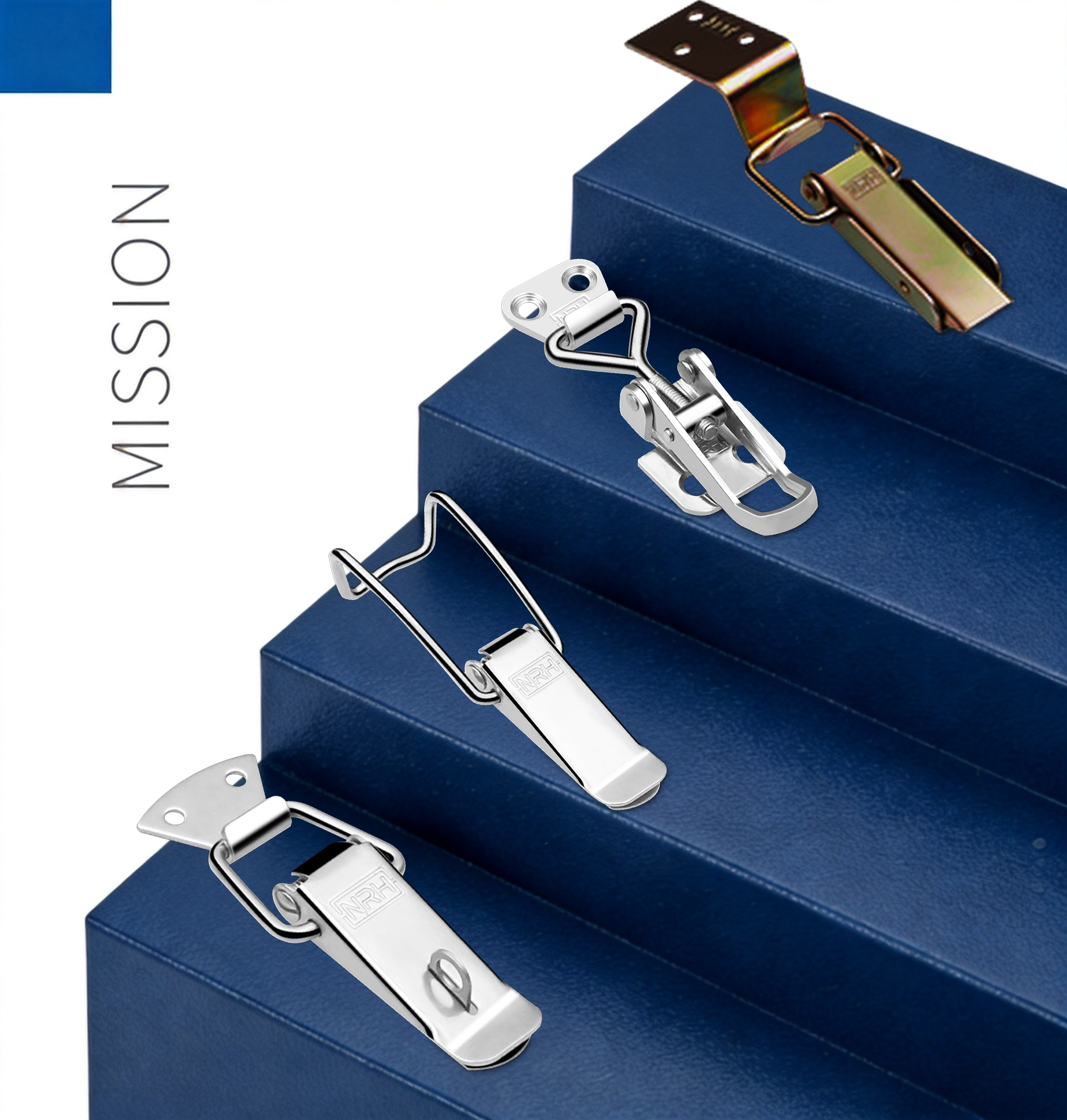
How the Toggle Latch Mechanism Works
A toggle latch operates through a simple yet effective mechanical principle. The latch consists of two main components: the latch body (mounted on the lid or door) and the catch plate or keeper (mounted on the enclosure body). When you close the lid and flip the handle, the linkage pulls the hook toward the catch plate. As the handle passes the center point, the mechanism locks into place with a distinct snap.
Key components of a typical toggle latch include:
- Lever handle: The operating element that the user flips to open or close. Longer handles require less force to operate.
- Linkage mechanism: The connecting arms that translate handle movement into linear motion, pulling the hook toward the catch.
- Hook or claw: The engaging element that catches the strike plate or keeper.
- Catch plate (keeper/strike): The fixed receiver mounted on the mating surface.
- Spring (optional): Integrated in spring-loaded variants to provide smoother operation and wider positional tolerances.
- Threaded rod (adjustable models): Allows fine-tuning of tension and grip range.
The cam action is calibrated so that a moderate amount of force is required to overcome the cam resistance when opening or closing. Once the handle passes the peak resistance point, the latch snaps firmly into place and remains securely closed. This over-center design is what gives toggle latches their characteristic reliability and resistance to accidental opening.
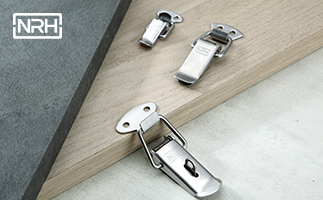
Types of Toggle Latches
Toggle latches are available in a diverse selection of models and configurations to suit different applications:
Adjustable Toggle Latches
Adjustable toggle latches feature a threaded rod connecting the hook to the fastening plate, allowing the grip range to be fine-tuned. This enables precise adjustment of tension or compression between the latch and the catch, making them ideal for applications where gasket compression or variable clamping force is required. NRH’s 5601 series (e.g., 5601-173K in SUS304, 291 g, 1176 N tensile load) and 5624 series (e.g., 5624-110S in SUS304, 91 g, 343 N tensile load) are examples of adjustable toggle latches.
Adjustable toggle latches are commonly used on mechanical engine covers, industrial equipment, excavators, and heavy machinery.
Spring-Loaded Toggle Latches
Spring-loaded toggle latches include a tightly wound metal spring as a core part of the cam system. The spring provides smoother operation, wider positional tolerances, and helps hold the lever in the open position. These latches are easier to install and use than non-sprung versions, making them popular for applications requiring frequent access.
Locking Toggle Latches
Locking toggle latches integrate a key cylinder or padlock hasp into the latch body, providing security against unauthorized access. The NRH 5101 series includes lockable variants such as the 5101-70K series. These are commonly specified for shared-workspace enclosures, medical carts, and applications where content security matters.
Heavy-Duty Toggle Latches
Heavy-duty toggle latches are constructed from thicker materials and designed for demanding industrial applications. The NRH 5101 series butterfly latches are known for their high clamping force, simple structure, ease of use, and impact resistance. Applications include heavy wooden crates, military cases, import/export packaging, machinery, and aviation equipment.
NRH Toggle Latch Product Series
NRH Box Hardware offers a comprehensive range of toggle latches across multiple series, each designed for specific applications and performance requirements.
5101 Series – Butterfly Latches
The 5101 series is NRH’s flagship toggle latch line. Known as butterfly latches, these products feature a distinctive lever design that provides strong clamping force and a visible locked position. Key characteristics include:
- Materials: SUS304 stainless steel, iron with chrome plating (FE-CR), iron with zinc plating (FE-ZL)
- Surface treatments: Vibration polishing (ZG), bright polishing (LG), chrome plating (CR), zinc plating (ZL)
- Load capacity: Tensile ratings up to 392 N
- Features: Easy installation, high temperature resistance, heavy load capacity, vibration resistance, durable, reusable
- Locking options: Key-lock variants available (5101-70K series)
- Applications: Heavy wooden crates, military cases, import/export packaging, machinery, aviation equipment, monitoring equipment
5201 Series – Draw Latches
The 5201 series features draw latches with hook-and-catch design. Key models include:
- 5201-89: SUS304 stainless steel, 93 g, tensile load 196 N. High temperature resistant, suitable for medical high-temperature sterilization applications.
- 5201-125: SUS304 stainless steel, 86 g, tensile load 343 N. Extended hook design with versatile engagement range.
- Features: Built-in spring, adjustable function, safety lock options
- Applications: Medical equipment, instruments, industrial cleaning machines, insulation containers, vacuum cleaners
5601 Series – Adjustable Toggle Latches
The 5601 series features adjustable toggle latches with a threaded rod for precise tension adjustment. Key models include:
- 5601-173K: SUS304 stainless steel, vibration-polished finish, 291 g, 1176 N tensile load
- 5601-173K-1 / 5601-173K-2: 269 g / 286 g, same 1176 N load rating
- Iron variants: Blue zinc plating, 980 N tensile load
- Features: Threaded rod allows length adjustment and flexible positioning independent of hole pattern restrictions
- Applications: Special vehicles, rail, ships, heavy equipment, mechanical engine covers, industrial equipment, excavators
5624 Series – Shock-Absorbing Adjustable Latches
The 5624 series features adjustable latches with shock-absorbing capabilities. Key models include:
- 5624-110S: SUS304 stainless steel, vibration-polished finish, 91 g, 343 N tensile load
- 5624-775: 38 g, 245 N tensile load
- 5624-56S: Lightweight variant
- Features: Shock-absorbing design, adjustable tension
- Applications: Plastic products, mechanical equipment, industrial equipment, aviation cases, heavy cases, fire cases, trunks, import/export packaging, wooden crates, machinery, instruments, ships
Materials and Surface Treatments
Toggle latches are available in a range of materials and finishes to suit different environmental conditions and aesthetic requirements:
| Material | Code | Characteristics | Recommended Environment |
|---|---|---|---|
| SUS304 Stainless Steel | S04 | Corrosion-resistant, good strength, clean appearance | Standard choice for outdoor, humid, and marine environments |
| SUS316 Stainless Steel | S16 | Contains molybdenum, superior salt spray and chemical resistance | Coastal, marine, and chemical-exposure environments |
| Iron/Carbon Steel + Chrome Plating | FE-CR | Bright mirror finish, cost-effective | Dry indoor environments |
| Iron/Carbon Steel + Nickel Plating | FE-NI | Warm silver tone, moderate corrosion resistance | Indoor / semi-protected environments |
| Iron/Carbon Steel + Zinc Plating | FE-ZL | Matte blue-silver finish, most economical | Cost-sensitive indoor applications |
| Iron/Carbon Steel + Black Oxide | BK | Matte black, tactical/military aesthetic | Military, tactical, low-visibility applications |
Applications and Industries Served
Toggle latches are used across a wide range of industries and applications:
- Transport cases and flight cases: Toggle latches secure lids during air, sea, and ground transport.
- Toolboxes and storage cases: Workshop and job site tool cases benefit from durable, reliable toggle latches.
- Industrial equipment and machinery: Safety panels, machine covers, and equipment enclosures.
- Medical equipment: Diagnostic devices, portable monitors, and sterilization equipment.
- Military and defense: Field equipment cases require rugged, reliable hardware.
- Aviation and aerospace: Flight cases, equipment containers, and aircraft panels.
- Packaging and export crates: Wooden crates and shipping containers.
- Automotive: Engine covers, trunk lids, and under-dash compartments.
- Marine: Ships and marine equipment.
Installation and Maintenance
Installation of toggle latches is straightforward:
- Position the latch body on the lid or door surface and mark the mounting hole positions using the product as a template.
- Position the catch plate on the enclosure body so the hook engages cleanly when the lid closes.
- Drill pilot holes at the marked positions.
- Secure both components with screws, rivets, or spot welding.
- For adjustable models, fine-tune the threaded rod to achieve the desired tension.
- Test the closure by opening and closing several times to verify alignment and tension.
Maintenance requirements are minimal. Inspect latches periodically for loose fasteners, worn components, or corrosion. In dirty or dusty environments, occasional cleaning of the mechanism prevents grit buildup that could stiffen the action. For locking variants, lubricate the key cylinder periodically with a dry lubricant.
Frequently Asked Questions (FAQ)
What is a toggle latch?
A toggle latch, also known as a draw latch, over-center fastener, or tension latch, is a mechanical fastener that securely closes and fastens lids, doors, and panels. It uses a lever and linkage system with a calibrated cam action that locks the latch firmly in place when the handle is flipped past the center point.
How does a toggle latch work?
A toggle latch operates through a lever-and-linkage mechanism. When you flip the handle past the center point, the linkage pulls the two surfaces together with mechanical advantage. The cam action locks the latch firmly in place, creating strong clamping force that resists vibration and maintains tension.
What are the different types of toggle latches?
Common types include adjustable toggle latches (with threaded rod for tension adjustment), spring-loaded toggle latches (with integrated spring for smoother operation), locking toggle latches (with key cylinder or padlock hasp), and heavy-duty toggle latches for industrial applications. NRH offers all these variants across its 5101, 5201, 5601, and 5624 series.
What materials are toggle latches available in?
Toggle latches are available in SUS304 stainless steel (corrosion-resistant, standard for most applications), SUS316 stainless steel (marine/chemical environments), iron/carbon steel with chrome, nickel, or zinc plating (cost-effective indoor use), and zinc alloy. Surface treatments include vibration polishing (ZG), bright polishing (LG), chrome plating (CR), nickel plating (NI), and black oxide (BK series).
What is the typical load capacity of a toggle latch?
Load capacities vary by model and size. NRH 5101 series butterfly latches deliver tensile ratings up to 392 N. The 5601-173K adjustable toggle latch in SUS304 rates at 1176 N tensile load. The 5201 series draw latches support tensile loads up to 343 N. Always select a latch with adequate rating for your application and derate by 25-30% for dynamic or shock loads.
How do I install a toggle latch?
Installation is straightforward: mount the latch body on one surface (lid or door) and the catch plate on the mating surface. Mark hole positions using the product as a template, drill pilot holes, and secure with screws, rivets, or spot welding. Ensure proper alignment so the hook engages the catch cleanly when closed. For adjustable models, fine-tune the threaded rod to achieve the desired tension.
When should I choose a toggle latch over other latch types?
Choose a toggle latch when you need high clamping force, gasket compression, vibration resistance, or a visible locked/unlocked position. Toggle latches are ideal for heavy lids, large enclosures, transport cases, and applications where adjustable tension is required.
Need help choosing? Contact NRH Box Hardware for toggle latch recommendations based on your load requirements, environmental conditions, and budget. The full product catalog is available at nrh.hk.