

Quick Answer: A spring-loaded toggle latch uses an over-center mechanism with an integrated coil spring that automatically retracts the hook when the lever releases. Unlike standard toggle latches that leave the hook dangling, spring-loaded versions snap it back to its rest position instantly, enabling true one-handed operation. These latches are engineered for vibration-prone environments, where spring tension maintains clamping force and prevents loosening. NRH offers two series: the 51 Series (single spring) and the 55 Series (dual spring), with tensile loads from 196N to 1500N, weights from 21g to 90g, and material options including SUS304, SUS316, 201 stainless, and zinc-plated steel.
Introduction: Why Spring-Loaded Toggle Latches Matter
Standard toggle latches work. Their over-center mechanism creates a geometric lock that resists vibration and holds clamping force. But they have a persistent problem: the hook stays wherever you leave it. Open one, and the hook dangles. It snags on cables, catches on clothing, blocks adjacent panels, and forces you to use a second hand to reposition it before closing.
Spring-loaded toggle latches solve this mechanically, not with brute spring force, but with a dual-action spring mechanism that retracts the hook automatically when the lever releases. That is the defining feature.
Beyond auto-retraction, these latches are built for vibration-heavy environments. The spring maintains constant clamping force under continuous vibration, thermal cycling, and wear, conditions that loosen standard latches over time. That makes them the go-to choice for transport cases, military equipment, industrial machinery, and any application where reliability under vibration is non-negotiable.
This guide covers how the spring toggle mechanism works, compares spring-loaded vs. standard toggle latches, provides a selection framework, and presents real product data from the NRH 51 Series (single spring) and 55 Series (dual spring) lines. All specifications come directly from manufacturer catalog data.
Key Finding: The spring does more than retract the hook, it applies consistent clamping force when the latch is closed. That constant tension keeps the joint tight when vibration, thermal cycling, or wear would otherwise loosen a standard latch. NRH spring-loaded toggle latches come in two series: the 51 Series with a single spring (392N to 1500N) and the 55 Series with dual springs (20kg to 30kg). Material options range from zinc-plated steel (24-48h salt spray) to SUS316 stainless steel (96h+), letting engineers match hardware to environment.
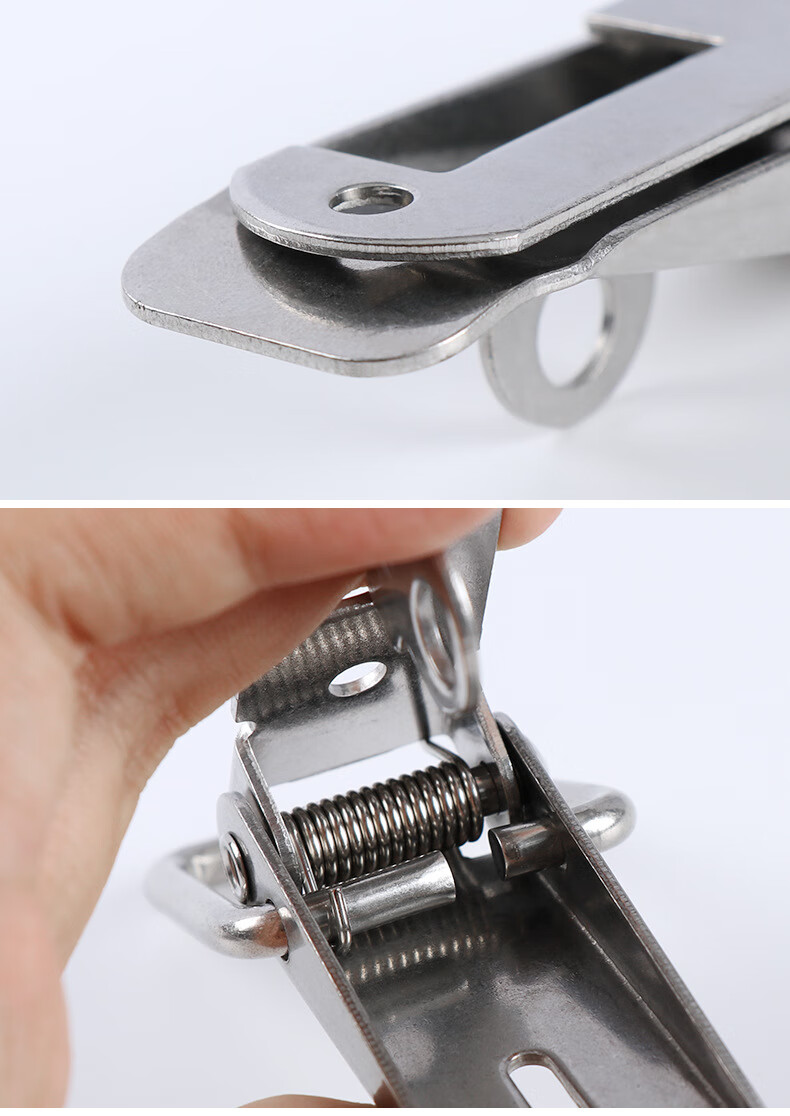
Part 1: How the Spring Toggle Mechanism Works
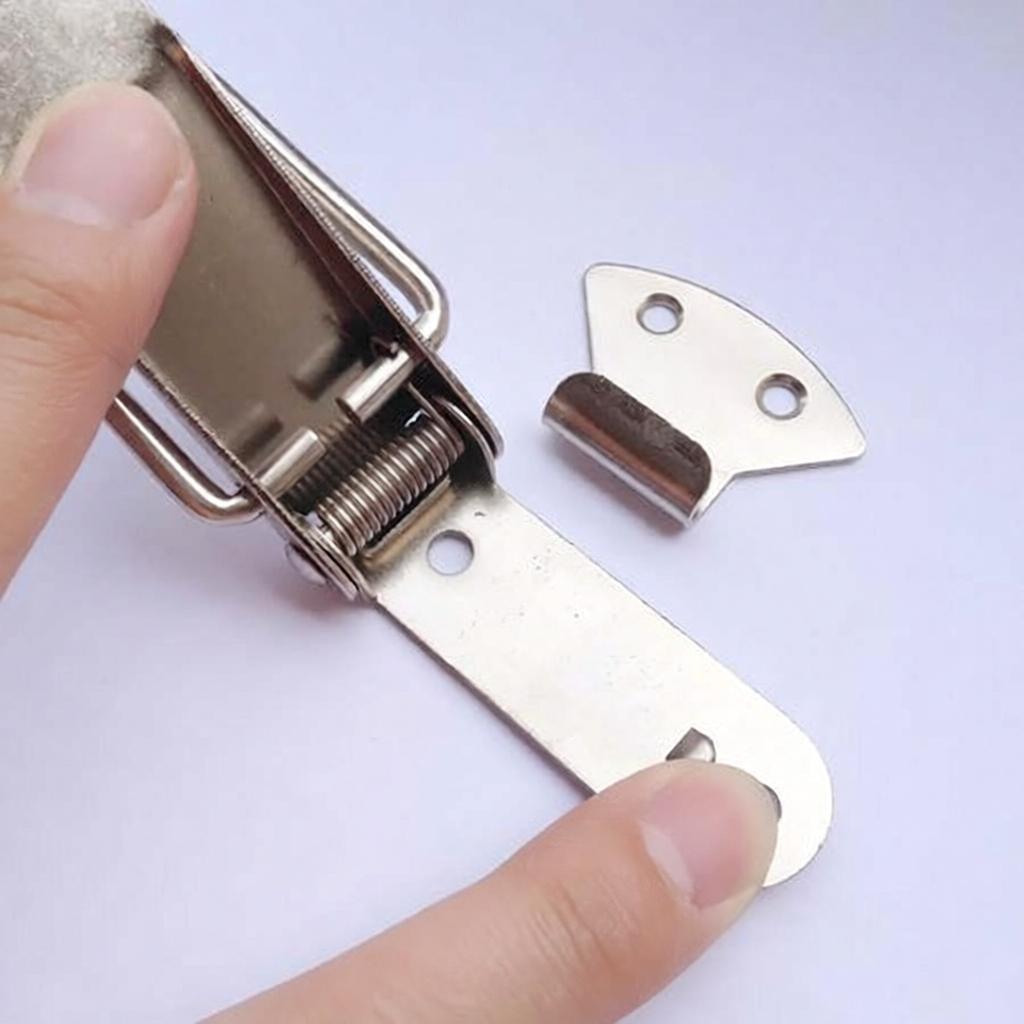
A spring-loaded toggle latch mates a standard over-center toggle linkage with an integrated coil spring. Flip the lever past the dead-center point, and the toggle locks while the spring preloads the connection. Release the lever, and the spring snaps the hook back to rest.
The auto-retracting spring mechanism is not a simple spring return hinge. In a toggle latch, the lever passes through a dead-center position, where all pivot axes align in a straight line. Past that point, the linkage self-locks without any continued hand force. The spring inside does double duty:
- Assisted closing: The spring pulls the latch into the closed position, ensuring consistent engagement
- Auto-retract on release: When the toggle releases, the spring pulls the hook back to its rest position
- Vibration resistance: Spring tension maintains secure closure under movement and vibration
- Shock absorption: Springs accommodate minor shifts between the latch and catch plate
Three components define the auto-retracting action:
- Coil spring, mounted within the latch body, stores energy on closing and releases it on opening
- Toggle linkage, the lever-and-link system that moves past center to create a mechanical lock
- Hook or claw, the catch that engages the strike plate; the spring pulls it back automatically when the toggle disengages
The result: true one-handed operation. Press the lever to lock. Press again to release, the hook retracts on its own. No secondary action required.
Part 1.5: Single Spring vs. Dual Spring, Engineering Comparison
Understanding the difference between single spring and dual spring toggle latches is critical to correct specification. The core distinction is spring count and structural layout: dual spring latches place one spring on each side of the latch body for balanced bi-directional clamping force. Single spring latches use a single internal return spring.
This is not a minor detail. The spring layout directly impacts vibration resistance, load distribution, and long-term reliability.
| Feature | Single Spring (51 Series) | Dual Spring (55 Series) |
|---|---|---|
| Spring layout | Single internal return spring | Independent springs on left and right sides, bi-directional clamping |
| Vibration resistance | Standard. Moderate vibration may cause loosening or gaps over time. | Superior. Bi-directional damping and self-compensation prevent loosening under strong vibration. |
| Load distribution | Force concentrates on one side. Risk of misalignment or deformation over time. | Symmetric force distribution. Minimal risk of side-load deformation. |
| Best application | Light-load, low-vibration static applications (toolboxes, cabinet doors) | High-vibration, transport, outdoor, or high-sealing applications (machine tools, transit cases, outdoor enclosures) |
| Compensation capability | Limited to spring deflection | Bi-directional compensation. Maintains clamping force even when panels shift or settle. |
| Typical weight | 21-90g | 32-79g |
Why Dual Spring Matters for High-Vibration Environments
In a single spring latch, vibration energy travels through a single load path. The spring absorbs some energy, but the design lacks redundancy. If the spring weakens or the pivot wears, clamping force drops.
A dual spring latch distributes vibration energy across two independent load paths. If one spring compresses under shock, the other maintains clamping pressure. This self-compensating behavior is the defining engineering advantage of dual spring toggle latches. In high-vibration environments, transport cases, military equipment, industrial machinery, dual spring latches are the right choice for reliable, long-term performance.
Selection Rule of Thumb
| Application Condition | Recommended Series |
|---|---|
| Static fixing, low vibration, frequent manual opening/closing | 51 Series (single spring), cost-effective |
| Continuous vibration, transport, outdoor exposure, high seal integrity required | 55 Series (dual spring), must select |
NRH offers both configurations:
- 51 Series (single spring): Four sizes (5104/5103/5102/5101). SUS304-ZG standard. Tensile loads 392-1500N. Weights 21-90g. Best for general-purpose, cost-sensitive, low-vibration applications.
- 55 Series (dual spring): Two sizes (5505 large / 5502 small). SUS304-ZG standard. Working loads 20-30kg. Weights 32-79g. Best for transport cases, outdoor equipment, machine enclosures, and any application subject to continuous vibration.
Part 2: Spring-Loaded vs. Standard Toggle Latches
Standard toggle latches lock and unlock through the over-center mechanism alone. The hook stays wherever you leave it, open, closed, or somewhere in between. A spring-loaded version adds the auto-retract feature.
Here is how the two types compare across key performance dimensions:
| Feature | Standard Toggle Latch | Spring-Loaded Toggle Latch |
|---|---|---|
| Hook position after release | Stays where left | Auto-retracts |
| One-handed operation | Sometimes | Yes |
| Risk of hook snagging | Higher | Lower |
| Closing speed | Manual | Faster due to spring assist |
| Vibration resistance | Good (over-center lock) | Better (spring + over-center) |
| Consistent clamping force | Varies with wear | Maintained by spring tension |
| Typical weight penalty | — | Minimal (spring adds 1-5g) |
The spring does more than retract the hook. It also applies a consistent clamping force when the latch is closed. That constant tension keeps the joint tight when vibration or thermal cycling loosens a standard latch. In applications subject to constant movement, flight cases, transport containers, mobile equipment, this difference matters.
Part 3: NRH Spring-Loaded Toggle Latch Series
NRH manufactures two distinct spring-loaded toggle latch series: the 51 Series (single spring) and the 55 Series (dual spring). Each series is available in multiple sizes, materials, and configurations to suit different applications.
51 Series, Single Spring Toggle Latches
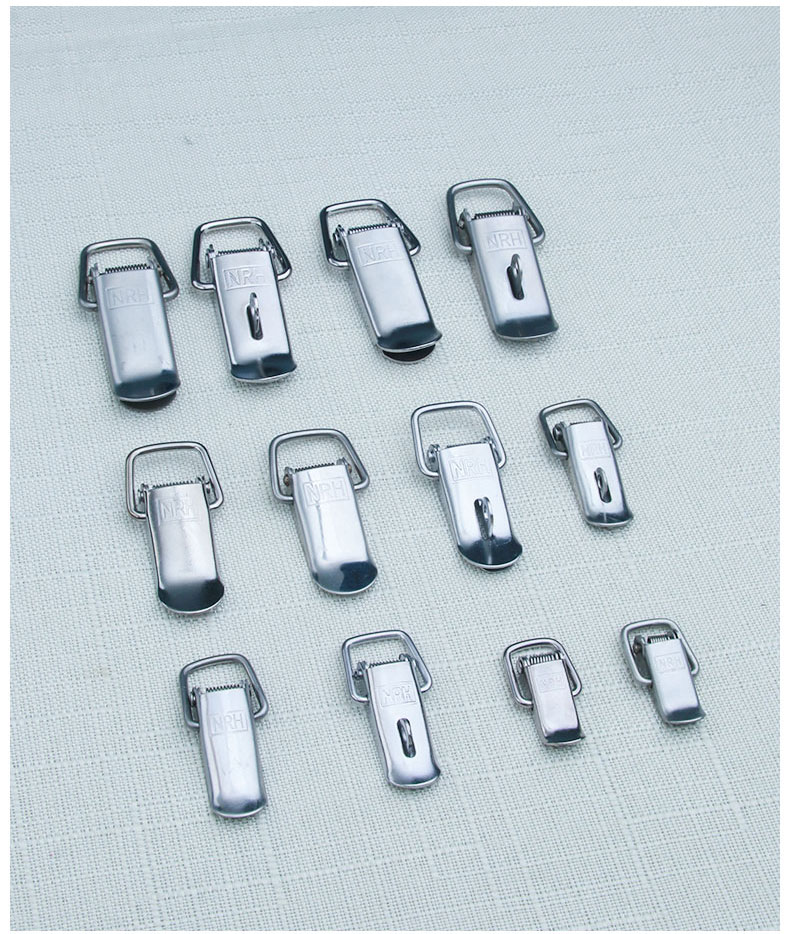
The 51 Series features a single integrated spring that assists handle return and maintains consistent tension across the latch stroke. Available in four sizes, small, medium, large, and extra-large, with SUS304 stainless steel and vibratory ground (ZG) finish as standard. Locking (K suffix) and non-locking versions available.
| Model | Size | Tensile Load | Weight | Lock Hole | Best Application |
|---|---|---|---|---|---|
| 5104-56 | Small | 750N | 21g | No | Light cases, instrument boxes |
| 5104-56K | Small | 750N | 21g | Yes | Light cases requiring security |
| 5103-70 | Medium | 1500N | 36g | No | Medium cases, enclosures |
| 5103-70K | Medium | 1500N | 35g | Yes | Medium cases requiring security |
| 5102-88 | Large | 1000N | 61g | No | Large cases, transit cases |
| 5102-88K | Large | 1000N | 60g | Yes | Large cases requiring security |
| 5101-96 | Extra Large | 392N | 90g | No | Heavy cases, flight cases |
| 5101-96K | Extra Large | 392N | 86g | Yes | Heavy cases requiring security |
All tensile load and weight values sourced from manufacturer specification sheets. Note: Tensile load indicates destructive test limits. Select with appropriate safety margin for your application. “K” suffix indicates padlockable version with integrated lock hole. Contact NRH for official engineering drawings.
55 Series, Dual Spring Toggle Latches
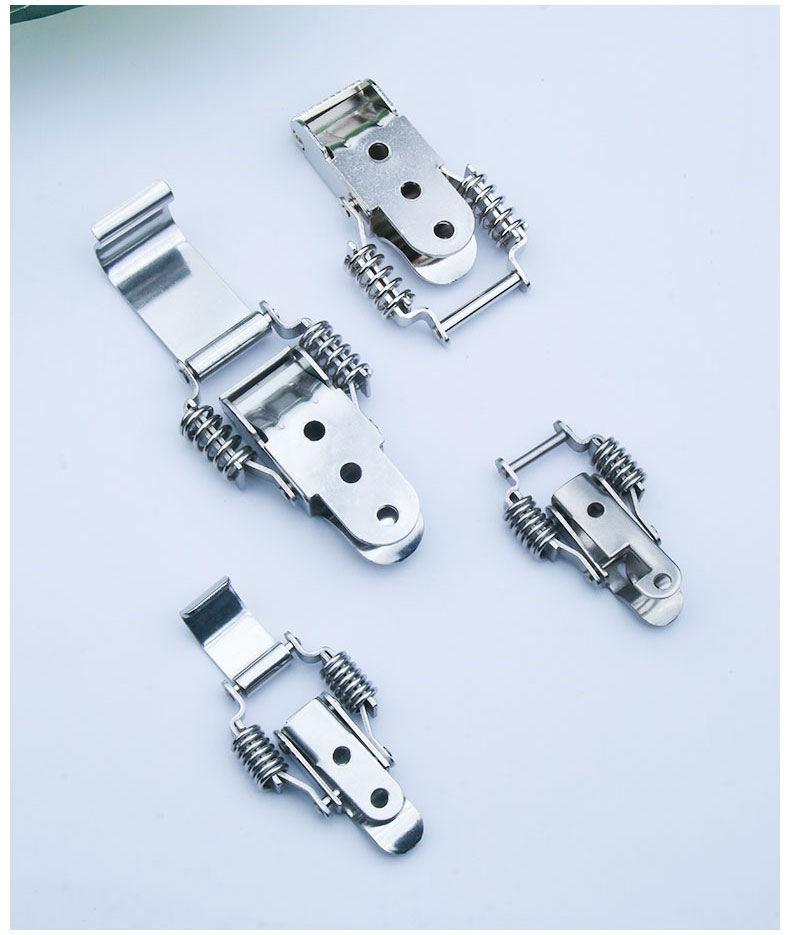
The 55 Series features dual springs for enhanced return force and handle positioning. Available in large (5505) and small (5502) sizes with lock hole options. The dual spring design ensures positive handle positioning in both open and closed states, ideal for high-cycle applications where consistent handle feel matters.
| Model | Size | Load | Weight | Lock Hole | Best Application |
|---|---|---|---|---|---|
| 5505-75 | Large | 294N (tensile) | 75g | No | Heavy cases, high-cycle applications |
| 5505-75K | Large | 30kg (working load) | 79g | Yes | Heavy cases requiring security |
| 5502-59 | Small | 196N (tensile) | 33g | No | Light cases, instrument boxes |
| 5502-59K | Small | 20kg (working load) | 32g | Yes | Light cases requiring security |
All load and weight values sourced from manufacturer specification sheets. Note: Tensile load (e.g., 294N, 196N) indicates destructive test limits. Working load (e.g., 30kg, 20kg) indicates recommended maximum safe working load. “K” suffix indicates padlockable version with integrated lock hole. Contact NRH for official engineering drawings.
Part 4: Material and Finish Options
NRH spring-loaded toggle latches are manufactured in multiple material grades and surface finishes to suit different environmental and cost requirements.
| Material | Finish | Salt Spray (ASTM B117) | Best Environment |
|---|---|---|---|
| Iron | Nickel-plated | 24-48h | Indoor dry |
| Iron | Chrome-plated | 24-48h | Indoor dry / light outdoor |
| 201 Stainless | Vibratory ground (ZG) | 24-72h | Indoor / light outdoor |
| 304 Stainless | Vibratory ground (ZG) | 72-96h | Outdoor / coastal / food-grade |
| 316 Stainless | Vibratory ground (ZG) | 96h+ | Marine / harsh / chemical |
Salt spray values per industry standards and manufacturer catalog data. ASTM B117 is the standard neutral salt spray test used across the hardware industry. Actual service life varies with field conditions. Coating thickness and passivation quality significantly impact results. Contact NRH for specific product test data.
Finish explanation:
- Vibratory ground (ZG): A mechanical tumbling process that produces a uniform satin texture. Hides fingerprints and minor scratches. Standard on NRH stainless steel spring-loaded toggle latches. Available on SUS201, SUS304, and SUS316.
- Nickel-plated: Provides corrosion resistance at a lower cost point. Standard on NRH iron spring-loaded toggle latches. 24-48h salt spray.
- Chrome-plated: Provides a bright, decorative finish with corrosion resistance. Standard on NRH iron spring-loaded toggle latches. 24-48h salt spray.
Part 5: Five Parameters for Latch Selection
Five parameters drive latch selection. Get these right and the hardware performs as expected. Get them wrong and you face latch failure, rework, or both.
1. Load Capacity
Match the tensile load or working load to your case weight and closure force. The 5103-70 handles 1500N, suited for heavy enclosures. The 5502-59, at 196N and only 33g, is better for lightweight instrument cases. Underspecify and the latch deforms under load. Overspecify and you pay for capacity you do not need.
Safety margin rule: Always select a latch with a rating at least 1.5x the expected load to account for dynamic forces and vibration.
2. Material and Finish
SUS304 stainless steel with vibratory finish (ZG) resists corrosion in humid or coastal environments. For dry indoor use, nickel-plated or chrome-plated iron saves cost. For salt-spray exposure, consider SUS316 (96h+). The vibratory finish also removes burrs and sharp edges, important for cases handled frequently.
3. Spring Configuration
Refer to Part 1.5 for the full engineering comparison. In brief:
- 51 Series (single spring): Standard auto-retract action. Suitable for most applications. Lighter weight (21-90g).
- 55 Series (dual spring): Enhanced return force and handle positioning. Ideal for high-cycle applications where consistent handle feel matters. Heavier (32-79g) but provides more positive action and superior vibration resistance.
4. Locking Feature (K Suffix)
Models with a “K” suffix include a keyhole for padlock insertion. If security matters, medical cases, defense transport, server racks, choose a lockable variant. If quick access is the priority, a plain lever suffices.
5. Size Selection
NRH spring-loaded toggle latches are available in six size grades:
- 5104 (Small): 56mm body length, 21g, 750N, compact applications
- 5103 (Medium): 70mm body length, 35-36g, 1500N, general-purpose
- 5502 (Small dual): 59mm body length, 32-33g, 196N / 20kg, light dual-spring
- 5102 (Large): 88mm body length, 60-61g, 1000N, heavy-duty
- 5101 (Extra Large): 96mm body length, 86-90g, 392N, extra-heavy
- 5505 (Large dual): 75mm body length, 75-79g, 294N / 30kg, heavy dual-spring
Selection Matrix
| Application | Recommended Series | Recommended Model | Material |
|---|---|---|---|
| Light instrument cases (indoor, low vibration) | 55 Series | 5502-59 | SUS304-ZG |
| Light cases requiring security | 55 Series | 5502-59K | SUS304-ZG |
| General-purpose enclosures (low vibration) | 51 Series | 5104-56 | SUS304-ZG |
| Medium cases / transit cases | 51 Series | 5103-70 | SUS304-ZG |
| Medium cases requiring security | 51 Series | 5103-70K | SUS304-ZG |
| Heavy flight cases / road cases | 51 Series | 5102-88 | SUS304-ZG |
| Heavy cases requiring security | 51 Series | 5102-88K | SUS304-ZG |
| High-vibration / transport applications (heavy) | 55 Series | 5505-75 | SUS304-ZG |
| High-vibration / transport with security | 55 Series | 5505-75K | SUS304-ZG |
| Extra-heavy flight cases | 51 Series | 5101-96 | SUS304-ZG |
| Extra-heavy cases requiring security | 51 Series | 5101-96K | SUS304-ZG |
All recommendations based on manufacturer catalog data. For outdoor/coastal environments, upgrade to SUS316-ZG. For indoor dry environments, nickel-plated or chrome-plated iron offers cost savings. Contact NRH for application-specific guidance.
Part 6: Common Applications
Spring-loaded toggle latches appear wherever fast, repeatable access matters and loose hooks create problems. Below are specific deployment scenarios where the auto-retract feature and vibration resistance provide measurable operational benefits.
Flight cases and road cases for touring audio equipment. A major AV rental company reported that standard toggle latches on their speaker flight cases required manual hook repositioning an average of 12 times per show, adding 8-10 minutes to setup and teardown. Switching to NRH 51 Series spring-loaded latches eliminated that step entirely. The auto-retract hook also stopped snagging on the internal foam padding, which had been tearing and requiring replacement every 3 months. The spring preload additionally kept the case lids clamped tight during truck transport, reducing driver complaints about rattling.
Medical equipment enclosures in surgical theaters. A medical device OEM supplying portable ultrasound units found that technicians were frustrated by standard latches that required two hands to close while holding the unit. The NRH 5104-56K spring-loaded latch (21g, 750N) was specified because the auto-retract feature lets a technician open the case with one hand while reaching for the probe with the other. The SUS304-ZG finish also withstands weekly wipedown with isopropyl alcohol, which had caused pitting on their previous plated steel latches within 6 months.
Industrial control panels in high-traffic manufacturing plants. A panel builder supplying automotive assembly lines needed a latch that would not hang open when maintenance staff walked past. An open latch on a panel door had previously caught a worker’s coverall, causing a trip hazard and an OSHA recordable incident. The plant switched to NRH 55 Series dual spring latches, which hold the handle firmly in the open position and retract the hook automatically on closing. The bi-directional spring damping also prevents the latch from vibrating open on panels mounted near stamping presses, where standard latches had been loosening weekly.
Military transport cases for sensitive electronics. A defense logistics provider tested standard toggle latches against NRH 55 Series dual spring latches on ammunition shipping containers. Vibration testing at 50 Hz with 7.7g RMS acceleration (MIL-STD-810) showed standard latches began loosening after 4 hours of continuous vibration. The dual spring latches showed no measurable preload loss after 24 hours. The auto-retract feature also eliminated the need for soldiers to manually tuck hooks before closing cases during night operations, reducing fumbling and speeding load times.
Server and telecom racks in data centers. A colocation provider had recurring issues with latch hooks blocking adjacent servers when technicians removed side panels for maintenance. The protruding hooks made it difficult to slide equipment in and out of the rack, leading to scratched chassis and damaged connectors. Switching to NRH 5104-56K spring-loaded latches resolved the issue. The hook retracts flush with the panel when released, giving technicians full access to the rack channel without obstruction.
Toolboxes and mobile workstations for field service technicians. A fleet maintenance company tracked time on service calls and found that technicians spent an average of 45 seconds per toolbox visit dealing with standard latches, closing lids, repositioning hooks, and ensuring latches were fully engaged. With over 200 toolbox openings per week per technician, this added up to nearly 200 hours of lost productivity annually across the fleet. The company retrofitted their toolboxes with NRH 55 Series latches, reducing latch-related time per visit to under 10 seconds and virtually eliminating accidental lid openings during transport.
Food processing and pharmaceutical enclosures. A food packaging equipment manufacturer required latches that could withstand daily high-pressure washdown with caustic cleaners. Standard chrome-plated latches showed corrosion after 60 days. NRH 5104-56K in SUS304-ZG was selected for its 72-96h salt spray rating and crevice-free vibratory finish. The auto-retract feature also proved critical during washdowns, as the hook automatically retracts away from the spray path, preventing cleaning solution from pooling in the hook cavity. The plant reported zero latch failures in 18 months of operation.
Part 7: Installation and Maintenance
Installation: Mount the latch body and strike plate on flat, parallel surfaces. Misalignment causes uneven spring loading and reduces auto-retract reliability. Use the mounting hole positions specified in the product drawing, do not drill oversized holes to compensate for alignment errors.
Maintenance: Inspect the spring action every 6-12 months in high-cycle applications. If the hook does not snap back fully, clean the pivot points and check for debris. Do not lubricate the spring itself, excess lubricant attracts dirt and accelerates wear. A dry PTFE spray on the pivot pins is acceptable if stiction develops.
Frequently Asked Questions (FAQ)
What does “auto-retracting” mean in a toggle latch?
What is the difference between single spring (51 Series) and dual spring (55 Series)?
When should I choose dual spring over single spring?
Can a spring-loaded toggle latch replace a standard toggle latch?
Does the spring wear out over time?
Is SUS304 stainless steel necessary for indoor applications?
How much weight can a spring-loaded toggle latch hold?
Can spring-loaded latches be used on vibration-heavy equipment?
What does the “K” suffix mean in NRH model numbers?
What finish options are available for NRH spring-loaded toggle latches?
Key Takeaways
- Spring-loaded toggle latches auto-retract the hook when the lever releases, enabling true one-handed operation and preventing snagging.
- Two spring configurations available: NRH 51 Series (single spring, 21-90g, 392-1500N) and 55 Series (dual spring, 32-79g, 20-30kg working load).
- Dual spring (55 Series) provides superior vibration resistance: Independent springs on both sides create bi-directional damping, symmetric force distribution, and self-compensation, critical for transport cases and high-vibration equipment.
- Single spring (51 Series) is cost-effective for static/low-vibration applications: Lighter weight and lower cost, suitable for toolboxes, cabinet doors, and general-purpose enclosures.
- Four size grades in 51 Series: 5104 (small, 750N), 5103 (medium, 1500N), 5102 (large, 1000N), 5101 (extra-large, 392N).
- Two size grades in 55 Series: 5505 (large, 294N/30kg) and 5502 (small, 196N/20kg).
- “K” suffix indicates padlockable: Models with “K” include an integrated lock hole for padlock security.
- Five material options: Nickel-plated iron (24-48h), chrome-plated iron (24-48h), SUS201-ZG (24-72h), SUS304-ZG (72-96h), SUS316-ZG (96h+).
- Selection rule of thumb: Static/low vibration, 51 Series. Continuous vibration/transport, 55 Series (must select).
- Use 1.5x safety margin: Never exceed 80% of rated load capacity to account for dynamic forces and vibration.
- When in doubt, contact NRH: All specifications in this guide are for reference only. For official engineering drawings, rated load values, and custom configurations, reach out to the NRH sales team directly.
About NRH
NRH is a brand of Shanghai Nahui Hardware Products Co., Ltd., established in 1996 and headquartered in Shanghai, China. The company specializes in R&D and production of high-quality case hardware, including spring-loaded toggle latches, standard toggle latches, draw latches, handles, hinges, and corner protectors, serving industries worldwide.
NRH holds ISO 9001:2015 and GJB (National Military Standard) certifications, and is recognized as a National High-Tech Enterprise. With vertically integrated manufacturing and a five-point national development strategy, NRH delivers reliable, production-ready hardware solutions to global clients.
For official engineering drawings, customization enquiries, or bulk orders, please contact the NRH sales team directly.
Disclaimer: All product specifications, including tensile load, working load, weight, dimensions, and salt spray ratings, are sourced from manufacturer catalog data and are provided for reference only. They are not intended as tooling or mold-making data. For official engineering drawings and certified specifications, please contact NRH directly. Actual performance may vary depending on application, installation, and environmental conditions.