

What Is a Draw Latch and How Does It Work?
Quick Answer: A draw latch is a mechanical fastener that uses a hook-and-strike engagement to pull two surfaces together and hold them securely. When the lever is pressed down, the hook rotates to catch the strike plate, drawing the lid toward the base and creating clamping force. The over-center geometry keeps the latch locked under vibration. NRH offers four major draw latch types: standard (fixed hook), adjustable (threaded rod for variable gaps), safety (key lock for access control), and spring-loaded (assisted closing). Choose based on load requirements, environment, and security needs.
Have you ever closed a transit case and found the latch unlatched – without anyone touching it? That is the signature failure of a poorly matched draw latch under vibration. A draw latch is not just a closure device – it is the component that determines whether your enclosure stays sealed during transport, resists water ingress, and protects its contents. In flight cases, military containers, and industrial enclosures, latch failure is a leading cause of equipment damage. Selecting the right draw latch is not optional – it is essential.
Applicable Buyers
This guide is for case builders, product designers, engineers, and procurement professionals selecting draw latches for flight cases, industrial enclosures, military containers, medical equipment, and any application requiring secure closure, vibration resistance, or ingress protection. This article covers draw latch types, hook-and-strike engineering principles, selection criteria, and installation guidance based on real NRH product data.
Key Finding: The hook-and-strike engagement is the defining mechanical feature of a draw latch. When the lever is pressed down, the hook rotates to catch the strike plate, drawing the lid toward the base. The over-center geometry creates a stable geometric lock that resists opening forces – the latch becomes tighter under load. NRH offers four latch types across 304 stainless steel and zinc-plated steel, serving applications from flight cases to heavy industrial enclosures.
Open any flight case, toolbox, or industrial enclosure and you will find the same type of hardware holding the lid shut: a small lever-actuated clamp that snaps closed and stays closed without any external force. That is a draw latch – also called a toggle latch, an over-center latch, or (when it has a wing-shaped handle) a butterfly latch. It is one of the simplest and most reliable mechanical fasteners ever designed, and it is the default choice for any application where a lid, door, or panel must be secured quickly and released just as fast.
Yet despite its apparent simplicity, choosing the wrong draw latch can have outsized consequences. A latch that rusts shut after a season outdoors, one that vibrates open during truck transport, or one whose clamping force is insufficient to maintain a gasket seal – each of these failures can damage the contents of the case and erode confidence in the entire packaging system. The difference between a latch that lasts a decade and one that fails in months comes down to understanding the mechanism, matching the type to the application, and specifying the right material and finish.
What Is a Draw Latch? Definition and Mechanism
A draw latch is a mechanical fastening device that closes and secures a lid, door, or panel by pulling two surfaces together through a hook-and-strike engagement. The name “draw” comes directly from the drawing action: when the operator presses the lever arm down, a hook claw rotates inward and catches a fixed strike plate (also called a catch or keeper), simultaneously pulling the lid toward the base and creating clamping force that holds the closure tight.
Hook-and-Strike Engagement Explained
The fundamental operating principle involves three components working in sequence:
- The hook (claw): A curved metal finger attached to the lever arm. As the lever is depressed, the hook rotates around its pivot point and sweeps toward the strike plate.
- The strike plate (catch): A fixed bracket mounted on the opposing surface (typically the case base or frame). The strike plate presents a crossbar or lip for the hook to grab.
- The lever arm: The handle the operator presses. The lever’s geometry creates a mechanical advantage that multiplies the operator’s input force into a much stronger clamping force at the hook-strike interface.
When the lever reaches its fully closed position, the hook is past the strike plate’s crossbar and clamping force holds both parts rigidly. To open, the operator lifts the lever, the hook rotates clear of the strike plate, and clamping force releases. The over-center geometry ensures the latch remains closed under vibration and shock unless deliberately opened.
Draw Latch Types: Standard, Adjustable, Safety, and Spring-Loaded
Not all draw latches work the same way. The four primary categories differ in construction, clamping mechanism, and intended application.
1. Standard Draw Latch
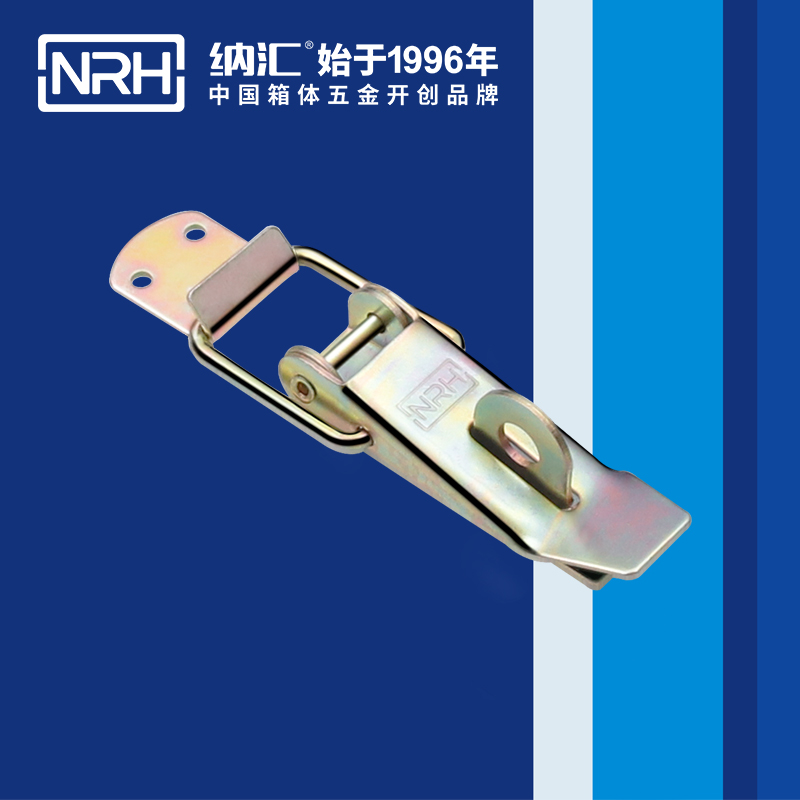
The standard draw latch uses a fixed hook-and-strike pair with a rigid lever arm. It provides straightforward closure for cases and enclosures where the gap between lid and base is consistent and vibration is moderate. The 5301-112K-KS-FE-CL is a typical example: an iron draw latch with zinc-chromate plating, 119g, 45kg load capacity, commonly used on indoor industrial enclosures and wooden freight cases where cost-effectiveness is the priority.
Standard latches are the most economical option but do not accommodate variable gap distances and offer no secondary locking mechanism.
2. Adjustable Draw Latch
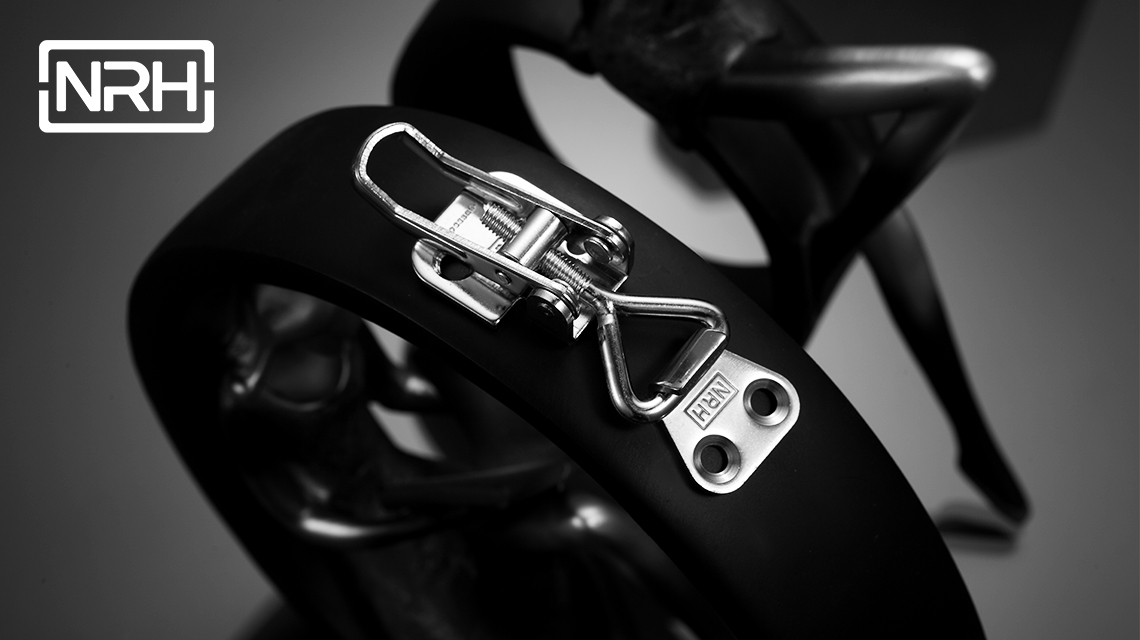
Adjustable draw latches incorporate a threaded rod that lets the operator fine-tune the clamping distance, compensating for gasket compression, thermal expansion, or manufacturing tolerances. The 5608-70K-S04-ZG (304 stainless steel, vibratory finish, 51g, 490N tensile load) is a representative model from this category, providing 70-82mm adjustment range with threaded hook mechanism.
As the gasket ages and compresses, the adjustable latch can be tightened to restore the original seal pressure.
3. Safety Draw Latch
Safety draw latches add a secondary locking mechanism – typically a key lock, padlock hole, or safety catch – that prevents the primary lever from being accidentally opened. Even if vibration or shock pushes the main lever past dead center, the secondary lock holds it closed until deliberately released.
Safety latches are required on cases and enclosures where unintended opening could cause injury, contamination, or significant property damage. Applications include medical transport cases, hazardous-material enclosures, and military transit cases subject to extreme vibration profiles.
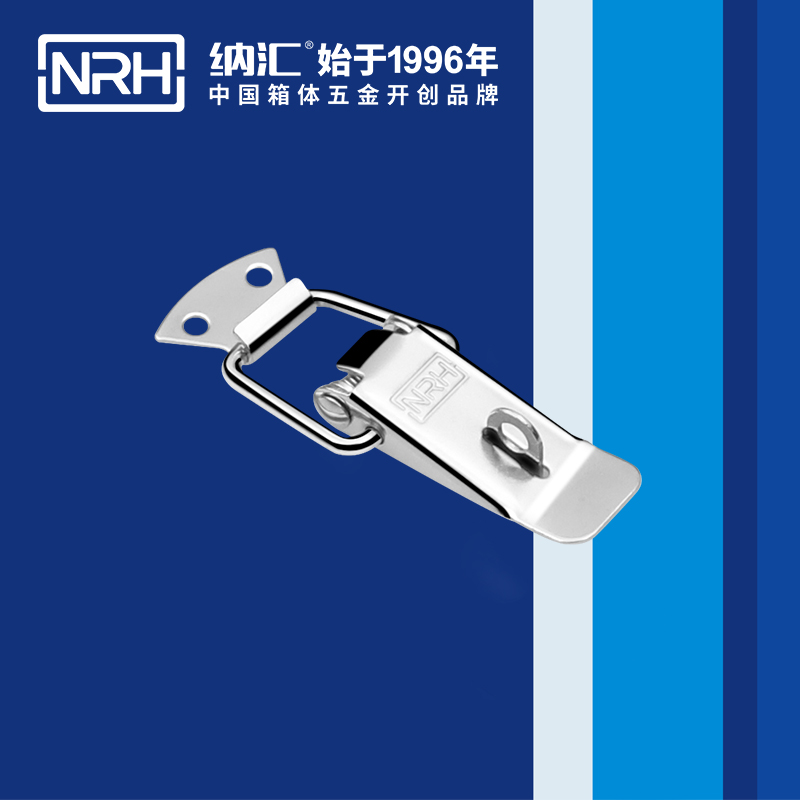
NRH offers two safety latch designs:
- 5102-88K: 304 stainless steel, vibratory finish, 60g, 1000N tensile load, padlock hole for dual-locking security.
- 6401-89K: Zinc-plated steel, chrome finish, 68g, 245N tensile load, integrated keyed cylinder for controlled access.
4. Spring-Loaded Draw Latches
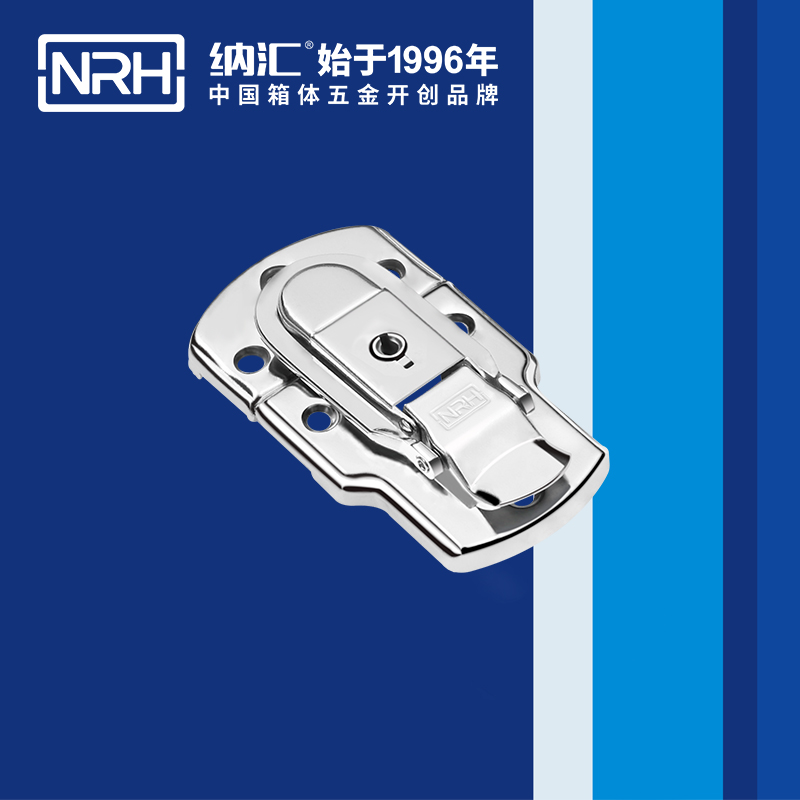
Spring-loaded draw latches incorporate a spring mechanism that either assists closing or provides a bias force keeping the lever in the open position when not engaged. The spring assistance reduces effort on large cases with multiple latches that must be operated repeatedly.
Some spring-loaded designs also provide vibration damping: the spring absorbs micro-movements at the pivot points, reducing the risk of the lever creeping toward dead center under sustained vibration.
The NRH 51 series exemplifies spring-loaded draw latches. The 5104-56-S04-ZG (304 stainless steel, vibratory finish, 21g, 750N tensile load) features a single integrated spring that assists handle return and maintains consistent tension across the latch stroke.
| Latch Type | Representative Model | Material | Weight | Load Rating | Key Feature |
|---|---|---|---|---|---|
| Standard | 5301-112K-KS-FE-CL | Zinc-plated steel | 119g | 45kg | Lowest cost, indoor use |
| Adjustable | 5608-70K-S04-ZG | 304 SS | 51g | 490 N | 70-82mm threaded adjustment |
| Safety (Padlock) | 5102-88K | 304 SS | 60g | 1000 N | Highest tensile, padlock hole |
| Safety (Key) | 6401-89K | Zinc-plated steel | 68g | 245 N | Integrated key cylinder, 6 mounting holes |
| Spring-Loaded | 5104-56-S04-ZG | 304 SS | 21g | 750 N | Single spring return, highest strength-to-weight |
How Draw Latches Work: Step by Step
Understanding the operating sequence helps with specification and troubleshooting:
Closing Sequence
- Position the lever: The lever arm is raised (open). The hook is rotated clear of the strike plate, and the gap between lid and base is unclamped.
- Engage the hook: As the operator presses the lever down, the hook rotates around its pivot and sweeps toward the strike plate. The tip passes over the crossbar.
- Draw and clamp: Continued lever rotation pulls the hook downward, drawing the lid toward the base. Clamping force increases as the lever approaches its over-center position.
- Lock over-center: The lever passes through the over-center point. At this position, any force trying to push the lid open actually pushes the lever further into its locked position. The latch is now mechanically held closed without external force.
Opening Sequence
- Lift the lever: The operator lifts the lever past the over-center point. The mechanical advantage reverses.
- Release the hook: The hook rotates clear of the strike plate crossbar, releasing clamping force.
- Disengage: The hook clears the strike plate entirely, and the lid is free to open.
A typical draw latch generates a clamping force several times the force applied to the lever, due to the mechanical advantage of the over-center linkage. On adjustable models like the 5608-70K-S04-ZG, the effective reach of the hook can be changed: more threads engaged increases pre-load on the gasket, fewer threads reduces it – allowing the operator to restore optimal gasket compression as the seal ages.
Draw Latch vs. Toggle Latch: When to Use Which
Draw latches and toggle latches are frequently confused because both use a lever-actuated over-center mechanism. The critical difference lies in what the lever moves:
| Feature | Draw Latch | Toggle Latch |
|---|---|---|
| Operating principle | Hook engages fixed strike plate; lever draws lid toward base | Toggle linkage compresses two surfaces together directly |
| Clamping direction | Perpendicular to lid surface (drawing action) | Parallel to toggle axis (compression action) |
| Adjustability | Available with threaded adjustment (e.g., 5608-70K) | Limited adjustability |
| Locking options | Key lock and padlock variants common | Available but less common |
| Typical gap range | Wider range due to hook reach and adjustable models | Narrower; requires precise gap matching |
| Best for | Flight cases, transport boxes, food equipment, power cabinets | Lighter enclosures, access panels, cabinet doors |
When to Choose a Draw Latch
- The closure must maintain a seal under vibration or shock.
- The gap between lid and base varies or needs field adjustment.
- A key lock or padlock security is required.
- The application involves heavy lids that need a strong drawing action to close fully.
When a Toggle Latch May Suffice
- The gap is consistent and does not require adjustment.
- The enclosure is lightweight (cabinet doors, access panels).
- No locking feature is needed.
In practice, many professionals default to draw latches for transit and transport cases because the drawing action provides a more secure closure under the dynamic loads of shipping. Toggle latches are more common on stationary enclosures where the closure sees less mechanical stress.
Selection Guide: Which Draw Latch for Which Application?
Choosing the right draw latch involves four decision points: type, material, size, and surface finish.
Step 1: Determine the Latch Type
| Application | Recommended Type | Recommended Model | Key Reason |
|---|---|---|---|
| Indoor enclosures, consistent gap | Standard | 5301-112K-KS-FE-CL | 45kg capacity, lowest cost |
| Gasket-sealed enclosures | Adjustable | 5608-70K-S04-ZG | 70-82mm threaded adjustment |
| Security enclosures | Safety (padlock) | 5102-88K | 1000N tensile, padlock hole |
| Controlled access applications | Safety (key) | 6401-89K | Integrated key cylinder |
| Compact equipment boxes | Spring-loaded | 5104-56-S04-ZG | Small footprint, 750N tensile at 21g |
Step 2: Choose the Material and Surface Finish
Material determines corrosion resistance, strength, and cost. Surface finish refines the corrosion performance and appearance:
- SUS304 stainless steel: Provides excellent corrosion resistance. With high-quality passivation, 304 stainless steel delivers 200-500+ hours of ASTM B117 salt spray resistance. The vibratory finish (ZG) provides a satin texture that hides fingerprints and scratches.
- SUS316 stainless steel: Provides superior chloride resistance due to 2-3% molybdenum content. With proper passivation, SUS316 can achieve 1,000+ hours of ASTM B117 salt spray resistance.
- Zinc-plated steel (ZL): Approximately 72 hours of ASTM B117 salt spray resistance – the most economical option for indoor or covered transport use.
- Chrome-plated steel (CR): Approximately 72-200 hours of ASTM B117 salt spray resistance – adequate for sheltered and indoor environments; not recommended for sustained outdoor exposure.
Important note on salt spray data: The 200-500+ hour range for 304 stainless steel is achieved through high-quality passivation, not by the vibratory finish (ZG) alone. Unpassivated 304 stainless steel typically provides only 48-72 hours of salt spray resistance. For detailed salt spray data and environment-specific recommendations, refer to our full Surface Finish Guide for Case Hardware.
Step 3: Size the Latch to the Application
Draw latch sizes are specified by the mounting hole center distance (e.g., 56mm, 88mm, 89mm, 110mm). A larger latch provides a longer hook reach and wider clamping range but requires more mounting space. For compact enclosures, the 5104-56-S04-ZG at 56.5mm provides spring-loaded operation in a small footprint. For larger transport boxes, the 5102-88K at 88mm delivers 1000N tensile load with padlock security.
Step 4: Verify Quantity and Placement
A single draw latch applies clamping force along one line. On a long lid seam, multiple latches distribute force evenly and prevent the lid bowing open between points. As a general rule, place latches no more than 300-400mm apart along the lid seam.
Installation and Maintenance Tips for Draw Latches
1. Align Hook and Strike Plate Precisely
The hook must engage the strike plate crossbar squarely. Misalignment of even 2-3mm can cause the hook to ride over the crossbar or engage on only one side, creating uneven clamping force. Use a mounting template or jig, and test the engagement before finalizing fastener torque.
2. Use the Correct Fastener Grade
For SUS304 latches, use SUS304 or SUS316 machine screws to avoid galvanic corrosion between dissimilar metals. For iron latches, grade 8.8 or equivalent is appropriate. Torque all mounting bolts consistently – typically 2.5-3.5 N·m for M5 hardware, though this varies by material and specification; contact the manufacturer for rated values.
3. Reinforce Thin-Walled Mounting Surfaces
If the case wall is thinner than 2.0mm, install a metal reinforcement plate on the interior side of each mounting point. The plate should be at least 1.5mm thick and extend 10-15mm beyond the latch base in all directions.
4. Lubricate Pivot Points Periodically
On iron latches, apply a light machine oil or dry-film lubricant to the pivot pin every 3-6 months. SUS304 latches are more resistant to pivot wear but still benefit from periodic lubrication, especially in dirty or corrosive environments. Avoid petroleum-based lubricants on food-processing equipment; use food-grade lubricants compliant with NSF H1 standards.
5. Inspect Hook and Strike Plate for Wear
Over thousands of cycles, the hook tip and strike plate crossbar develop wear grooves. Inspect these surfaces every 6-12 months on high-cycle applications. If the hook tip has worn more than 0.5mm or the crossbar shows a groove deeper than 0.3mm, replace the latch.
6. Adjust Adjustable Latches When Gasket Compression Changes
On adjustable draw latches like the 5608-70K-S04-ZG, check gasket compression quarterly. If the lever closes too easily, increase the hook reach by adjusting the threaded rod. If the lever requires excessive force, reduce the reach. Properly adjusted, the lever should close with firm but comfortable hand pressure.
Draw Latch Models and Specifications
| Model | Type | Material | Surface Finish | Weight | Load Rating | Key Feature |
|---|---|---|---|---|---|---|
| 5301-112K-KS-FE-CL | Standard | Zinc-plated steel | Zinc-chromate | 119g | 45kg | Long curved hook, padlock hole |
| 5608-70K-S04-ZG | Adjustable | 304 SS | Vibratory | 51g | 490 N | 70-82mm threaded adjustment |
| 5102-88K | Safety (Padlock) | 304 SS | Vibratory | 60g | 1000 N | Highest tensile, padlock hole |
| 6401-89K | Safety (Key) | Zinc-plated steel | Chrome | 68g | 245 N | Integrated key cylinder, 6 mounting holes |
| 5104-56-S04-ZG | Spring-Loaded | 304 SS | Vibratory | 21g | 750 N | Single spring return, highest strength-to-weight |
Salt spray ratings: SUS304 with high-quality passivation: 200-500+ hours ASTM B117; zinc-plated steel: approximately 72 hours; chrome-plated steel: 72-200 hours. Unpassivated 304 stainless steel: 48-72 hours. Specific load ratings and clamping forces vary by material and specification; contact the manufacturer for rated values.
Frequently Asked Questions (FAQ)
What is the difference between a draw latch and a toggle latch?
A draw latch uses hook-and-strike engagement: the hook catches a fixed strike plate and draws the lid toward the base, creating clamping force through a pulling action. A toggle latch uses a toggle linkage that compresses two surfaces together directly. Draw latches generally offer wider adjustability and are more common on heavy transit cases, while toggle latches are typical on lighter enclosures and access panels.
Can draw latches hold a lid closed under vibration?
Yes. The over-center geometry means vibration and shock forces push the lever further into its locked position rather than opening it. This is why draw latches are the standard closure on flight cases, transport boxes, and industrial equipment that experiences vibration during transit. For extreme vibration environments, choose SUS304 models with vibratory finish for maximum durability.
What does an adjustable draw latch do that a standard one cannot?
An adjustable draw latch (such as the 5608-70K-S04-ZG) allows the operator to change the effective reach of the hook via a threaded rod, compensating for gasket compression, thermal expansion, or manufacturing tolerances. A standard draw latch has a fixed reach and cannot adapt to changing gap distances. If your application has a compressible gasket or a gap that varies, an adjustable model is essential.
When do I need a draw latch with a lock?
A lockable draw latch (such as the 5102-88K with padlock hole or the 6401-89K with key cylinder) is required whenever the enclosure contains hazardous materials, live electrical components, or sensitive equipment that must be protected against unauthorized access. Electrical safety standards often mandate lockable closures on power distribution boxes and control panels. Choose padlock hole for existing lock systems or key cylinder for controlled key distribution.
Is chrome-plated iron adequate for outdoor use?
Chrome plating (CR) provides approximately 72-200 hours of ASTM B117 salt spray resistance depending on plating thickness – adequate for sheltered and semi-sheltered environments but not for sustained outdoor, marine, or coastal exposure. For outdoor applications, 304 stainless steel with high-quality passivation (200-500+ hours) is the recommended choice.
How many draw latches do I need on a case lid?
The number depends on the lid length and the required clamping force distribution. As a general guideline, place latches no more than 300-400mm apart along the lid seam. More latches provide more even clamping and better gasket compression. The total load rating of all latches combined should exceed the lid weight by at least 2x.
How do I maintain draw latches on food processing equipment?
Use 304 stainless steel latches for maximum corrosion resistance. Lubricate pivot points with food-grade lubricant (NSF H1 compliant) every 3-6 months. Inspect hook and strike engagement surfaces for wear grooves every 6 months, and replace any latch showing wear deeper than 0.3mm on the crossbar. Avoid petroleum-based lubricants that can contaminate food-contact surfaces.
Can I replace a toggle latch with a draw latch on an existing case?
In most cases, yes – but the mounting hole patterns differ between toggle and draw latch models. You will likely need to drill new mounting holes and install a strike plate on the opposing surface. Verify that the case wall thickness is sufficient (at least 2.0mm, or use a reinforcement plate on thinner walls). NRH Box Hardware can advise on compatible replacement models for your existing case.
Key Takeaways
- A draw latch uses hook-and-strike engagement with an over-center mechanism that self-locks when the lever is pushed past the dead-center point – the harder you pull, the tighter it holds.
- Four major types serve different applications: standard (fixed hook), adjustable (threaded rod), safety (key or padlock), and spring-loaded (assisted closing).
- The NRH 5104-56-S04-ZG spring-loaded latch delivers 750N tensile at just 21g – exceptional strength-to-weight ratio for high-cycle applications.
- The NRH 5102-88K security padlock latch offers 1000N tensile with padlock hole – the strongest option in the verified product range.
- The NRH 5608-70K-S04-ZG adjustable latch offers 70-82mm adjustment range with 490N tensile load – ideal for gasket-sealed enclosures.
- 304 stainless steel with high-quality passivation provides 200-500+ hours salt spray resistance – the recommended specification for demanding outdoor applications. Unpassivated 304 provides 48-72 hours.
- Always verify the latch reaches full over-center travel during installation – you should feel and hear a distinct snap when the lever passes dead center.
- Tensile load (N) is the breaking point, not the service load. Always apply a safety factor of 2:1 to 4:1 for reliable service.
- When in doubt, move up one size – the cost difference between a 25kg latch and a 50kg latch is minimal compared to the cost of failure.
About NRH
NRH is a brand of Shanghai Nahui Hardware Products Co., Ltd., established in 1996 and headquartered in Shanghai, China. The company specialises in R&D and production of high-quality hardware fittings for cases and boxes – including draw latches, toggle latches, handles, hinges, and corner protectors. NRH offers a comprehensive range of draw latch types across multiple substrate and finish combinations, serving military, medical, aviation, industrial, and logistics applications worldwide.
All NRH product data presented in this guide is based on actual product specifications and marked “for reference only – not for tooling/mould creation”. For official engineering drawings, customisation enquiries, or bulk orders, please contact the NRH sales team directly.
For official engineering drawings, customisation enquiries, or bulk orders, please visit the NRH product pages or contact the sales team directly.