

What Is a Toggle Latch and How Does It Work?
Quick Answer: A toggle latch is a mechanical fastener that uses an over-center linkage to clamp two surfaces together. When the handle is pushed past the dead-center point, the linkage locks into a stable position that actually becomes tighter under load. NRH offers five major toggle latch types: butterfly (flush profile for stacking), adjustable (threaded hook for gasket compression), draw (standard over-center), safety (secondary lock for vibration), and spring-loaded (assisted closing). The 5104-56-S04-ZG spring-loaded latch delivers 750N tensile at just 21g, while the 5808-98S safety latch provides push-button secondary locking for vibration-intensive transport. Choose based on load requirements, environment, and security needs.
Have you ever opened a transit case and found the latch unlatched – without anyone touching it? That is the signature failure of a poorly matched toggle latch under vibration. A toggle latch is not just a closure device – it is the component that determines whether your enclosure stays sealed during transport, resists water ingress, and protects its contents. In industrial cases, flight cases, and military containers, latch failure is the leading cause of equipment damage. Selecting the right toggle latch is not optional – it is essential.
Applicable Buyers
This guide is for case builders, product designers, engineers, and procurement professionals selecting toggle latches for flight cases, industrial enclosures, military containers, medical equipment, and any application requiring secure closure, vibration resistance, or ingress protection. This article covers toggle latch types, over-center engineering principles, selection criteria, and installation guidance based on real NRH product data.
Key Finding: The over-center mechanism is the defining engineering feature of a toggle latch. When the handle is pushed past the dead-center point, the linkage enters a stable geometric lock that resists opening forces – the latch becomes stronger under load. Vibration, impact, and thermal cycling do not loosen an over-center latch because the lock is geometry-based, not friction-dependent. NRH offers five latch types across 304 stainless steel and zinc-plated steel, with tensile loads up to 1000N, serving applications from flight cases to heavy industrial enclosures.
Open any flight case, toolbox, or industrial enclosure and you will find the same type of hardware holding the lid shut: a small lever-actuated clamp that snaps closed and stays closed without any external force. That is a toggle latch – also called an over-center latch, a draw latch, or (when it has a wing-shaped handle) a butterfly latch. It is one of the simplest and most reliable mechanical fasteners ever designed, and it is the default choice for any application where a lid, door, or panel must be secured quickly and released just as fast.
Yet despite its apparent simplicity, choosing the wrong toggle latch can have outsized consequences. A latch that rusts shut after a season outdoors, one that vibrates open during truck transport, or one whose clamping force is insufficient to maintain a gasket seal – each of these failures can damage the contents of the case and erode confidence in the entire packaging system. The difference between a latch that lasts a decade and one that fails in months comes down to understanding the mechanism, matching the type to the application, and specifying the right material and finish.
The Over-Center Principle Explained
Imagine two pivot points connected by a rigid link. When the three points – the base pivot, the intermediate pivot, and the catch pivot – are aligned in a straight line, the linkage is at its dead-center position. Any force applied along the axis of clamping passes directly through the pivots and produces zero torque on the lever. The latch is balanced but not locked: a small perturbation can push the linkage to either side.
When the lever is pushed past this dead-center position so that the intermediate pivot moves to the opposite side of the line between the base and catch pivots, the geometry reverses. Any force trying to pull the clamped surfaces apart now generates a torque that pushes the lever further toward the closed position – not toward open. The harder you pull, the tighter the latch holds. This is the over-center lock.
The only way to release the latch is to lift the lever back past dead center, which requires a deliberate, directed force. Random vibration, shock, or pulling on the case lid cannot generate this force because it must be applied in the correct direction (upward on the lever) and must overcome the mechanical advantage of the linkage.
Toggle Latch Types: A Complete Breakdown
While all toggle latches share the over-center locking principle, they differ significantly in handle design, adjustability, safety features, and intended applications. The following sections cover the five major categories you will encounter in case hardware.
1. Butterfly Latches
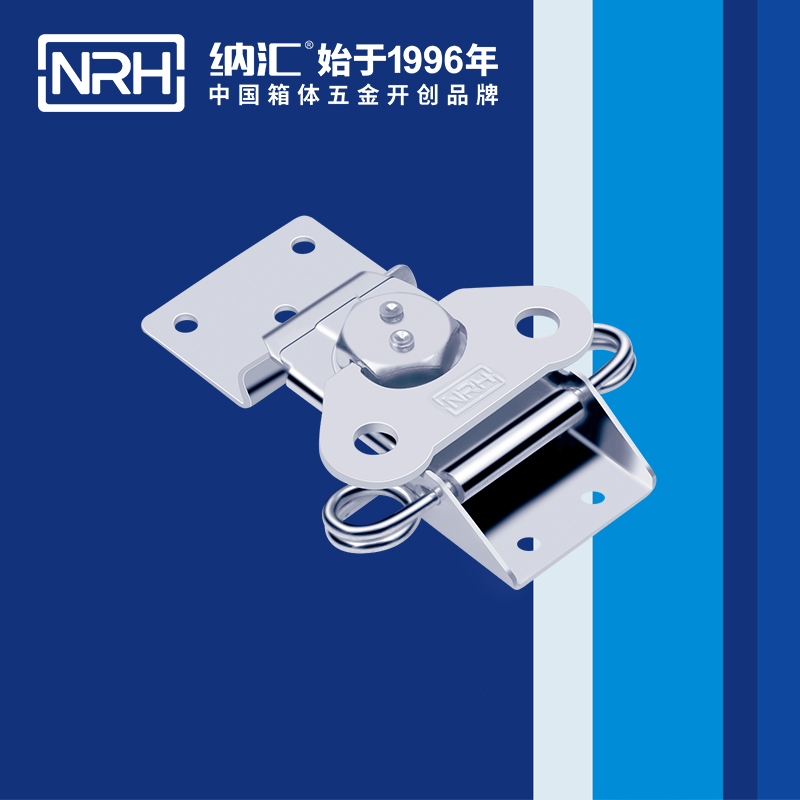
Butterfly latches – also called case catches or box catches – are the most widely used toggle latch on freight cases and large wooden transport boxes. The wing-shaped handle folds flat against the case surface when closed, creating a nearly flush profile. This low-profile design is critical for cases that will be stacked or palletized where protruding hardware can snag on adjacent cargo.
In the NRH Box Hardware catalog, the 6306-85 series exemplifies the butterfly latch. The 6306-85-FE-ZL (85mm width, iron substrate, zinc-plated) is the standard version, while the R6306-85-FE-ZL provides the right-hand variant for symmetrical installations. Per manufacturer catalog data, these latches are used on wooden freight cases where cost-effectiveness and reliable clamping are the priorities. Detailed specifications for these models are not available in the current data set.
2. Adjustable Toggle Latches
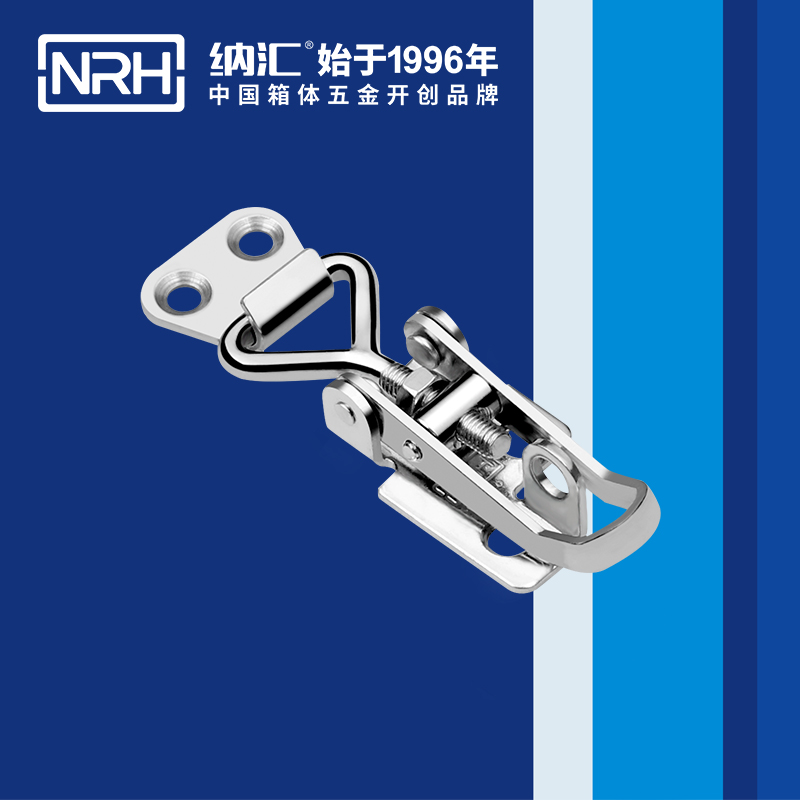
Adjustable toggle latches incorporate a threaded hook or loop that allows the user to change the effective clamping distance. By turning the threaded catch, you can compensate for gasket compression, thermal expansion, or manufacturing tolerances in the case. This adjustability is essential when the latch must maintain a specific clamping force – for example, to keep an environmental gasket compressed to its rated sealing pressure.
For adjustable toggle latches, NRH offers the 56 series. The 5608-70K-S04-ZG (304 stainless steel, vibratory finish, 51g, 490N tensile load) is a representative model from this series, providing 70-82mm adjustment range with threaded hook mechanism.
3. Draw Latches (Standard Toggle Latches)
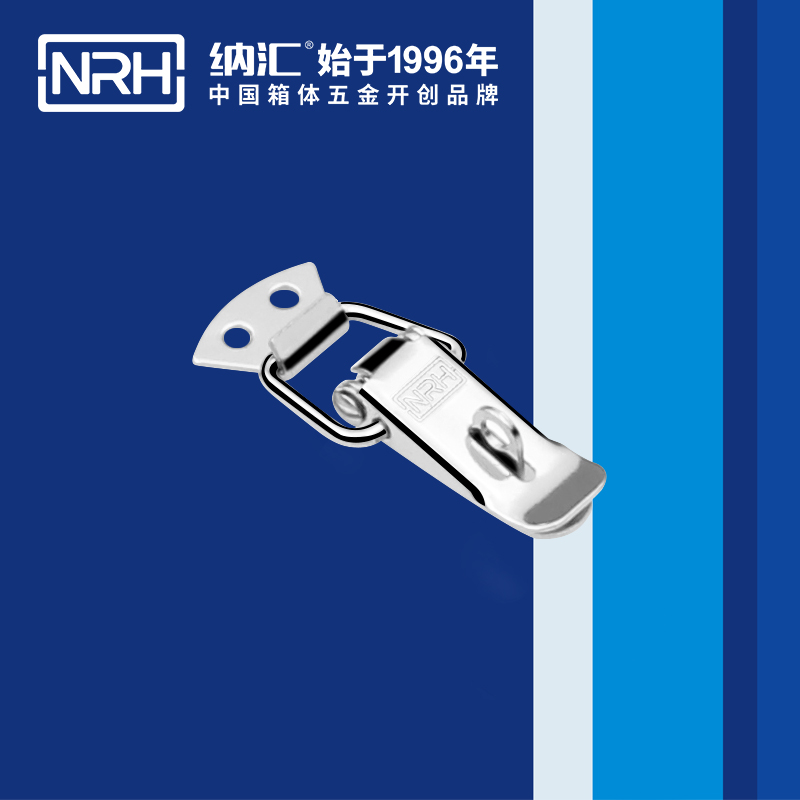
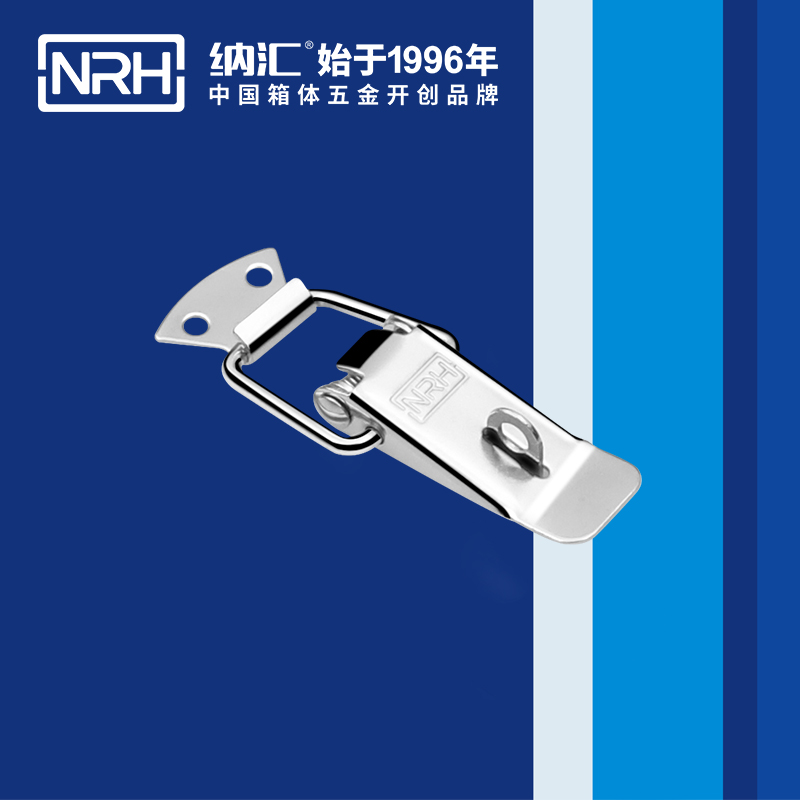
Draw latches are the classic toggle latch form: a lever arm connected to a loop or hook that draws a catch plate toward the latch base when the lever is closed.
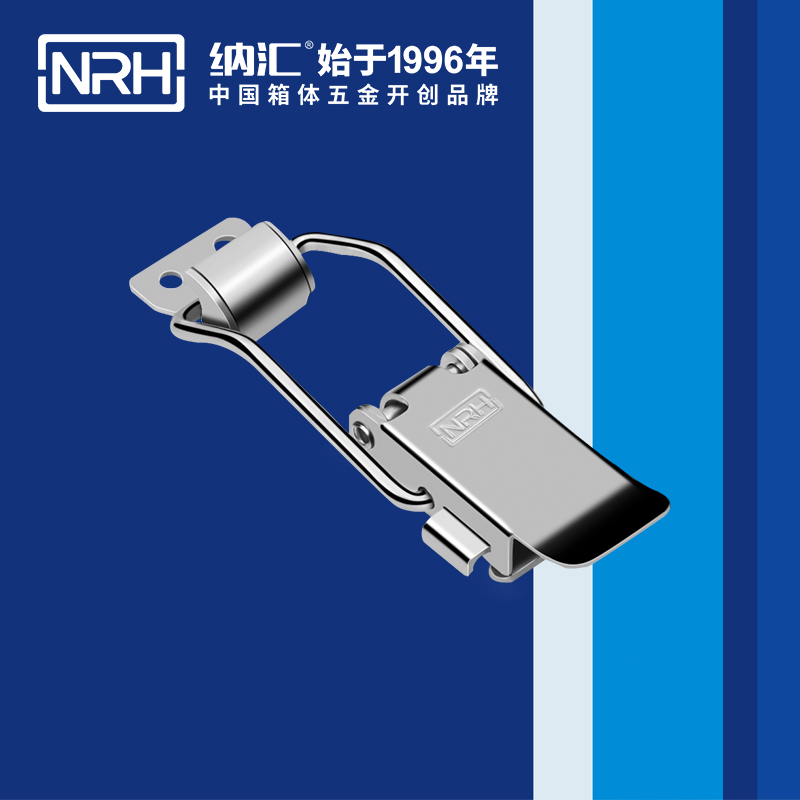
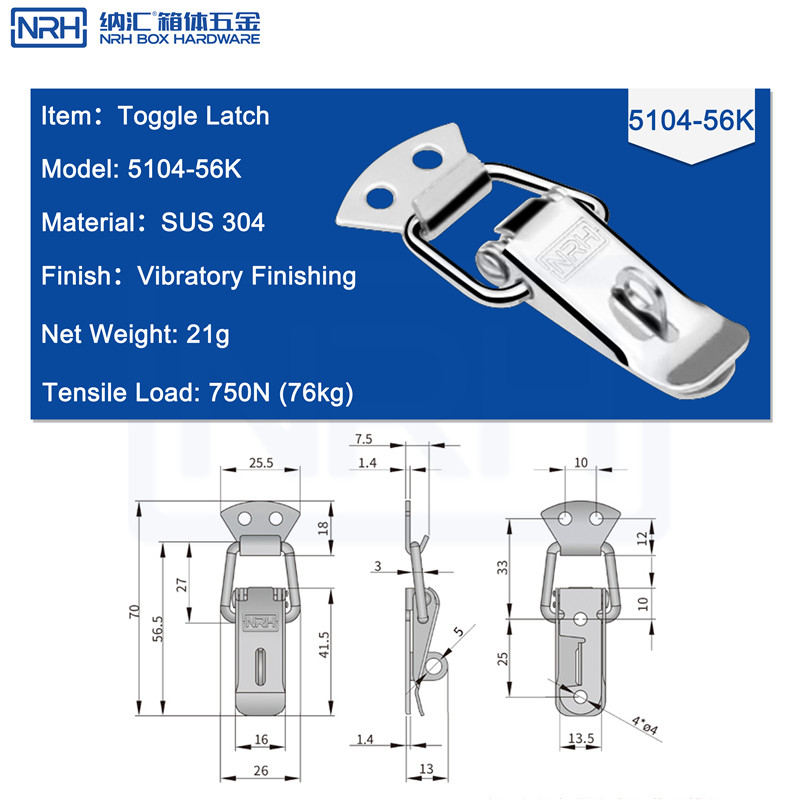
For compact, high-performance applications, the 5104-56-S04-ZG uses 304 stainless steel with a vibratory finish, delivering 750N tensile load at just 21g. For applications requiring security, the 5102-88K offers 1000N tensile load with a padlock hole for dual-locking security. The 5808-98S (304 stainless steel, 65g, 441N tensile load) provides a safety draw latch option with push-button secondary locking. The 5403-83-FE-CL covers the mid-range with an 83mm iron, chrome-plated option.
Engineering Note: Tensile load values (in Newtons) represent the breaking point under laboratory test conditions. These are not recommended service loads. Always apply an appropriate safety factor (2:1 to 4:1) based on your application requirements.
4. Safety Toggle Latches
Safety toggle latches add a secondary locking mechanism – typically a spring-loaded pin or safety catch – that prevents the primary lever from being accidentally opened. Even if vibration or shock pushes the main lever past dead center, the safety catch holds it closed until both mechanisms are deliberately released.
Safety latches are required on cases and enclosures where unintended opening could cause injury, contamination, or significant property damage. Applications include medical transport cases, hazardous-material enclosures, and military transit cases subject to extreme vibration profiles.
The NRH 5808 series exemplifies safety toggle latches with its push-button safety lock design. The 5808-98S (304 stainless steel, vibratory finish, 65g, 441N tensile load) features a spring-loaded push button that engages a secondary locking mechanism – press the button to release the safety lock while lifting the handle. No keys or padlocks required.
5. Spring-Loaded Toggle Latches
Spring-loaded toggle latches incorporate a spring mechanism that either assists closing or provides a bias force keeping the lever in the open position when not engaged. The spring assistance reduces effort on large cases with multiple latches that must be operated repeatedly.
Some spring-loaded designs also provide vibration damping: the spring absorbs micro-movements at the pivot points, reducing the risk of the lever creeping toward dead center under sustained vibration.
The NRH 51 series exemplifies spring-loaded toggle latches. The 5104-56-S04-ZG (304 stainless steel, vibratory finish, 21g, 750N tensile load) features a single integrated spring that assists handle return and maintains consistent tension across the latch stroke. Available in large, medium, small, and miniature sizes with options for 201 stainless steel, 304 stainless steel, and zinc-plated steel.
| Latch Type | Representative Model | Material | Weight | Load Rating | Key Feature |
|---|---|---|---|---|---|
| Butterfly | 6306-85-FE-ZL | Iron / Zinc-plated | – | – | Flush profile for stacking |
| Adjustable | 5608-70K-S04-ZG | 304 SS | 51g | 490 N | 70-82mm threaded adjustment |
| Draw / Toggle | 5104-56-S04-ZG | 304 SS | 21g | 750 N | Highest strength-to-weight ratio |
| Security Padlock | 5102-88K | 304 SS | 60g | 1000 N | Highest tensile, padlock hole |
| Safety | 5808-98S | 304 SS | 65g | 441 N | Push-button secondary lock |
How Toggle Latches Work: Step-by-Step Mechanism
Understanding the full operating cycle of a toggle latch helps clarify why certain types are better suited to specific applications and why installation details matter so much.
Step 1: Open Position
In the open position, the lever is raised and the hook or loop is disengaged from the catch plate. The linkage pivots keep the lever stable in the open position via a spring detent or natural geometry.
Step 2: Engagement
The user positions the hook over the catch plate and presses the lever downward. As the linkage moves toward dead center, the mechanical advantage increases, converting the user’s applied force into clamping pressure.
Step 3: Dead Center
At dead center, the pivot points align and the clamping force peaks – but the linkage is only balanced, not locked. The lever must be pushed firmly past this point. A properly installed toggle latch produces a distinct “snap” as the lever crosses dead center, confirming the lock is engaged.
Step 4: Over-Center Lock
Past dead center, any force trying to pull the clamped surfaces apart generates a torque that holds the lever firmly closed. The latch is self-locking and remains closed until the lever is deliberately lifted past dead center.
Step 5: Release
To release, the user lifts the lever upward. The force required is comparable to the closing force near dead center. Once past dead center, the linkage snaps open and the hook disengages.
Selection Guide: Which Toggle Latch for Which Application?
Choosing the right toggle latch requires balancing six factors: clamping force, profile height, adjustability, corrosion resistance, security, and cost. The following table summarizes the key decision criteria.
| Application | Recommended Type | Recommended Model | Key Reason |
|---|---|---|---|
| Large wooden freight cases | Butterfly | 6306-85-FE-ZL | Flush profile for stacking, cost-effective |
| Flight cases / ATA road cases | Butterfly | 6306-85-FE-ZL / CR | Low-profile handle, quick operation |
| Gasket-sealed enclosures | Adjustable | 5608-70K-S04-ZG | Threaded hook maintains gasket compression |
| Security enclosures | Security padlock | 5102-88K | 1000N tensile, padlock hole for security |
| Compact equipment boxes | Spring-loaded | 5104-56-S04-ZG | Small footprint, 750N tensile at 21g |
| Industrial toolboxes | Draw | 5403-83-FE-CL / 5808-98S | Durable, chrome or vibratory finish options |
| Vibration-intensive transport | Safety | 5808-98S | Push-button secondary lock prevents accidental release |
Clamping Force Considerations
Clamping force is not the same as tensile strength. A toggle latch’s clamping force depends on the linkage geometry, lever length, and the force the user applies. A longer lever provides more mechanical advantage but increases the risk of over-tightening, which can deform the case panel or compress a gasket beyond its rated range.
For gasket-sealed enclosures, an adjustable toggle latch is almost always the right choice because the threaded hook lets you set the clamping distance precisely. Close the latch, then adjust the hook until the gasket is compressed to the manufacturer’s recommended percentage.
Corrosion Resistance by Environment
Surface finish determines how long the latch will function in corrosive environments. Salt spray performance varies significantly based on the combination of substrate and treatment:
- 304 stainless steel (unpassivated): Typically 48-72 hours in ASTM B117 salt spray testing before red rust appears. The natural chromium-oxide passive film provides baseline protection but can be compromised by machining contamination.
- 304 stainless steel with standard passivation: 96-200 hours – removal of free-iron contamination and thickening of the passive film significantly improves performance.
- 304 stainless steel with high-quality passivation: 200-500+ hours – achieved with optimized process control and solution chemistry, suitable for demanding outdoor and marine-proximate applications.
- Iron with chrome plating (CR): approximately 72-200 hours ASTM B117 – adequate for sheltered and indoor environments; not recommended for sustained outdoor exposure.
- Iron with zinc plating (ZL): approximately 72 hours ASTM B117 – the most cost-effective option for indoor or covered transport use.
For applications where the case may be exposed to road salt, sea spray, or prolonged outdoor storage, 304 stainless steel with high-quality passivation is the recommended specification. The 200-500+ hour salt spray rating provides a significant margin of safety over zinc or chrome finishes. For detailed salt spray data and environment-specific recommendations, refer to our full Surface Finish Guide for Case Hardware.
Profile Height and Stacking
If cases will be stacked or loaded into tight cargo spaces, the butterfly latch is the only type that provides a truly flush profile when closed. Draw latches and adjustable latches have levers that protrude above the case surface, and spring-loaded latches typically have the highest profile due to the spring housing.
Installation and Maintenance Tips
Mounting Surface Preparation
Toggle latches perform best when mounted on rigid, flat surfaces. Before installation, ensure the mounting area is free of paint runs, weld spatter, or surface deformations that could prevent the latch base from sitting flush. A gap between the latch base and the mounting surface concentrates stress on the mounting hardware and can lead to premature failure.
Reinforcement Plates
On thin-walled aluminum or composite cases, always use a metal reinforcement plate on the interior side of each mounting point. The plate should be at least 1.5mm thick and extend 10-15mm beyond the latch base in all directions. Without reinforcement, the mounting screws can pull through the case wall under clamping load or shock.
Catch Plate Alignment
The catch plate (the stationary piece that the hook or loop engages) must be positioned so that the latch achieves its full over-center travel when closed. If the catch plate is too close, the lever will not reach dead center and the latch will not lock. If it is too far, the hook will not engage. Always test the latch operation after installation: you should feel and hear a distinct snap as the lever passes dead center.
Fastener Torque
Mounting hardware should be torqued consistently across all latches on a case. Uneven torque can cause the latch base to tilt, misaligning the hook and catch and reducing clamping efficiency. For iron and stainless steel latches on aluminum cases, use serrated flange nuts or thread-locking compound to prevent vibration loosening.
Maintenance Schedule
Toggle latches require minimal maintenance, but a few practices extend service life significantly:
- Inspect pivot points every 6-12 months for wear, corrosion, or looseness. Worn pivots increase the dead-center zone and reduce locking reliability.
- Lubricate pivots with a light machine oil or dry film lubricant annually. Avoid heavy greases that attract grit and debris.
- Check hook engagement after any case has sustained a severe impact or shock. Impact can bend the hook or catch plate, reducing the over-center margin.
- Replace compromised latches immediately. A latch that has been deformed, corroded past the surface layer, or subjected to a shock load that exceeded its rating should be replaced, not repaired.
Frequently Asked Questions (FAQ)
What is the difference between a toggle latch and a butterfly latch?
A toggle latch is the general category: any latch that uses an over-center linkage to achieve self-locking. A butterfly latch is a specific type of toggle latch with a wing-shaped handle that folds flat against the case surface when closed. All butterfly latches are toggle latches, but not all toggle latches are butterfly latches. Draw latches, adjustable latches, and safety latches are also toggle latches.
How does an adjustable toggle latch work?
An adjustable toggle latch has a threaded hook or loop that screws in and out to change the effective length of the linkage. Turning the hook clockwise shortens the reach, increasing clamping force; turning it counterclockwise does the opposite. This adjustability lets you compensate for gasket compression set, thermal expansion, and manufacturing tolerances without repositioning the latch or catch plate. The NRH 5608-70K-S04-ZG offers 70-82mm adjustment range.
Can a toggle latch vibrate open during transport?
A properly installed toggle latch in good condition should not vibrate open, because the over-center geometry actively resists opening forces. However, three conditions can compromise this: (1) the lever was not pushed fully past dead center during closing, (2) the pivot points have worn enough to increase the dead-center zone, or (3) the vibration environment is extreme enough to push the lever back through dead center. For high-vibration applications, a safety latch with a secondary lock provides additional protection.
What material should I choose for outdoor cases?
304 stainless steel with high-quality passivation is the recommended choice for outdoor cases. With proper passivation, 304 stainless steel provides 200-500+ hours of ASTM B117 salt spray resistance – significantly more than unpassivated 304 (48-72 hours) or zinc-plated iron (approximately 72 hours). For short-term outdoor exposure or sheltered applications, zinc-plated iron may be adequate and more cost-effective.
How many toggle latches does my case need?
The number of latches depends on the case size, the lid span, the gasket type, and the expected transport conditions. As a general guideline: small cases (under 600mm lid span) use two latches; medium cases (600-1,200mm) use four; large freight cases (over 1,200mm) may need six or more. When a gasket seal must be maintained, add enough latches to keep the gasket uniformly compressed across the entire lid perimeter – typically no more than 300-400mm between latch points.
Do toggle latches work with gasket-sealed cases?
Yes, but an adjustable toggle latch is strongly preferred for gasket-sealed applications. Standard (non-adjustable) toggle latches apply a fixed clamping force determined by the linkage geometry and the installation dimensions. If the gasket compresses over time (compression set), the clamping force decreases. An adjustable latch lets you retighten the threaded hook to restore the original gasket compression without repositioning any hardware.
Can I replace a zinc-plated latch with a stainless steel one?
In most cases, yes. Stainless steel latches are dimensionally compatible with their iron counterparts in the same series. However, verify two things: (1) the mounting hole pattern matches, and (2) if the case is aluminum, be aware that stainless steel hardware in direct contact with aluminum can cause galvanic corrosion in the presence of moisture. Use an isolation barrier – such as a nylon washer or a coated mounting plate – between the stainless latch and the aluminum surface.
What is the strongest toggle latch in the NRH range?
Based on verified product data, the 5102-88K security padlock latch offers the highest tensile load at 1000 N, followed by the 5104-56-S04-ZG spring-loaded latch at 750 N. For heavy-duty applications requiring maximum retention force, the 5102-88K is recommended; for applications requiring a balance of strength and light weight, the 5104-56-S04-ZG offers 750N tensile at just 21g.
Key Takeaways
- A toggle latch uses an over-center mechanism that self-locks when the lever is pushed past the dead-center point – the harder you pull, the tighter it holds.
- Five major types serve different applications: butterfly (flush profile), adjustable (threaded hook), draw (standard toggle), safety (secondary lock), and spring-loaded (assisted closing).
- The NRH 5104-56-S04-ZG spring-loaded latch delivers 750N tensile at just 21g – exceptional strength-to-weight ratio for high-cycle applications.
- The NRH 5102-88K security padlock latch offers 1000N tensile with padlock hole – the strongest option in the verified product range.
- The NRH 5808-98S safety latch provides push-button secondary locking for vibration-intensive transport – press to release, no keys required.
- 304 stainless steel with high-quality passivation provides 200-500+ hours salt spray resistance – the recommended specification for demanding outdoor applications.
- Unpassivated 304 stainless steel typically provides 48-72 hours salt spray resistance – adequate for sheltered or short-term outdoor exposure.
- Always verify the latch reaches full over-center travel during installation – you should feel and hear a distinct snap when the lever passes dead center.
- Tensile load (N) is the breaking point, not the service load. Always apply a safety factor of 2:1 to 4:1 for reliable service.
- When in doubt, move up one size – the cost difference between a 25kg latch and a 50kg latch is minimal compared to the cost of failure.
About NRH
NRH is a brand of Shanghai Nahui Hardware Products Co., Ltd., established in 1996 and headquartered in Shanghai, China. The company specialises in R&D and production of high-quality hardware fittings for cases and boxes – including toggle latches, handles, hinges, and corner protectors. NRH offers a comprehensive range of toggle latch types across multiple substrate and finish combinations, serving military, medical, aviation, industrial, and logistics applications worldwide.
All NRH product data presented in this guide is based on actual product specifications and marked “for reference only – not for tooling/mould creation”. For official engineering drawings, customisation enquiries, or bulk orders, please contact the NRH sales team directly.
For official engineering drawings, customisation enquiries, or bulk orders, please visit the NRH product pages or contact the sales team directly.