

Let’s be real: Custom hardware lead times are the biggest headache in any enclosure project. One phase slips, and your entire assembly line goes dark. We’ve run the numbers across hundreds of custom latch, hinge, and corner protector jobs at NRH. Here’s the unfiltered breakdown of exactly how long each stage really takes – from the moment we get your PDF to the day the pallet lands on your dock. Use this to plan your schedule, and more importantly, to catch the hidden pitfalls that blow budgets.
1. Pre-Production: Drawing Review and Tooling
Before we cut any steel or fire up a press, the first thing we do is tear into your drawings. Our engineers check dimensions, tolerances, materials, and surface finishes against what’s actually feasible on our shop floor. Sometimes we catch things you didn’t – like a feature that looks great on screen but can’t be stamped in one hit.
Straightforward designs clear review in 3-5 business days. But if you’re pushing tight tolerances (below +/-0.05mm) or asking for exotic materials, budget 5-7 days. We’re checking four things: can we make it, do we have the material (SUS304, SUS316, zinc alloy), what finish works (chrome, nickel, powder coat), and will it actually fit your case assembly.
Heads up: If your drawing is missing tolerance callouts, we’ll have to come back and ask. Each round of back-and-forth adds 1-2 days. Save yourself the headache – send the full package the first time.
Pro tip: Send us STEP, IGES, or DWG files with clear notes on tolerances, material grade, finish, and load expectations. For example, our standard butterfly latches (5101 series) are rated at 392N tensile – if yours needs more, we need to know.

Tooling Lead Times
Tooling is where the schedule really starts to stretch. Mold complexity is the main driver – here’s what we typically see:
- Simple stamping die (like flat corner protectors): 15-20 days
- Multi-cavity die-casting mold (zinc alloy locks): 25-35 days
Tool steel matters too. P20 steel is fine for runs under 50,000 pieces. H13 steel lasts past 200,000 cycles but adds 5-7 days to fabrication. Tell us your volume early so we pick the right steel from the start.
Worth checking: We keep a library of existing tooling. If your design is close to something we’ve already built, we can skip the new mold entirely and just do modifications – that drops tooling time to 5-10 days. Always ask before greenlighting a new mold.
Warning: Design changes after we’ve started cutting steel? That hurts. A single mid-process change can add 7-14 days to the timeline. Lock your design down before approving tooling – your future self will thank you.
2. Production: Sampling, Manufacturing, and Surface Treatment
First Article Sampling
This is where we prove the tooling actually works. We run 5-20 sample parts, check every dimension, verify the finish, and test function.
Samples take 3-5 days to produce, then 3-5 days in the mail to you. You’ll need 1-3 days to inspect and approve. All in: 7-14 days per round.
First-pass approval rate across the industry is about 70-80%. If we need to make adjustments, each revision adds another 7-10 days. Most rejections come from dimensional drift (the most common), finish mismatches, fit issues with mating parts, or failing load tests.
Here’s a way to speed things up: Ask us to send high-res photos and CMM reports before we ship the physical samples. You can catch obvious problems without waiting for the courier. It’s saved our clients weeks.
Production Lead Times
Once the samples are approved, mass production depends on three things: quantity, process, and finish. Here’s our rule of thumb:
- Stamping/Forming: 5-10 days for 1,000-5,000 pieces
- Die Casting: 7-12 days for 500-3,000 pieces
- Machining: 10-15 days for 100-500 pieces
- Surface Treatment: 3-7 days (plating, coating, polishing)
- Assembly (if required): 2-5 days
Surface treatment is the usual bottleneck. Chrome and nickel plating take 3-5 days per batch. Powder coating runs 3-4 days. Electrophoresis black coating (standard on locks like the 6306-85-1) needs 2-3 days. Electrolytic polishing for stainless parts adds 2-4 days. Vibration grinding – standard on draw latches like the 5201-106 (35kg rating) – adds 1-2 days.
One more thing: Many factories outsource plating and coating. That adds 2-5 days on top of the treatment itself. Ask upfront whether your finish work is in-house or subcontracted – it matters.
3. Delivery: Shipping, Customs, and Logistics
Shipping is where the timeline gets unpredictable. Here’s what each option actually looks like:
- Express courier (DHL/FedEx/UPS): 3-7 days – use this for urgent orders under 100kg
- Air freight: 5-10 days – works for 100-500kg
- Sea freight (LCL): 20-35 days – bulk orders over 500kg
- Sea freight (FCL): 18-30 days – full container loads
Don’t forget customs. Import clearance takes 2-5 days depending on your country. Case hardware usually goes under HS code 8302 – confirm with your broker. If your order shares a container with others, add another 5-10 days for coordination.
Don’t get held up at the border: Incomplete paperwork is the #1 reason shipments sit in customs. Missing HS codes, wrong material declarations, or missing origin certificates will trigger a hold. Get your documents ready 3 days before we ship.
4. Total Lead Time Planning & Practical Actions
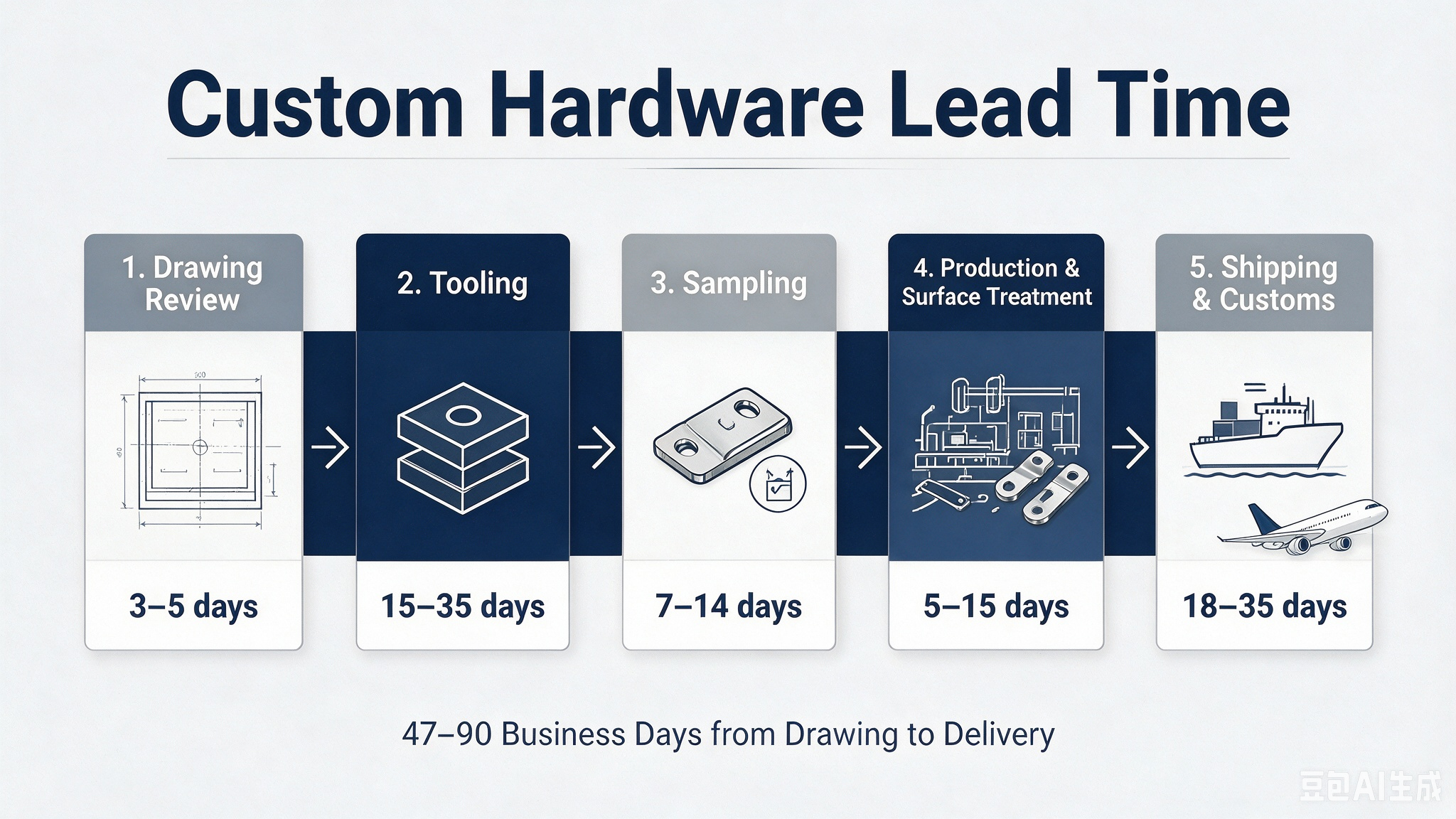
All in, most custom case hardware projects take 47-90 business days from start to finish. But here’s the reality: things go wrong. Add 15-20% buffer to each phase. If we tell you 60 days, plan for 70-72. That buffer is what keeps your production line from going dark.
If you want to shave weeks off this schedule, here’s what actually moves the needle in our shop:
- Send complete drawings. Tolerances, materials, surface specs – include everything the first time. No back-and-forth = weeks saved.
- Ask about existing tooling. We might already have a mold that works. That saves 10-20 days right there.
- Approve samples digitally. Photos and CMM reports get you 80% of the way there without waiting for physical samples. Cuts 3-5 days off each approval round.
- Verify surface treatment capacity. If we’re doing it in-house, it’s faster. If it’s subcontracted, expect delays.
- Prep shipping docs ahead of time. Complete, accurate paperwork = no customs surprises. We’ve seen it happen too many times.
About NRH Box Hardware: We keep an extensive tooling library covering standard latches, handles, hinges, and corner protectors. If your design fits existing tooling, we can cut total project time by 30-50%. Always worth a conversation before you start from scratch.
Frequently Asked Questions (FAQ)
How soon can you actually get custom hardware made?
Fastest we’ve done is 32 days, but that’s only if your design fits our existing molds and you approve samples via email the same day. For new tooling, plan on 47-90 business days.
What’s the real cost of expediting tooling?
Expect to pay 30-50% more on the mold. In return, you’ll shave 5-10 days off the build. Not every shop offers this, so ask upfront.
Can we skip sampling to save time?
We strongly advise against it. Skipping samples to save a week is how you end up scrapping 10,000 pieces and losing a month. The 7-14 day delay is cheap insurance.
Does surface treatment always add to the timeline?
Yes, almost always. Plating, coating, and polishing all happen after forming. Vibration grinding adds 1-2 days. Chrome plating adds 3-5 days. Plan for it from day one.
What actually causes the longest delays?
Design changes after tooling starts. Period. A single mid-process revision can set you back 7-14 days. Second place: incomplete initial drawings that force us to go back and ask for missing tolerances.
How does order size impact the timeline?
Surprisingly less than you’d think. A 1,000-piece stamping run takes about 7 days. A 10,000-piece run takes 12-15 days. The real cost impact is on unit price, not time.
When should I use air freight vs sea freight?
Air freight is 4-6 times more expensive per kilo. Use it only for urgent, low-volume orders under 500kg. Above that, sea freight wins on cost even with the longer transit time.
What shipping documents do I need to get right?
Commercial invoice, packing list, bill of lading, certificate of origin, and MSDS if needed. Double-check the HS code – it’s usually 8302 for case hardware. Get it wrong and customs will hold your shipment.
Where the numbers come from: Lead time data is based on real jobs we’ve run at NRH, plus industry benchmarks from SME and ASTM material standards. Your actual timeline may vary depending on design complexity, our current workload, and what’s happening with global logistics. The best way to get an accurate number? Talk to us directly – we’ll give you a straight answer.