

No MOQ on Catalog Hardware: Order Exactly What You Need from Stock
Here’s what sets NRH apart from most hardware manufacturers: all standard catalog items ship with no minimum order quantity (MOQ). Need 5 pieces for a prototype? Order 5. Need 50 for a small production run? Order 50. Need 1,000 for a large project? Order 1,000. There is no minimum. There is no penalty for ordering small quantities. You order exactly what your project requires.
This is not a limited-time promotion or a marketing gimmick. It is a deliberate business model built around finished goods inventory rather than made-to-order production. NRH stocks the most popular SKUs across all major product categories in regional warehouses, ready to ship when you need them.
Note on custom parts: The no-MOQ policy applies to standard catalog items only. Custom parts – including non-standard hole patterns, special surface treatments, modified dimensions, or new tooling – are subject to MOQs. See the Custom Parts section below for details.
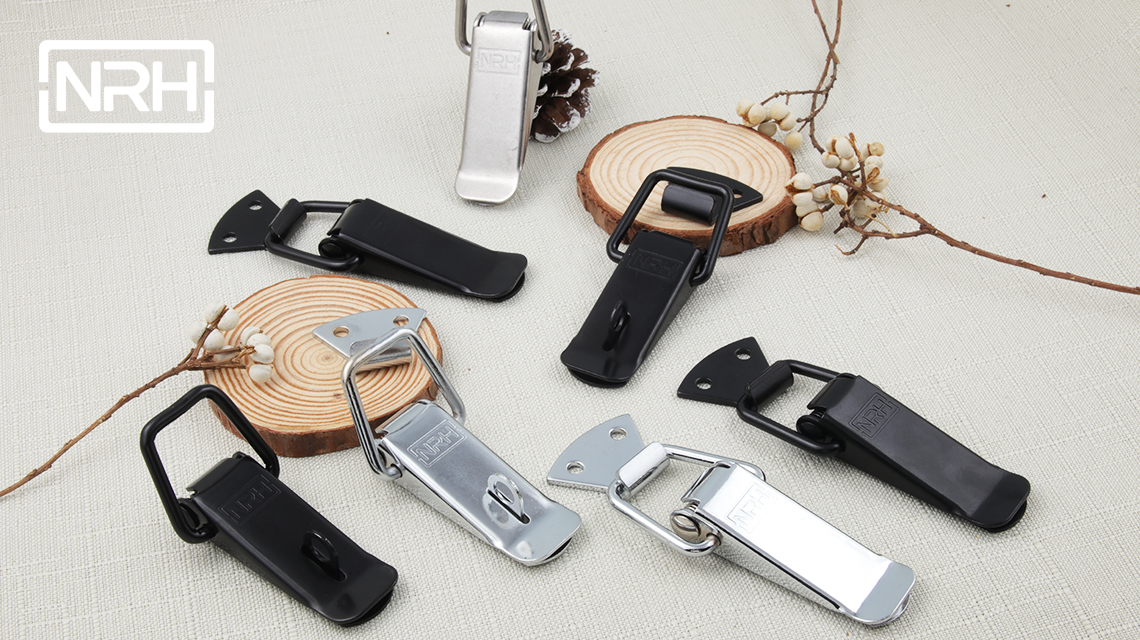
Why Most Hardware Manufacturers Require MOQs
Before explaining the NRH model, it helps to understand why MOQs exist in the first place.
Traditional hardware manufacturers set MOQs for three reasons:
- Setup cost recovery. Every production run requires machine calibration, die mounting, and first-article inspection. For a die-cast zinc alloy handle, tooling setup takes 45-90 minutes. If a buyer orders 50 pieces, the setup cost per unit exceeds the part cost. A 500-piece minimum lets the manufacturer amortize that fixed cost.
- Raw material procurement. Stainless steel rod stock ships in bundles of 500-1,000 kg. Zinc alloy ingots come in minimum lots of 250 kg. Small orders leave manufacturers with leftover material that is difficult to resell.
- Production line efficiency. CNC lathes, stamping presses, and polishing lines run most efficiently in continuous batches. Stopping a line after 100 pieces wastes time and increases defect rates at the next startup.
These are legitimate constraints – for manufacturers that operate on a made-to-order basis. NRH takes a different approach.
How NRH Eliminates MOQs on Catalog Items
NRH eliminates MOQs on catalog items by maintaining finished goods inventory rather than producing only against purchase orders. The model works like this:
- High-volume production runs keep per-unit costs at factory-direct levels
- Finished goods are stocked in regional warehouses, not produced on demand
- Small orders pull from inventory rather than triggering a new production run
- Replenishment is automated based on consumption data, not order minimums
This separates manufacturing efficiency from order flexibility. NRH gets the cost benefits of high-volume production. You get the flexibility of ordering exactly what you need – whether that’s 5 pieces or 5,000.
Catalog Items Available with No MOQ
The no-MOQ policy covers all standard catalog items across every major product category:
| Category | Series | Stock Status | MOQ |
|---|---|---|---|
| Butterfly latches | 5101 series | In stock | 0 |
| Draw latches | 5201 series | In stock | 0 |
| Compression latches | 5301 series | In stock | 0 |
| Recessed handles | 4101 series | In stock | 0 |
| Folding handles | 4201 series | In stock | 0 |
| Short hinges | 8101 / 8201 series | In stock | 0 |
| Continuous hinges | 8001 series | In stock | 0 |
| Corner protectors | 7101 – 7601 series | In stock | 0 |
| Case locks | 6101 / 6306 series | In stock | 0 |
| Toggle clamps | 3101 series | In stock | 0 |
Products are available in multiple materials (SUS304 stainless steel, iron with chrome/zinc/nickel plating) and finishes (vibration polishing, bright polishing, chrome, zinc, nickel, black oxide). All standard configurations are stocked.
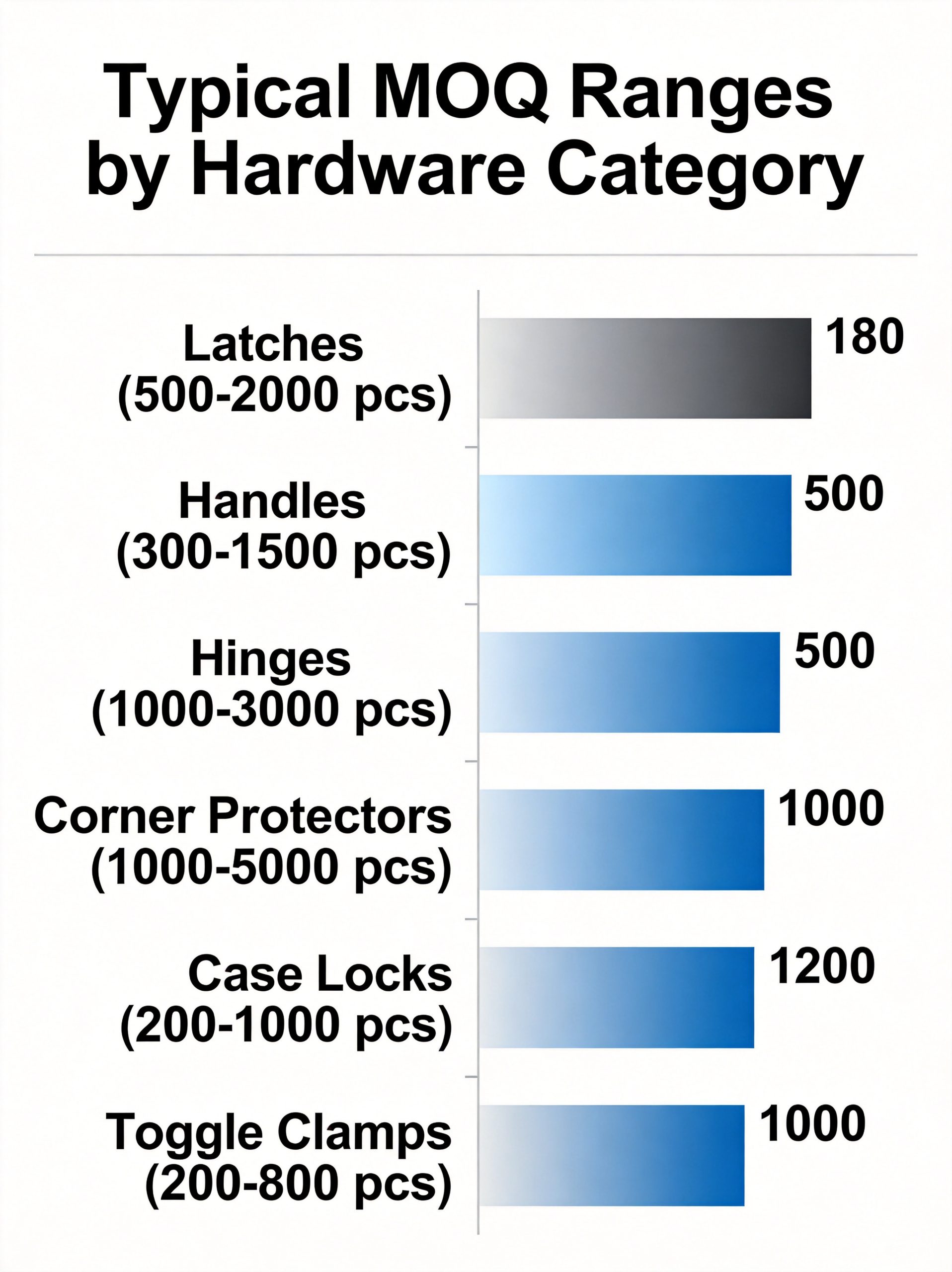
Custom Parts: MOQs Apply
While standard catalog items have no MOQ, custom parts are a different story. Any modification to a standard catalog item requires new tooling, process changes, or specialized materials – and these come with MOQs.
Custom modifications that trigger MOQs include:
- Non-standard hole patterns – different mounting hole sizes, positions, or quantities
- Special surface treatments – finishes not offered in the standard catalog
- Modified dimensions – altered lengths, widths, thicknesses, or profiles
- Custom material specifications – materials outside standard options
- New tooling – custom dies, molds, or fixtures required for production
Typical custom MOQ ranges:
| Customization Type | Typical MOQ Range | Key Driver |
|---|---|---|
| Simple modifications (hole pattern changes) | 500-1,000 pieces | Tooling adjustment |
| Surface treatment changes | 500-2,000 pieces | Plating batch minimums |
| Dimension modifications | 1,000-3,000 pieces | Die/mold modification |
| New tooling (custom die/mold) | 2,000-5,000 pieces | Tooling cost amortization |
For custom parts, NRH provides MOQ quotes on a project-by-project basis. The minimum depends on tooling complexity, material availability, and production setup requirements. Contact the sales team with your specifications for a firm custom MOQ quote.
Before going custom: Many buyers find that standard catalog items meet their requirements. Always check the catalog first – you might not need a custom part at all.
Who Benefits from No-MOQ Catalog Hardware
The no-MOQ model serves a wide range of buyers who would otherwise be blocked by traditional minimums:
- Prototype and R&D teams – Order 5-10 pieces for testing without committing to 1,000-piece minimums. Validate fit, finish, and function at catalog pricing.
- Small-batch manufacturers – Produce 50-200 units without tying up capital in excess hardware inventory.
- Maintenance and repair operations – Replace damaged hardware on existing cases without over-ordering.
- Custom case builders – Match hardware quantities to case production runs, not the other way around.
- International buyers – Test market demand with small orders before committing to large volumes.
Catalog vs. Custom: Side-by-Side Comparison
| Factor | Catalog Items | Custom Parts |
|---|---|---|
| MOQ | 0 (no minimum) | 500-5,000+ pieces |
| Tooling cost | Already amortized | Separate charge ($300-$3,000+) |
| Lead time | 1-3 business days (in stock) | 10-25 business days + production |
| Unit pricing | Catalog pricing | Quoted per project |
| Engineering support | Standard spec sheet | Full technical review & approval |
How to Order: No-MOQ Process for Catalog Items
Ordering catalog hardware with no MOQ is straightforward:
- Identify your part numbers from the NRH catalog or website.
- Specify the quantity – any number from 1 piece upward.
- Submit your order through the website, email, or contact the sales team.
- Receive confirmation with pricing, availability, and estimated shipping date.
- Order ships within 1-3 business days for in-stock items.
For custom parts, the process includes an additional step: submit your specifications, receive a custom MOQ quote and tooling cost estimate, approve the sample, then proceed to production.
Frequently Asked Questions (FAQ)
Does NRH charge MOQ for catalog hardware items?
No. For all standard catalog items – including butterfly latches, draw latches, compression latches, recessed handles, folding handles, hinges, corner protectors, case locks, and toggle clamps – NRH maintains stock inventory with no minimum order quantity. You can order exactly what you need.
Do custom hardware items have MOQs?
Yes. Custom parts – including non-standard hole patterns, special surface treatments, modified dimensions, and new tooling – require MOQs. The minimum depends on tooling complexity, material availability, and production setup. Contact the NRH sales team for a custom MOQ quote.
What is the difference between NRH’s catalog and custom items?
Catalog items are standard products with existing tooling, stocked in NRH warehouses, and available with no MOQ. Custom items are modified to your specifications – they require new tooling or process changes, and therefore carry MOQs to cover setup costs. Always check if a catalog item meets your needs before going custom.
What catalog items are available with no MOQ?
All standard catalog items: butterfly latches (5101 series), draw latches (5201 series), compression latches (5301 series), recessed handles (4101 series), folding handles (4201 series), short hinges (8101/8201 series), continuous hinges (8001 series), corner protectors (7101-7601 series), case locks (6101/6306 series), and toggle clamps (3101 series).
How does NRH keep catalog pricing competitive without MOQs?
NRH uses a hybrid model: high-volume production runs keep per-unit costs low, while regional warehouses maintain finished goods inventory. This separates manufacturing efficiency from order minimums – you get factory pricing without factory MOQs on catalog items.
What is the MOQ range for custom parts?
Custom MOQs vary by product type and complexity. Simple modifications like hole pattern changes may start at 500 pieces. Complex custom parts with new tooling may require 2,000-5,000 pieces. Contact NRH with your specifications for a firm quote.
Can I order samples of catalog items before placing a volume order?
Yes. Sample orders of 5-20 pieces are available for all catalog items at standard catalog pricing. Since there is no MOQ, you can order samples without committing to a larger quantity upfront.
Need help choosing? Contact NRH for current stock availability, pricing, or a custom MOQ quote. The full product catalog is available at nrh.hk.