

Chrome Plating vs Zinc Plating vs Nickel Plating: Environmental Compliance and Performance Comparison
Chrome plating, zinc plating, and nickel plating are the three dominant surface treatments for iron-based case hardware. All three protect carbon steel from corrosion. Each delivers distinct visual finishes and performance characteristics. But they differ in environmental compliance status, salt spray endurance, appearance, hardness, and total cost. This comparison breaks down those differences with test data and regulatory facts so you can specify the right plating for your next enclosure project.
What Chrome, Zinc, and Nickel Plating Actually Do
All three processes deposit a thin metallic layer onto an iron (FE) substrate. The layer acts as a sacrificial or barrier shield that blocks oxygen and moisture from reaching the base metal. Without plating, bare carbon steel begins to rust within hours of exposure to humid air.
Chrome Plating (CR) – The Premium Decorative Finish
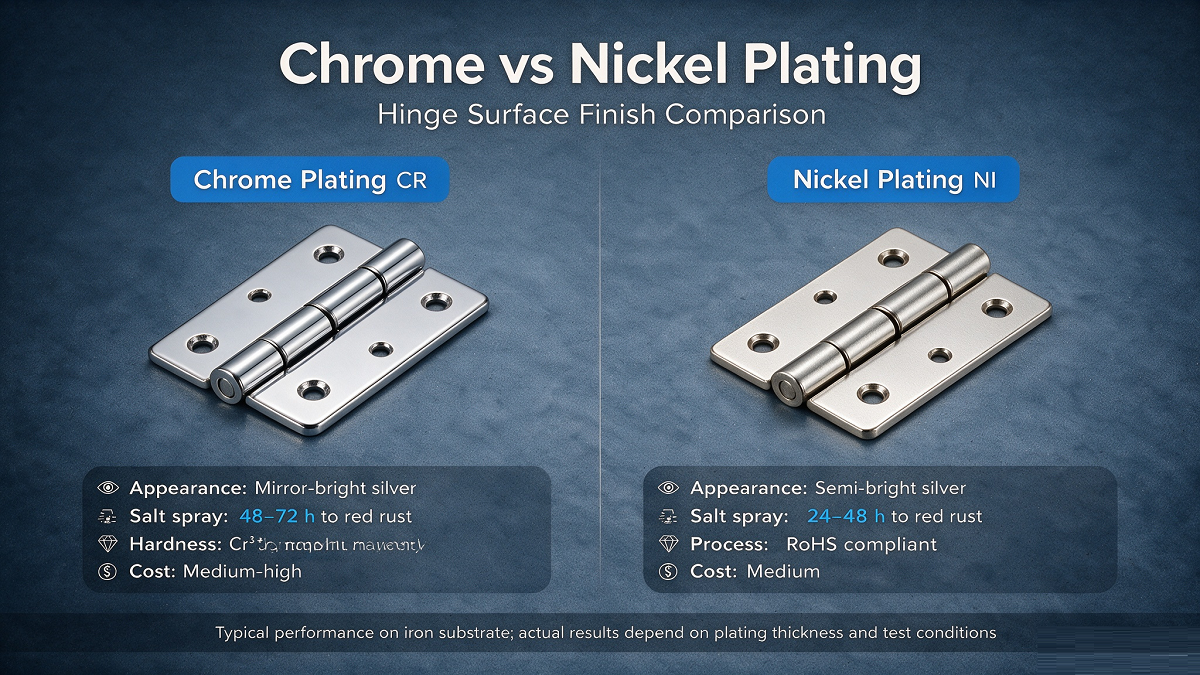
Decorative chrome plating on case hardware uses a multi-layer system: a copper undercoat, a nickel intermediate layer, and a thin chromium topcoat (typically 0.5-1.0 micron). The nickel layer provides the bulk of the corrosion protection. The chromium topcoat supplies the mirror-bright, slightly blue-tinted appearance that distinguishes chrome from all other finishes. The result is a hard, wear-resistant surface with high reflectivity and a premium look.
Chrome plating delivers the highest gloss and most striking visual effect among all surface treatment processes. The mirror-like chrome surface with its distinctive silver-blue tone significantly enhances product quality perception and visual appeal. Beyond appearance, chrome plating offers excellent hardness and abrasion resistance, effectively resisting scratches and wear from daily handling – making it particularly suitable for frequently operated handles, locks, and corner protectors.
In the NRH product line, chrome-plated models span every hardware category. The 6101-108K butterfly lock (FE-CR, 237 g, 392 N tensile load), the 7301-38 flat corner (FE-CR, 17 g), and the 4101-160 recessed handle (FE-CR, 371 g, 80 kg load rating) all use this treatment per manufacturer catalog data. These parts share a consistent bright-silver aesthetic that makes chrome the default choice for visible, appearance-critical installations.
Zinc Plating (ZL) – The Cost-Effective Alternative
Zinc plating deposits a layer of zinc directly onto the iron substrate through electroplating. The zinc layer is thicker than the chromium topcoat – typically 5-15 microns – and protects the base metal through sacrificial action. When the zinc surface is scratched and exposed to moisture, the zinc corrodes preferentially, leaving the underlying steel intact. This galvanic protection continues even after the zinc layer sustains minor damage.
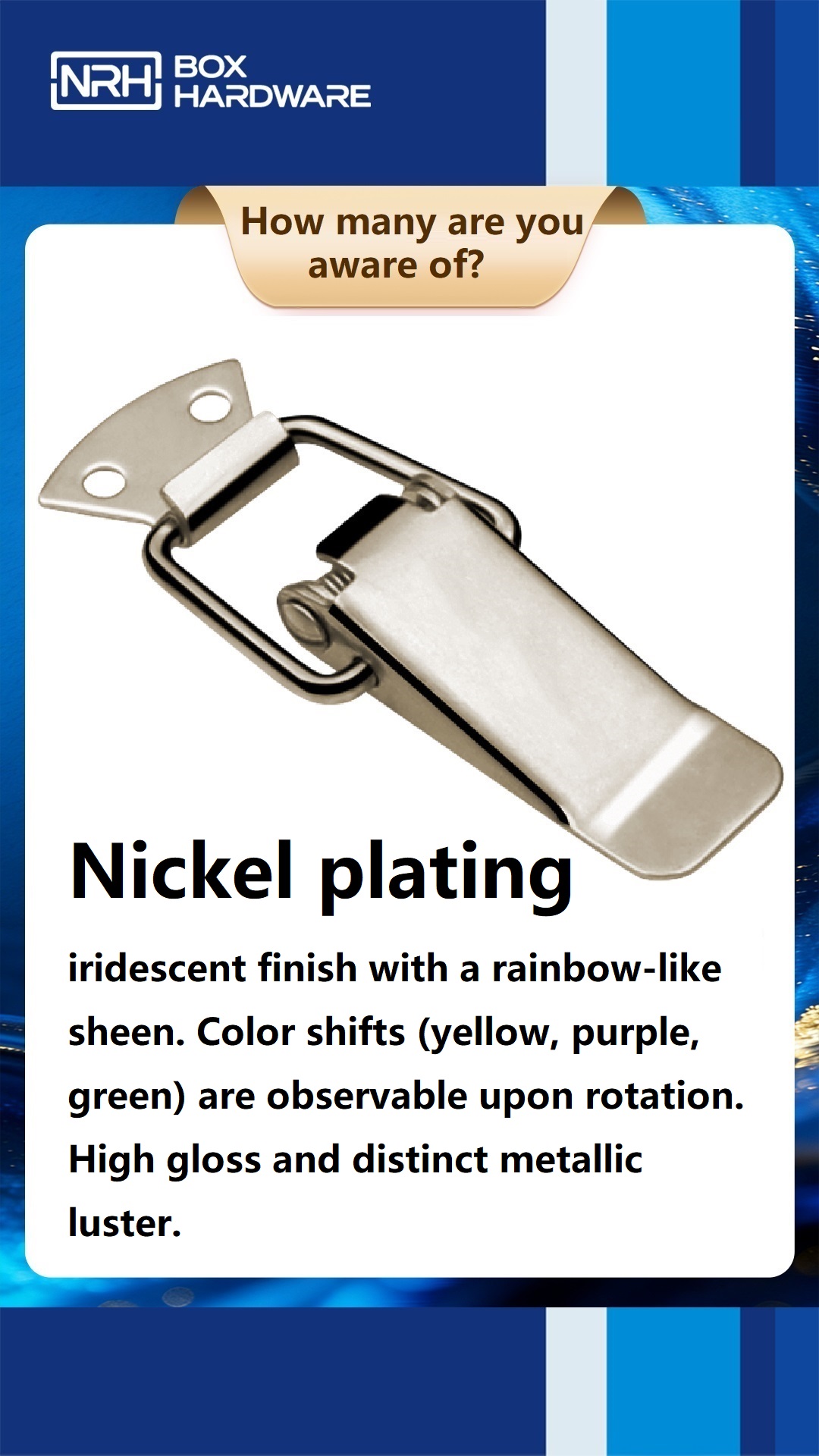
Blue zinc (also called clear zinc) is the standard variant for case hardware. It produces a matte, slightly iridescent blue-silver finish. Yellow zinc (gold iridescent) offers slightly better corrosion resistance but is less common on modern hardware due to hexavalent chromium concerns in the passivation layer. The NRH 6306-85 latch lock (FE-ZL, 203 g, 588 N tensile) and the 8101-100 butt hinge (FE-ZL, 82 g, 13 kg load) represent the zinc-plated category per manufacturer catalog data.
Nickel Plating (NI) – The Corrosion-Resistant Workhorse
Nickel plating deposits a layer of nickel directly onto the iron substrate through electroplating. The nickel layer typically ranges from 5-25 microns in thickness, providing a dense barrier that effectively blocks oxygen and moisture from reaching the base metal. Unlike zinc, nickel does not offer sacrificial protection – it relies entirely on its barrier properties. Nickel plating offers good corrosion resistance and serves as the essential underlayer for chrome plating.
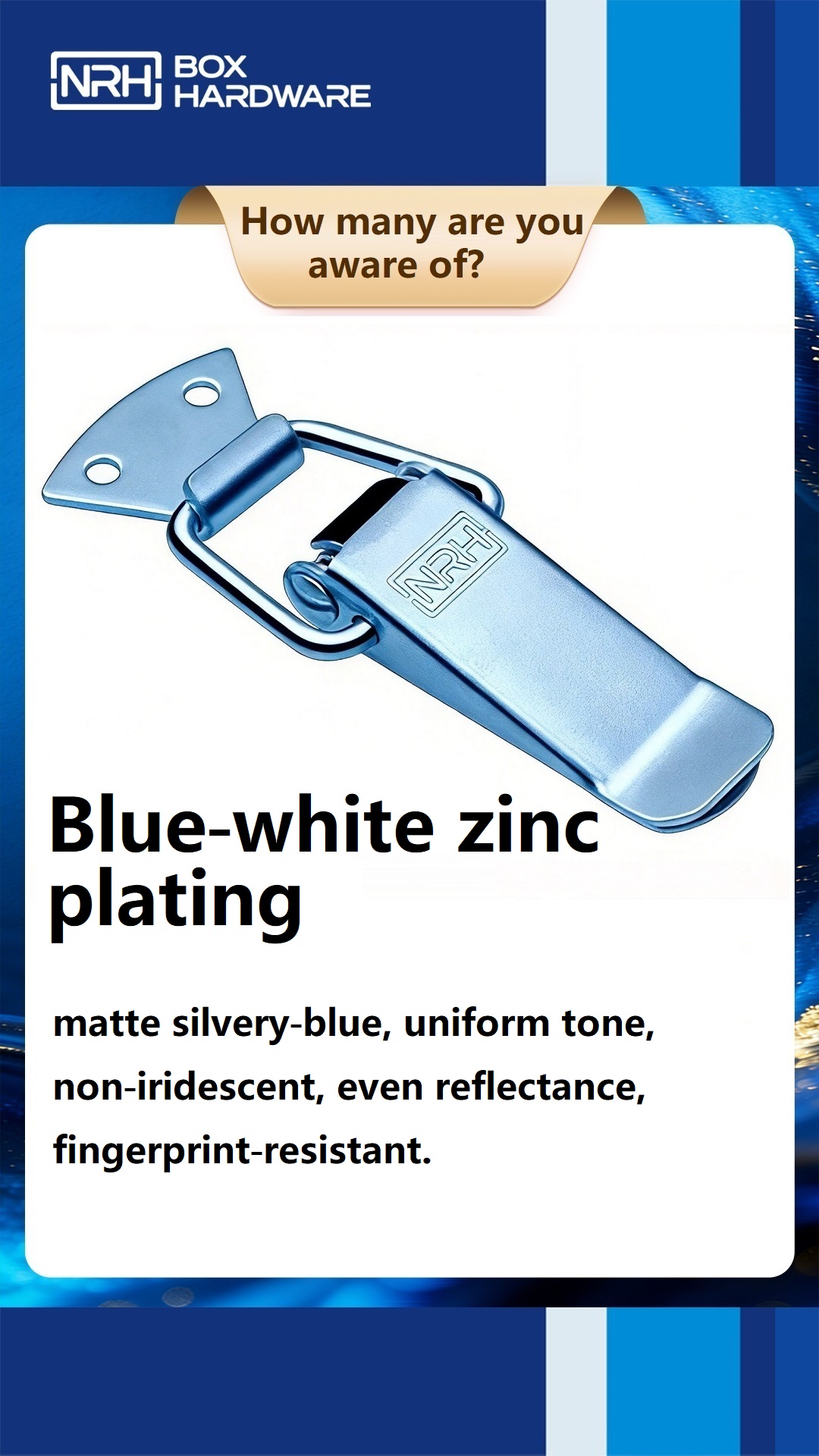
Nickel plating features a warm, slightly yellowish-silver tone with a soft, satin-like luster. The appearance sits between zinc’s matte finish and chrome’s mirror brightness, offering a subtle, elegant metallic appearance. Nickel plating provides good corrosion resistance and moderate hardness, making it a widely used surface treatment for industrial hardware. Beyond serving as a decorative finish, nickel plating is also an essential intermediate layer in the chrome plating process, providing the foundation for chrome’s protective and aesthetic properties. In the NRH product line, nickel-plated models are available across multiple hardware categories, offering customers a balanced option that combines good corrosion resistance with a refined appearance.
Key advantages of nickel plating include:
- Good corrosion resistance: Nickel provides effective protection against rust and oxidation in indoor and semi-protected environments.
- Warm silver appearance: Nickel has a softer, warmer silver tone compared to chrome’s cool blue-silver mirror finish.
- Versatile application: Nickel serves as both a final decorative finish and an essential underlayer for chrome plating.
- Moderate wear resistance: Nickel offers better hardness and wear resistance than zinc, with a balanced cost-performance ratio.
Environmental Compliance: RoHS, REACH, and Hexavalent Chromium
Environmental regulation is a critical factor separating these plating systems today. If your product ships to the EU, or if your customer requires RoHS/REACH documentation, this section determines your specification.
Hexavalent Chromium (Cr6+): The Restricted Substance
Hexavalent chromium is a known carcinogen. The EU Restriction of Hazardous Substances (RoHS) directive limits Cr6+ to 0.1% (1000 ppm) by weight in any homogeneous material. REACH classifies hexavalent chromium compounds as Substances of Very High Concern (SVHC), requiring authorization for use. These limits are legally enforceable, and non-compliant products face import refusal, market withdrawal, and fines.
Historically, chrome plating, zinc plating, and nickel plating processes have all faced Cr6+ compliance challenges. In chrome and nickel plating, chromate conversion coatings sometimes contained hexavalent chromium. In zinc plating, yellow zinc passivation relied on Cr6+ for its characteristic gold-iridescent color. All these uses are now restricted.
Trivalent Chromium (Cr3+): The Compliant Replacement
Modern chrome and nickel plating processes have largely transitioned to trivalent chromium (Cr3+) baths. Cr3+ is not classified as a carcinogen. It falls outside the RoHS restriction scope for chromium compounds. Plating produced with Cr3+ chemistry and Cr3+ passivation meets RoHS and REACH requirements.
Zinc plating has undergone the same transition. Blue zinc passivation now uses Cr3+ chemistry exclusively. The result is fully RoHS-compliant. Yellow zinc can also be produced with Cr3+ passivation, though the color and corrosion performance differ slightly from the older Cr6+ versions.
Compliance Status Summary
- Chrome plating (Cr3+ process): RoHS compliant when produced with Cr3+ chemistry. Verify with your plating supplier that the process uses Cr3+ baths and Cr3+ passivation. Request a material test report if your customer requires documentation.
- Nickel plating (Cr3+ process): RoHS compliant when produced with Cr3+ chemistry. Nickel plating has a straightforward compliance path when produced with modern Cr3+ processes.
- Zinc plating (Cr3+ blue passivation): RoHS compliant. This is the most straightforward compliance path among the three.
- Yellow zinc (legacy Cr6+ passivation): Not RoHS compliant. Avoid for any product that ships to regulated markets.
Key takeaway: All three platings can meet RoHS and REACH when produced with modern Cr3+ processes. However, compliance depends entirely on the specific chemistry used by your plating supplier. Always request documentation to confirm Cr3+ chemistry and avoid any process that uses hexavalent chromium (Cr6+).
Performance Comparison: Corrosion Resistance, Appearance, Hardness, and Cost
Corrosion Resistance (ASTM B117 Salt Spray Test)
The ASTM B117 salt spray test is the industry standard for rating plating performance. Test results are measured in hours to white rust (zinc oxidation) or red rust (base steel corrosion). The following data represents typical values for iron-substrate hardware under standard process conditions:
- FE-CR (chrome plating on iron): 24-48 hours to red rust, depending on nickel undercoat thickness and chromium topcoat quality.
- FE-NI (nickel plating on iron): 24-48 hours to red rust, depending on nickel layer thickness.
- FE-ZL (zinc plating on iron): 24-48 hours to white rust for standard blue zinc.
Chrome, nickel, and zinc plating offer comparable corrosion resistance under standard process conditions. All three are suitable for indoor and semi-protected environments. For applications requiring extended corrosion protection, specify SUS304 or SUS316 stainless steel hardware.
Appearance and Aesthetic Selection
Chrome plating produces a mirror-bright, highly reflective surface with a subtle blue tint. It is the most visually striking finish available for case hardware. Chrome is the standard choice for premium equipment cases, display enclosures, and any application where the hardware contributes to the product’s visual identity.
Nickel plating produces a warm, slightly yellowish-silver tone with a soft, satin-like luster. It is less reflective than chrome but offers a more subtle, sophisticated appearance that blends well with industrial and commercial equipment. Nickel is often specified for applications where a high-quality metallic finish is desired without the extreme brightness of chrome.
Zinc plating produces a matte, non-reflective surface. Blue zinc has a utilitarian appearance that blends with industrial equipment but does not draw attention. For cost-driven projects where appearance is secondary to function, zinc plating is adequate.
Hardness and Wear Resistance
Chrome plating is one of the hardest metals used in decorative plating. The chrome topcoat resists scratching, abrasion, and surface marring better than either nickel or zinc. This matters for hardware that sees frequent handling – locks, handles, and corner protectors that operators grip and release repeatedly.
Nickel plating offers moderate hardness – harder than zinc but not as hard as chrome. It provides good wear resistance for most industrial applications and is suitable for handles, hinges, and other hardware that receives regular use.
Zinc plating is the softest of the three. It scratches more easily, and those scratches expose the underlying steel, accelerating localized corrosion.
Total Cost Analysis
Zinc plating costs the least among the three. Nickel plating is mid-range. Chrome plating is the most expensive. The difference stems from process complexity:
- Zinc plating: Single-step electroplating with passivation rinse. Lowest cost.
- Nickel plating: Single-step electroplating with optional post-treatment. Mid-range cost.
- Chrome plating: Three-layer system (copper, nickel, chromium), each deposited in a separate bath. Highest cost.
On a per-unit basis, chrome typically costs 30-50% more than zinc, with nickel falling in between. However, total cost extends beyond the plating charge. Factor in the following:
- Compliance documentation: Chrome and nickel may require material test reports to confirm Cr3+ compliance.
- Warranty and replacement: Chrome and nickel’s superior wear resistance reduce replacement frequency in demanding applications.
- Customer perception: Chrome and nickel finishes signal higher product quality compared to zinc.
Side-by-Side Summary
- Salt spray endurance (typical): FE-CR 24-48 h / FE-NI 24-48 h / FE-ZL 24-48 h. All three offer comparable performance under standard conditions.
- RoHS/REACH compliance: All three can be compliant with Cr3+ processes. Compliance depends on supplier chemistry – always verify.
- Appearance: Chrome is mirror-bright blue-silver. Nickel is warm silver with satin luster. Zinc is matte blue-silver. Chrome wins for maximum brightness; nickel wins for subtle sophistication.
- Hardness: Chrome > Nickel > Zinc. Chrome is best for high-wear surfaces.
- Cost: Zinc is cheapest. Nickel is mid-range. Chrome is most expensive (30-50% more than zinc).
- Sacrificial protection: Zinc continues to protect even after surface damage. Nickel and chrome rely on barrier integrity.
Frequently Asked Questions (FAQ)
Is chrome plating RoHS compliant?
Yes, when produced with trivalent chromium (Cr3+) chemistry. Modern decorative chrome plating uses Cr3+ baths and Cr3+ passivation, which fall outside the RoHS restriction for hexavalent chromium. Request a compliance certificate from your plating supplier to confirm the process.
What is the difference between chrome plating and nickel plating?
Chrome plating provides a mirror-bright, decorative finish with excellent hardness and wear resistance. Nickel plating offers good corrosion resistance and serves as the base layer for chrome plating. Nickel has a warm silver tone; chrome has a cool blue-silver mirror finish.
Which plating offers the best corrosion resistance among chrome, zinc, and nickel?
Chrome and nickel plating both offer similar corrosion resistance (24-48 hours salt spray), outperforming zinc plating. However, stainless steel (SUS304/SUS316) outperforms all plated carbon steel finishes for outdoor exposure.
Does zinc plating contain hexavalent chromium?
Modern zinc plating does not. Blue zinc passivation uses Cr3+ chemistry exclusively and is fully RoHS compliant. Legacy yellow zinc passivation used Cr6+ and is not compliant. Confirm that the passivation is Cr3+-based when sourcing zinc-plated hardware.
Which plating lasts longer in salt spray testing?
Chrome plating on iron (FE-CR) typically achieves 24-48 hours to red rust per ASTM B117. Nickel plating on iron (FE-NI) typically achieves 24-48 hours. Zinc plating on iron (FE-ZL) typically achieves 24-48 hours to white rust. All three offer comparable performance under standard process conditions.
Is chrome plating more expensive than zinc and nickel plating?
Yes. Chrome plating typically costs 30-50% more than zinc plating due to its multi-layer process (copper, nickel, chromium). Nickel plating falls in the mid-range, offering a balance of cost, corrosion resistance, and appearance. Zinc is the most economical option.
Which plating is better for outdoor use?
None of the plated finishes (zinc, nickel, chrome) is ideal for prolonged outdoor exposure. All are designed for indoor or semi-protected environments. For outdoor applications, specify SUS304 or SUS316 stainless steel hardware, which provides corrosion resistance that exceeds any plated carbon steel by an order of magnitude.
What is the appearance difference between nickel and chrome plating?
Nickel plating has a warm, slightly yellowish-silver tone with a soft satin luster. Chrome plating has a cool, bluish-silver mirror finish. Chrome is brighter and more reflective. Nickel offers a more subtle, classic silver appearance that is often preferred for industrial and commercial equipment where a high-quality but less flashy finish is desired.
How do I confirm plating compliance for my shipment?
Request a material test report (MTR) or a RoHS compliance certificate from your hardware supplier. The document should state the plating chemistry (Cr3+ or Cr6+) and the applicable test standard (typically ICP-OES or XRF analysis). NRH Box Hardware provides compliance documentation for all plated products upon request. Keep these records on file for customer audits and regulatory inspections.
Need help choosing? Contact NRH Box Hardware for plating recommendations based on your environmental requirements, appearance preferences, and budget. The full product catalog is available at nrh.hk.