

What Is a Caster Wheel? Types, Materials & Load Rating Guide for Industrial Use
A caster wheel is a wheeled assembly mounted inside a fork bracket that attaches to the bottom of carts, cases, racks, and equipment platforms. It enables stationary objects to roll. Industrial caster wheels carry loads from 50 kg to over 5,000 kg per unit, and the wrong choice damages floors, fails under weight, or creates ergonomic hazards. This guide covers caster types, wheel materials, load rating math, and brake options so you can specify with confidence.
How Caster Wheels Work: Core Components
Every caster has three functional parts: the wheel, the fork (also called the bracket or yoke), and the mounting interface. The wheel rotates around an axle pinned through the fork legs. The fork either swivels 360 degrees around a kingpin or stays fixed in one direction. The mounting interface – top plate, stem, or threaded – connects the assembly to the equipment.
Swivel casters add a raceway between the fork and the mounting plate. Ball bearings sit inside this raceway and allow the fork to rotate freely. This rotation is what lets a cart change direction without lifting. Rigid casters skip the raceway entirely. The fork bolts directly to the mounting plate, forcing the wheel to track in a straight line. Most industrial carts use two swivel casters and two rigid casters: the swivels provide steering, the rigids maintain directional stability.
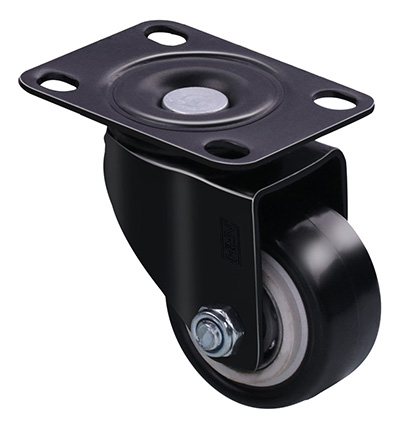
Three mounting styles dominate industrial applications. Top-plate casters use a rectangular steel plate with four bolt holes. They distribute load across the widest area and handle the highest weights – up to 5,000 kg per caster in heavy-duty configurations. Stem casters insert a threaded or grip-ring stem into a socket. They are faster to install but carry less weight, typically under 300 kg per caster. Expanding-stem casters fit inside hollow tubing and expand against the inner wall when tightened, providing a secure mount without welding or drilling.
Caster Wheel Materials: Performance Comparison
Wheel material determines four performance variables: load capacity, floor protection, rolling resistance, and chemical resistance. Below is a direct comparison of the four primary industrial wheel materials.
Rubber Caster Wheels
Rubber wheels operate at 40-70 Shore A hardness. That softness absorbs vibration, silences rolling noise to under 50 dB on smooth concrete, and protects floor coatings. Rubber leaves no marks on tile, epoxy, or hardwood surfaces. Solid rubber caster wheels support 100-300 kg per wheel in typical industrial sizes.
The trade-off is load capacity and heat resistance. Rubber deforms under sustained heavy loads, developing flat spots that make rolling uneven. Natural rubber degrades in UV light, ozone, and petroleum-based oils. Synthetic rubber (SBR, neoprene) improves chemical resistance but reduces elasticity. Use rubber wheels on medical carts, office trolleys, and light-duty warehouse equipment where floor protection and quiet operation outweigh raw load capacity.
Polyurethane (PU) Caster Wheels
Polyurethane occupies the middle ground at 85-95 Shore A. PU wheels carry 300-1,200 kg per wheel depending on diameter and core construction. They protect floors nearly as well as rubber while handling 2-4 times the load. Taber abrasion tests show PU losing 20-50 mg versus 200+ mg for rubber under identical conditions, translating to 3-5 times longer tread life on abrasive concrete.
PU resists oils, solvents, and moderate chemicals. It performs in factory environments where rubber fails and nylon marks floors. The limitation is temperature: PU begins losing mechanical properties above 80 degrees C continuous. In high-heat applications, nylon or phenolic wheels outperform PU. Use PU wheels on warehouse logistics carts, production line trolleys, electronics handling equipment, and hospital supply carts.
Nylon Caster Wheels
Glass-filled nylon wheels are the highest-load polymer option. At 100-125 mm diameter, they carry 500-2,500 kg per wheel per manufacturer catalog data. The 33% glass fiber content retains impact strength down to -54 degrees C, making nylon the default choice for freezer and cold-chain applications.
Nylon rolls with very low resistance, reducing push force on heavy loads. It resists most industrial chemicals, does not absorb moisture, and never swells in humid environments. The downsides are noise and floor damage. Nylon marks and scratches finished floors. Rolling noise on concrete exceeds 65 dB. Nylon offers no shock absorption, so fragile loads may suffer damage on rough surfaces. Use nylon on heavy industrial carts, freezer racks, and applications where load capacity and low rolling resistance are the top priorities.
Steel and Cast Iron Caster Wheels
Steel and cast iron wheels carry the highest loads – 1,000-5,000+ kg per wheel. They withstand extreme temperatures, resist chemical exposure, and never deform under static load. They are essentially indestructible in normal industrial use.
The penalty is severe: steel wheels damage every floor type except steel plate and concrete. They are loud, transmitting vibration directly through the fork and into the cart frame. They require lubrication at the axle to prevent seizure. Use steel wheels on heavy-duty platform trucks in steel mills, foundries, and scrapyards where floor condition is irrelevant and load capacity is everything.
| Material | Hardness | Load per Wheel | Floor Protection | Noise Level | Best Application |
|---|---|---|---|---|---|
| Rubber | 40-70 Shore A | 100-300 kg | Excellent | Low (<50 dB) | Medical, office, light warehouse |
| Polyurethane | 85-95 Shore A | 300-1,200 kg | Good | Medium (50-60 dB) | Warehouse, factory, hospital |
| Nylon (glass-filled) | Rockwell R110+ | 500-2,500 kg | Poor | High (>65 dB) | Freezer, heavy industrial |
| Steel / Cast Iron | Rockwell C50+ | 1,000-5,000+ kg | None | Very high | Foundry, steel mill, extreme load |
Load Rating: How to Calculate What You Need
Caster load rating is not the weight of the caster. It is the maximum load each wheel can support without permanent deformation or failure. Calculating the correct rating requires a simple formula with a safety margin.
Required Load per Caster = (Equipment Weight + Maximum Payload) / Number of Casters x Safety Factor
The safety factor accounts for uneven weight distribution, shock loads, and floor imperfections. Industrial standards use a 1.3-1.5x safety factor. For example: a cart weighing 80 kg carrying 800 kg of product on 4 casters requires (80 + 800) / 4 x 1.33 = 293 kg per caster. Choose casters rated at 300 kg or higher.
Three common mistakes invalidate this calculation. First, assuming equal load distribution when the payload sits off-center. A 600 kg load positioned over two casters instead of four doubles the load on those two wheels. Second, ignoring dynamic forces. Hitting a door threshold at speed can generate a momentary load spike 2-3 times the static weight. Third, using nameplate ratings without verifying test conditions. Some manufacturers rate casters at slow walking speed on smooth floors; others test at standstill. Always confirm the test standard behind the rating per manufacturer catalog data.
Frequently Asked Questions (FAQ)
What is the difference between a swivel caster and a rigid caster?
A swivel caster has a raceway with ball bearings that lets the fork rotate 360 degrees around the mounting point. This rotation allows the cart to change direction without lifting. A rigid caster has no raceway – the fork bolts directly to the mounting plate, and the wheel tracks in one direction only. Most industrial carts use two swivel casters at one end and two rigid casters at the other. The swivels provide steering. The rigids keep the cart tracking straight. Four swivel casters make a cart highly maneuverable but difficult to control in a straight line.
How do I choose the right caster wheel diameter?
Larger diameter wheels roll over obstacles more easily and generate less rolling resistance. A 125 mm wheel rolls over a 10 mm threshold with less effort than a 75 mm wheel. General guidelines: 75-100 mm for loads under 200 kg on smooth floors, 100-125 mm for loads up to 500 kg, 125-200 mm for loads over 500 kg or rough floors, and 200-300 mm for extreme loads above 2,000 kg. Always match diameter to the floor condition. A small wheel on a rough floor requires excessive push force regardless of load rating.
What type of brake do caster wheels use?
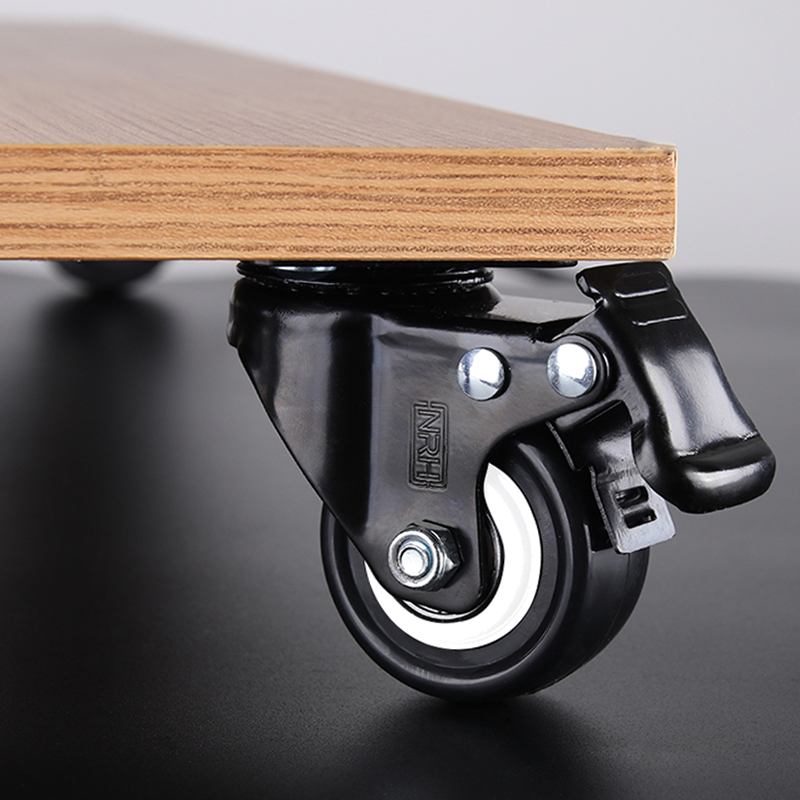
Three brake types are common on industrial casters. A side brake (also called a tread brake) has a lever that presses a pad directly against the wheel tread, stopping rotation. A total lock brake locks both the wheel rotation and the swivel raceway simultaneously, preventing the cart from moving and turning. A directional lock locks the swivel raceway only, converting a swivel caster into a rigid caster for straight-line travel. Total lock brakes provide the most secure hold. Side brakes are simpler and cheaper but allow the fork to swivel even when the wheel is locked.
Can I mix different wheel materials on the same cart?
Mixing materials is not recommended. Different wheel diameters and hardnesses create uneven rolling heights and resistance. A rubber wheel at 70 Shore A compresses under load and sits lower than a nylon wheel at Rockwell R110 carrying the same weight. The result is unequal load distribution: the harder wheels carry more than their rated share while the softer wheels underperform. If you must mix materials due to budget constraints, ensure all wheels share the same diameter, and place the harder wheels on the heavier end of the cart.
How does temperature affect caster wheel performance?
Temperature changes the mechanical properties of wheel materials. Rubber hardens below -20 degrees C and loses elasticity, cracking under impact. Polyurethane softens above 80 degrees C and begins to flat-spot under static load. Nylon performs from -54 degrees C to +120 degrees C without significant property change. Steel operates across the widest range but offers no shock absorption at any temperature. For freezer applications, specify glass-filled nylon. For bakery or autoclave carts, specify phenolic resin or high-temperature nylon. For general indoor use between 0 degrees C and 50 degrees C, polyurethane is the standard choice.
What is the difference between a top plate and a stem mount?
A top-plate caster has a flat steel plate with four bolt holes that screws directly to the bottom of the cart or equipment frame. Top plates distribute load over the widest area and handle the heaviest weights. A stem caster has a cylindrical shaft that inserts into a socket or hole. Stem mounts are faster to install and common on furniture and light equipment, but they carry less load because the stem concentrates force on a small contact area. For loads above 300 kg per caster, always use top-plate mounting.
How often should caster wheels be replaced?
Replacement depends on usage intensity, floor condition, and load level. On smooth concrete at rated load, polyurethane wheels typically last 2-5 years. Nylon wheels last 3-7 years. Rubber wheels wear fastest at 1-3 years due to abrasion and flat-spotting. Inspect casters every 6 months for tread wear, bearing play, and fork distortion. Replace a wheel when the tread has worn more than 20% of its original thickness, when flat spots cause visible bouncing, or when the swivel raceway develops excessive play. Running casters past their service life increases push force, damages floors, and risks sudden failure.
Need help choosing? Contact NRH Box Hardware for caster-compatible case hardware recommendations. The full product catalog is available at nrh.hk.