

Nickel Plating for Case Hardware: Durable, Chromium-Free Surface Finish
Nickel plating is one of the most widely specified surface finishes for industrial case hardware, and for good reason. It delivers a hard, corrosion-resistant, chromium-free barrier that protects the underlying steel while maintaining a clean, professional appearance. For engineers and procurement professionals specifying case hardware, understanding what nickel plating offers – and where it excels – is essential to making the right finish decision.
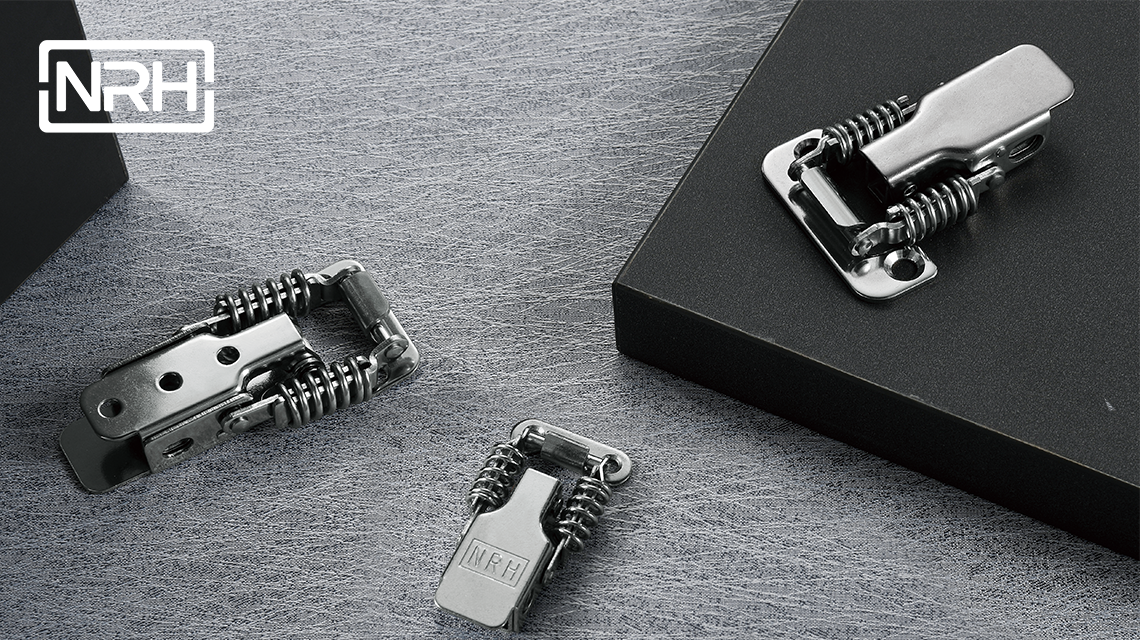
In NRH’s finish coding system, FE-NI indicates iron (FE) base metal electroplated with nickel (NI). This finish is available across multiple hardware categories, including latches, handles, and hinges. NRH products with nickel plating include the 5101 series draw latches, the 4302 series recessed handles, and other hardware lines where durability and appearance are equally important.
What Is FE-NI Nickel Plating?
FE-NI is a finish code where FE denotes the iron or steel substrate and NI denotes the electroplated nickel layer. The nickel coating is applied through an electroplating process: the hardware component is immersed in a nickel electrolyte bath, and an electric current deposits a uniform layer of nickel onto the surface. The thickness typically ranges from 8 to 20 microns for single-layer systems.
Nickel plating can be produced in different finishes: bright nickel yields a mirror-like reflective surface, while satin or matte nickel produces a softer, brushed appearance. Both variants offer the same corrosion protection; the choice is primarily aesthetic. For case hardware applications, bright nickel is more common on visible components such as handles and decorative latches, while satin nickel may be preferred on industrial equipment where glare reduction is beneficial.
How Nickel Plating Protects Case Hardware
Nickel plating protects the underlying steel through barrier protection. Unlike zinc, which acts as a sacrificial anode and corrodes to protect the steel, nickel forms a dense, low-porosity physical layer that blocks moisture, oxygen, and contaminants from reaching the iron substrate. The protection is effective as long as the nickel layer remains intact.
This barrier mechanism has a critical implication: nickel does not “self-heal” at scratches the way zinc does. If the nickel layer is damaged, the exposed steel has no galvanic protection. However, this limitation is offset by nickel’s superior hardness and wear resistance, which make it less likely to be damaged in the first place. For hardware that sees frequent handling, cycling, or mechanical contact, nickel’s durability makes it a reliable choice over softer sacrificial coatings.
For applications requiring extended corrosion resistance, a duplex copper-nickel system can be specified. A copper undercoat is applied before the nickel layer. The copper fills surface irregularities and closes microscopic pores in the substrate, while the nickel layer seals over the copper. This duplex system significantly extends corrosion resistance and is commonly specified for demanding indoor or sheltered outdoor applications.
Key Properties of Nickel-Plated Hardware
Hardness and Wear Resistance
Nickel plating provides a hard, wear-resistant surface that significantly outperforms softer finishes like zinc in high-cycle applications. The hardness can be further enhanced through specific plating formulations and post-treatments.
On case hardware, this hardness advantage translates directly to longer wear life. A nickel-plated latch or handle withstands repeated gripping, pulling, and tool contact without visible wear tracks. In high-cycle applications such as transit cases, flight cases, and equipment enclosures that are opened and closed frequently, nickel’s hardness significantly extends service life.
Corrosion Resistance
Nickel plating provides reliable corrosion protection for indoor and sheltered outdoor applications. In standard neutral salt spray testing (ASTM B117, ISO 9227, GB/T 10125), single-layer nickel plating typically withstands 24 to 48 hours before the onset of corrosion. The actual performance depends on plating thickness, bath chemistry, and post-treatment processes. Thicker deposits and the use of a copper underlayer can significantly extend this duration.
For context, 24 to 48 hours of salt spray resistance translates to years of service in typical indoor environments. The test results serve as a relative comparison tool rather than an absolute predictor of service life.
NRH tests all plated hardware to ASTM B117 standards. Test results are available on request for customer qualification processes.
Appearance and Consistency
Nickel plating produces a bright, silver-white metallic finish that is uniform and consistent between production batches. The finish maintains its appearance over time because nickel resists tarnishing in most atmospheric conditions. This makes nickel-plated hardware particularly suitable for consumer-facing applications where appearance matters, such as premium tool boxes, musical instrument cases, and retail display cases.
Environmental Compliance: Chromium-Free Advantage
One of the key advantages of nickel plating is its chromium-free composition. The nickel electrodeposited layer contains no chromium. This simplifies environmental compliance documentation and makes nickel plating inherently compliant with RoHS and REACH regulations.
By contrast, yellow zinc chromate conversion coatings have historically used hexavalent chromium (Cr6+), a substance restricted under EU RoHS and REACH regulations. While modern yellow zinc processes use trivalent chromium (Cr3+) instead, nickel plating avoids chromium entirely. For customers with strict substance-avoidance policies, or for applications where environmental documentation is a procurement requirement, nickel plating offers a straightforward compliance path.
Nickel itself is classified as a skin sensitizer under REACH (Annex XVII, entry 27). For hardware that contacts skin for prolonged periods, a nickel-release test may be required for EU compliance. For case hardware such as latches and handles that users touch briefly during normal operation, this is rarely a compliance issue. NRH products meet applicable regulatory requirements for their intended applications.
Best Applications for Nickel-Plated Hardware
Nickel-plated hardware is the right choice when any of the following conditions apply:
- Frequent handling or cycling: Hardware that is opened, closed, or gripped repeatedly benefits from nickel’s superior hardness and wear resistance. This includes latches on transit cases, handles on flight cases, and hinges on frequently accessed enclosures.
- Premium or consumer-facing products: The clean silver appearance of nickel plating conveys quality and professionalism. It is the preferred finish for musical instrument cases, medical equipment cases, and retail display cases.
- Chromium-free compliance requirements: For customers who require documentation that their hardware contains no chromium, nickel plating provides a straightforward compliance path without the need for special exemptions or substitutions.
- Moderate corrosion environments: For indoor environments with occasional humidity, or sheltered outdoor applications, nickel plating provides reliable corrosion protection. For more demanding conditions, the duplex copper-nickel system is recommended.
- Consistent appearance across batches: Nickel plating processes are tightly controlled, resulting in uniform color and finish from one production run to the next. This consistency is important for products where hardware is visible and appearance standards are high.
FE-NI in the NRH Product Line
NRH offers FE-NI nickel plating across multiple hardware categories:
- Latches: The 5101 series draw latches are available with nickel plating, offering the corrosion resistance and hardness advantages of FE-NI in a heavy-duty latching solution.
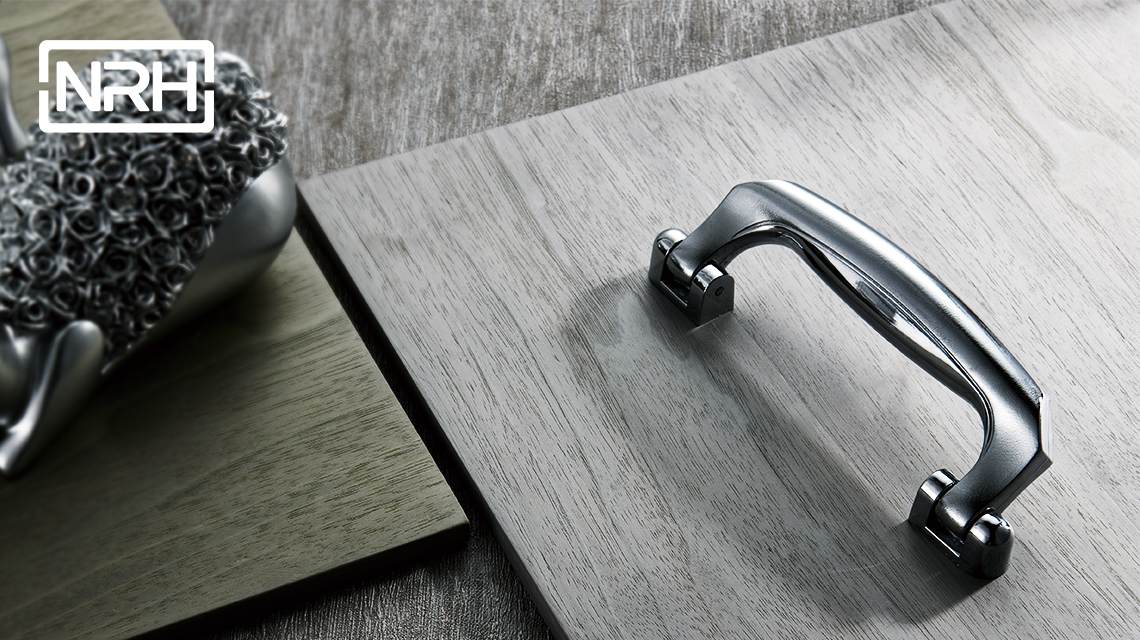
- Handles: The 4302 series recessed handles and other handle lines are offered in nickel-plated variants, combining durability with a professional silver appearance.
- Hinges and other hardware: Nickel plating is available across NRH’s product range where the application demands its combination of hardness, corrosion resistance, and chromium-free compliance.
NRH products with FE-NI finish are manufactured to consistent quality standards, with plating thickness and salt spray performance verified through regular testing.
Decision Summary
| Property | FE-NI (Nickel Plating) |
|---|---|
| Protection mechanism | Barrier (dense, non-sacrificial) |
| Salt spray (ASTM B117) | 24“48 hours |
| Surface hardness | Significantly harder than zinc |
| Appearance | Bright silver / satin |
| Chromium in finish | No (chromium-free) |
| RoHS / REACH compliant | Yes |
| Best for | High-wear, visible, chromium-free applications |
Nickel plating is the finish of choice when hardware durability, appearance, and environmental compliance are all priorities. Its hardness makes it suitable for high-cycle applications. Its chromium-free composition simplifies regulatory compliance. Its consistent silver finish meets the aesthetic requirements of premium and consumer-facing products.
Frequently Asked Questions
What does FE-NI mean on case hardware?
FE-NI is a finish code indicating iron (FE) base metal electroplated with nickel (NI). The nickel layer provides barrier protection against corrosion and wear, and the finish is chromium-free.
How hard is nickel plating compared to other finishes?
Nickel plating provides a hard, wear-resistant surface that significantly outperforms softer finishes like zinc. This hardness translates to superior wear resistance in high-cycle applications.
How long does nickel plating last in salt spray testing?
Single-layer nickel plating typically withstands 24 to 48 hours of neutral salt spray testing per ASTM B117. The actual performance depends on plating thickness, bath chemistry, and post-treatment processes. Thicker deposits and the use of a copper underlayer can significantly extend this duration.
Is nickel plating RoHS and REACH compliant?
Yes. Nickel plating contains no chromium and is inherently RoHS and REACH compliant. This makes it a preferred finish for customers with strict substance-avoidance policies.
Does nickel plating contain chromium?
No. The nickel electrodeposited layer contains no chromium. The finished FE-NI surface is chromium-free, simplifying environmental compliance documentation.
What does nickel-plated hardware look like?
Nickel plating produces a bright, silver-white metallic finish. Bright nickel processes yield a mirror-like reflectivity, while satin or matte nickel processes produce a softer, brushed appearance.
Can nickel plating be used outdoors?
Nickel plating provides reliable corrosion protection in indoor and moderate outdoor environments. For prolonged outdoor exposure or more demanding conditions, a duplex copper-nickel system is recommended. For the most demanding outdoor conditions, SUS304 stainless steel may be the better choice.
Is nickel plating available on NRH hardware?
Yes. NRH offers FE-NI nickel plating across multiple product categories, including the 5101 series draw latches, 4302 series recessed handles, and other hardware lines.
Need help choosing the right finish? Contact the NRH team at nrh-gz@nrh.cn or call +86 180 1797 5137. You can also visit the headquarters at Room 1703-1704, Zhongji Building, No. 819 Yinxiang Road, Nanxiang Town, Jiading District, Shanghai, China.