

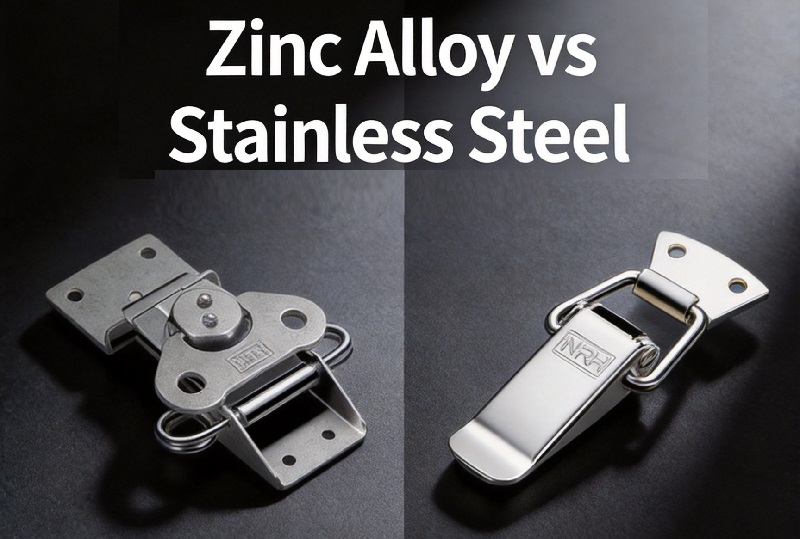
Quick Answer: Zinc alloy and stainless steel serve different purposes in case hardware. Zinc alloy is used for high-end lockable hardware (compression latches, cam locks, decorative hasps) where complex shapes, fine surface finish, and aesthetic quality matter. Stainless steel is used for structural hardware (toggle latches, draw latches, handles, hinges) where strength, impact resistance, and corrosion resistance are critical. Zinc alloy costs more in raw material but enables complex geometries via precision casting. Stainless steel costs more in fabrication but delivers superior mechanical performance. The right choice depends on function, not price.
Introduction: Two Materials, Two Purposes
Every case hardware specification involves a material decision. But the choice between zinc alloy and stainless steel is not about which is “better.” It is about which is right for the function.
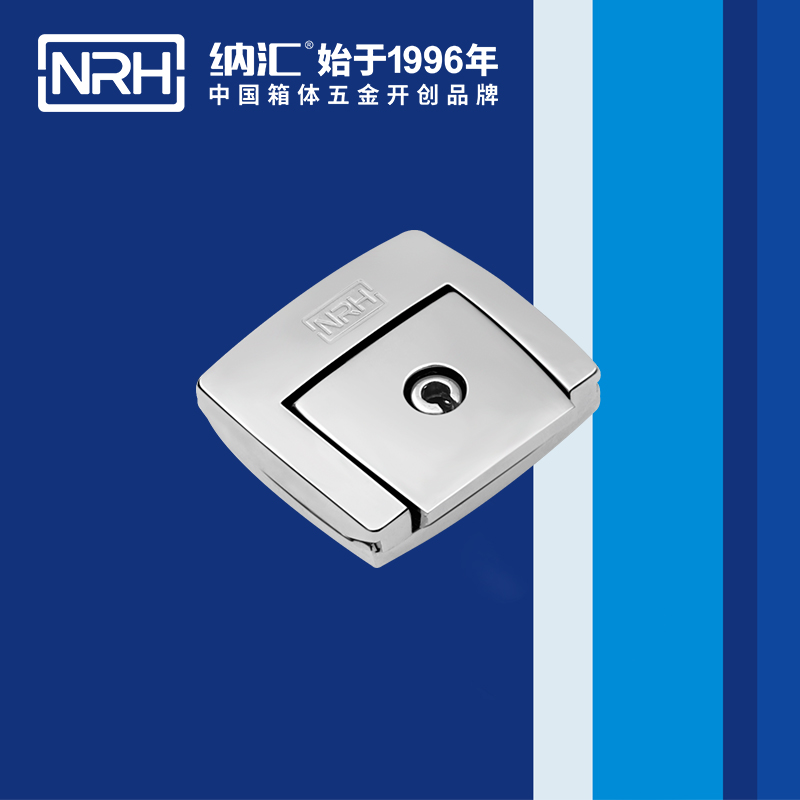
Zinc alloy is the material of choice for lockable hardware, compression latches, cam locks, and decorative hasps. Its excellent castability allows complex internal mechanisms, precision keyways, and premium surface finishes. Products like the NRH 9918B-30 (zinc alloy, bright silver) and 6503-45K (zinc alloy, chrome-plated, 80g, 294N tensile load) exemplify this category.
Stainless steel is the material of choice for structural hardware, toggle latches, draw latches, handles, and hinges. Its high strength, impact resistance, and corrosion resistance make it ideal for load-bearing and outdoor applications. Products like the 5101-96-S04-ZG (SUS304, 392N tensile, 90g) and 5808-128S-S04-ZG (SUS304, 588N tensile, 124g safety latch) represent this category.
This guide compares zinc alloy and stainless steel hardware across tensile strength, corrosion resistance, weight, cost, manufacturing process, and application fit. All data is sourced from manufacturer catalog data and industry standards.
Key Finding: Zinc alloy and stainless steel are not substitutes, they serve different hardware categories. Zinc alloy enables complex lock mechanisms and premium finishes for high-end case hardware (9918B-30, 6503-45K). Stainless steel delivers the strength, impact resistance, and corrosion resistance required for structural hardware (toggle latches, draw latches, handles). The material decision should be driven by function and design requirements, not cost alone.
Part 1: What Zinc Alloy and Stainless Steel Actually Are
Zinc alloy (typically Zamak, Zn-Al4-Cu1) is a cast metal used for hardware requiring complex geometries and premium finishes. It is produced through precision die casting, which allows intricate shapes, internal cavities, keyways, and decorative details to be formed in a single production step.
Key characteristics of zinc alloy:
- Excellent castability: Fills complex mold cavities with high precision
- Fine surface finish: Accepts chrome, nickel, bright silver, and other decorative platings
- Good dimensional stability: Maintains tolerances critical for lock mechanisms
- Moderate strength: Tensile strength 280-330 MPa, sufficient for lock hardware
- Lower ductility: Elongation 3-10%, less impact-resistant than wrought metals
Stainless steel (SUS304, SUS316) is a wrought metal with a self-healing chromium oxide passive layer. It is used for structural hardware requiring strength, impact resistance, and corrosion resistance.
Key characteristics of stainless steel:
- High strength: Tensile strength 520-620 MPa (SUS304), roughly 1.8x zinc alloy
- High ductility: Elongation 40-50%, absorbs impact without fracture
- Self-healing corrosion resistance: Chromium oxide layer repairs itself if scratched
- No plating required: The material itself resists corrosion
- Limited castability: Typically forged, machined, or fabricated
The fundamental difference: zinc alloy is cast for complexity and finish, stainless steel is wrought for strength and durability.
Part 2: Head-to-Head, Tensile Strength and Mechanical Properties
| Property | Zinc Alloy (Zamak) | SUS304 Stainless |
|---|---|---|
| Tensile strength | 280-330 MPa | 520-620 MPa |
| Elongation at break | 3-10% | 40-50% |
| Density | 6.6-7.1 g/cm³ | 7.9 g/cm³ |
| Castability | Excellent | Limited |
| Surface finish options | Chrome, nickel, bright silver, paint | Vibratory ground, polished |
| Corrosion resistance (ASTM B117) | Dependent on plating (24-96h) | 72-96h (SUS304) |
| Impact resistance | Moderate (can crack) | High (bends, does not crack) |
| Typical hardware | Compression latches, cam locks, lockable hasps | Toggle latches, draw latches, handles, hinges |
All mechanical property values sourced from industry standards and manufacturer catalog data. Zinc alloy elongation varies by specific alloy composition (typically 3-10% for Zamak grades). Contact NRH for product-specific specifications.
Part 3: Zinc Alloy Hardware, For Complex Locking Mechanisms
Zinc alloy is the material of choice for hardware that requires complex internal mechanisms and premium appearance. The precision die casting process can produce intricate shapes that would be impossible or prohibitively expensive to machine from stainless steel.
NRH Zinc Alloy Products
NRH manufactures zinc alloy hardware for high-end case and enclosure applications:
| Model | Type | Material | Finish | Tensile Load | Weight |
|---|---|---|---|---|---|
| 9918B-30 | Compression latch | Zinc alloy | Bright silver | N/A | N/A |
| 6503-45K | Lockable hasp | Zinc alloy | Chrome-plated | 294N | 80g |
All values sourced from manufacturer specification sheets. N/A (Not Applicable) indicates the data point was not available in the published specification. Contact NRH for official engineering drawings.
The 6503-45K exemplifies zinc alloy’s capabilities: a lockable hasp with integrated key mechanism, chrome-plated finish for premium appearance, and 294N tensile load. The zinc alloy casting enables the complex internal lock cylinder and keyway, which would be extremely difficult to produce in stainless steel.
Key applications for zinc alloy hardware:
- Compression latches for industrial enclosures (9918B-30)
- Lockable hasps and draw latches requiring keyed access
- Cam locks and cylinder locks for cases and cabinets
- Decorative hardware where appearance is paramount
- High-end equipment cases requiring integrated security
Part 4: Stainless Steel Hardware, For Structural Performance
Stainless steel hardware is designed for load-bearing, impact-resistant, and corrosion-resistant applications. The material’s strength and durability make it the standard for structural case hardware.
NRH Stainless Steel Products
NRH manufactures a comprehensive range of stainless steel hardware:
| Model | Type | Material | Finish | Tensile Load | Weight |
|---|---|---|---|---|---|
| 5104-56 | Toggle latch | SUS304 | ZG | 750N | 21g |
| 5103-70 | Toggle latch | SUS304 | ZG | 1500N | 36g |
| 5102-88 | Toggle latch | SUS304 | ZG | 1000N | 61g |
| 5101-96 | Toggle latch | SUS304 | ZG | 392N | 90g |
| 5505-75 | Dual spring latch | SUS304 | ZG | 294N | 75g |
| 5808-128S | Safety latch | SUS304 | ZG | 588N | 124g |
All tensile load and weight values sourced from manufacturer specification sheets. Note: Tensile load indicates destructive test limits. Select with appropriate safety margin for your application. Contact NRH for official engineering drawings.
The 5103-70 toggle latch demonstrates stainless steel’s capability: 1500N tensile load at only 36g, with vibratory ground finish for corrosion resistance. The high strength-to-weight ratio is unmatched by zinc alloy.
Key applications for stainless steel hardware:
- Toggle latches for flight cases and industrial enclosures
- Draw latches for wooden freight cases and transit containers
- Handles for heavy equipment and outdoor enclosures
- Hinges for continuous operation and load-bearing
- Safety latches for critical applications (5808-128S)
Part 5: Corrosion Resistance Comparison
Salt spray testing (ASTM B117) is the standard accelerated corrosion test for hardware finishes.
| Material / Finish | Salt Spray (ASTM B117) | Best Environment |
|---|---|---|
| FE-ZL (zinc-plated iron) | 24-48h | Indoor dry |
| FE-CR (chrome-plated iron) | 24-48h | Indoor dry / light outdoor |
| Zinc alloy + chrome/nickel plate | 24-96h | Indoor / high-end applications |
| SUS304-ZG (stainless, vibratory) | 72-96h | Outdoor / coastal |
| SUS316-ZG (marine stainless) | 96h+ | Marine / direct saltwater |
All salt spray data sourced from manufacturer catalog data and industry standards. Zinc alloy corrosion resistance is plating-dependent; plating thickness and quality significantly impact results. ASTM B117 is an accelerated test and does not directly translate to field service life.
Part 6: The Cost Reality
The cost relationship between zinc alloy and stainless steel is often misunderstood. Here are the facts:
Raw material cost: Zinc alloy raw material (Zamak) currently costs approximately 25,000-25,800 RMB/ton, significantly higher than SUS304 at 14,000-15,000 RMB/ton. Zinc alloy raw material is roughly 1.7x the cost of 304 stainless steel.
Manufacturing cost: Zinc alloy uses precision die casting, which is highly efficient for complex shapes. However, zinc alloy hardware requires multiple finishing operations: casting, trimming, deburring, polishing, and electroplating. The total manufacturing cost is not simply “lower” than stainless fabrication; it depends on part complexity and production volume.
Final product cost: Zinc alloy lock hardware (9918B-30, 6503-45K) is typically positioned in the premium price tier due to its complex mechanisms, tight tolerances, and decorative finishes. Stainless steel structural hardware (toggle latches, handles) offers different value: strength, durability, and corrosion resistance in demanding environments.
Key takeaway: Zinc alloy is not a “cheaper alternative” to stainless. It is a material chosen for different reasons: complex shapes, integrated locking mechanisms, and premium finishes. Stainless steel is chosen for structural integrity, impact resistance, and long-term durability.
Part 7: Material Selection Decision Matrix
With zinc alloy raw material costing more than stainless steel, the natural question is: why choose zinc alloy? The answer is manufacturing capability. Stainless steel cannot be precision die-cast into complex shapes with internal cavities, keyways, and moving parts. Zinc alloy can.
This is the defining advantage of zinc alloy hardware: it enables integrated lock mechanisms, key cylinders, compression latches, and lockable hasps, in a single, seamless casting. To produce the same function in stainless steel, you would need to machine multiple separate components and assemble them, driving up cost and complexity while reducing reliability.
In other words: choose zinc alloy when you need integrated locking functionality. Choose stainless steel when you need structural strength and corrosion resistance. The two materials are not substitutes, they serve different design requirements.
| Application Requirement | Recommended Material | Example NRH Model | Primary Advantage |
|---|---|---|---|
| Lockable compression latch with key cylinder | Zinc alloy | 9918B-30 | One-piece casting with internal lock mechanism |
| Premium lockable hasp with decorative finish | Zinc alloy | 6503-45K | Integrated keyway + chrome plate |
| Light toggle latch for instrument cases | SUS304 | 5104-56 | 21g, 750N, corrosion-resistant |
| Heavy-duty toggle for transit cases | SUS304 | 5103-70 | 1500N load, 36g |
| Safety-critical enclosure (medical, defense) | SUS304 | 5808-128S | Secondary safety lock, 588N |
| High-cycle dual spring application | SUS304 | 5505-75 | Dual springs, 75g |
| Outdoor exposed hardware (coastal) | SUS304 or SUS316 | 5101-96 | 72-96h salt spray |
| Indoor dry, cost-sensitive application | Iron + zinc plate (FE-ZL) | 6306-85 | Lowest cost |
Part 8: Real-World Application Scenarios
Scenario 1: High-end equipment case with security requirements. A medical device manufacturer needs cases with integrated locks for hospital environments. The case hardware must look premium, operate smoothly, and provide reliable keyed access. Solution: NRH 6503-45K (zinc alloy, chrome-plated, 80g, 294N). Zinc alloy enables the complex lock mechanism and premium finish required for this application.
Scenario 2: Heavy-duty flight case for touring equipment. An AV rental company needs latches that withstand thousands of open-close cycles, survive truck transport, and resist corrosion. Solution: NRH 5103-70 (SUS304, 1500N, 36g). Stainless steel delivers the strength, impact resistance, and corrosion resistance required for demanding transit applications.
Scenario 3: Safety-critical enclosure for defense application. A defense contractor requires latches that cannot open accidentally under vibration and shock. Solution: NRH 5808-128S (SUS304, 588N, secondary safety lock). Stainless steel provides the structural integrity and reliability demanded by safety-critical applications.
Frequently Asked Questions (FAQ)
Is zinc alloy hardware cheaper than stainless steel?
Why is zinc alloy used if it costs more than stainless steel?
Why is zinc alloy used for lock hardware?
Is stainless steel stronger than zinc alloy?
Which material is more corrosion-resistant?
Can zinc alloy hardware be used outdoors?
What are the weight differences between zinc alloy and stainless steel?
Why is zinc alloy raw material more expensive than stainless steel?
How do I choose between zinc alloy and stainless steel?
What does the “K” suffix mean in NRH zinc alloy models?
Are there food-grade zinc alloy products?
Key Takeaways
- Zinc alloy and stainless steel serve different functions. Zinc alloy is for lockable, high-end hardware with complex mechanisms. Stainless steel is for structural hardware requiring strength and durability.
- Zinc alloy raw material costs more than stainless steel. Zinc alloy (Zamak) is approximately 25,000-25,800 RMB/ton vs. SUS304 at 14,000-15,000 RMB/ton.
- Zinc alloy enables complex castings. Precision die casting produces intricate lock mechanisms, keyways, and decorative details in a single operation.
- Stainless steel is 1.8x stronger. SUS304 tensile strength (520-620 MPa) vs. zinc alloy (280-330 MPa). Higher strength means no permanent deformation under high loads.
- Stainless has superior impact resistance. 40-50% elongation vs. 3-10% for zinc alloy. Stainless bends under impact; zinc alloy cracks.
- Zinc alloy requires plating for corrosion resistance. Chrome or nickel plating provides 24-96h salt spray. SUS304 has 72-96h self-healing corrosion resistance.
- Choose zinc alloy for integrated locking mechanisms. This is the one thing stainless steel cannot do. If you need a key cylinder or compression latch with internal moving parts, zinc alloy is the right choice.
- Choose stainless steel for structural integrity, impact resistance, and outdoor durability. If you need strength and long-term corrosion resistance, stainless steel is the right choice.
- NRH zinc alloy products include 9918B-30 and 6503-45K. These are premium lockable hardware for high-end enclosures and cases.
- NRH stainless steel products include 5101-96, 5103-70, 5808-128S, and 5505-75. These are structural hardware for demanding applications.
- When in doubt, match material to function. Zinc alloy = complex locks and decorative hardware. Stainless steel = load-bearing and outdoor hardware.
About NRH
NRH is a brand of Shanghai Nahui Hardware Products Co., Ltd., established in 1996 and headquartered in Shanghai, China. The company specializes in R&D and production of high-quality case hardware, including zinc alloy lock hardware (compression latches, lockable hasps) and stainless steel structural hardware (toggle latches, draw latches, handles, hinges, and corner protectors), serving industries worldwide.
NRH holds ISO 9001:2015 and GJB (National Military Standard) certifications, and is recognized as a National High-Tech Enterprise. With vertically integrated manufacturing and a five-point national development strategy, NRH delivers reliable, production-ready hardware solutions to global clients.
For official engineering drawings, customization enquiries, or bulk orders, please contact the NRH sales team directly.
Disclaimer: All product specifications, including tensile load, working load, weight, dimensions, and salt spray ratings, are sourced from manufacturer catalog data and are provided for reference only. They are not intended as tooling or mold-making data. For official engineering drawings and certified specifications, please contact NRH directly. Actual performance may vary depending on application, installation, and environmental conditions.