

Quick Answer: Selecting the right latch for your case comes down to five questions: load, environment, security, mounting surface, and lifecycle cost. A toggle latch with an over-center mechanism handles dynamic loads and vibration better than a butterfly latch. SUS304 with vibratory finish (ZG) is required for outdoor and coastal environments. SUS304-ZG rates 72-96 hours in ASTM B117 salt spray. Adjustable toggle latches like the 5603-103-FE-ZL are recommended for applications requiring draw-length flexibility. Start with load, end with budget–never spec by price alone.
Introduction: Why Latch Selection Matters More Than You Think
Every year, thousands of cases, enclosures, and containers fail in the field–not because the shell cracked or the gasket degraded, but because a $2 latch was specified for a $2,000 case. The hardware that holds your case closed is the single most failure-prone component in the entire assembly. Yet it receives the least engineering attention.
A latch failure in the field doesn’t just mean a popped-open lid. It means:
- Equipment damage from impacts during transit
- Contamination when gaskets lose compression
- Safety hazards from unsecured access panels
- Brand reputation damage when a case fails in front of an end user
This guide walks you through a five-question decision framework that eliminates guesswork from latch selection. Each question narrows your options until only one or two candidates remain. All product data in this guide is sourced directly from manufacturer specification sheets.
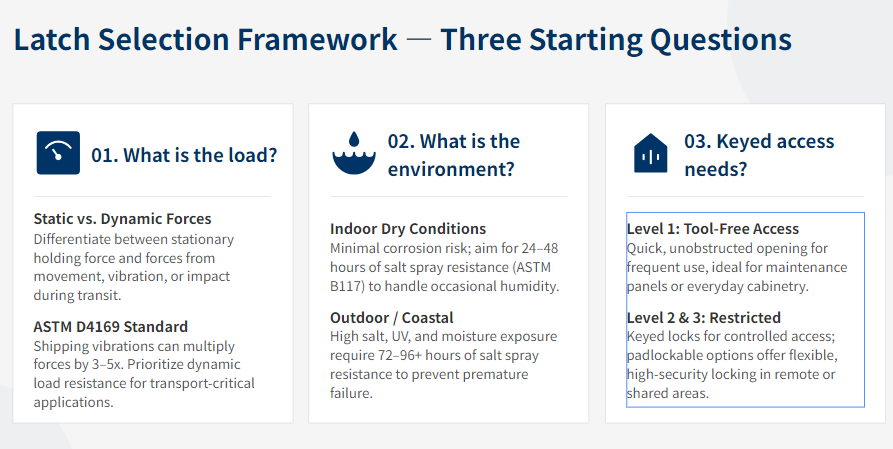
Key Finding: The most common latch specification error is mismatching finish to environment. FE-ZL (zinc-plated) rates 24-48 hours in ASTM B117 salt spray. SUS304-ZG (vibratory-finished stainless) rates 72-96 hours. On a coastal installation, that gap is the difference between hardware that survives and hardware that doesn’t. Most latch specification errors come down to one thing: nobody asked the right questions before picking the part number. This article walks through five questions–load, environment, security, mounting surface, and lifecycle cost–in that order. Each one eliminates options that won’t work. By the end, you can narrow any latch choice to one or two candidates without guesswork.
Part 1: Understanding the Over-Center Mechanism
Before diving into selection criteria, it’s essential to understand why toggle latches work the way they do. The over-center mechanism is the defining engineering feature that separates a true toggle latch from a simple draw latch.
A toggle latch consists of three main components: a base plate mounted to one surface, a lever handle that the operator actuates, and a hook or loop that engages a keeper on the opposing surface. When the handle is pressed down, the linkage moves through a pivot sequence until it passes the dead-center point–the position where all pivot axes align in a straight line. Once past that point, the mechanism enters a stable locked state where tension actually increases with any pulling force.
This geometric lock is fundamentally different from friction-based fasteners:
- Friction catches (spring clips, magnetic catches) rely on a holding force with a defined threshold. Vibration can exceed that threshold repeatedly, causing progressive creep toward open.
- Over-center latches have no friction threshold. The locked position is a stable equilibrium that vibration cannot incrementally shift.
This is why over-center toggle latches are standard on military cases, flight cases, and equipment enclosures subject to transport vibration.
Part 2: The Five-Question Decision Framework
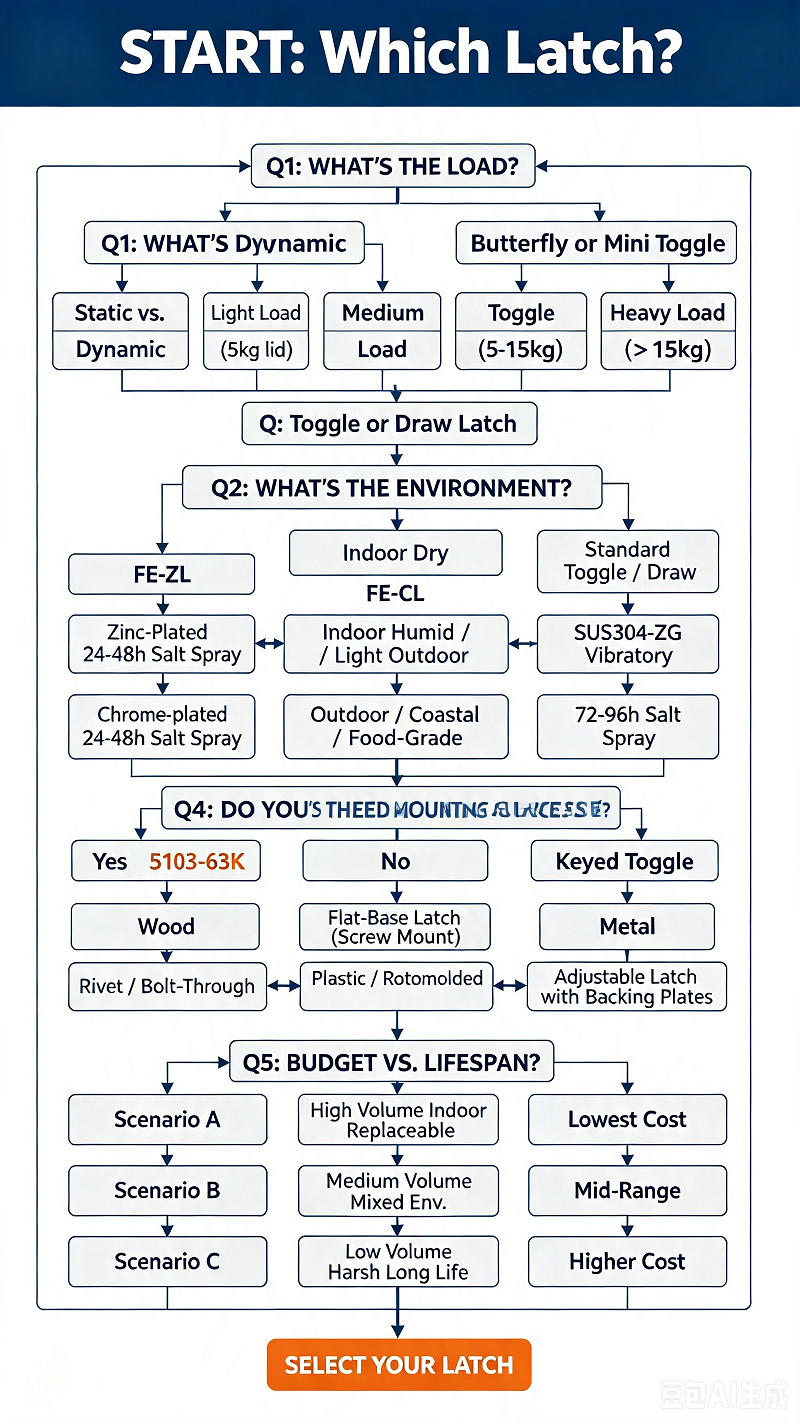
These five questions go in order for a reason. Each one eliminates options that would fail in your application, so you never waste time comparing latches that won’t work.
- What’s the load? — Static vs. dynamic, lid weight, vibration
- What’s the environment? — Indoor dry, outdoor, marine, food-grade
- Do you need keyed access? — Security level and access control
- What’s the mounting surface? — Wood, metal, plastic/rotomolded
- What’s the budget vs. lifespan tradeoff? — Initial cost vs. replacement cycle
Q1: What’s the Load?
Load is the first filter because it determines latch type and size. Get this wrong and the latch either won’t hold or you’ll overpay for capacity you don’t need.
Static Load vs. Dynamic Load
Static load is the lid weight at rest. A wooden case lid weighing 8 kg needs 8 kg of clamping force–but not 8 kg per latch if you’re using two. Divide the load across your latch count, then add a 1.5x safety margin. A general industry guideline is to select a latch with a rating approximately double the force it will encounter in use.
Dynamic load is the harder problem. Truck vibration adds cyclical stress. Mobile equipment adds shock spikes on every bump. According to ASTM D4169 (Standard Practice for Performance Testing of Shipping Containers), shipping environments can expose cases to dynamic loads significantly higher than static storage–commonly 3 to 5 times the static weight depending on the assurance level selected.
A toggle latch handles dynamic load better than a butterfly latch because the over-center locking mechanism cannot vibrate open. Draw latches handle dynamic load well too, but the hook-and-catch design has more flex under shock.
Load Range by Latch Type
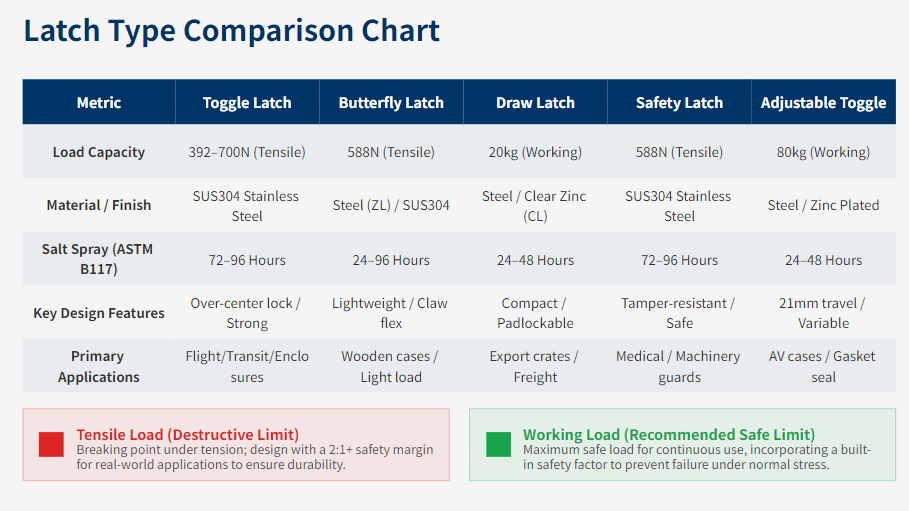
| Part Number | Latch Type | Material | Tensile / Working Load | Weight (g) | Best Environment |
|---|---|---|---|---|---|
| 5103-63K-S04-ZG | Compact toggle (keyed) | SUS304-ZG | 700N (tensile) | 36g | Outdoor / coastal |
| 5101-96-S04-ZG | Toggle latch | SUS304-ZG | 392N (tensile) | 90g | Outdoor / industrial |
| 5808-128S-S04-ZG | Safety latch | SUS304-ZG | 588N (tensile) | 124g | Safety-critical / heavy-duty |
| 6306-85-FE-ZL | Butterfly latch | Zinc-plated iron | 588N (tensile) | 203g | Indoor dry / wooden cases |
| 5403-83-FE-CL | Draw latch | Chrome-plated iron | 20kg (working load) | 75g | Indoor / wood freight |
| 5603-103-FE-ZL | Adjustable toggle | Zinc-plated iron | 80kg (working load) | 112g | Indoor / adjustable draw applications |
All tensile load, working load, and weight values sourced from manufacturer specification sheets. Note: Tensile load (e.g., 700N, 588N) indicates destructive test limits. Working load (e.g., 20kg, 80kg) indicates recommended maximum safe working load. Select with appropriate safety margin for your application. Contact NRH for official engineering drawings.
Q2: What’s the Environment?
Environment determines material and finish. This is where most specification errors occur. The finish code on the drawing–ZL, CL, ZG, LG–tells you exactly how many salt-spray hours the hardware can deliver. Match the code to the environment and the decision makes itself.
ASTM B117 is the standard neutral salt spray test used across the hardware industry. The hours-to-failure number it produces is not a direct predictor of service life–real-world conditions vary too much–but it is the only apples-to-apples comparison available. A 24-48h rating vs. a 72-96h rating is a meaningful gap regardless of climate.
Environment Tiers
- Tier 1 — Indoor dry. Climate-controlled warehouses, server rooms, office storage. Zinc-plated iron (FE-ZL) works. Salt spray rating: 24-48 hours per ASTM B117. Plenty for an environment that never sees moisture.
- Tier 2 — Indoor humid / light outdoor. Unheated warehouses, covered outdoor storage. Chrome-plated iron (FE-CL) gives you 24-48 hours per ASTM B117.
- Tier 3 — Outdoor / coastal. Truck beds, dockside storage, any location within 5 km of saltwater. SUS304 with vibratory finish (S04-ZG) is the minimum. Salt spray rating: 72-96 hours per ASTM B117.
- Tier 4 — Marine / food-grade / medical. Direct saltwater contact, washdown environments, hygienic requirements. SUS304 vibratory (S04-ZG) at minimum. Salt spray rating: 72-96 hours per ASTM B117. SUS316 for marine immersion.
The most common specification error in latch hardware: Tier 3 environment, Tier 1 finish. The unit cost savings look good on paper. The replacement cost after one corrosion failure erases it.
Finish Code Quick Reference
| Code | Finish | Substrate | Salt Spray (ASTM B117) | Best Environment |
|---|---|---|---|---|
| ZL | Zinc-plated (blue) | Iron (FE) | 24-48h | Indoor dry |
| CL | Chrome-plated / zinc-chromate | Iron (FE) | 24-48h | Indoor humid / light outdoor |
| ZG | Vibratory ground | SUS304 (S04) | 72-96h | Outdoor / coastal / food-grade |
| LG | Polished / mirror | SUS304 (S04) | 72-96h | Marine / decorative visible |
Salt spray values per industry standards. Actual service life varies with field conditions. Coating thickness and passivation quality significantly impact results. Contact NRH for specific product test data.
Q3: Do You Need Keyed Access?
Three security levels, three latch configurations.
- Level 1 — Tool access only. Standard butterfly and toggle latches. Anyone with a screwdriver can open the case. Fine for internal enclosures and equipment in controlled areas.
- Level 2 — Keyed lock. Integrated key cylinders. The 5103-63K-S04-ZG compact toggle with key adds the lock in the same 63mm footprint as the non-keyed version. Right choice for electrical enclosures and server racks.
- Level 3 — Padlockable. Padlock hole in the catch plate. More flexible than keyed–use your own padlock system. Available on select draw latch models like the 5403-83-FE-CL.
For electrical enclosures, spec the keyed version at the outset. Retrofitting a lock onto a standard latch means re-drilling mounting holes and potentially weakening the enclosure. The 5103-63K is footprint-compatible with the non-keyed variant–no redesign needed.
Q4: What’s the Mounting Surface?
The mounting surface determines latch style and attachment method. This question often gets answered implicitly by the case material, but the wrong latch on the wrong surface creates installation problems.
Wood
Flat-base latches with screw holes. Butterfly latches (6306-85-FE-ZL) and draw latches (5403-83-FE-CL) both mount to wooden cases with standard wood screws. The flat bracket sits flush against the surface, and screw clamping distributes the load well. Adjustable toggle latches like the 5603-103-FE-ZL also mount to wood with standard screws while offering draw-length adjustment.
Metal
Rivet-on or bolt-through mounting. Toggle latches are standard here. The 5101-96-S04-ZG and 5103-63K-S04-ZG both mount with standard hardware on metal enclosures. For thicker metal panels, bolt-through is stronger–the load transfers through the panel rather than relying on rivet grip.
Plastic / Rotomolded
This is where most specs go wrong. You cannot rivet into rotomolded plastic–wall thickness varies, and rivets pull through. You need bolt-through mounting with backing plates, or a latch designed specifically for irregular plastic surfaces.
Mixing metal latches with rotomolded plastic is not just a mounting problem–it can be a galvanic one. Stainless steel hardware in contact with certain treated plastics in wet environments can accelerate corrosion at the interface.
Q5: What’s the Budget vs. Lifespan Tradeoff?
The right latch for a marine environment is SUS304-ZG. But if you are building 500 cases for indoor use on a tight budget, zinc-plated iron does the job at a fraction of the cost. The question is not “what’s the best latch?”–it is “what’s the right latch for this application’s lifecycle?”
Three Cost Scenarios
Scenario A: High volume, indoor, replaceable. Zinc-plated iron on 1,000+ indoor storage cases. FE-ZL finish, 24-48 hours salt spray per ASTM B117. Low unit cost. If a latch fails after 3-5 years (unlikely indoors), replacement cost is negligible. Right economic decision.
Scenario B: Medium volume, mixed environment. Chrome-plated iron for cases with occasional outdoor exposure. FE-CL at 24-48 hours per ASTM B117. Moderate cost increase over zinc, but holds up better to humidity. Good balance for transit cases that ship nationwide.
Scenario C: Low volume, harsh environment, long life. SUS304 vibratory finish. The 5101-96-S04-ZG toggle–SUS304 with ZG finish, rated 72-96 hours per ASTM B117. Higher unit cost, but these latches last the life of the case outdoors. When the case costs thousands, cheaping out on the latch is a false economy.
Match the finish to the environment. Do not over-spec indoor cases and do not under-spec outdoor ones. The middle ground (chrome-plated iron) exists for a reason.
Part 3: Latch Type Comparison
Once you’ve answered the five questions, here is how the main latch types compare. Understanding these differences is critical to making the right selection.
| Factor | Toggle Latch | Butterfly Latch | Draw Latch | Safety Latch | Adjustable Toggle |
|---|---|---|---|---|---|
| Load capacity | 392-700N tensile | 588N tensile | 20kg working | 588N tensile | 80kg working |
| Dynamic load resistance | Strong (over-center lock) | Limited (claw flex) | Good | Strong (safety lock) | Good (adjustable) |
| Key lock option | Yes (5103-63K) | Padlockable versions available | Padlockable | No | Varies |
| Best material option | SUS304-ZG | FE-ZL or SUS304-ZG | FE-CL | SUS304-ZG | FE-ZL |
| Mounting surface | Metal, some wood | Wood | Wood, metal | Metal | Wood, metal |
| Adjustability | Fixed | Fixed | Fixed | Fixed | 103-124mm |
Load capacity values sourced from manufacturer specification sheets. Tensile load = destructive test limit; working load = recommended maximum safe load. Actual performance varies by application; contact NRH for official engineering drawings and rated values.
Part 4: Applying the Framework — Three Real-World Walk-Throughs
How the five questions narrow a real specification. These are application patterns, not project anecdotes.
Walk-Through 1: Food-Grade Washdown Enclosure
Requirements: SUS304 enclosure panels, daily high-pressure washdown with chemical cleaners, electrical controls inside that need restricted access.
Five questions:
- Load: Light–thin-gauge SUS304 doors.
- Environment: Tier 4 — food-grade washdown.
- Keyed access: Yes — electrical controls require restricted access.
- Mounting: Metal (SUS304 sheet).
- Budget: Lifecycle cost matters more than unit cost.
Result: 5103-63K-S04-ZG compact toggle with key. SUS304-ZG handles the washdown at 72-96 hours salt spray per ASTM B117. The key cylinder adds the security layer. 63mm fits the panel scale. ZG finish does not trap contaminants in crevices the way a polished finish can–relevant in food-grade contexts where hygiene inspectors check hardware for residue traps.
Walk-Through 2: High-Volume Wooden Transit Cases
Requirements: Wooden freight cases, mostly indoor warehouse storage with occasional truck transit, 2,000+ units, tight per-unit budget.
Five questions:
- Load: Medium — wooden lids at 5-10 kg.
- Environment: Tier 1-2 — mostly indoor, some transit exposure.
- Keyed access: No — cases sealed with strapping.
- Mounting: Wood.
- Budget: Tight — cost-sensitive operation.
Result: 5403-83-FE-CL draw latch for heavier cases, 6306-85-FE-ZL butterfly latch for lighter ones. Chrome plating on the draw latch gives 24-48 hours per ASTM B117–sufficient for indoor/transit use. Zinc on the butterfly is fine for cases that stay indoors. Both mount to wood with standard screws. The draw latch’s hook-and-catch design holds well under static clamping load on wooden freight lids. The butterfly latch is simpler and cheaper for light lids that do not need positive locking. Hardware cost per case stays low.
Walk-Through 3: Adjustable-Draw Wooden Cases
Requirements: Wooden equipment cases with varying lid gaps due to gasket compression, thermal expansion, or inconsistent panel thickness. Need ability to fine-tune clamping force in the field.
Five questions:
- Load: Medium — equipment weight 10-20 kg per case.
- Environment: Tier 1-2 — indoor storage, occasional outdoor exposure.
- Keyed access: No — quick access preferred.
- Mounting: Wood.
- Budget: Moderate — willing to pay for adjustability.
Result: 5603-103-FE-ZL adjustable toggle latch. The threaded adjustment mechanism allows 103-124mm draw-length adjustment–ideal for compensating gasket compression, thermal expansion, or panel thickness variations. 80kg working load provides ample capacity for medium-weight equipment cases. Zinc-plated finish with 24-48 hours salt spray is sufficient for indoor/light outdoor use. The adjustable feature eliminates the need for multiple fixed-length SKUs–one latch covers a range of panel gaps.
Part 5: Five Common Specification Mistakes
1. Specifying by Price Alone
A zinc-plated latch on a coastal installation will corrode and require replacement. The replacement cost + labor + downtime exceeds the cost difference of specifying SUS304 at the outset. If the case will be within 5 km of saltwater, anything less than SUS304-ZG is a deferred cost.
2. Ignoring Dynamic Load
Static load is what you calculate on paper. Dynamic load is what the latch actually sees in transit. Vibration, shock, and impact multiply the effective force. Butterfly latches are less reliable here because the claw is not a positive lock. Toggle latches with over-center mechanisms hold under conditions that shake a butterfly latch open.
3. Wrong Finish for the Environment
The easiest mistake to avoid. The finish code tells you everything. ZL = indoor. ZG = outdoor and harsh. CL = in between. Match the code to the tier and you will not go wrong.
4. Forgetting the Mounting Surface
A standard toggle latch on a rotomolded case is a problem. The latch was designed for flat metal or wood. On rotomolded plastic, wall thickness varies, the surface is not flat, and rivet holes do not hold. Use an adjustable latch with bolt-through mounting and backing plates, or a latch designed for plastic surfaces.
5. Not Accounting for Adjustability Needs
Fixed-length latches work when panel gaps are consistent. But gaskets compress over time, thermal expansion changes gaps, and panel thickness varies across production runs. The 5603-103-FE-ZL adjustable toggle latch with 103-124mm range solves these problems without requiring multiple SKUs. Specifying adjustability at the outset is cheaper than replacing fixed latches later.
Frequently Asked Questions (FAQ)
What is a toggle latch and how does it work?
What is the difference between a toggle latch and a draw latch?
How do I know if I need SUS304 instead of zinc-plated iron?
Can I use a butterfly latch on a transit case?
What does “vibratory finish” mean on stainless steel?
What latch works best on rotomolded plastic cases?
Do keyed latches cost significantly more than standard latches?
How many latches should I use per case lid?
What is a safety latch and when should I use one?
What is an adjustable toggle latch and when should I use one?
What finish code should I use for outdoor applications?
Key Takeaways
- Five questions in order: Load, environment, security, mounting surface, and lifecycle cost. Ask them in this sequence and each one eliminates options that won’t work in your application.
- Over-center mechanism is the defining feature: A true toggle latch locks geometrically, not frictionally. This is why it resists vibration where other latches fail.
- Finish code matters. FE-ZL = 24-48 hours salt spray (indoor). SUS304-ZG = 72-96 hours (outdoor/coastal). FE-CL = 24-48 hours (humid/light outdoor). Spec the finish to the environment–never by price alone.
- Dynamic load is not static load. Transit vibration can multiply effective force by 3-5x. Toggle latches with over-center mechanisms hold where butterfly latches can vibrate open.
- Keyed access belongs in the design stage. The 5103-63K-S04-ZG shares the same footprint as the non-keyed version–no redesign needed. Retrofitting costs more.
- Mounting surface determines latch style. Flat-base latches for wood, bolt-through for metal, and adjustable for rotomolded plastic.
- Adjustable latches solve variable gap problems. The 5603-103-FE-ZL offers 103-124mm adjustment range with 80kg working load–ideal for gasket compression, thermal expansion, and production variation.
- NRH offers data-verified options. All six models in this guide (5103-63K, 5101-96, 5808-128S, 6306-85, 5403-83, 5603-103) are backed by manufacturer specification sheets.
- Safety latches are for safety-critical applications. The 5808-128S-S04-ZG includes a secondary locking mechanism for equipment where accidental opening creates a hazard.
- Use 1.5x safety factor on load calculations. Divide lid weight by number of latches, then multiply by 1.5–and still verify against the latch’s rated load.
- When in doubt, contact NRH. The data in this guide is for reference only. For official engineering drawings, rated load values, and custom configurations, reach out to the NRH sales team directly.
About NRH
NRH is a brand of Shanghai Nahui Hardware Products Co., Ltd., established in 1996 and headquartered in Shanghai, China. The company specializes in R&D and production of high-quality case hardware — including latches, handles, hinges, and corner protectors — serving industries worldwide.
NRH holds ISO 9001:2015 and GJB (National Military Standard) certifications, and is recognized as a National High-Tech Enterprise. With vertically integrated manufacturing and a five-point national development strategy, NRH delivers reliable, production-ready hardware solutions to global clients.
For official engineering drawings, customization enquiries, or bulk orders, please contact the NRH sales team directly.
Disclaimer: All product specifications, including tensile load, working load, weight, dimensions, and salt spray ratings, are sourced from manufacturer catalog data and are provided for reference only. They are not intended as tooling or mold-making data. For official engineering drawings and certified specifications, please contact NRH directly. Actual performance may vary depending on application, installation, and environmental conditions.