

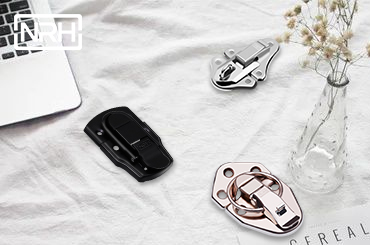
Case Latch Material and Surface Finish Guide: A Complete Selection Framework
Quick Answer: Latch material and surface finish selection is the most common specification pitfall in case hardware procurement. The substrate determines the ceiling – carbon steel offers high strength at low cost but requires mandatory corrosion protection; stainless steel provides inherent passivity; aluminum needs anodizing; zinc alloy works best with plating. Surface finish selection must match the substrate: carbon steel pairs with zinc plating (indoor), zinc-nickel or Dacromet (outdoor), hot-dip galvanizing (heavy corrosion), and chrome plating (decorative). Stainless steel benefits from passivation (lowest cost, significant improvement) or vibratory finishing (satin appearance). This guide provides a data-driven framework with real NRH product examples to help you make informed decisions.
Have you ever specified a zinc-plated latch for a coastal installation – and watched it rust within months? That is the signature mistake of selecting surface finish by price alone. The substrate determines the ceiling; the surface finish determines how close you get to it. This guide provides a systematic framework for matching latch material and surface finish to your application environment, backed by real product data and industry-standard corrosion test results.
Applicable Buyers
This guide is for case builders, product designers, engineers, and procurement professionals selecting latches for flight cases, industrial enclosures, military containers, outdoor electrical cabinets, and any application where material and surface finish selection directly impacts product lifecycle cost and reliability.
Key Finding: The substrate determines the performance ceiling; the surface finish determines how much of that ceiling you can access in a given environment. Carbon steel offers high strength at low cost but has no inherent corrosion resistance – it must be protected. Stainless steel provides inherent passivity – surface treatment is for enhancement, not necessity. Aluminum requires oxide film reinforcement. Zinc alloy requires plating or coating. The selection decision must be made at the system level, not by individual component specification.
Part 1: Substrate Corrosion Resistance – The Ceiling
Different substrates have fundamentally different corrosion resistance characteristics. Understanding the baseline of each material is essential before selecting a surface treatment.
| Substrate | Inherent Corrosion Resistance | Key Limitation | Protection Required |
|---|---|---|---|
| Carbon Steel / Iron | Very low – rusts within days in humid air | No passive film; active corrosion from initial exposure | Mandatory – no exception |
| 304 Stainless Steel | Good – chromium oxide passive film provides protection in most indoor environments | Pitting in chloride environments (coastal, marine); crevice corrosion in confined spaces | Passivation recommended (enhances existing protection) |
| 316 Stainless Steel | Excellent – 2-3% molybdenum content provides superior chloride resistance | Cost is the limiting factor; still can pit in extreme conditions | Passivation recommended for maximum performance |
| Aluminum | Moderate – natural oxide film provides some protection | Oxide film is thin and soft; susceptible to galvanic corrosion with dissimilar metals | Anodizing (reinforces oxide film) |
| Zinc Alloy | Low to moderate – zinc provides some sacrificial protection | Corrosion products can cause swelling and jamming; surface porosity from casting | Plating or coating required for most applications |
Critical observation: Carbon steel has essentially no corrosion resistance. It rusts within days in humid air. This is not a design trade-off – it is a mandatory protection requirement. No carbon steel latch should ever be used without surface treatment. Conversely, stainless steel is inherently corrosion-resistant; surface treatment is optional enhancement, not necessity.
Part 2: Surface Treatment Processes – The Tools
Seven surface treatment processes are commonly used for case hardware. Each has distinct characteristics in terms of corrosion resistance, cost, appearance, and compatibility with different substrates.
1. Electroplating – Zinc, Nickel, Chrome
Process principle: Electrochemical deposition of a metallic coating onto the substrate surface. A direct current drives metal ions from an anode to the cathode (the part), depositing a thin, adherent metallic layer.
Zinc plating (ZL): The most common and cost-effective finish for carbon steel hardware. Zinc provides sacrificial (cathodic) protection – zinc is more electrochemically active than steel, so it corrodes preferentially, protecting the steel even when scratched.
| Passivation Type | Appearance | Typical NSS (hours) |
|---|---|---|
| Clear / Blue-white (Cr3+) | Silver, bright | 12-24 hours |
| Yellow Iridescent (Cr3+) | Golden-yellow | 48-96 hours |
| Yellow Iridescent + Sealant | Golden-yellow | 96-200 hours |
| Olive Drab | Dark green | 120-200 hours |
Nickel plating: Provides a warm silver appearance with improved corrosion resistance over zinc. The corrosion protection comes from the nickel layer thickness – typically 10-25 μm. Cost is approximately 20-30% higher than zinc plating. Salt spray performance ranges from 48-240 hours depending on nickel layer thickness and subsequent chromium topcoat.
Chrome plating (CR): A multi-layer system consisting of copper (adhesion layer) + nickel (corrosion barrier and luster) + chromium (hardness and appearance). The chromium layer itself is only 0.25-0.8 μm thick – it provides hardness (HV 800-1,000) and the signature mirror-bright finish, but the corrosion protection comes from the nickel layer below. Chrome plating costs 2-4x zinc plating and is used primarily for decorative applications.
Hydrogen embrittlement risk – the critical warning:
Electroplating generates hydrogen atoms at the cathode surface. Some of these hydrogen atoms diffuse into the metal lattice, essentially creating internal wedges that make the material brittle. The problem is that the part looks perfect – until it suddenly fractures under load with no warning deformation. This is catastrophic failure.
Which parts are most at risk? High-strength carbon steel – specifically parts with hardness greater than or equal to HRC 38 or tensile strength greater than or equal to 1,000 MPa. If your latch uses Grade 8.8 or higher bolts, standard electroplating carries significant hydrogen embrittlement risk.
Mitigation strategies:
- Post-plating baking: Heat the plated part within 4 hours of plating at 190-230°C for 4-8 hours to drive out the hydrogen.
- Alternative coatings: Use Dacromet (zinc-aluminum flake coating) or mechanical plating – neither process generates hydrogen.
- Specify hydrogen embrittlement testing: Include ASTM F1940 or ASTM F519 testing in your procurement specification.
2. Dacromet (Zinc-Aluminum Flake Coating)
Process principle: A water-based coating containing zinc and aluminum flakes is applied by dip-spin or spray, then baked at 300-350°C. No electrical current is involved, so there is no hydrogen embrittlement risk.
Corrosion performance: Dacromet consistently delivers 500-1,000+ hours in ASTM B117 salt spray testing, with some variants exceeding 1,500 hours. The coating also provides excellent uniform coverage – no sharp edges or recesses are left unprotected.
Limitations: Appearance is limited to matte silver-gray. The coating is less hard than electroplated chromium and can be scratched by metal tools. High-temperature curing may affect heat-treated parts.
When to choose: Outdoor applications requiring 500+ hours salt spray protection, high-strength steel parts where hydrogen embrittlement is a concern, and structural fasteners in corrosive environments.
3. Hot-Dip Galvanizing
Process principle: The part is immersed in molten zinc (approximately 450°C), forming a thick zinc-iron alloy layer typically 50-100 μm thick. The thickness – approximately 5-10x thicker than electroplated zinc – provides extremely long corrosion protection.
Corrosion performance: Hot-dip galvanizing delivers 500-1,500+ hours in ASTM B117 salt spray testing, with field performance often exceeding 20-50 years in moderate environments.
Limitations: The thick coating changes part dimensions significantly – threaded holes must be masked or oversized to accommodate the coating thickness. The surface appearance is matte gray with visible flow marks, making it unsuitable for decorative applications.
When to choose: Heavy outdoor structures, utility poles, transmission towers, and applications where maximum corrosion protection is required and appearance is not a concern.
4. Anodizing (Aluminum Only)
Process principle: An electrochemical process that converts the surface of aluminum into a thick, hard aluminum oxide layer. The part becomes the anode in an electrolytic cell, and the oxide film grows from the surface outward.
Performance: Anodized aluminum oxide has hardness of HV 300-500 – much harder than the natural aluminum oxide. The porous oxide film can be dyed in various colors (black, gold, red, etc.).
Types:
- Clear Anodizing: Transparent oxide film, preserves the natural aluminum appearance
- Color Anodizing: Dye impregnation for cosmetic colors
- Hard Anodizing (Hardcoat): Thicker (50-100 μm) and harder (HV 500-800) for wear-resistant applications
When to choose: Aluminum enclosures, electronic device housings, instrument panels, any application requiring lightweight, corrosion-resistant hardware with color options.
5. Passivation (Stainless Steel Only)
Process principle: A chemical treatment using nitric or citric acid solution that removes free-iron contamination from the surface and enhances the naturally occurring chromium-oxide passive film. The process is simple, low-cost, and highly effective.
Corrosion performance: Properly passivated 304 stainless steel achieves 200-500+ hours in ASTM B117 salt spray testing – significantly longer than the 72-96 hours typical of unpassivated 304. Passivated 316 stainless steel can achieve 1,000+ hours.
Why passivation is critical: Machining, stamping, and forming operations deposit microscopic free-iron particles onto the surface. These particles act as initiation sites for rust. Passivation removes them and thickens the protective chromium-oxide film – both essential for maximum corrosion resistance.
When to choose: Passivation is recommended for all stainless steel hardware, especially for outdoor, medical, food processing, and any application where maximum corrosion resistance is required. It is the lowest-cost way to significantly improve stainless steel performance.
Clarification: Passivation of stainless steel typically yields 200-500+ hours of salt spray resistance – significantly more than the 24-48 hours sometimes cited. The 24-48 hour figure is often confused with unpassivated stainless steel or basic passivation requirements rather than actual passivated performance. Quality passivation with proper process control delivers 200-500+ hours on 304 and 1,000+ hours on 316.
6. Painting and Powder Coating
Process principle: Organic coatings applied by spray, dip, or electrostatic deposition (powder coating). The coating forms a physical barrier between the substrate and the environment.
Performance: Coating performance depends heavily on surface preparation (cleaning, phosphating, or priming). Powder coating typically provides 200-500 hours of salt spray resistance, but performance varies significantly by formulation (polyester, epoxy, polyurethane).
Advantages: Unlimited color options, hides surface imperfections, provides additional mechanical protection, UV-resistant formulations available.
Limitations: Coating hardness and corrosion resistance are generally lower than electroplating or Dacromet. Chips and scratches expose the substrate to corrosion. Powder coating requires higher cure temperatures (160-200°C).
When to choose: When color customization is required, when appearance is a priority over corrosion performance, and for indoor applications where coating integrity is not subject to heavy abrasion.
7. Phosphating and Black Oxide
Process principle: Chemical conversion coatings that form a thin (typically 0.5-2 μm) phosphate or magnetite (Fe3O4) layer on the surface. No significant thickness change occurs.
Corrosion performance: Very limited – typically 12-48 hours of salt spray resistance on its own. The coating is porous and primarily functions as a base for subsequent paint or oil application.
Primary applications: Interior friction surfaces requiring oil retention (gears, sliding parts), or as a primer layer for painting. Not recommended as a standalone corrosion protection for any hardware exposed to humidity.
Part 3: Matching Substrate and Surface Treatment – The Combinations
The following combinations are the standard, proven approaches for each substrate. Deviating from these patterns requires careful engineering justification.
Carbon Steel – Maximum Options, but Mandatory Protection
Carbon steel is the most widely used substrate for case hardware because it provides excellent strength at low cost. However, it has essentially zero inherent corrosion resistance. Every carbon steel latch must receive some form of surface protection.
| Treatment | Salt Spray (NSS) | Cost Relative | Best Application |
|---|---|---|---|
| Zinc Plating + Clear/Yellow | 48-96 hours | 1x (baseline) | Indoor, dry environments |
| Zinc Plating + Sealant | 96-200 hours | 1.1-1.2x | Indoor, occasional moisture |
| Nickel Plating | 48-240 hours | 1.2-1.3x | Indoor, better appearance |
| Chrome Plating | 72-200 hours | 2-4x | Decorative, premium appearance |
| Dacromet | 500-1,000+ hours | 1.5-3x | Outdoor, high-strength steel |
| Hot-Dip Galvanizing | 500-1,500+ hours | 1.5-2x | Heavy outdoor structures |
| Phosphating / Black Oxide | 12-48 hours | 0.8-1x | Interior friction surfaces, primer base |
When to Choose Each Carbon Steel Finish
Indoor, climate-controlled environments – Zinc Plating (Clear/Yellow)
The default choice. Provides 48-96 hours salt spray protection, adequate for normal indoor conditions. NRH’s 5301-112K-KS-FE-CL draw latch uses zinc-chromate plated steel with 45kg load capacity – a typical example of indoor-grade carbon steel hardware.
Indoor with occasional moisture or condensation – Zinc Plating with Sealant
The sealant topcoat extends salt spray to 96-200 hours, providing additional protection against incidental moisture exposure.
Outdoor, general environment – Dacromet
Provides 500-1,000+ hours salt spray protection with no hydrogen embrittlement risk. The preferred choice for high-strength carbon steel hardware in outdoor applications.
Outdoor, heavy corrosion environment – Hot-Dip Galvanizing
Provides maximum corrosion protection for carbon steel. Thick coating delivers 500-1,500+ hours salt spray resistance and decades of field service. Threaded holes must be masked or oversize to accommodate the coating thickness.
High-strength steel parts (greater than or equal to 8.8 grade) – Dacromet only. No electroplating.
This is a critical safety requirement. High-strength steel subjected to electroplating is at significant risk of hydrogen embrittlement. Dacromet eliminates this risk entirely.
Decorative, visible hardware – Chrome Plating or Painting
Chrome plating provides mirror-bright appearance with 72-200 hours salt spray protection. Painting provides custom colors with comparable corrosion performance. Both are appropriate for premium visible hardware where appearance is a priority.
304 and 316 Stainless Steel – Surface Treatment for Enhancement
Stainless steel’s inherent corrosion resistance comes from its chromium-oxide passive film. Surface treatments enhance this film or modify the surface appearance – they are optional, not mandatory.
| Treatment | Salt Spray (NSS) | Appearance | Best Application |
|---|---|---|---|
| Passivation | 200-500+ hours (304) 1,000+ hours (316) |
Unchanged | All stainless steel – highly recommended |
| Vibratory Finishing (ZG) | 500+ hours (304) 1,000+ hours (316) |
Satin-matte | General industrial, hides fingerprints |
| Bright / Mirror Polish (LG) | 200-500+ hours (304) | High-gloss reflective | Medical, display, premium appearance |
| Brushed Finish (LS) | 200-500+ hours (304) | Directional grain | Architectural, premium industrial |
| Electropolishing | 500+ hours (304) | Smooth, bright, mirror-like | Medical, food processing, cleanroom |
When to Choose Each Stainless Steel Finish
General purpose, any environment – Passivation
This is the highest-value treatment for stainless steel. Low cost, significant performance improvement, and no change in appearance. Passivation removes free-iron contamination and thickens the passive film – every stainless steel component benefits from it.
Industrial enclosures, frequent handling – Vibratory Finishing (ZG)
The satin-matte finish hides fingerprints and minor scratches. NRH’s 5104-56-S04-ZG spring-loaded latch (21g, 750N tensile) and 5102-88K security padlock latch (60g, 1000N tensile) both use vibratory finishing – demonstrating that this finish is suitable for both light and heavy-duty applications.
Medical, display, premium applications – Bright Polish (LG) or Electropolishing
High-gloss appearance signals quality and cleanliness. NRH’s 4265-100-S04-LG mirror-polished handle (115g, 30kg) and 6324-74 butterfly locking latch (97g, 588N) both use high-polish finishes for premium applications.
Stainless steel does NOT need electroplating. The adhesion of plated layers to stainless steel is poor, and the corrosion benefits are negligible compared to passivation or mechanical finishing. Electroplating stainless steel is generally a waste of money and can actually degrade performance by introducing galvanic corrosion risks.
Aluminum – Anodizing is the Proven Standard
Aluminum’s natural oxide film is thin and soft. Anodizing thickens and hardens it, significantly improving corrosion and wear resistance.
- Clear Anodizing: Preserves natural aluminum appearance, provides HV 300-500 hardness, good corrosion resistance
- Color Anodizing: Adds dye impregnation for color options (black, gold, red, etc.)
- Hard Anodizing (Hardcoat): HV 500-800 hardness, 50-100 μm thickness, for extreme wear applications
- Painting / Powder Coating: Color flexibility, but adhesion requires proper pretreatment
Aluminum does NOT accept electroplating effectively. Plating on aluminum requires a zincate immersion process first, making it complex and expensive. Anodizing is the proven standard for aluminum hardware.
Zinc Alloy – Plating is the Standard
Zinc alloy (often ZAMAK or similar) is a popular material for die-cast hardware due to its excellent castability. Surface treatment options include:
- Electroplating (Nickel or Chrome): The most common finish for zinc alloy hardware. Provides bright, decorative appearance with moderate corrosion protection.
- Painting / Powder Coating: Color flexibility, but requires thorough degreasing (mold release agents can cause adhesion failure).
- Passivation: For zinc alloy, passivation provides a thin conversion coating that offers limited corrosion protection, primarily used as a primer.
Zinc alloy does NOT accept anodizing – that process is limited to aluminum.
Part 4: Application-Based Selection Matrix
The following matrix provides direct application-based recommendations, making the selection process straightforward.
| Application Environment | Recommended Substrate | Recommended Finish | NRH Example | Key Consideration |
|---|---|---|---|---|
| Indoor, dry, climate-controlled | Carbon steel | Zinc plating (yellow passivation) | 5301-112K-KS-FE-CL | Lowest cost, 48-96 hours NSS adequate |
| Indoor, humid or occasional moisture | Carbon steel | Zinc plating + sealant | – | 96-200 hours NSS |
| Indoor, premium visible hardware | Carbon steel or zinc alloy | Chrome plating (Cu-Ni-Cr) | 4101-160-FE-CR | Mirror-bright, 72-200 hours NSS |
| Outdoor, general environment | 304 stainless steel | Vibratory finishing (ZG) + passivation | 5104-56-S04-ZG | 500+ hours NSS, satin appearance |
| Outdoor, coastal / marine | 316 stainless steel | Passivation | 5101-96-S16-ZG | 1,000+ hours NSS, maximum corrosion protection |
| Outdoor, heavy corrosion (chemical, salt) | 316 stainless steel | Vibratory finishing (ZG) + passivation | – | 1,000+ hours NSS, satin hides scratches |
| High-strength steel(8.8 grade or higher) | Carbon steel (high strength) | Dacromet – NO electroplating | – | 500+ hours NSS, zero hydrogen embrittlement risk |
| Medical / Food processing | 304 or 316 stainless steel | Electropolishing | 4265-100-S04-LG | Smooth, cleanable, 500+ hours NSS |
| Aluminum enclosure / panel | Aluminum | Anodizing (clear or color) | – | HV 300-500 hardness, color options |
| Lightweight electronic enclosure | Aluminum | Hard anodizing (Hardcoat) | – | HV 500-800, wear-resistant |
Part 5: Hydrogen Embrittlement – The Hidden Failure Mode
Hydrogen embrittlement is one of the most serious and least-understood failure mechanisms in hardware procurement. A part can look perfect – shiny plating, smooth edges, precise dimensions – and then fail catastrophically under moderate load with no warning deformation. The metal simply breaks. Like chalk.
What Causes Hydrogen Embrittlement?
During electroplating, hydrogen atoms are generated at the cathode surface. Some of these atoms diffuse into the metal lattice, accumulating at grain boundaries and other defect sites. These hydrogen atoms act as internal wedges, creating stress concentrations. The trapped hydrogen reduces the metal’s toughness and ductility.
The failure is delayed – it may occur hours, days, or even weeks after the part is put into service. This makes it extremely difficult to trace back to the plating process. It is catastrophic failure with no visible warning.
Which Parts Are at Highest Risk?
Not all parts are equally susceptible. The risk is highest when three conditions are met:
- High hardness: HRC 38 or higher
- High tensile strength: greater than or equal to 1,000 MPa (approximately Grade 8.8 or higher)
- Electroplating process: Zinc, nickel, or chrome plating
If your latch uses high-strength fasteners or the latch body itself is made from hardened steel, standard electroplating carries significant hydrogen embrittlement risk.
Mitigation Strategies
Strategy 1: Post-Plating Baking
Heat the plated part within 4 hours of plating at 190-230°C for 4-8 hours. This drives the hydrogen out of the metal lattice before it can cause embrittlement. ASTM F1940 provides specific baking requirements.
Strategy 2: Alternative Coating Processes
Switch to processes that do not generate hydrogen:
- Dacromet / Zinc-aluminum flake coatings – no hydrogen risk
- Mechanical plating – no hydrogen risk
- Hot-dip galvanizing – no hydrogen risk
Strategy 3: Testing
Include hydrogen embrittlement testing in your procurement specification. ASTM F519 (sustained load testing) and ASTM F1940 (baking requirements) are the relevant standards.
Selection Rule for High-Strength Parts
If your application involves high-strength steel (greater than or equal to HRC 38 or greater than or equal to 1,000 MPa tensile):
Do not use electroplating. Specify Dacromet or mechanical plating instead.
Part 6: Base Material Quality – The Overlooked Variable
Surface finish cannot fix base material defects. This is perhaps the most commonly overlooked factor in hardware procurement.
If the base material has porosity, pinholes, inclusions, or casting voids, the surface treatment will highlight, not hide, these defects. Plating can blister over subsurface defects. Paint can bridge over them temporarily, but corrosion will find its way through.
What to verify:
- Mill certificates confirming material grade and composition
- Surface quality inspection before processing (visual, dye penetrant, or other NDT methods)
- Process controls that ensure consistent base material quality
Surface finish is the final layer of protection – but the substrate determines whether that protection has any chance of performing as intended.
Part 7: Quick Reference – Finish Codes and Terms
| Term | Abbreviation | Process Type | Typical Substrate |
|---|---|---|---|
| Zinc Plating | ZL | Electroplating | Carbon steel |
| Chrome Plating | CR | Electroplating | Carbon steel / Zinc alloy |
| Vibratory Finish | ZG | Mechanical | Stainless steel |
| Bright / Mirror Polish | LG | Mechanical / Chemical | Stainless steel |
| Passivation | PA | Chemical | Stainless steel |
| Dacromet | DAC | Zinc-aluminum flake | Carbon steel (especially high-strength) |
| Anodizing | AN | Electrochemical | Aluminum |
| Hot-Dip Galvanizing | HDG | Molten zinc immersion | Carbon steel (heavy structural) |
Frequently Asked Questions (FAQ)
What surface treatment is best for carbon steel latches in indoor environments?
Zinc plating with yellow passivation is the standard choice for indoor carbon steel hardware. It provides 48-96 hours of salt spray protection at the lowest cost. For indoor applications with occasional moisture, specify zinc plating with sealant to achieve 96-200 hours protection.
What is the difference between passivation and vibratory finishing on stainless steel?
Passivation is a chemical treatment that removes free-iron contamination and enhances the passive chromium-oxide film – it improves corrosion resistance with no change to appearance. Vibratory finishing (ZG) is a mechanical process that creates a uniform satin-matte texture – it improves appearance and hides scratches, while also enhancing corrosion resistance. They are complementary; passivation is recommended for all stainless steel, while vibratory finishing is selected for appearance.
What salt spray performance should I expect from passivated 304 stainless steel?
Properly passivated 304 stainless steel typically achieves 200-500+ hours in ASTM B117 salt spray testing. This is significantly higher than the 72-96 hours typical of unpassivated 304. The 24-48 hour figure sometimes cited is either the performance of unpassivated material or a minimum requirement, not the actual performance of properly passivated stainless steel.
What is hydrogen embrittlement, and why should I care?
Hydrogen embrittlement is a failure mechanism where hydrogen atoms absorbed during electroplating cause high-strength steel to become brittle and fracture without warning. Parts at highest risk have hardness greater than or equal to HRC 38 or tensile strength greater than or equal to 1,000 MPa. The failure is delayed and catastrophic – the part breaks suddenly with no visible deformation. For high-strength steel, specify Dacromet (zinc-aluminum flake coating) instead of electroplating. Dacromet generates no hydrogen and eliminates the risk.
Why can’t I just electroplate stainless steel?
Stainless steel is inherently corrosion-resistant due to its chromium-oxide passive film. Electroplating onto stainless steel requires special preparation (depassivation) and adhesion is often poor. The plated layer can blister or peel, and the corrosion benefits are negligible compared to passivation or mechanical finishing. Electroplating stainless steel is generally a waste of money and can degrade performance. Use passivation or vibratory finishing instead.
Can aluminum hardware be electroplated?
Aluminum can be electroplated, but it requires a complex zincate immersion pretreatment and specialized plating baths. The process is expensive and the adhesion is still not as reliable as anodizing. Anodizing is the standard, proven surface treatment for aluminum hardware. It is more cost-effective, provides better corrosion protection, and can be dyed in various colors.
How do I choose between zinc plating and Dacromet for carbon steel?
Choose zinc plating when the application is indoors, the required salt spray protection is 48-96 hours, and cost is the primary concern. Choose Dacromet when the application is outdoors (500+ hours protection required), the parts are high-strength steel (hydrogen embrittlement risk), or you need long-term corrosion protection without regular maintenance.
What is the most cost-effective way to improve stainless steel corrosion resistance?
Passivation is the most cost-effective improvement for stainless steel. The process is low-cost, requires no specialized equipment, and significantly enhances the passive film. For approximately 1-2% of the part cost, passivation can increase salt spray resistance from 72-96 hours to 200-500+ hours. It also removes free-iron contamination that causes rust spots. Every stainless steel component should be passivated.
Key Takeaways
- Substrate determines the ceiling. Carbon steel requires mandatory protection; stainless steel provides inherent passivity; aluminum needs oxide reinforcement.
- Zinc plating is the baseline for carbon steel – 48-96 hours NSS at the lowest cost. Choose Dacromet for outdoor (500+ hours) or high-strength steel (hydrogen embrittlement risk).
- Passivation is the highest-value treatment for stainless steel – low cost, significant corrosion improvement (200-500+ hours on 304, 1,000+ hours on 316), no appearance change.
- Vibratory finishing (ZG) provides satin appearance that hides fingerprints and scratches, with equivalent corrosion protection to passivation. NRH’s 5104-56-S04-ZG (750N tensile) and 5102-88K (1000N tensile) are examples.
- Bright polish (LG) provides mirror appearance for premium visible applications. NRH’s 4265-100-S04-LG (115g, 30kg) is an example.
- Hydrogen embrittlement is a critical risk for high-strength steel (greater than or equal to HRC 38) with electroplating. Use Dacromet instead – no hydrogen generation.
- Anodizing is the standard for aluminum. Clear, color, and hardcoat variants available. Hardcoat provides HV 500-800 hardness.
- Base material quality determines the ceiling. Surface finish cannot fix porosity, inclusions, or casting voids.
- Match the finish to the environment, not just the price. The cost of replacement always exceeds the cost of the correct finish.
About NRH
NRH is a brand of Shanghai Nahui Hardware Products Co., Ltd., established in 1996 and headquartered in Shanghai, China. The company specialises in R&D and production of high-quality hardware fittings for cases and boxes – including toggle latches, handles, hinges, and corner protectors. NRH offers products in multiple substrate and finish combinations, including zinc-plated steel (ZL), chrome-plated steel (CR), and vibratory-finished stainless steel (ZG), with passivation available on request, serving military, medical, aviation, industrial, and logistics applications worldwide.
All NRH product data presented in this guide is based on actual product specifications and marked “for reference only – not for tooling/mould creation”. For official engineering drawings, customisation enquiries, or bulk orders, please contact the NRH sales team directly.
For official engineering drawings, customisation enquiries, or bulk orders, please visit the NRH product pages or contact the sales team directly.