

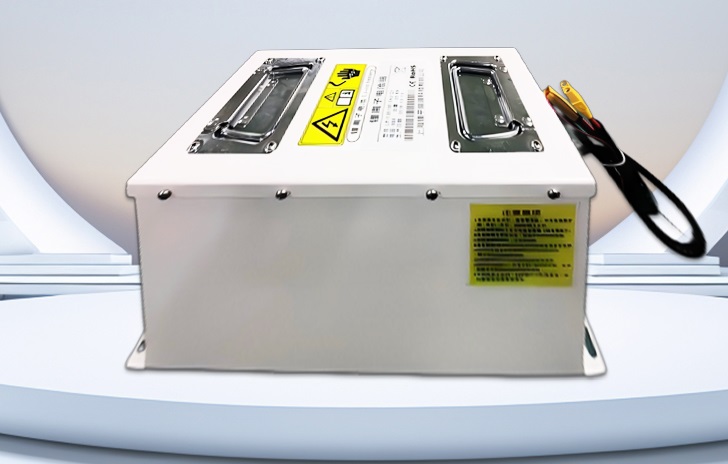
Zero-height folded profile. 25 kg load capacity per handle (110mm version). Two handles per medium-format case. Recessed folding handles solve the core conflict in portable power case design: maximizing interior volume while maintaining a flush stacking surface. The 4101-110-FE-CR delivers iron-chrome construction at a price point suited for volume production, with a folded height of zero millimetres when mounted in a routed pocket. For heavy-load applications requiring higher capacity, the 4101-160-FE-CR provides 80 kg load capacity at a longer 160mm grip span.
Portable power cases serve critical functions across military field operations, medical equipment transport, industrial maintenance, and outdoor recreation. These enclosures house batteries, power conversion electronics, and connectivity hardware that demand protection from shock, moisture, and environmental contamination. The physical case must balance three competing requirements: maximizing interior volume for energy storage, maintaining structural integrity under transport loads, and enabling efficient handling during deployment and retrieval.
Here’s what makes recessed folding handles different: they add nothing to case height when folded. Surface-mount handles project 3-8 mm above the panel, which compounds across stacked cases and wastes pallet space. Recessed handles eliminate that problem entirely.
Portable Power Case with 4101-110-FE-CR: Real-World Application
A 400 mm x 295 mm x 252 mm portable power enclosure demonstrates recessed folding handle integration in practice. Two 4101-110-FE-CR handles mount flush with the top panel surface, using iron body construction with chrome plating for corrosion protection. When folded, the grip mechanism sits below the panel plane, creating a completely flat stacking surface.
The case accommodates a substantial battery pack and inverter system, placing the fully loaded weight near the upper range for this form factor. Each 4101-110-FE-CR handle carries a 25 kg rated capacity per manufacturer specifications, providing a 2:1 safety margin when the case approaches 12.5 kg fully loaded. Chrome plating on the iron body resists oxidation from handling and provides adequate protection for dry indoor and sheltered outdoor environments typical of portable power applications.
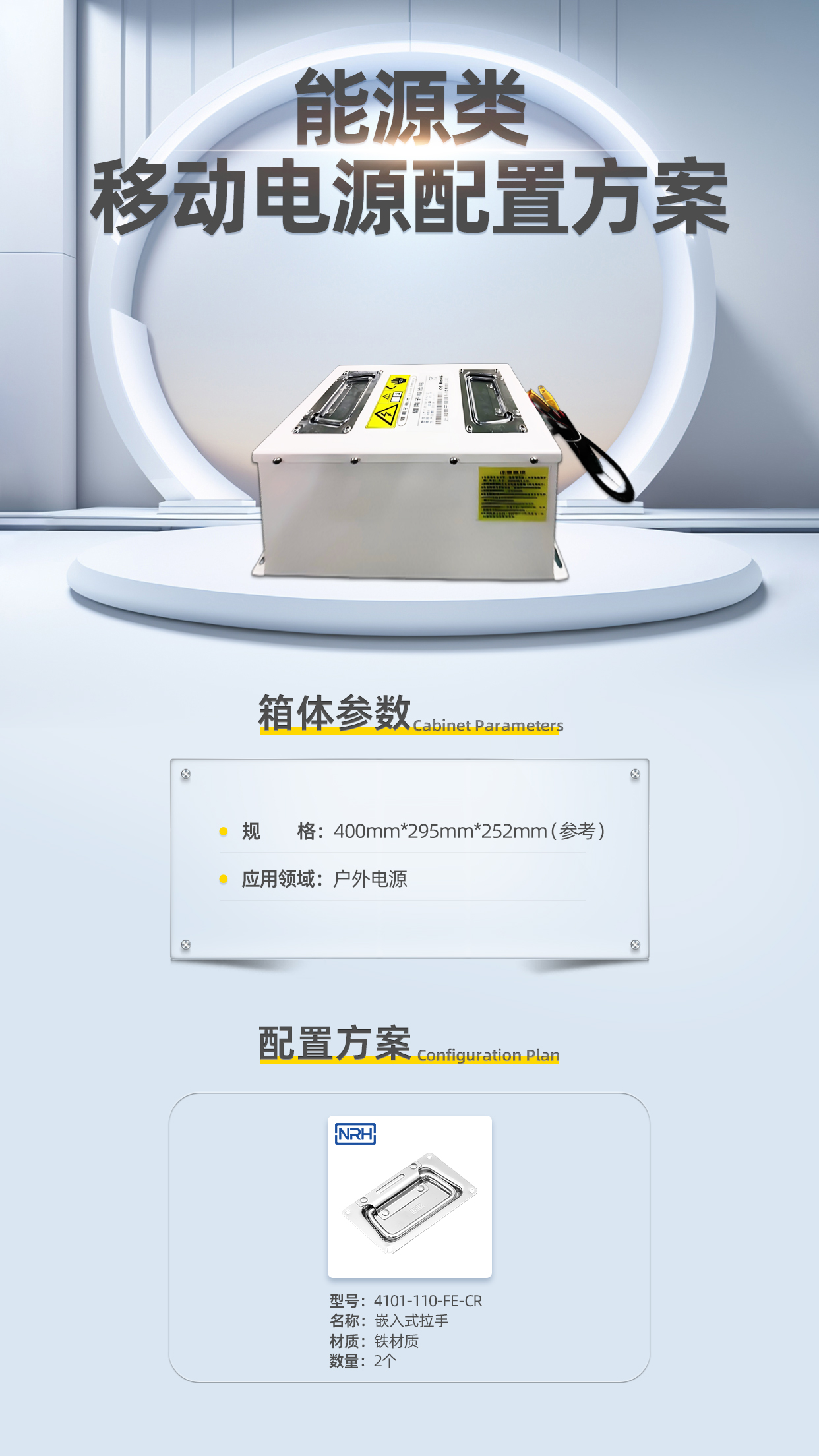
Portable power case (400x295x252mm) equipped with dual 4101-110-FE-CR recessed folding handles. Chrome-plated iron construction enables zero-clearance stacking when handles are in the folded position. The recessed mounting eliminates any projection above the panel surface.
4101 Series Folding Handles: Product Overview
The 4101 series offers recessed folding handles in two primary material grades: iron-chrome (FE-CR) and SUS304 stainless steel. The recessed mounting design eliminates external height addition when folded, making these handles the standard choice for stacking applications where case profiles must remain uniform.
Surface-mount folding handles in the 4201 and 4265 series sit atop the panel surface, adding 3-8 mm of height when folded. This projection compounds across stacked cases, creating gaps that reduce pallet efficiency and cause lateral instability during transport. Recessed handles eliminate this problem by integrating into the case structure rather than adding to it.
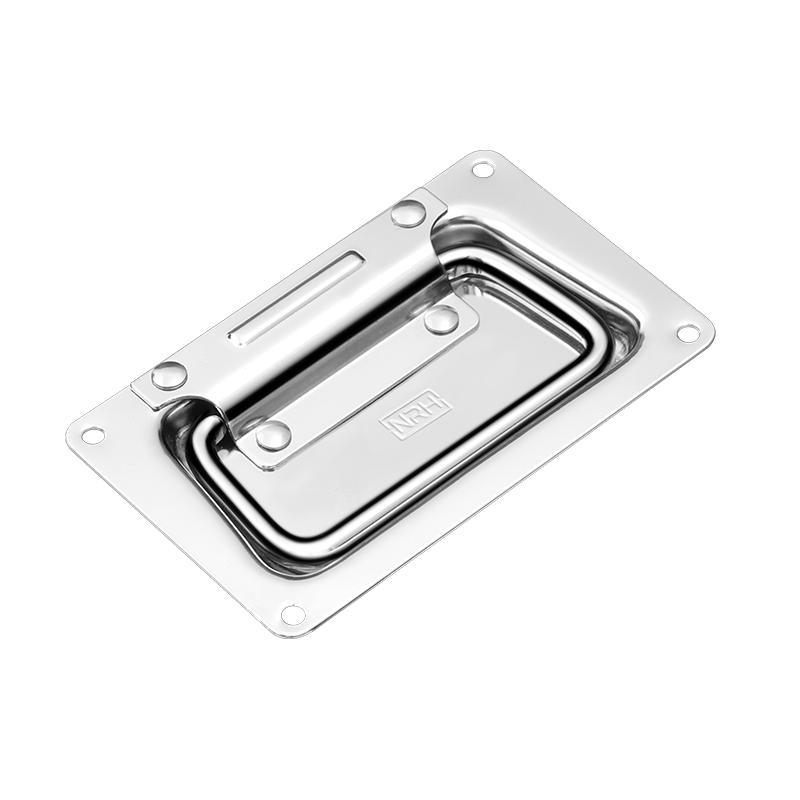
4101-110-FE-CR recessed folding handle. Iron body with chrome plating. Rated 25 kg load capacity. Compact 110mm center-to-center mounting dimension suitable for medium-format cases.

4101-132-SUS304 recessed folding handle. SUS304 stainless steel with bright finish. Rated 25 kg load capacity. Extended 132mm grip length provides improved leverage for larger enclosures requiring longer reach.
4101 Series: Material and Finish Options
| Model | Material | Finish | Weight | Load Rating | Application |
|---|---|---|---|---|---|
| 4101-110-FE-CR | Iron | Chrome | 105g | 25 kg | Cost-sensitive, dry environments |
| 4101-110-S04-LG | SUS304 | Bright | 122 g | 25 kg | Corrosion-resistant applications |
| 4101-132-S04-LG | SUS304 | Bright | 215 g | 25 kg | Extended grip for larger enclosures |
| 4101-160-FE-CR | Iron | Chrome | 371 g | 80 kg | Heavy-load applications, large cases |
| 4301-100-S04-ZG | SUS304 | Vibratory Ground | 142 g | 50 kg | Marine, outdoor, food processing |
Load capacity by model: The 4101-110 series (all material variants) is rated at 25 kg per handle. The 4101-160-FE-CR, with its larger 160mm body and heavier 371g construction, achieves 80 kg capacity. Select based on your enclosure’s fully loaded weight and apply a 2x safety margin.
Why Recessed Folding Handles Excel for Power Cases
Portable power cases prioritize energy density. Every millimetre of case height consumed by a surface-mounted handle reduces the available interior volume for batteries and power electronics. Recessed folding handles solve this by integrating into the case structure rather than adding to it.
The recessed mounting approach requires panel preparation, a routed pocket sized to contain the folded handle, but this manufacturing step pays dividends across the product lifecycle. The case gains a flat stacking surface, the handle gains protection from impact damage, and the overall profile remains clean and professional.
Key advantages for power case applications:
- Zero external height when folded. The grip mechanism sits inside a routed pocket, below the panel surface. Nominal case dimensions equal usable stacking dimensions. On a 400x295x252mm enclosure, this means consistent footprint across stacked units without accounting for handle protrusion tolerances.
- Consistent load capacity across material variants. Both iron-chrome and SUS304 versions of the same model deliver identical load ratings. The 4101-110 series carries 25 kg regardless of material choice, allowing engineers to select based on corrosion resistance needs without compromising strength.
- Clean stacking profile. No handle projection means cases stack without clearance gaps, maximizing pallet and vehicle load efficiency. A stable column of stacked cases resists lateral shifting during transport.
- Pivot mechanism protection. Recessed mounting shields the hinge from direct impact during handling. The handle sits protected inside the panel pocket, away from the edge impacts that damage surface-mount hardware.
- Professional appearance. When folded, the handle disappears into the case surface. The top panel presents a clean, flat profile suitable for branding, labelling, or additional hardware like casters.
Installation Guidelines for Recessed Folding Handles
Panel preparation: Route a pocket sized to the handle body dimensions. The pocket must accommodate the folded grip profile with sufficient clearance for the pivot motion. Reference the dimensional drawing for exact pocket depth and width specifications.
Minimum panel thickness: 3 mm for the 4101 series. Thicker panels provide superior thread engagement and distribute fastener loads over a larger area. Panels below 3 mm risk thread stripping under repeated loading.
Edge distance: Position mounting holes at least 25 mm from panel edges to prevent material splitting under load. Insufficient edge distance concentrates stress at the panel perimeter where cracks propagate.
Adjacent hardware clearance: Verify the folded handle clears nearby latches, hinges, and corner protectors through the full pivot range. Handle rotation must not interfere with lid operation, sealing surfaces, or structural features.
Handle quantity:
- Two handles for cases up to 600 mm in length
- Four handles for large-format cases exceeding 600 mm
- Mount symmetrically around the case center of gravity to prevent tilting during carry
- Position handles on the longer case sides for comfortable two-person carrying
Torque specifications: Reference the installation drawing for specific torque values. Over-tightening compresses the mounting tabs and restricts pivot motion. Under-tightening allows vibration loosening over time. Apply thread-locking compound for high-vibration environments.
Selection Criteria: Choosing the Right Handle Model
Selecting the appropriate recessed folding handle requires evaluating application-specific factors. The decision framework below guides specification choices for power case applications.
Step 1: Calculate load requirements. Determine the fully loaded weight of your enclosure, then apply a 2x safety margin. For a 4101-110 series handle rated at 25 kg, the maximum recommended working load is 12.5 kg per handle. If your case exceeds this, consider the 4101-160-FE-CR at 80 kg rating (40 kg working load with 2x margin), or increase the number of handles.
Step 2: Evaluate the environment. Dry indoor and sheltered outdoor conditions suit iron-chrome (FE-CR) handles. Moisture, salt air, chemical exposure, or temperature extremes demand SUS304 stainless steel variants. The corrosion resistance difference between iron-chrome and SUS304 becomes significant in demanding environments.
Step 3: Match grip length to case size. Longer cases or heavier loads benefit from extended grip models that distribute hand pressure over a larger area. The 4101-132 series offers a longer handle for improved leverage on larger enclosures where grip width matters for comfort.
Step 4: Consider finish requirements. Chrome (CR) provides bright reflective appearance suitable for consumer and industrial applications. Vibratory ground (ZG) delivers superior corrosion resistance with a matte surface ideal for marine and outdoor use. Black coatings (BK2/BK4) suit tactical and military applications where low visual signature is required.
Stacking Optimization for Portable Power Cases
Stackability determines logistics efficiency from manufacturing through end-use deployment. A case that stacks cleanly maximizes pallet utilization, simplifies vehicle load planning, and reduces storage footprint at field bases or service depots.
When recessed folding handles fold flat, the case top becomes a flat surface with no protrusions. Cases stack directly on each other with consistent contact between the top panel and the bottom panel of the unit above. The result is a stable column that resists lateral shifting during transport over rough terrain.
The 4101-110-FE-CR recessed folding handle integrates into the case top panel with the grip mechanism recessed below the surface plane. The folded handle adds no height to the case profile, which means the nominal external dimensions of the case remain the usable stacking footprint. Designers can specify standard stacking footprints without accounting for handle protrusion tolerances.
For mobile applications requiring additional stability, stacking casters or interlocking features on adjacent cases further improve column stability during transport.
FAQ
Folded height of the 4101-110-FE-CR
The 4101-110-FE-CR adds zero millimetres of external height when folded. The handle sits completely inside the routed pocket, flush with or below the panel surface plane. Confirm pocket depth matches handle specifications to ensure full containment without interference during pivot operation.
Iron-chrome for outdoor power cases
Iron-chrome handles perform well in sheltered outdoor environments protected from direct precipitation. For cases exposed to rain, salt spray, or humid conditions, select SUS304 stainless steel variants (4101-110-S04 series) for enhanced corrosion resistance and longer service life without maintenance interventions.
How many handles for a 400x295x252mm case?
Two handles is standard for this size class. The 400 mm length provides sufficient span for comfortable two-handed carrying. Single handle mounting concentrates load at one point, creating wrist torque and imbalance on extended carries. The two-handle configuration distributes weight symmetrically for ergonomic handling.
Minimum panel thickness for recessed mounting
The 4101 series requires a minimum panel thickness of 3 mm for secure fastener engagement. Thicker panels improve thread retention and distribute clamping force across a larger area. Panels at or below 2 mm risk stripped threads and joint failure under repeated loading cycles. Always verify against the specific installation drawing for hole sizes and torque specifications.
Recessed folding handles on rotating lid panels
Yes, with proper verification. Confirm the folded handle clears the lid opening through the full closure cycle. Spring-return models automatically fold when released, eliminating the risk of an upright handle blocking lid closure. Verify pivot spring tension provides reliable return without binding in the pocket.
FE-CR vs SUS304 variants
FE-CR uses iron with chrome plating, offering cost-effective construction with moderate corrosion resistance. SUS304 stainless steel provides superior resistance to oxidation and chemical exposure at a higher price point. Both variants of the same model deliver identical load ratings. The material choice affects corrosion resistance and long-term maintenance requirements in demanding environments, not load capacity.
Maintenance: recessed vs surface-mount
No difference. The pivot mechanism design is identical between recessed and surface-mount variants. Recessed mounting actually provides mechanical protection by shielding the handle from direct impact during handling. Annual inspection of pivot points for wear or corrosion remains the standard maintenance practice for both configurations.
Safety margin for load ratings
Apply a minimum 2x safety margin to manufacturer-rated capacity. For the 4101-110-FE-CR at 25 kg rated load, the recommended maximum working load is 12.5 kg. For the 4101-160-FE-CR at 80 kg rated load, the recommended maximum working load is 40 kg. Exceeding rated capacity risks handle deformation, pivot joint wear, and failure under shock loading during transport. Dynamic loads from drops and impacts can briefly multiply static forces significantly.
Need help choosing? Contact the NRH Box Hardware team for model-specific recommendations based on your case dimensions and load requirements.