

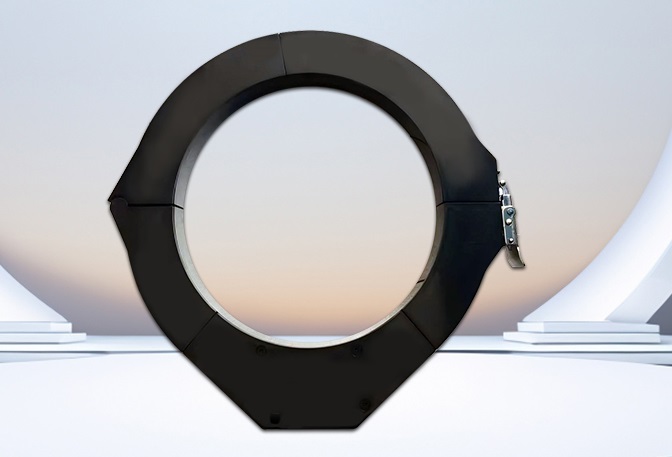
Automation Equipment Panel Latch – 5806-60S Safety Lock Toggle Latch
Applicable Buyers: Industrial automation panel builders | Motor control center manufacturers | Packaging machinery OEMs | Factory automation integrators | Control cabinet fabricators
Key finding: A single 5806-60S-S04-ZG safety lock toggle latch provides reliable panel retention for a 100x100x30mm automation control module in high-vibration environments. The integrated safety lock prevents vibration-induced opening – a common failure mode in motor control centers and packaging lines – while maintaining tool-free access for maintenance.
Automation equipment panels and enclosures often require frequent access for maintenance, wiring adjustments, or sensor calibration. In high-vibration environments such as motor control centers, packaging lines, and production machinery, standard toggle latches can shake loose over time, creating safety hazards and unplanned downtime.
A toggle latch with an integrated safety lock provides the solution for applications where vibration resistance is the primary concern. This article covers a specific installation involving a 100mm x 100mm x 30mm automation control module equipped with one NRH 5806-60S-S04-ZG safety lock toggle latch.
Case Study: Automation Equipment (100mm x 100mm x 30mm)
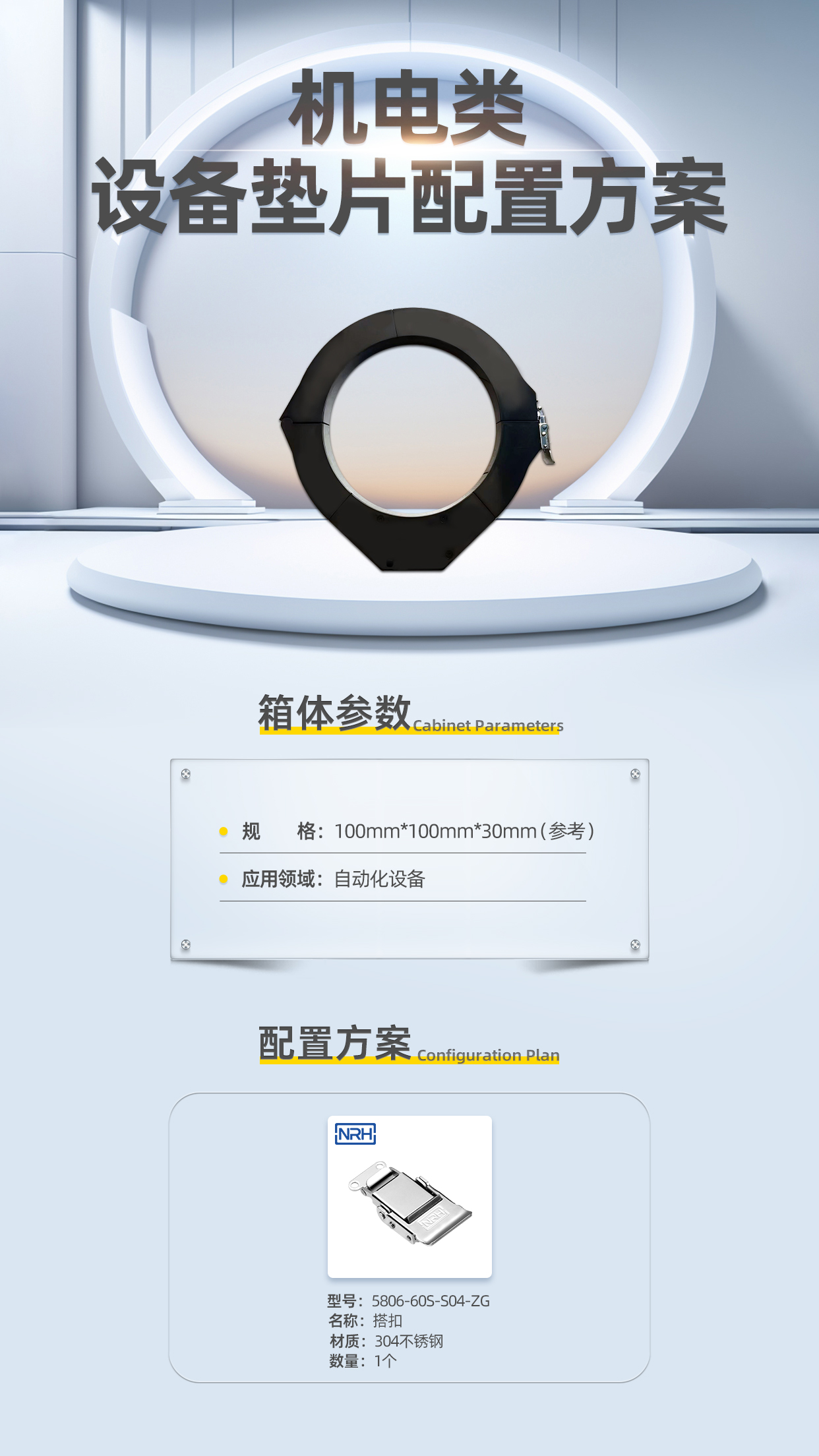
NRH 5806-60S-S04-ZG safety lock toggle latch securing the front panel of a 100mm x 100mm x 30mm automation control module. 304 stainless steel body with integrated safety lock function.
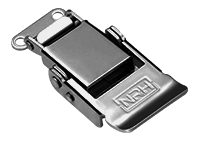
The automation control module in this installation measures 100mm by 100mm by 30mm – a compact form factor typical of distributed I/O modules, sensor junction boxes, or small HMI terminals. Only one latch was required to secure the front panel. The panel width matches the enclosure depth and the latch toggle arm covers the full panel span, providing sufficient retention force for maintenance access without requiring tools to open multiple latch points.
The 5806-60S-S04-ZG is a toggle latch with an integrated safety lock function. The latch body and toggle arm are constructed from 304 stainless steel for corrosion resistance in industrial environments. The spring mechanism inside the housing is also stainless steel – the entire latch assembly is 304 stainless steel, ensuring uniform corrosion resistance across all components without dissimilar metal concerns. The safety lock mechanism prevents the toggle from accidentally opening due to vibration – a common failure mode in motor control centers, packaging machinery, and other high-vibration automation settings. The latch features a square body design with a flat profile, a built-in double spring that provides automatic spring return action, and a push-button release mechanism that must be pressed before the toggle can be lifted.
Note on model variants: The 5806 series includes multiple configurations. The 5806-60S-S04-ZG featured in this article is the safety lock version – it provides vibration resistance with a push-button release but does not include a padlock hole or thickness adjustment mechanism. For applications requiring padlock compatibility, specify the 5806-60K-S04-ZG variant (padlock hole diameter: 9.5mm). For applications requiring panel thickness adjustment, NRH offers separate adjustable toggle latch series with screw-type adjustment mechanisms.
5806 Series Model Variants
The 5806 series offers three primary variants to suit different application requirements. All models share the same all-304 stainless steel construction, 392N tensile strength, and square body design with double spring return mechanism.
| Model | Weight | Safety Lock | Padlock Hole | Release Mechanism | Best Application |
|---|---|---|---|---|---|
| 5806-60-S04-ZG | 40g | No | No | Standard toggle | Standard tool-free access, low-vibration environments |
| 5806-60S-S04-ZG | 41g | Yes | No | Push-button release | High-vibration environments, motor control centers, packaging lines |
| 5806-60K-S04-ZG | 42g | No | Yes (9.5mm) | Standard toggle | Security-sensitive areas requiring padlock access restriction |
For applications requiring panel thickness adjustment, NRH offers separate adjustable toggle latch series with screw-type adjustment mechanisms. For 316 stainless steel requirements, NRH supports custom orders with minimum quantity requirements – contact technical support for details.
How the Safety Lock Works
The safety lock mechanism on the 5806-60S-S04-ZG operates on a simple but effective principle. When the toggle lever is pushed fully closed, a spring-loaded safety hook automatically engages with the base body, locking the toggle in position.
To open the latch, the user must first press the release button to disengage the safety hook, then pivot the toggle lever upward using the same motion as a standard toggle latch. The safety lock is designed to remain engaged under vibration and shock loads, but releases instantly when the release button is pressed – requiring a deliberate two-step action (press then lift) that prevents accidental opening while maintaining quick access for authorized personnel.
This two-step sequence – press the button, then lift the lever – ensures the latch resists vibration-induced opening while maintaining quick, tool-free access for maintenance personnel. The safety lock adds a second layer of protection on top of the inherent over-center locking action.
Performance Data
The 5806 series toggle latches are designed for reliable panel retention in industrial automation environments. Key specifications:
- Tensile strength: 392N (all three variants)
- Material: 304 stainless steel (body, toggle arm, and spring)
- Finish: Vibratory grinding (ZG)
- Weight: 40g (standard), 41g (safety lock), 42g (padlock)
- Safety lock: Integrated push-button release (5806-60S only)
- Padlock hole: 9.5mm diameter (5806-60K only)
The over-center locking mechanism provides inherent vibration resistance by locking securely past the dead center point. The latch is suitable for repeated open-close cycles in maintenance-access applications. For applications with specific cycle life requirements, consult NRH technical support for application-specific verification.
What Happens If You Choose Wrong – Typical Scenario
Scenario: A packaging line specifies standard toggle latches (5806-60-S04-ZG) for control panel enclosures on a high-speed cartoning machine operating at 120 cycles per minute, generating continuous low-frequency vibration.
Outcome: Within three months, panels are found slightly ajar during inspections. The vibration gradually works the standard latches loose – the over-center mechanism alone cannot resist continuous shaking. One panel opens completely during operation, exposing live terminals. Production is halted for emergency repair.
Solution: Replace all standard latches with 5806-60S-S04-ZG safety lock toggle latches. The push-button release mechanism prevents vibration-induced opening while maintaining the same tool-free access for maintenance.
Lesson: In high-vibration environments, the additional cost of a safety lock latch is negligible compared to the cost of unplanned downtime and safety incidents.
Latch Selection Criteria for Automation Equipment
Safety lock for vibration-prone environments. The “S” variant (5806-60S-S04-ZG) includes an integrated safety lock with push-button release that prevents the toggle from opening due to machine vibration. This is particularly critical in motor control centers, packaging machinery, and other high-vibration settings where a standard latch might shake loose over time.
Single-latch coverage for narrow panels. For panels under 150mm wide, one latch mounted at center span provides sufficient retention force. The 5806-60S-S04-ZG covers the full span from thin aluminum cover plates to reinforced steel doors.
All-304 stainless steel construction. Automation equipment rooms often have elevated humidity, coolant mist, or cleaning agents. The 304 stainless steel body and spring mechanism resist surface oxidation under these conditions without requiring additional coating or periodic inspection schedules. Unlike designs that use dissimilar metals (e.g., stainless body with carbon steel springs), the all-304 construction eliminates galvanic corrosion concerns between components.
Padlock security when needed. For applications requiring access restriction, the 5806-60K-S04-ZG variant provides a 9.5mm padlock hole suitable for standard padlocks.
316 stainless steel for aggressive environments. For marine, coastal, or high-corrosion applications, 316 stainless steel variants are available via custom order with minimum quantity requirements. Contact NRH technical support for details.
Installation Procedure: Step-by-Step Guide
Proper installation ensures reliable operation and maximum service life. Follow these steps for mounting the 5806-60S-S04-ZG on an automation enclosure:
Step 1: Prepare the Mounting Surface
Clean the mounting area on the enclosure frame. Remove any debris, old adhesive, or surface contaminants. The mounting surface must be flat and free of burrs that could prevent the latch body from seating properly.
Step 2: Position the Latch Body
Place the latch body on the fixed portion of the enclosure. Align the through-hole mounting flange with the pre-drilled holes. For new installations, use the latch body as a template to mark hole positions. Ensure the latch body orientation matches the intended toggle travel direction.
Step 3: Secure the Latch Body
Fasten the latch body using the supplied screws or appropriate fasteners for your panel material. For steel enclosures, use M4 or M5 machine screws. For aluminum or thin-gauge panels, consider using rivet nuts or backing plates to prevent thread stripping. Torque fasteners to 2-3 Nm – over-tightening can distort the latch body and impede toggle operation.
Step 4: Install the Keeper
Position the keeper (catch plate) on the removable panel to align with the toggle arm when closed. The keeper should engage the toggle hook squarely – misalignment can cause binding or reduced clamping force. Mark and drill keeper mounting holes, then secure with appropriate fasteners.
Step 5: Test and Adjust
Close the panel and actuate the toggle to the fully closed position. The toggle should snap into place with a positive feel, and the safety lock should engage automatically when the lever reaches the fully closed position. If the latch does not fully close, adjust the keeper position slightly. If the toggle feels too loose, move the keeper closer to the latch body to increase clamping force.
Step 6: Final Verification
Cycle the latch through five open-close operations to confirm consistent engagement. For the 5806-60S variant, verify that the push-button release mechanism engages each time the toggle is fully closed and that intentional opening force releases the lock smoothly. For high-vibration environments, apply thread-locking compound to all mounting fasteners to prevent loosening over time.
Industry Applications
The 5806 series safety lock toggle latches are specified in automation equipment across several industries:
- Factory automation: Distributed I/O modules and remote terminal units benefit from vibration-resistant panel retention
- Production equipment: Small HMI terminals and operator interface enclosures remain secure despite machine vibration
- Process control: Sensor junction boxes and field-mount signal conditioners maintain panel integrity in high-vibration settings
- Packaging machinery: Control cabinets require vibration-resistant latches during format changeovers and high-speed operation
- Motor control centers: Panel doors stay securely closed despite continuous low-frequency vibration from adjacent motors
Design Considerations for Panel Retention
When specifying toggle latches for automation enclosures, consider the vibration environment and access frequency. For motor control centers or packaging lines with continuous vibration, the safety lock feature on the 5806-60S-S04-ZG provides an additional layer of reliability that standard latches cannot offer.
For high-vibration environments, using thread-locking compound on all mounting fasteners is strongly recommended. Periodically inspect the latch during scheduled maintenance to confirm the safety lock mechanism continues to function correctly.
Application Summary
The 5806-60S-S04-ZG safety lock toggle latch addresses the core requirements for compact automation equipment enclosures in high-vibration environments. The integrated safety lock with push-button release provides reliable panel retention that standard latches cannot offer, while the all-304 stainless steel construction holds up in industrial environments without surface treatment maintenance or galvanic corrosion concerns.
Key selection factors for this application included:
- Safety lock function: Push-button release mechanism prevents vibration-induced opening
- Single-latch coverage: One latch at center span secures 100mm-wide panels
- All-304 stainless steel: Uniform corrosion resistance across all components
- Tool-free access: Press button, lift lever – no tools required for maintenance
- Model variants: Standard (5806-60), safety lock (5806-60S), padlock (5806-60K)
Recommended for similar applications: This latch configuration is also well-suited for sensor enclosures, terminal boxes, small control panels, HMI stations, and any compact automation enclosure requiring vibration-resistant panel retention with tool-free maintenance access.
Frequently Asked Questions
Q: What does the “S” in 5806-60S mean?
Data answer: The “S” indicates the safety lock function, which includes a push-button release mechanism that prevents the toggle from accidentally opening due to vibration.
Q: Is the 5806-60S-S04-ZG adjustable for different panel thicknesses?
Data answer: No. The 5806-60S-S04-ZG is a fixed-position safety lock latch. It does not include a thickness adjustment mechanism. For applications requiring panel thickness adjustment, NRH offers separate adjustable toggle latch series with screw-type adjustment mechanisms.
Q: What is the difference between 5806-60, 5806-60S, and 5806-60K?
Data answer: The 5806-60 is the standard model (40g) with no additional features. The 5806-60S adds a safety lock with push-button release (41g) that prevents vibration-induced opening. The 5806-60K adds a 9.5mm padlock hole (42g) that allows the latch to be secured with a padlock for access restriction.
Q: Is the 5806-60S-S04-ZG lockable with a padlock?
Data answer: No. The 5806-60S-S04-ZG features a safety lock with push-button release to prevent vibration opening but does not include a padlock hole. For padlock-compatible options, specify the 5806-60K-S04-ZG variant with 9.5mm padlock hole.
Q: How does the safety lock work?
Data answer: The safety lock mechanism engages automatically when the toggle lever is pushed fully closed. A spring-loaded safety hook clicks into the base body, creating a secondary retention point. To open the latch, the user must first press the release button to unlock the hook, then pivot the toggle lever upward. This two-step action – press then lift – ensures the latch stays securely closed under vibration but opens quickly when intentionally accessed.
Q: What materials are used in the 5806-60S-S04-ZG?
Data answer: The latch body, toggle arm, and internal spring mechanism are all constructed from 304 stainless steel. This all-stainless construction ensures uniform corrosion resistance across all components and eliminates galvanic corrosion concerns that can occur when dissimilar metals are used in the same assembly.
Q: What panel materials is this latch suitable for?
Data answer: Aluminum, steel, and glass-filled polycarbonate panels are all compatible with the 5806-60S. The latch is not recommended for panels made of brittle materials that cannot tolerate the clamping force of the toggle mechanism.
Q: How many latches are needed for a given panel?
Data answer: For panels up to 150mm wide, one latch at center span is typically sufficient. Wider panels benefit from two latches spaced evenly across the span to prevent panel flex during actuation and to distribute retention force more evenly across the panel perimeter.
Q: Does the latch require periodic maintenance?
Data answer: Periodically check mounting fasteners for tightness in high-vibration applications. The toggle pivot point may be lubricated with a light machine oil if actuation resistance increases over extended service periods. Verify the safety lock mechanism engages correctly during routine inspections.
Q: Is 316 stainless steel available for this latch series?
Data answer: 316 stainless steel is not available as standard stock but can be custom ordered with minimum quantity requirements. Contact NRH technical support to discuss your specific material requirements, volume, and lead time.
Q: What is the tensile strength of the 5806 series?
Data answer: All three variants (5806-60, 5806-60S, and 5806-60K) share the same 392N tensile strength. The difference between models is in the additional features (safety lock or padlock hole), not in load capacity.
Need help choosing the right latch for your automation equipment? Contact our technical team for specification support and sample requests.
Contact Information:
- TEL and WhatsApp and WeChat: +86 180 1797 5137
- E-MAIL: nrh-gz@nrh.cn
- ADD: Room 1703-1704, Zhongji Mansion, 819 Yinxiang Road, Nanxiang Town, Jiading District, Shanghai, China