

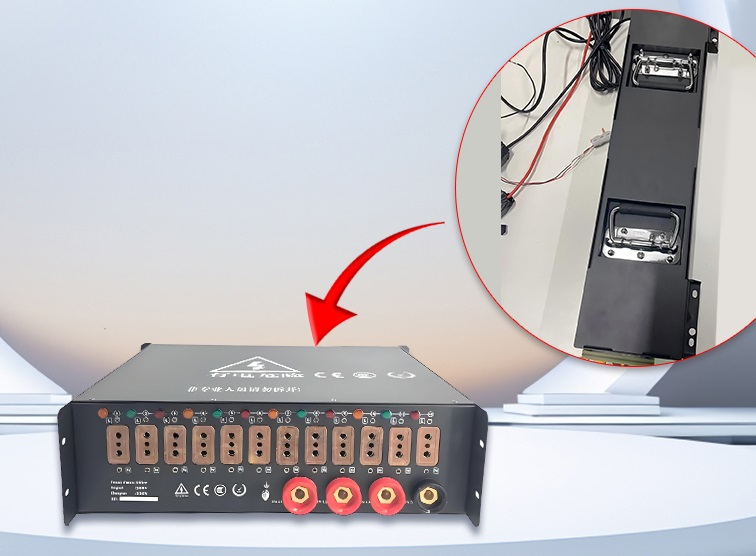
Portable Power Station Handle Selection – Spring-Loaded Folding Handles
Applicable Buyers: Portable power station manufacturers | Outdoor equipment OEMs | Emergency response equipment builders | Portable enclosure fabricators | Field-deployable system integrators
Key finding: A 400x150x300mm outdoor power station was configured with two NRH 4201-100-S04-LG spring-loaded folding handles (SUS304, polished finish, 25kg each) mounted symmetrically on opposite sides for two-person carry. The spring-loaded auto-return mechanism keeps handles folded flat when not in use, reducing snag hazards and enabling tighter stacking during transport.
Field technicians, outdoor explorers, and emergency responders share one common frustration: handles on portable power stations that snag on equipment, clothing, or adjacent surfaces during handling, corrode prematurely, or simply break under real-world use. Handle-related warranty claims often stem from protruding grip designs that catch on transit case walls or straps during loading, or from corrosion at mounting points where moisture accumulates.
The solution is deceptively simple: spring-loaded folding handles that sit flat against the enclosure surface when not in use and deploy a load-bearing grip when lifted. Folding handles significantly reduce device footprint compared to protruding alternatives, enabling tighter stacking in vehicles and transit cases. They eliminate the moisture-trapping cavities that accelerate corrosion at mounting points. And they distribute lifting loads across a full mounting flange rather than concentrating force at adhesive bonds or small fastener clusters. This article examines a specific installation involving a 400mm x 150mm x 300mm outdoor power station equipped with two NRH 4201-100-S04-LG spring-loaded folding handles in 304 stainless steel with a polished finish, then provides a comprehensive selection and installation guide for engineers and procurement teams evaluating handle solutions.
Case Study: Dual-Handle Installation on a 400mm Outdoor Power Station
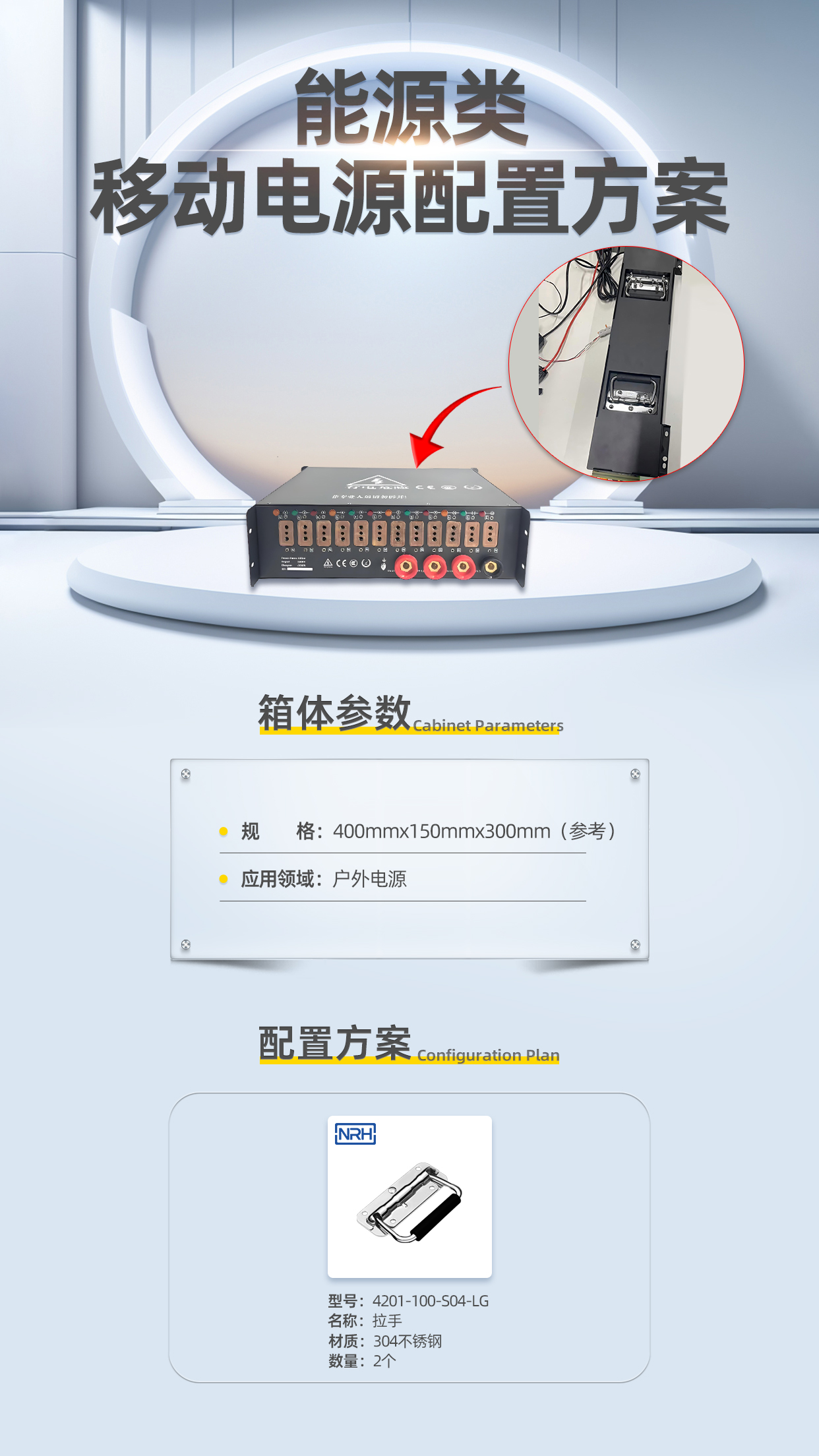
Dual NRH 4201-100-S04-LG spring-loaded folding handles installed on opposite sides of a 400mm x 150mm x 300mm portable power station for two-person carry. Material: 304 stainless steel, polished finish. Configuration: 2 handles, surface-mounted.
The unit in this installation is a 400mm wide, 150mm tall, and 300mm deep outdoor power station intended for field deployment in remote locations. The enclosure is fabricated from aluminum alloy with a powder-coated exterior finish. Two 4201-100-S04-LG handles were mounted symmetrically on opposite long-side panels, one handle per side. This bilateral arrangement provides balanced lifting points that allow two operators to carry the unit securely, or a single operator to lift from one side when the unit is stationary.
The 4201-100-S04-LG is a spring-loaded folding handle with a rated load capacity of 25kg per manufacturer catalog data. The handle body is constructed from SUS304 (304 stainless steel) with a polished (LG) surface finish. The integrated spring mechanism automatically returns the handle to the folded position when released, eliminating the need for manual stowing and reducing the risk of damage during transport.
Polished 304 stainless steel provides superior resistance to surface corrosion compared to painted or coated alternatives, making it well-suited for outdoor and marine environments where the unit may be exposed to humidity, salt air, and temperature cycling. The polished finish also contributes to a clean, professional aesthetic that aligns with premium portable power equipment branding.
Installation was completed using four M5 stainless steel socket head cap screws per handle, torqued to 4 Nm. No adhesive was used. The surface-mount design means the handles sit flush against the exterior panel surface when folded, creating a low-profile exterior when not in use.
Product Images
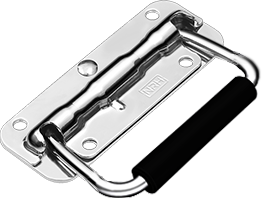
NRH 4201-100-S04-LG spring-loaded folding handle – SUS304, polished finish (LG). Load rating: 25kg. Spring-assisted auto-return. Hole spacing: 100mm.
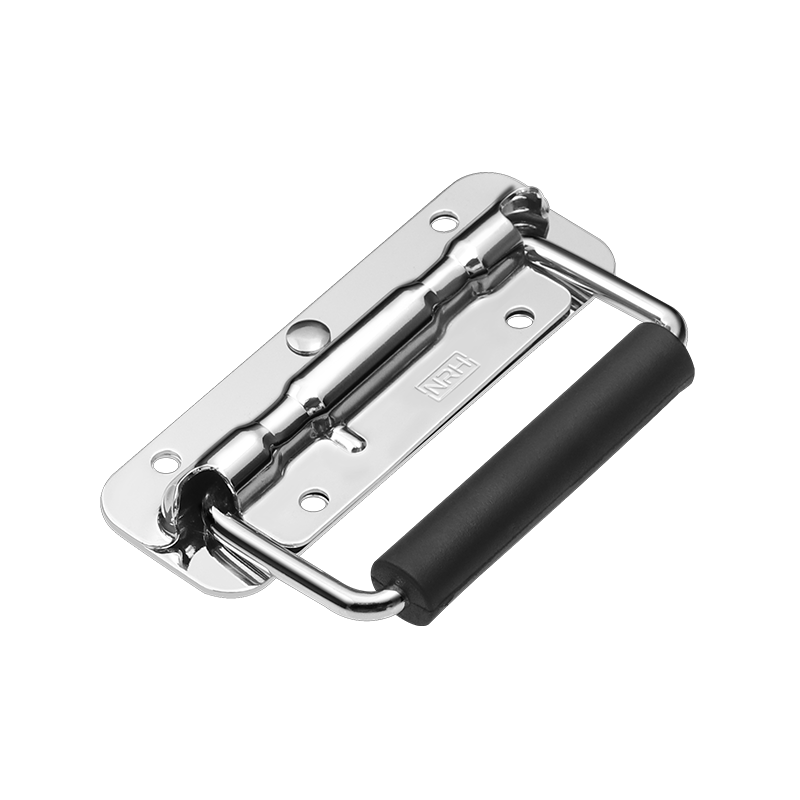
NRH 4201-120-SUS304 folding handle – SUS304, polished. Compact 120mm centers. Spring-loaded auto-return. Ideal for space-constrained enclosures.
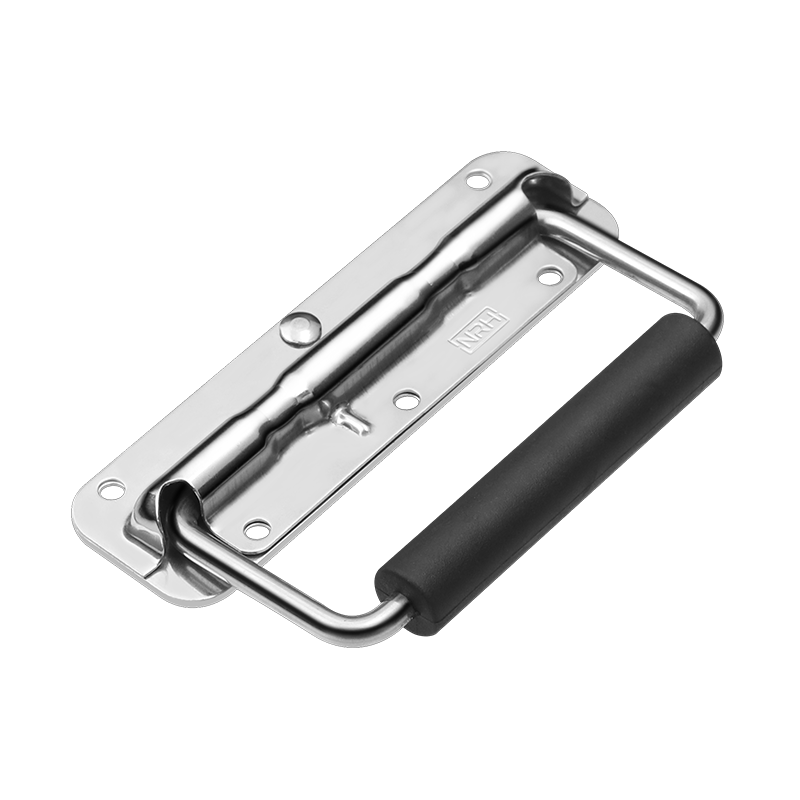
NRH 4201-140-SUS304 folding handle – SUS304, polished. Extended 140mm centers for heavier loads. Spring-loaded auto-return. Rated up to 50kg.
Handle Type Comparison: Folding vs. Embedded
Choosing the right handle type depends on your enclosure constraints: available panel space, load requirements, aesthetics, and budget. The table below compares the two most common handle types for portable power station applications.
| Feature | Folding Handle (4201 Series) | Embedded Handle (4101 Series) |
|---|---|---|
| Mounting Type | Surface mount – attaches to panel exterior | Embedded – requires routed cavity in panel |
| Flush When Retracted | Low profile – folds flat against surface | Yes – completely flush with panel surface |
| Return Mechanism | Spring-loaded auto-return | Spring-loaded auto-return |
| Load Capacity (SUS304) | 25-60kg | 60-80kg |
| Weight per Handle | 122-215g | 215-371g |
| Panel Preparation Required | Minimal – drill 4 mounting holes | Extensive – route cavity + drill holes |
| Material Options | SUS304, Iron/Chrome | SUS304, Iron/Chrome |
| Best For | Compact enclosures, portable power, quick installation | Heavy industrial enclosures, premium aesthetic, maximum flush finish |
| Typical Price Point | $$ | $$$ |
Installation Guide: Folding Handles for Portable Power Stations
Tools and Materials Required
- Drill with drill bits (matching screw diameter)
- Torque wrench (0-10 Nm range)
- Thread-locking adhesive (medium-strength, e.g., Loctite 243)
- M5 or M6 socket head cap screws (stainless steel, qty 4 per handle)
- Center punch
- Deburring tool
- Isopropyl alcohol and lint-free cloth
Step-by-Step Installation Procedure
Step 1: Assess Enclosure Material and Thickness
Verify that the enclosure wall at the intended mounting location has adequate thickness for the selected fasteners. As a general recommendation, aluminum panels should be at least 2mm thick and steel panels at least 1.5mm thick. Thinner walls may require reinforcement plates or backing washers to distribute load. For this 400mm x 150mm x 300mm unit, the 4mm aluminum side panels provided adequate strength without reinforcement.
Step 2: Mark Mounting Hole Positions
Position the handle at the desired location, ensuring at least 30mm clearance from enclosure corners and 20mm from nearby fastener or cable penetrations. Use the handle base as a template to mark the four mounting hole positions. Center-punch each mark to prevent drill bit wandering.
Step 3: Drill the Mounting Holes
Drill four holes using a drill press or precision drill guide to ensure perpendicularity. Drill bit diameter should match the screw pilot hole specification (typically 4.2mm for M5 screws). Deburr all holes thoroughly on both sides. Apply a small amount of anti-corrosion compound to the hole edges on the exterior surface.
Step 4: Apply Thread-Locking Adhesive
Clean the mounting surface with isopropyl alcohol. Apply one drop of medium-strength thread-locking adhesive to the first 2-3 threads of each fastener. This prevents loosening from vibration during transport and field use.
Step 5: Mount the Handle
Position the handle over the mounting holes and insert the screws. Torque to 4 Nm in a diagonal cross-pattern to ensure even seating. Do not over-tighten – excessive torque can deform the handle base or strip threads in soft materials.
Step 6: Verify Operation
Pull the handle to the deployed position and release. The spring mechanism should return the handle to the folded position smoothly. Cycle the handle 10 times to verify smooth operation and confirm no binding against the panel surface. Check that all screws remain tight after cycling.
Selection Decision Guide: Choosing the Right Handle for Your Power Station
1. Match Load Rating to Unit Weight
Select a handle with a rated load capacity at least 2x-3x the expected lift weight as a general safety practice. For the 4201-100-S04-LG (25kg rating), use two handles for units up to 15kg. Consider the 4201-140-SUS304 (50kg) for heavier units.
2. Choose Mounting Type Based on Panel Design
Surface-mount folding handles (4201 series) require only four drilled holes and are ideal for existing enclosures where panel routing is not feasible. Embedded handles (4101 series) require routed cavities and are better suited for new designs where a completely flush finish is required.
3. Evaluate Environmental Exposure
For outdoor or marine use, SUS304 stainless steel with polished finish provides the best corrosion resistance. Iron handles with chrome plating are suitable for indoor or controlled-environment applications where cost is a primary concern.
4. Consider Aesthetic Integration
If the handle will be visible on the exterior of a consumer-facing product, the polished stainless steel finish of the 4201-100-S04-LG offers a premium appearance. Chrome-plated iron handles provide a mirror finish at a lower cost but with reduced corrosion resistance compared to solid stainless steel.
5. Check Hole Spacing Against Available Panel Width
Ensure the handle hole spacing does not exceed the available flat panel area. Standard hole spacings range from 90mm to 178mm. For narrow panels (under 120mm wide), choose compact handles like the 4201-100-S04-LG with 100mm hole spacing or the 4201-120-SUS304 with 120mm spacing.
6. Consider Lifting Configuration
For larger units requiring two-person carry, mount handles on opposite sides as demonstrated in this case study. For single-person carry, mount two handles on the same side or one handle on the top panel. For units under 10kg, a single handle may be sufficient.
What Happens If You Choose Wrong?
- Using surface-mount handles on enclosures requiring complete flush finish: Folding handles sit approximately 8-12mm above the panel surface when folded, which may not meet the aesthetic requirements of premium consumer products. Specify embedded handles for completely flush designs.
- Specifying iron handles for outdoor marine environments: Chrome-plated iron will corrode rapidly in salt spray conditions. Within 6-12 months, visible rust appears on edges and high-wear areas. Specify SUS304 or SUS316 stainless steel for outdoor applications.
- Installing only one handle on a 15kg unit: A single 25kg-rated handle may technically support the weight, but one-handed lifting creates torsional stress on the handle mounting points and reduces operator control. Two handles provide balanced lifting and reduce the risk of handle failure.
- Choosing handles without spring return for field equipment: Without auto-return, handles left in the open position create snag hazards during transport and may be damaged by adjacent equipment. Spring return is essential for portable equipment that moves frequently.
- Using adhesive-only mounting for handles: Adhesive bonds degrade under UV exposure, temperature cycling, and moisture. Handle attachments must use mechanical fasteners (screws or rivets) for reliable load transfer. Adhesive may be used as a supplement but never as the primary retention method.
Application Summary
The 400mm x 150mm x 300mm portable power station demonstrates how two 4201-100-S04-LG spring-loaded folding handles provide reliable, low-profile carry solutions for outdoor equipment. The 25kg per-handle rating, SUS304 stainless steel construction, and polished finish make this handle suitable for field-deployable equipment in demanding environments. The spring-loaded auto-return mechanism keeps handles folded flat when not in use, reducing snag hazards and enabling tighter stacking during transport.
Key selection factors for this application included:
- Spring-loaded auto-return: Handles fold flat automatically when released, eliminating manual stowing
- Opposite-side mounting: Two handles on opposite sides for balanced two-person carry
- SUS304 stainless steel: Corrosion resistance for outdoor and marine environments
- Polished finish: Premium appearance for consumer-facing equipment
- Surface-mount design: Minimal panel preparation – only four drilled holes required
- 25kg load rating: Adequate for 15kg unit with 1.6x safety margin
Recommended for similar applications: This handle configuration is also well-suited for portable battery packs, field generators, camping power stations, emergency response equipment, and any portable enclosure requiring low-profile handles with corrosion resistance and automatic stowing.
Frequently Asked Questions
Q: What is the difference between the 4201 folding handle and the 4101 embedded handle?
Data answer: The 4201 series is a surface-mount folding handle with spring-loaded auto-return. It requires only four drilled holes for installation and folds flat against the panel surface. The 4101 series is an embedded handle that requires a routed cavity in the panel for flush mounting. The 4101 offers a completely flush finish but requires more extensive panel preparation.
Q: What is the load capacity of the 4201-100-S04-LG handle?
Data answer: The 4201-100-S04-LG is rated for 25kg per handle. When using two handles, the combined rating is 50kg. As a general safety practice, apply a 2x-3x safety factor for human lifting applications. For heavier loads, consider the 4201-140-SUS304 (50kg) or 4101 series embedded handles (60-80kg).
Q: Does the 4201 handle automatically return to the folded position?
Data answer: Yes. The 4201 series features an integrated spring mechanism that automatically returns the handle to the folded position when released. This eliminates the need for manual stowing and reduces the risk of damage during transport.
Q: Can folding handles be installed on plastic or composite enclosures?
Data answer: Yes, folding handles can be installed on plastic or composite enclosures using heat-set inserts or self-clinching nuts to provide threaded mounting points. The enclosure must have sufficient wall thickness to support the insert. For enclosures under 3mm wall thickness, a metal backing plate is recommended to distribute loads and prevent cracking at the mounting points.
Q: How do I prevent corrosion at the handle mounting point?
Data answer: Use stainless steel fasteners (A2-70 or A4-70 grade) with medium-strength thread-locking adhesive. Apply a moisture barrier compound between the handle base and the enclosure surface to prevent galvanic corrosion between dissimilar metals. For outdoor applications, periodically inspect and reapply protective compounds as needed.
Q: Do surface-mount handles affect the IP rating of the enclosure?
Data answer: Surface-mount handles create penetrations at the mounting holes that must be addressed if the enclosure has a defined IP rating. Use sealing washers or gaskets between the handle base and the panel surface, and apply sealant around the screw penetrations. Consult the enclosure manufacturer for IP-rated mounting procedures.
Q: What screw size is required for the 4201-100-S04-LG handle?
Data answer: The 4201-100-S04-LG uses M5 mounting screws. Recommended specification is M5 x 12mm socket head cap screw (SHCS) in A2-70 stainless steel, torqued to 4 Nm. The screw length should be selected so that at least 5mm of thread engages the enclosure wall without protruding through the interior surface.
Q: How do I determine the correct hole spacing for my application?
Data answer: Measure the available flat panel area where the handle will be mounted. Subtract 20mm from the total panel width to account for edge margins. The result is the maximum hole spacing your panel can accommodate. NRH handles are available in hole spacings ranging from 50mm to 178mm. When in doubt, select a handle with hole spacing at least 10mm less than your calculated maximum to provide a safety margin.
Need help choosing the right handle for your portable power station? Contact our technical team for specification support and sample requests.
Contact Information:
- TEL and WhatsApp and WeChat: +86 180 1797 5137
- E-MAIL: nrh-gz@nrh.cn
- ADD: Room 1703-1704, Zhongji Mansion, 819 Yinxiang Road, Nanxiang Town, Jiading District, Shanghai, China