

Triangle Hook Latches for Wooden Freight Cases – Export Packaging Hardware
Applicable Buyers: Export packaging manufacturers | Wooden crate builders | Industrial shipping case fabricators | Military logistics case suppliers | Heavy equipment freight specialists
Key finding: An 800x600x500mm wooden freight case was configured with 4 sets of triangle hook latches (5321-GP-4 hook plates, 8g each; 5406-57-KS latch bodies, 24g each, 15kg load). The triangular hook geometry provides self-locking action that resists vibration-induced loosening – critical for ocean freight and rail transport where cargo experiences sustained dynamic loading.
Triangle hook latches are a proven solution for securing wooden freight cases in industrial shipping and logistics applications. The unique triangular hook geometry creates a self-locking mechanism that resists vibration-induced loosening, making these latches ideal for ocean freight and rail transport where cargo experiences sustained dynamic loading.
NRH Box Hardware supplies complete triangle hook latch assemblies including the 5321-GP-4 hook plate and 5406-57-KS latch body, engineered specifically for wooden cases measuring 800mm x 600mm x 500mm and larger. These iron hardware components feature polished finishes that provide both aesthetic appeal and basic corrosion resistance for indoor warehouse storage and controlled environment transport.
Case Study: Wooden Freight Case Configuration
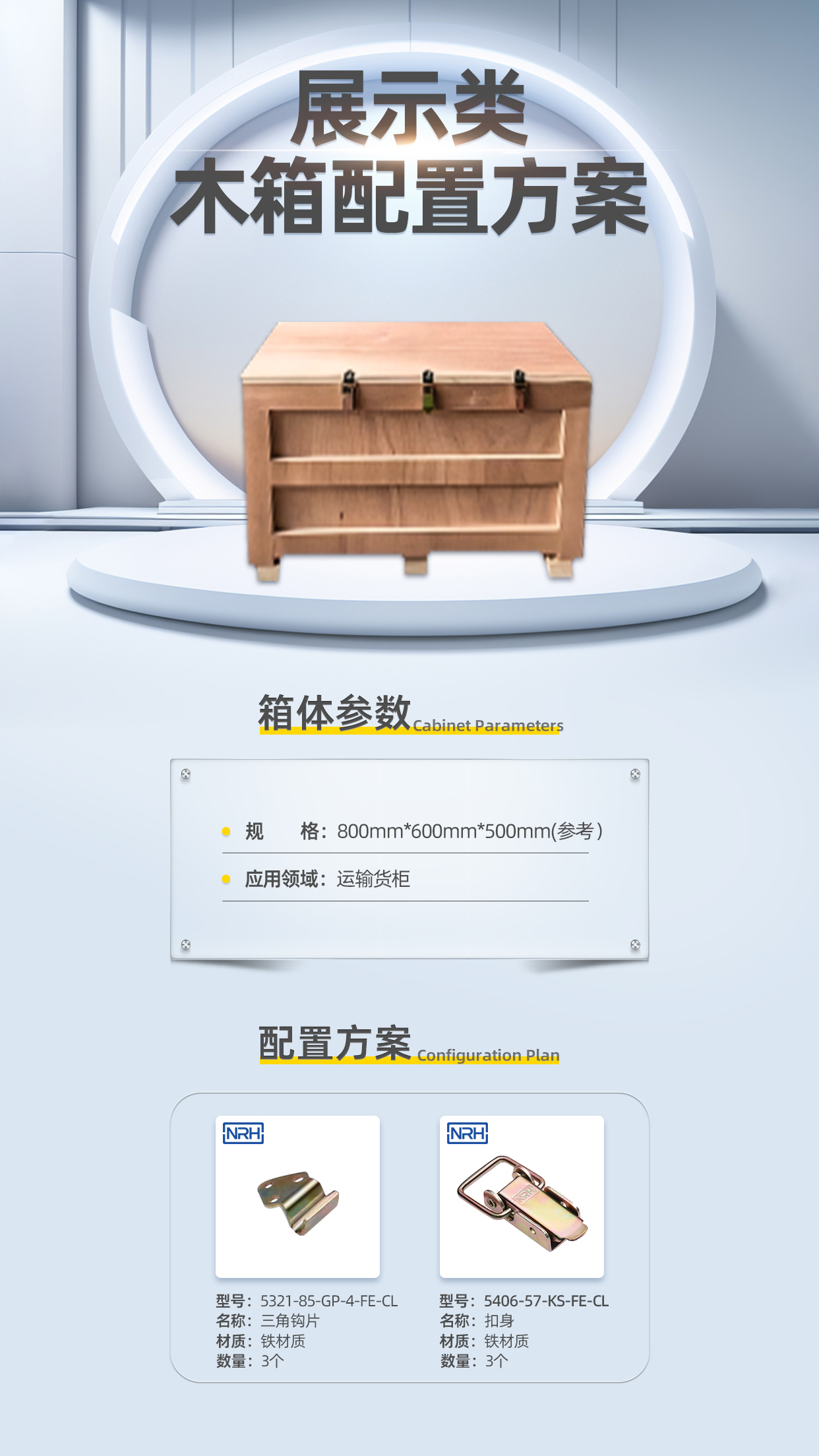
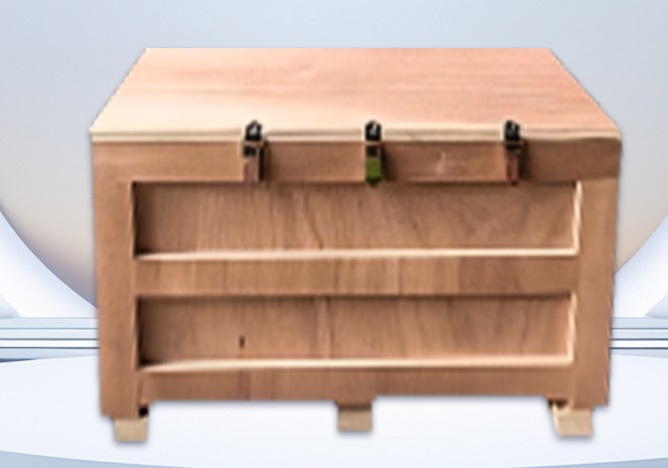
Wooden freight case (800x600x500mm) equipped with 4 sets of triangle hook latches for secure container closure during export transit.
A standard wooden freight case configuration (800mm x 600mm x 500mm external dimensions) requires a specific hardware assembly designed to withstand the rigors of international shipping. The recommended configuration employs 4 complete latch sets positioned symmetrically around the container perimeter.
| Component | Model Number | Material | Surface Finish | Weight | Load Rating | Quantity |
|---|---|---|---|---|---|---|
| Hook Plate | 5321-GP-4 | Iron (FE) | Polished (CL) | 8g | N/A | 4 pieces |
| Latch Body | 5406-57-KS | Iron (FE) | Polished (CL) | 24g | 15kg | 4 pieces |
The symmetrical arrangement ensures even pressure distribution across the container lid, preventing warping and maintaining seal integrity during handling, container stacking, and transit. Each latch set engages with positive locking action, and the triangular hook geometry prevents accidental release even under vibration loads.
Product Specifications
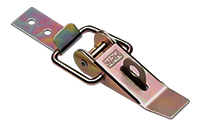
5321-GP-4 Hook Plate – Iron construction with polished finish. Weight: 8g.
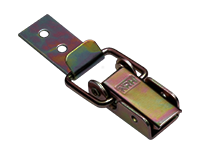
5406-57-KS Latch Body – Iron construction with polished finish. Weight: 24g. Load rating: 15kg.
The 5321-GP-4 hook plate features a precisely bent triangular hook profile that creates three-point contact with the latch body strike plate. This geometry provides mechanical advantage through lever action: minimal operator effort secures the lid, while the hook geometry maintains clamping force until deliberately released. The polished iron construction delivers durability suitable for repeated cycling in warehouse operations.
The 5406-57-KS latch body incorporates the complementary strike plate slot engineered to receive the triangle hook with consistent engagement depth. With a 15kg load rating per latch set, four sets provide 60kg total secure load capacity for the 800x600x500mm wooden case.
Product Comparison: Triangle Hook vs Toggle Latch Technology
| Specification | Triangle Hook (5406-57 / 5321-GP-4) | Heavy-Duty Toggle (6306-85) | Stainless Toggle (5101-96) |
|---|---|---|---|
| Material | Iron (FE) | Iron (FE) | SUS304 Stainless Steel |
| Surface Finish | Polished (CL) | Zinc Plated (ZL) | Vibratory (ZG) |
| Weight | 32g (8g+24g per set) | 203g | 90g |
| Load Capacity | 15kg per set | 588N tensile | 392N tensile |
| Primary Application | Wooden cases, export crates | Heavy transport, industrial boxes | Medical, food-grade enclosures |
| Corrosion Resistance | Basic (indoor use) | Moderate (zinc protection) | High (stainless steel) |
| Cost | Low | Medium | High |
Triangle hook latches excel in wooden case applications where the hook engages with a strike plate mounted on the case lid. This design provides mechanical advantage through lever action, requiring minimal effort to secure or release while maintaining high clamping force. The over-center action of toggle latches offers higher tensile ratings but requires more complex manufacturing and comes at a higher price point.
For wooden freight cases specifically, triangle hook latches provide the optimal balance of cost-effectiveness, reliability, and ease of installation. The simple two-component design (hook plate + latch body) reduces inventory requirements and simplifies field replacement during maintenance operations.
Installation Guide for Wooden Freight Cases
Required Tools and Materials
- Power drill with variable speed trigger
- Phillips head drill bit set (3mm, 4mm)
- Marking pencil or scribe
- Ruler or tape measure (minimum 1m capacity)
- Spirit level (300mm minimum)
- Screwdriver (manual backup recommended)
- M4 x 12mm stainless steel screws (quantity: 16 per case)
- White lithium grease (for pivot lubrication)
Step-by-Step Installation Procedure
- Site Preparation: Ensure the wooden case is fully assembled with all joints secured. Verify wood moisture content is below 18% using a moisture meter. Allow newly assembled cases to acclimatize for 24 hours before hardware installation.
- Position Marking: Mark latch body positions 50-80mm from case corners along the side wall frame. Maintain minimum 100mm spacing between adjacent latches for optimal leverage distribution. Use a spirit level to ensure alignment across opposite mounting positions.
- Pre-Drill Pilot Holes: Drill 3mm pilot holes for the latch body mounting screws. Use a depth stop set to 10mm to prevent drilling through the case wall. Clear chips with compressed air before proceeding.
- Mount the Latch Body: Position the 5406-57-KS latch body with the strike slot facing outward and upward. Align with pilot holes and secure with M4 stainless steel screws (length: 12-16mm depending on case wall thickness). Tighten to 2-3 Nm using a torque screwdriver.
- Install the Hook Plate: Attach the 5321-GP-4 hook plate to the case lid, aligning the hook with the latch body strike slot. The hook should sit centered in the slot with 2-3mm clearance when the lid is closed.
- Test Operation: Close the lid and engage all latches sequentially. Verify smooth hook engagement without binding. Check that the hook seats fully into the strike slot and the latch mechanism clicks into locked position.
- Final Verification: Open and close each latch 5 times to confirm consistent operation. Verify all screws are tightened and apply white lithium grease to pivot points. Recheck torque after 24 hours for any settling.
Critical Considerations for Successful Installation
- Wood moisture content: Install latches on wood with moisture content below 18% to prevent dimensional changes that affect latch alignment during humidity fluctuations.
- Minimum edge distance: Maintain minimum 15mm from panel edges to prevent splitting, especially with hardwood species used in export packaging.
- Hook orientation: Mount all hook plates with the hook opening facing the latch body entry direction. Consistent orientation ensures uniform engagement force.
- Maintenance schedule: Implement quarterly inspections including visual corrosion check, screw tightness verification, and pivot lubrication for continuous-use applications.
Selection Criteria for Wooden Case Applications
Choosing the correct triangle hook latch configuration depends on multiple application-specific factors. Consider the following criteria when specifying hardware for wooden freight case projects:
- Case dimensions and loaded weight: Larger cases require more latch sets to distribute clamping force evenly. As a general recommendation, use 4-6 latch sets per square meter of lid surface area for heavy loads.
- Transit conditions: Vibration-intensive transport modes (rail, ocean freight) benefit from the vibration-resistant triangular hook geometry. The 5406-57-KS with 15kg load rating provides reliable closure for standard export shipments.
- Environmental exposure: Outdoor storage or humid climates favor stainless steel components (5101 series) to prevent corrosion. Standard iron components are suitable for indoor warehouse storage and controlled-environment transport.
- Accessibility requirements: Frequent opening cycles favor quick-release toggle latches; infrequent opening cycles (sealed export crates opened once at destination) suit standard triangle hook configurations.
- Security level: For enhanced cargo security, specify models with integrated padlock eyelets or replaceable key locks. Triangle hooks can accommodate external padlock hasps.
- Reusability expectations: Single-trip packaging may use basic iron hardware; multi-trip containers benefit from stainless steel components with extended service life.
What Happens If You Choose Wrong?
- Using toggle latches where triangle hooks are better suited: Toggle latches require higher installation precision and offer limited mechanical advantage compared to triangle hooks on wooden cases.
- Using iron hardware in coastal environments: Standard iron triangle hook latches will corrode rapidly in salt-air environments. For export shipments to coastal destinations, specify stainless steel alternatives for corrosion resistance.
- Installing only 2 latches on an 800mm case: Two latches create uneven sealing pressure across the lid. Four latches distribute the load evenly, preventing lid warping and ensuring consistent sealing.
- Using the wrong hook orientation: If the hook plate is installed with incorrect orientation, engagement with the latch body will be inconsistent or fail entirely, compromising cargo security.
Application Summary
The 800x600x500mm wooden freight case demonstrates how four 5321-GP-4 hook plates (8g each) and four 5406-57-KS latch bodies (24g each, 15kg load) provide secure, cost-effective closure for export packaging applications. The triangular hook geometry resists vibration-induced loosening, making this configuration suitable for ocean freight and rail transport where cargo experiences sustained dynamic loading.
Key selection factors for this application included:
- Two-component design: Hook plate + latch body simplifies inventory and field replacement
- Vibration resistance: Triangular hook geometry prevents loosening during transit
- Cost-effective iron construction: Suitable for indoor warehouse storage and controlled transport
- 15kg load rating per set: Four sets provide 60kg total capacity for the 800mm case
- Symmetrical 4-set arrangement: Even pressure distribution across lid perimeter
Recommended for similar applications: This triangle hook latch configuration is also well-suited for export shipping crates, heavy equipment transport boxes, military logistics containers, and any wooden freight case requiring reliable closure with vibration resistance.
Frequently Asked Questions
Q: What is the load capacity of the 5406-57-KS latch body?
Data answer: The 5406-57-KS latch body is rated for 15kg per set. With 4 sets installed on an 800x600x500mm wooden case, the total secure load capacity is 60kg.
Q: Can triangle hook latches be used for outdoor wooden cases?
Data answer: Standard iron triangle hook latches are designed for indoor or covered applications with controlled humidity. For outdoor exposure, specify stainless steel variants such as the 5101-96-S04-ZG series, which offer superior corrosion resistance in humid or salt-air environments.
Q: How many latch sets are required for a wooden freight case?
Data answer: A standard 800x600x500mm case typically requires 4 sets (one per corner). Larger cases (1200x1000mm) may need 6-8 sets positioned at 200-300mm intervals. As a general recommendation, use 4-6 latch sets per square meter of lid surface area.
Q: What screw specifications are recommended for mounting?
Data answer: M4 x 12-16mm flat head Phillips screws provide optimal holding power for 2-3mm wooden case walls. For thicker walls (4mm+), use M4 x 20mm screws. Always use stainless steel screws to prevent galvanic corrosion when pairing with iron latches.
Q: What is the difference between the 5321-GP-4 and 5321-85-GP-4?
Data answer: The 5321-GP-4 is the standard hook plate for use with the 5406-57-KS latch body. The 5321-85-GP-4 variant features a different hook span dimension. Confirm compatibility with your specific latch model before ordering.
Q: Is the 5403-83-KS compatible with the 5321-GP-4?
Data answer: Yes. The 5403-83-KS is a heavier-duty triangle hook latch body (52g, 20kg load) that can be paired with the same 5321-GP-4 hook plate. For applications requiring higher load capacity, specify the 5403-83-KS instead of the 5406-57-KS.
Q: What maintenance is required for triangle hook latches?
Data answer: Triangle hook latches require minimal maintenance under normal operating conditions. Quarterly inspections should include: visual check for corrosion or surface damage, verification of screw tightness, lubrication of pivot points with white lithium grease, and functional test of locking action.
Q: Do triangle hook latches comply with export packaging standards?
Data answer: Iron triangle hook latches meet IPPC ISPM 15 requirements for wood packaging materials when used with heat-treated (HT) wooden cases. The hardware itself does not require phytosanitary certification.
Need help choosing the right triangle hook latch for your wooden freight case? Contact our technical team for specification support and sample requests.
Contact Information:
- TEL and WhatsApp and WeChat: +86 180 1797 5137
- E-MAIL: nrh-gz@nrh.cn
- ADD: Room 1703-1704, Zhongji Mansion, 819 Yinxiang Road, Nanxiang Town, Jiading District, Shanghai, China