

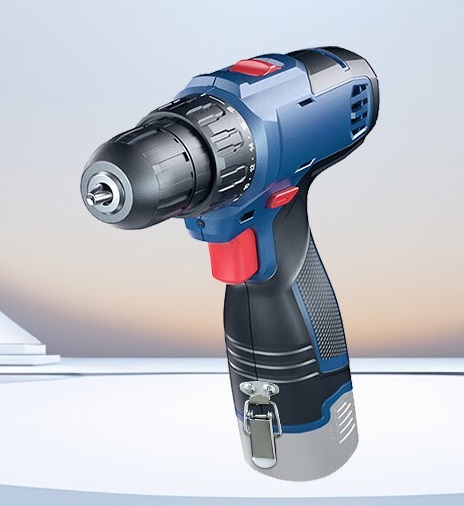
Toggle Latch for Power Tool Battery Cover – 5104-57-S01-ZG
Applicable Buyers: Power tool OEM/ODM manufacturers | Cordless power tool brands | Industrial tool designers | Battery pack housing manufacturers
Key finding: A single 5104-57-S01-ZG toggle latch provides reliable battery cover retention on a 290x200x67mm power drill body. The 57mm latch length aligns with the tool’s width profile, adding minimal bulk while securing the battery cover against vibration-induced opening during use.
Applicable scenario: Home-use power drills with removable battery packs. The toggle latch locks the battery compartment cover to the tool body, preventing accidental battery dislodgement during operation or transport.
Configuration Summary
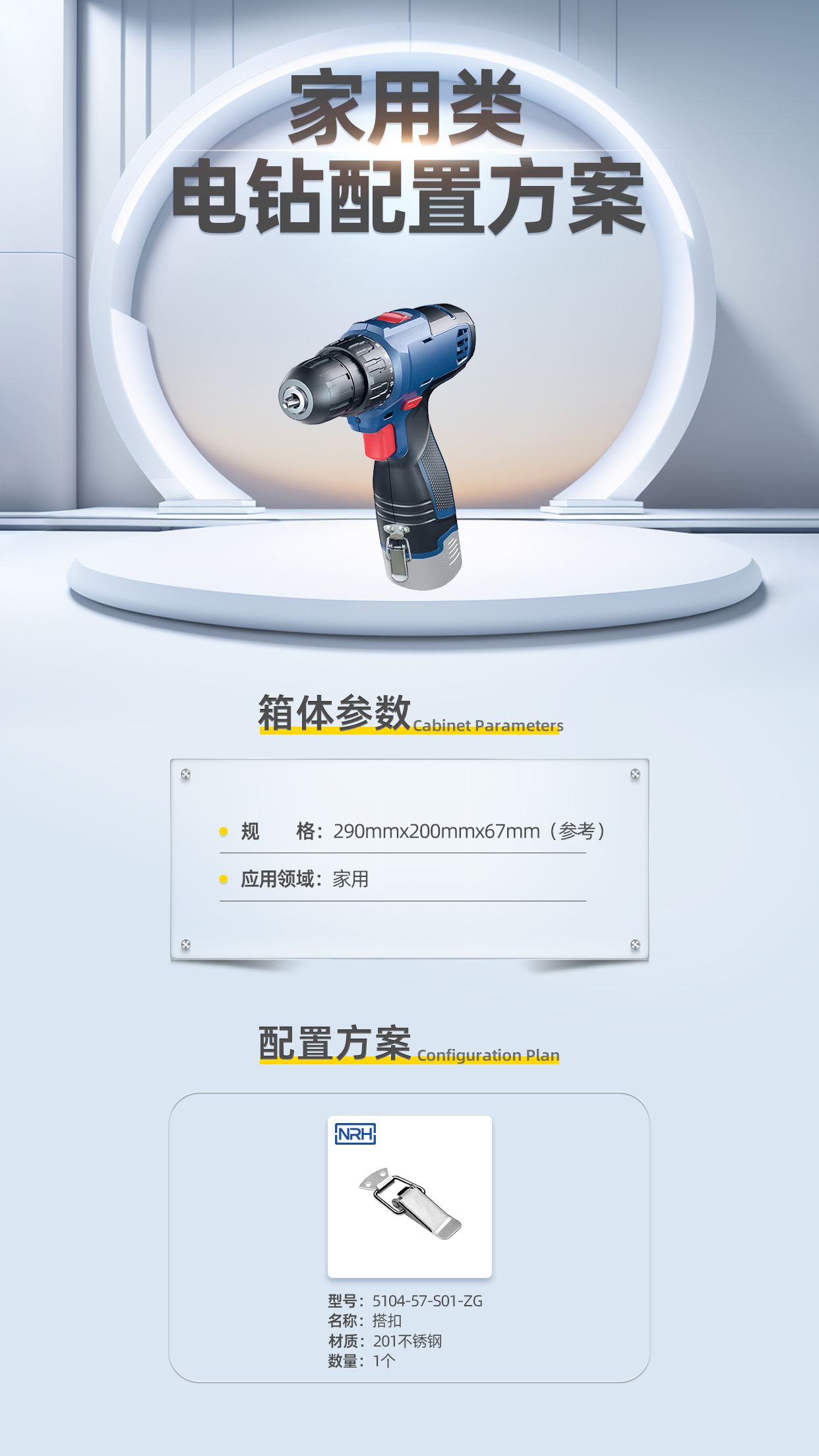
- Tool dimensions: 290mm (length) x 200mm (height) x 67mm (thickness)
- Latch model: 5104-57-S01-ZG
- Material: SUS201 stainless steel
- Surface finish: Vibratory polished (ZG)
- Quantity installed: 1
- Application: Battery cover retention on power tool body
Why This Configuration?
The 5104-57-S01-ZG was selected for three reasons:
- Compact footprint: The 57mm body length fits within the tool’s width profile, avoiding protrusions that catch on clothing or workpieces.
- Single-handed operation: The toggle mechanism allows one-handed opening of the battery cover – important when the user is holding the tool with the other hand.
- Cost-effective material: SUS201 stainless steel provides adequate corrosion resistance for indoor home-use tools at a lower cost than SUS304. Hand sweat and occasional workshop humidity do not compromise the latch’s functional integrity.
Toggle Latch Comparison for Power Tool Applications
| Model | Material | Finish | Body Length | Best For |
|---|---|---|---|---|
| 5104-57-S01-ZG | SUS201 | Vibratory | 57mm | Home-use drill battery covers |
| 5104-56-1-S04-ZG | SUS304 | Vibratory | 56mm | High-humidity or outdoor-use tools |
| 5101-96-S04-ZG | SUS304 | Vibratory | 96mm | Larger tool bodies or heavier battery packs |
Selection note: The 5104-57 is the recommended entry point for most consumer power tools in the 250-300mm length range. Upgrade to SUS304 if the tool is used in outdoor environments or coastal areas.
Installation Guide: Toggle Latch on Power Tool Battery Cover
Tools Required
- Drill with 3mm bit (for pilot holes)
- Rivet gun (4mm blind rivets)
- Marker or scribe
- Deburring tool
Step-by-Step Installation
- Position the latch components. The latch body (toggle assembly) mounts on the tool body (stationary part). The latch receiver (slot) mounts on the battery cover (movable part). Align both components so the toggle arm swings through its full arc without binding.
- Mark pilot hole locations. Use the latch flange as a template. Mark all four mounting holes on both the tool body and the battery cover. Ensure the cover closes fully before the toggle engages the receiver.
- Drill pilot holes. Drill 3mm pilot holes through each marked location. For plastic housings, use slow drill speed to prevent cracking or melting around the hole perimeter.
- Deburr and clean. Remove any burrs or plastic shavings from the hole edges. Clean the mounting surface to ensure the flange sits flush against the housing.
- Secure the latch components. Insert 4mm blind rivets through each flange hole. Set the rivets firmly. The flange must sit completely flat against the plastic housing – any gap reduces latch stability.
- Verify operation. Close the battery cover and engage the toggle. The latch should snap into the locked position with a crisp motion. The cover must not wobble or show gaps when locked.
- Test under vibration. Gently tap the tool body with a rubber mallet and confirm the latch remains locked. Repeat 10 times to verify consistent engagement.
Plastic Housing Considerations
- Pilot hole size: 3mm is recommended for plastic housings. Oversized holes reduce rivet grip and may strip under load.
- Rivet selection: Use aluminum blind rivets for plastic housings. Steel rivets may crack the plastic during setting due to higher expansion force.
- Stress distribution: Consider adding small metal backing plates inside the housing to distribute latch loads over a larger area, preventing stress cracks over time.
Selection Decision Points
1. Tool Size vs. Latch Quantity
For power tools up to 300mm in length, a single 5104-57 toggle latch provides sufficient battery cover retention. Tools exceeding 300mm – or those with large, heavy battery packs – may benefit from a dual-latch configuration using larger models like the 5101-96 series.
2. Material Selection: SUS201 vs. SUS304
- SUS201 is appropriate for indoor, home-use tools with occasional exposure to hand sweat and workshop humidity. It offers adequate corrosion resistance at lower material cost.
- SUS304 is recommended for outdoor use, coastal environments, or professional tools subjected to daily wear and moisture exposure. The higher nickel content provides superior long-term corrosion resistance.
3. What Happens If You Choose Wrong?
- Specifying SUS201 for outdoor use: The latch may show pitting or surface rust within 12-18 months of outdoor exposure, compromising both appearance and function.
- Using steel rivets on a plastic housing: The plastic may crack during installation or develop stress fractures over time, causing the latch to loosen and the battery cover to fail.
- Installing a 96mm latch on a 290mm tool: The oversized latch protrudes beyond the tool profile, creating a snag hazard and an unnatural grip for the user.
4. Mounting Method for Plastic Housings
Blind rivets are the recommended mounting method for plastic power tool housings. They distribute clamping force evenly and resist loosening under vibration. For low-volume or prototype production, self-tapping plastic screws (with appropriately sized pilot holes) can be used as an alternative.
Frequently Asked Questions
Q: Will the latch fit a 290x200x67mm power drill?
Data answer: Yes. The 5104-57 body length is 57mm, which fits comfortably within the 67mm thickness of the tool. The latch adds only 3-8mm to the tool profile when folded, preserving the tool’s handling characteristics.
Q: How does the toggle latch secure the battery cover?
Data answer: The toggle mechanism cams over center as the arm swings into the locked position. This creates a pulling action that draws the battery cover tight against the tool body. The over-center geometry prevents the latch from opening under vibration – it actually tightens further with movement.
Q: Is SUS201 stainless steel suitable for tools used in workshops?
Data answer: Yes. SUS201 provides sufficient corrosion resistance for indoor workshop environments. Hand sweat, humidity, and incidental moisture from cleaning do not degrade the latch within the expected service life of a consumer-grade power tool (5-10 years). For professional tools exposed to outdoor conditions, SUS304 is recommended.
Q: Can I install this latch myself on an existing drill?
Data answer: Yes, if you have basic tools (drill, 3mm bit, rivet gun) and are comfortable modifying the plastic housing. Mark positions carefully before drilling, and consider adding internal backup plates to distribute the load. However, modification will void the tool’s original warranty – this is recommended primarily for product development or prototype runs.
Q: What is the lifespan of the toggle mechanism in frequent-use conditions?
Data answer: In typical power tool use (5-10 battery cover cycles per day), the toggle mechanism exceeds 10,000 cycles without significant wear. The stamped wire-form toggle arm and body design minimize fatigue concentration points, extending operational life beyond the tool’s expected service period.
Q: Does the latch interfere with the tool grip or operation?
Data answer: No. The latch folds flat to approximately 3-8mm above the surface. When mounted on the 67mm-thick tool body, the latch sits within the tool’s natural grip profile. The battery cover remains accessible for replacement without disassembling the latch.
Q: What is the maximum battery pack weight this latch can secure?
Data answer: The latch itself carries a 245N tensile rating. The limiting factor is the plastic housing’s pull-out strength around the rivets, not the latch itself. For a typical 1.5mm-thick ABS housing with 4mm aluminum rivets, the safe working load is approximately 15-20kg – well above the 1-2kg weight of most power tool battery packs.
Need help choosing? Contact the NRH engineering team to review your tool dimensions, housing material, and expected use environment.
Contact Information:
- TEL & WhatsApp & WeChat: +86 180 1797 5137
- E-MAIL: nrh-gz@nrh.cn
- ADD: Room 1703-1704, Zhongji Mansion, 819 Yinxiang Road, Nanxiang Town, Jiading District, Shanghai, China