

Self-Closing Spring Hinge for Truck Cargo Partitions -Heavy Duty Vehicle Hardware
Applicable Buyers: Commercial vehicle OEMs | Pickup truck manufacturers | Automotive parts suppliers | Fleet upfitters | Commercial vehicle body builders
Key finding: Three NRH 8601-100-FE-BK2 spring hinges provide reliable, self-closing partition support for a 1000mm x 1200mm pickup truck cargo partition. The spring-loaded design automatically returns the partition to the closed position, eliminating manual latching steps and improving cargo security during transit.
Pickup trucks are increasingly used as both work vehicles and personal transportation, creating demand for flexible cargo management solutions. The cargo partition separates the rear passenger area from the truck bed, allowing secure storage of loose items while maintaining easy access. This case study examines a commercial vehicle manufacturer’s custom-designed activity partition for pickup trucks, fitted with NRH 8601-100-FE-BK2 spring hinges.
Case Study: Pickup Truck Cargo Partition with Spring Hinges
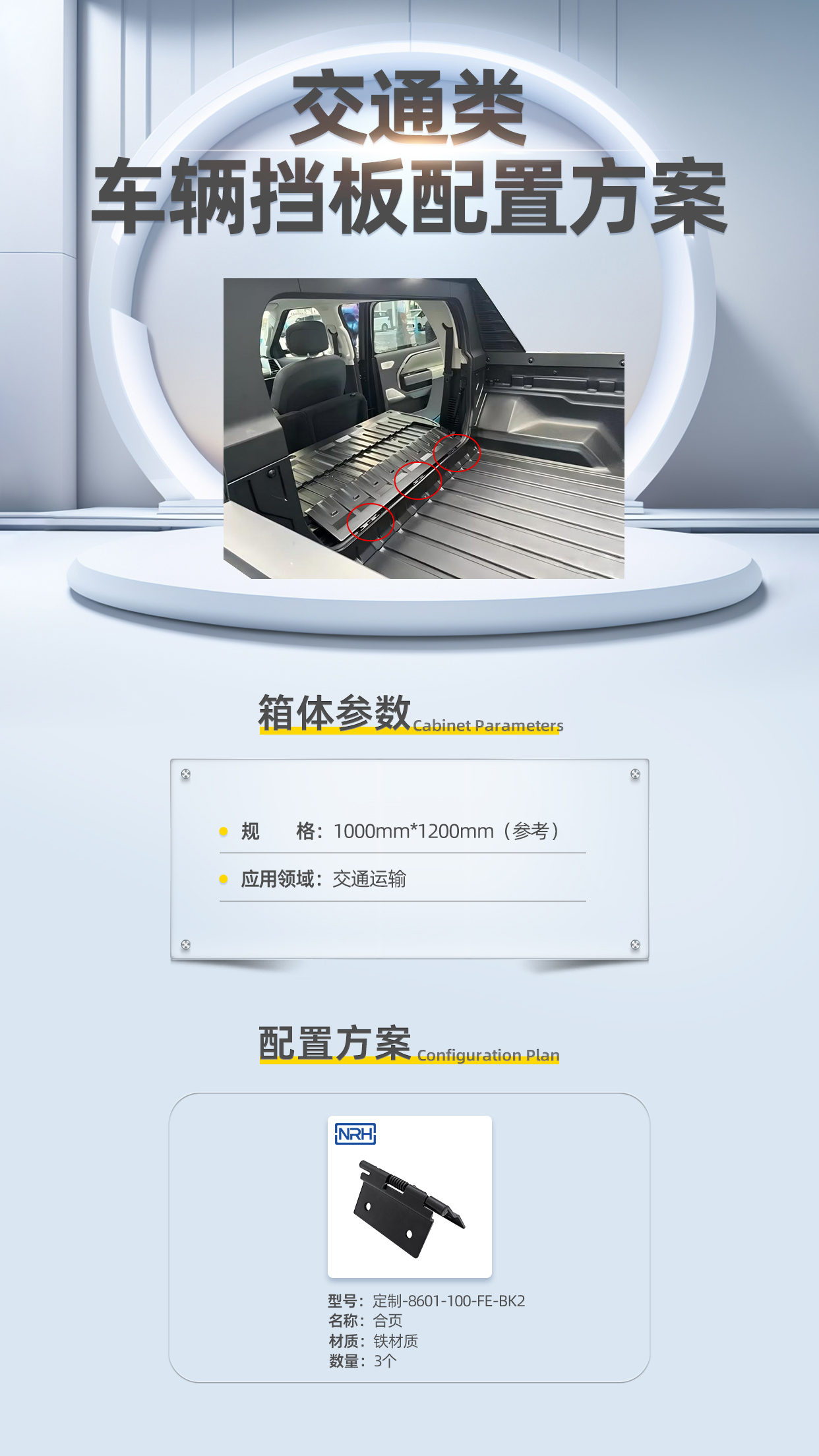
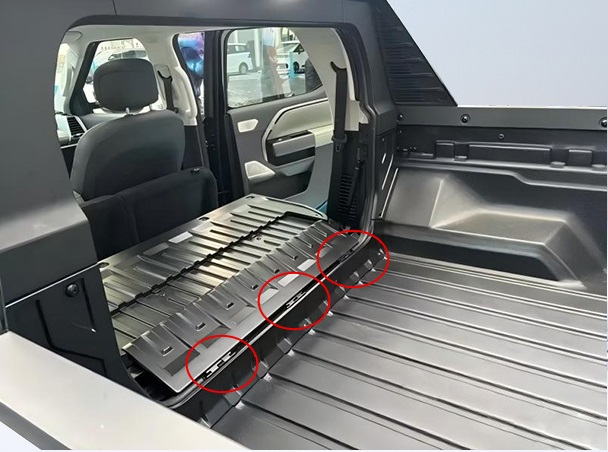
Pickup truck cargo partition (1000mm x 1200mm) fitted with NRH 8601-100-FE-BK2 spring hinges – automatic self-closing design for improved cargo security
Key Performance Data
- Partition Dimensions: 1000mm (width) x 1200mm (height)
- Hinge Model: 8601-100-FE-BK2
- Hinge Material: Iron (FE) with powder coating (BK2)
- Hinge Size: 100mm
- Panel Material: Q235 steel
- Pin & Spring Material: 304 stainless steel
- Surface Finish: Black powder coating
- Quantity Installed: 3 hinges
- Mounting Method: Screw fixing
- Application: Activity partition between rear seat and cargo bed
Application Context
This commercial vehicle manufacturer developed a custom activity partition system for pickup trucks, designed to separate the rear passenger area from the cargo bed. The partition allows users to store loose items securely behind the rear seats while maintaining the flexibility to fold the partition down when full cargo capacity is needed.
The design challenge was to create a partition that opens and closes smoothly while returning to the closed position automatically when released. The spring hinge solution eliminates the need for manual latches or straps, improving user convenience and cargo security during transit.
The 1000mm x 1200mm partition required hinges capable of supporting the panel weight while providing consistent spring return force. Three 8601-100-FE-BK2 spring hinges were selected to distribute the load evenly across the partition width.
Product Specifications
The 8601 series represents NRH’s spring hinge line, designed for applications requiring automatic return functionality. Key specifications for the 8601-100-FE-BK2:
| Parameter | Specification |
|---|---|
| Model | 8601-100-FE-BK2 |
| Material | Iron (FE) with powder coating |
| Panel Material | Q235 steel |
| Pin & Spring Material | 304 stainless steel |
| Surface Finish | Black powder coating (BK2) |
| Hinge Length | 100mm |
| Maximum Opening Angle | 180 degrees |
| Load Capacity (per hinge) | 25kg |
| Pin Diameter | 9.6mm |
| Mounting Hole Diameter | 6mm (through hole) / 9mm (counterbore) |
Why This Hinge Was Selected
The 8601-100-FE-BK2 was chosen for four key reasons:
- Automatic self-closing functionality: The spring-loaded pin mechanism automatically returns the partition to the closed position when released, eliminating manual latching steps and ensuring the partition stays closed during vehicle operation. This is critical for cargo security and driver convenience.
- Balanced load capacity: With a 25kg per-hinge rating, three hinges provide 75kg total capacity, comfortably supporting the Q235 steel partition panel.
- Durable corrosion resistance: The 304 stainless steel pin and spring ensure reliable operation in all weather conditions, while the black powder coating protects the iron body from rust and wear.
- Quiet operation: The precision-fit pin and spring mechanism ensures smooth, noiseless movement – essential for a vehicle interior application where squeaks and rattles would affect perceived quality.
Selection Decision Points
1. Partition Size vs. Hinge Quantity
For a 1000mm-wide partition, three hinges were specified to distribute the load evenly and prevent panel sag. The 8601-100’s 100mm length provides adequate mounting surface while maintaining a compact profile suitable for vehicle interior applications.
Hinge spacing recommendation: Position hinges at one-quarter, one-half, and three-quarters of the partition width for optimal load distribution.
2. Material Selection: Iron with Powder Coating vs. Stainless Steel
- Iron with powder coating (FE-BK2): Selected for this application due to the cost-effective balance of strength and corrosion protection. The powder coating provides durable weather resistance while the iron base delivers structural strength at a lower cost than stainless steel.
- 304 stainless steel pin and spring: The pin and spring are specified in 304 stainless steel to ensure reliable self-closing function in all weather conditions – corrosion of these components would compromise the spring return mechanism.
3. Quality Requirements
This commercial vehicle manufacturer specified strict quality requirements for the hinge:
- No burrs on external surfaces
- No rattling or abnormal noise during operation
- Smooth surface finish with no burrs
- Uniform coating with no surface impurities
- No missing coating coverage
What Happens If You Choose Wrong?
- Using standard hinges without spring return: The partition would remain open after each use, requiring manual closure. This creates a safety hazard as loose cargo could shift forward during braking, and reduces user convenience.
- Using carbon steel pins on an outdoor vehicle: The pin would rust within months of exposure to rain and humidity, causing the hinge to bind and the spring return function to fail. The 304 stainless steel pin is essential for long-term reliability in outdoor conditions.
- Installing only two hinges on a 1000mm partition: The panel would sag over time, causing misalignment and binding. Three hinges provide the necessary support for the Q235 steel panel.
- Specifying uncoated iron for an exterior application: The hinge body would rust rapidly in outdoor conditions, compromising appearance and structural integrity. The powder coating is essential for weather resistance.
Installation Guidelines
Mounting Method
The 8601-100-FE-BK2 is mounted using screw fixing. For this vehicle partition application:
- Fastener recommendation: M6 stainless steel screws with locking washers
- Pre-drill recommendation: 6mm through holes / 9mm counterbores
- Torque specification: Apply 8-10 Nm torque to each fastener
Step-by-Step Installation
- Position the hinges: Mark hinge positions at one-quarter, one-half, and three-quarters of the partition width. Align the hinge flanges flush with the partition edge.
- Mark mounting hole locations: Use the hinge flange as a template. Mark all mounting hole positions on both the partition and the vehicle mounting surface.
- Pre-drill holes: Drill 6mm through holes and 9mm counterbores for flush screw heads. Ensure holes are perpendicular to the mounting surface.
- Install the hinges: Align the hinge with marked positions and secure using M6 stainless steel screws. Apply 8-10 Nm torque to each fastener using a calibrated torque wrench.
- Verify operation: Open and close the partition through 10 complete cycles. The hinge should return the partition to the closed position smoothly with no binding or noise.
- Final inspection: Confirm all fasteners are secure, the partition closes fully, and there is no rattling or abnormal noise during operation.
Installation Considerations for Vehicle Applications
- Vibration resistance: Use locking washers or thread-locking compound on all fasteners to prevent loosening under vehicle vibration.
- Clearance: Ensure adequate clearance for the partition to open fully (180 degrees) without contacting surrounding vehicle interior components.
- Alignment: Verify the partition is properly aligned with the vehicle mounting surface before final tightening.
Application Summary
The 8601-100-FE-BK2 spring hinge addresses the core requirements for pickup truck cargo partitions. The spring-loaded design provides automatic self-closing functionality – essential for cargo security and user convenience – while the iron body with powder coating delivers structural strength and weather resistance at a competitive cost point.
The 304 stainless steel pin and spring ensure reliable operation in all weather conditions, from hot summer days to cold winter mornings. The three-hinge configuration distributes the Q235 steel partition load evenly across the 1000mm width, preventing sag and ensuring smooth operation over the vehicle’s service life.
Key selection factors for this application included self-closing functionality for cargo security, 304 stainless steel pin and spring for all-weather reliability, powder coating for corrosion resistance and appearance, and three-hinge configuration for load distribution.
Recommended for similar applications: This hinge series is also well-suited for SUV cargo partitions, van bulkheads, truck tool boxes, RV cabinet doors, commercial vehicle storage compartments, and any vehicle interior application requiring automatic self-closing functionality with weather-resistant durability.
Frequently Asked Questions
Q: Will three 8601-100 hinges support a 1000mm x 1200mm Q235 steel partition?
Data answer: Yes. Each 8601-100 hinge carries a 25kg load rating. Three hinges provide 75kg total capacity, comfortably supporting the Q235 steel partition. The actual panel weight is typically 15-25kg depending on thickness, providing a safety margin of 3x-5x.
Q: How does the spring return mechanism work in cold weather?
Data answer: The 304 stainless steel spring maintains consistent return force across a wide temperature range. The spring mechanism is designed for all-weather performance, ensuring reliable self-closing function from -20C to +60C. The 304 stainless steel construction prevents corrosion that could degrade spring performance over time.
Q: Is the powder coating durable enough for outdoor vehicle use?
Data answer: Yes. The black powder coating (BK2) provides excellent weather resistance for vehicle exterior applications. The coating is uniform and free from surface impurities, providing protection against rain, humidity, and UV exposure. For this application, the 304 stainless steel pin and spring provide additional corrosion protection in the hinge’s moving components.
Q: What is the maximum opening angle of the 8601-100 hinge?
Data answer: The 8601-100 hinge provides a maximum opening angle of 180 degrees. This allows the partition to fold completely flat against the vehicle interior when full cargo access is needed.
Q: What fasteners should be used for vehicle installation?
Data answer: M6 stainless steel screws with locking washers are recommended. The 6mm mounting holes accommodate M6 fasteners. Stainless steel is recommended to prevent galvanic corrosion between the fastener and the hinge body. Apply 8-10 Nm torque for secure attachment.
Q: Does the hinge make noise during operation?
Data answer: No. The precision-fit pin and spring mechanism ensures smooth, noiseless operation. The hinge is designed with tight tolerances that prevent rattling or squeaking. This commercial vehicle manufacturer specified “no rattling or abnormal noise” as a quality requirement, and the 8601-100 meets this specification.
Q: Are custom hinge configurations available?
Data answer: Yes. NRH supports OEM/ODM customization for hinge dimensions, materials, finishes, and mounting configurations. Custom lengths, mounting patterns, and material formulations can be developed for volume applications with specific performance requirements. Contact the NRH technical team to discuss your specific requirements.
Q: What is the expected service life of the spring mechanism?
Data answer: The 304 stainless steel spring is designed for the full service life of the vehicle (typically 10+ years or 150,000+ miles). The spring mechanism is rated for thousands of open-close cycles. At approximately 10-15 cycles per week, the hinge will exceed 5,000 cycles over 10 years without significant spring degradation.
Need help choosing? Contact our technical team to review your partition specifications and recommend optimal hardware configurations for your application.
Contact Information:
- TEL & WhatsApp & WeChat: +86 180 1797 5137
- E-MAIL: nrh-gz@nrh.cn
- ADD: Room 1703-1704, Zhongji Mansion, 819 Yinxiang Road, Nanxiang Town, Jiading District, Shanghai, China