

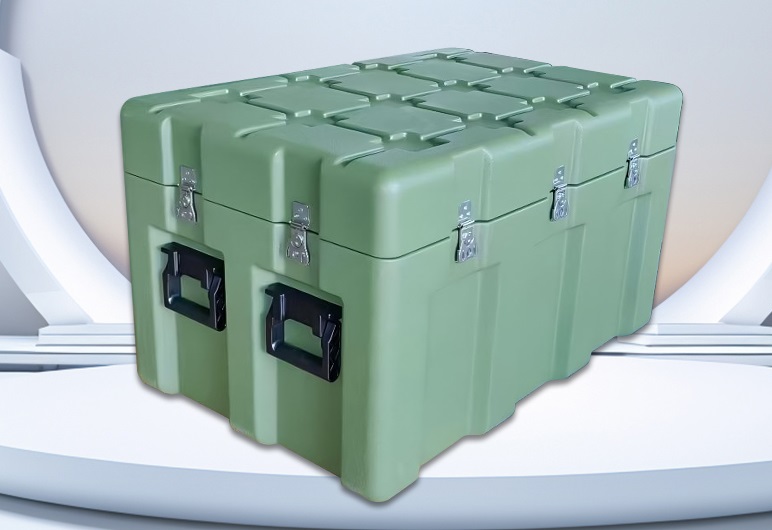
Carbon Fiber Transit Case Hardware – ABS Handles and Stainless Butterfly Latches
Applicable Buyers: Military equipment case manufacturers | Aerospace instrumentation case builders | High-end camera rig case OEMs | Tactical transit case fabricators | Carbon fiber enclosure designers
Key finding: A 1200mm x 800mm x 750mm carbon fiber military transit case was configured with NRH 4462-135-ABS-BK ABS handles (40kg load each) and 6324-74-3-S04-ZG 304 stainless butterfly latches (588N tensile strength). All hardware mounted via pre-installed reinforcement plates (4462-135F and 6324-74F) – carbon fiber panels require pre-drilled or pre-embedded mounting points, not field drilling.
Carbon fiber transit cases protect equipment worth thousands – sometimes millions – of dollars. Aerospace instrumentation, military communication systems, and high-end camera rigs all rely on cases that combine ultra-light weight with rigid structural integrity. But the case shell is only half the equation. The hardware that seals, opens, and reinforces the structure determines whether the case survives years of field deployment or fails at the hundredth closure cycle.
The challenge with carbon fiber is specific: the material is strong in tension but vulnerable at cut edges and mounting points. Every hole drilled, every screw tightened, every latch force applied creates a stress concentration. Choosing the wrong hardware – or the wrong combination of components – leads to delamination, cracked panels, and latches that lose tension after a few dozen cycles.
This guide walks through a real carbon fiber transit case build: a 1200mm x 800mm x 750mm military-spec enclosure equipped with ABS lifting handles, 304 stainless steel butterfly latches, and stainless reinforcement plates. Every model number comes from the actual bill of materials.
Case Study: 1200mm Carbon Fiber Military Transit Case
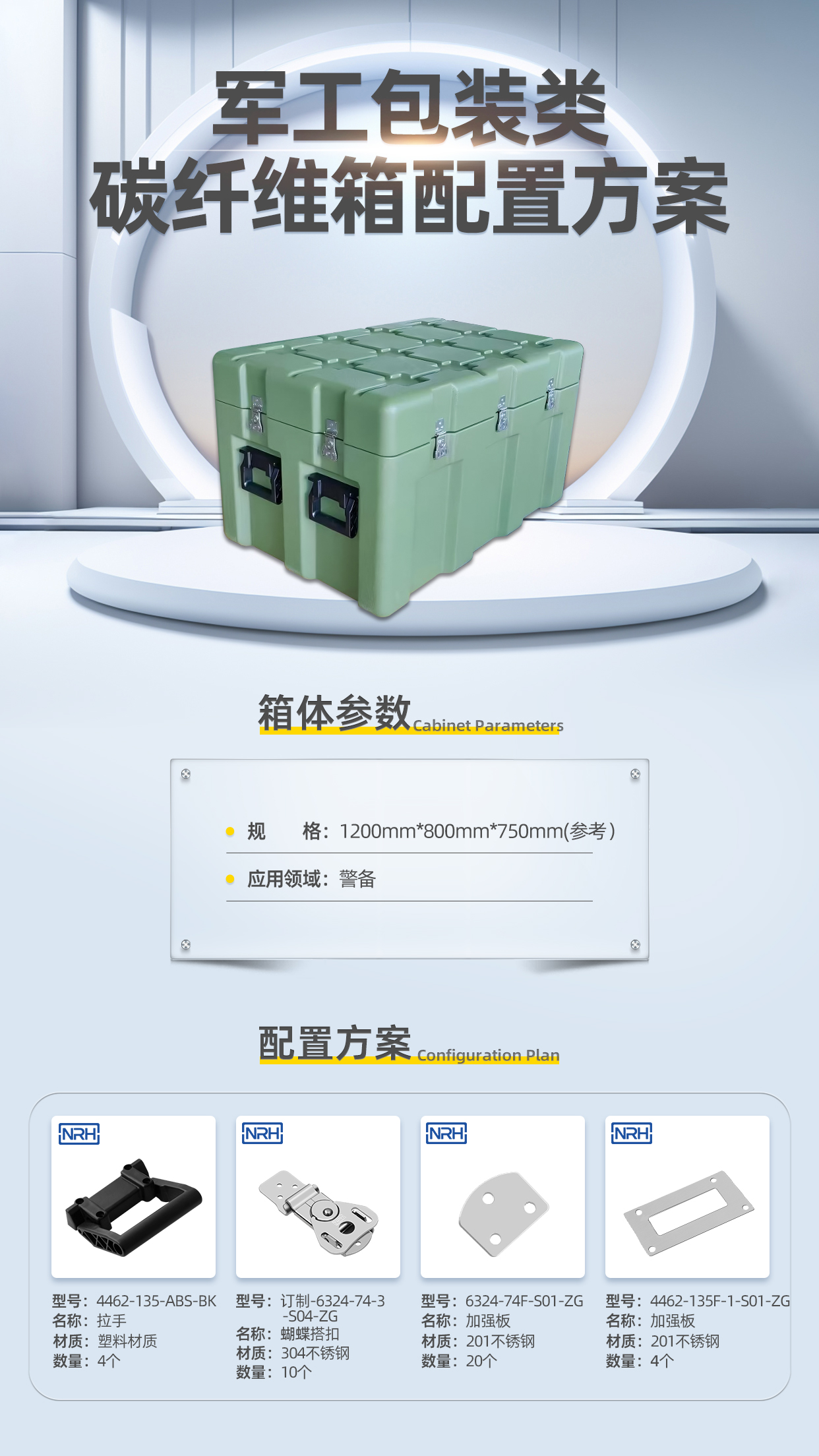
Fig. 1: 1200 x 800 x 750mm carbon fiber transit case configured with 4462-135-ABS-BK lifting handles, 6324-74-3-S04-ZG butterfly latches, and 201 stainless reinforcement plates at all structural joints.
Case Specifications
| Parameter | Value |
|---|---|
| External Dimensions | 1200 x 800 x 750 mm |
| Shell Material | Carbon fiber composite panel |
| Panel Thickness | 2-5mm (estimated) |
| Application Class | Military / Tactical equipment transport |
| Mounting Method | Pre-embedded mounting points (no field drilling) |
Complete Hardware Bill of Materials
| Component | Model | Material | Load Rating | Qty |
|---|---|---|---|---|
| Lifting Handle | 4462-135-ABS-BK | Nylon (ABS-type) | 40kg | 4 pcs |
| Butterfly Latch | 6324-74-3-S04-ZG | 304 Stainless Steel | 588N tensile | 10 pcs |
| Reinforcement Plate (for latch) | 6324-74F-S01-ZG | 201 Stainless Steel | – | 20 pcs |
| Corner Bracket (for handle) | 4462-135F-1-S01-ZG | 201 Stainless Steel | – | 4 pcs |
This build uses 38 total fastening points distributed across 8 corners, 4 lid edges, and 4 lifting positions. The reinforcement plates serve as load-spreading interfaces between the hardware and the carbon fiber shell, preventing point-load damage that would otherwise crack the composite laminate.
ABS Lifting Handles: Model 4462-135-ABS-BK
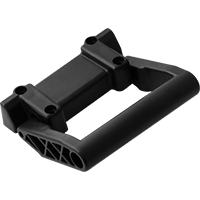
Fig. 2: Model 4462-135-ABS-BK nylon lifting handle. Engineered for 1200mm-class carbon fiber cases where weight reduction at handle stations is critical.
Four 4462-135-ABS-BK handles are mounted at the case’s primary carry positions: two on the long sides and two on the short sides. This nylon handle weighs 162g per unit, delivering a grip that stays comfortable in gloved hands while keeping each handle station lightweight.
Key specifications for the 4462-135-ABS-BK:
| Parameter | Specification |
|---|---|
| Model | 4462-135-ABS-BK |
| Material | Nylon (ABS-type) |
| Color | Black |
| Product Weight | 162g |
| Load Capacity | 40kg |
| Grip Length | 135mm |
| Mounting Hole Diameter | 6.5mm |
| Overall Dimensions | 133.8 x 99.8 x 28.8mm |
The nylon construction matters specifically for carbon fiber cases because metal handles create galvanic contact points. When an aluminum or steel handle touches carbon fiber laminate in the presence of moisture, galvanic corrosion attacks the carbon fiber’s epoxy matrix. The nylon body of the 4462-135-ABS-BK eliminates this galvanic path entirely, while maintaining the structural rigidity needed for loads up to 40kg per handle.
Mounting uses M6 bolts through the reinforcement plates (see below), distributing pull-out forces across the 135mm grip length. The grip length accommodates both bare-hand and gloved operation, a requirement for military and field-service applications.
304 Stainless Butterfly Latches: Model 6324-74-3-S04-ZG
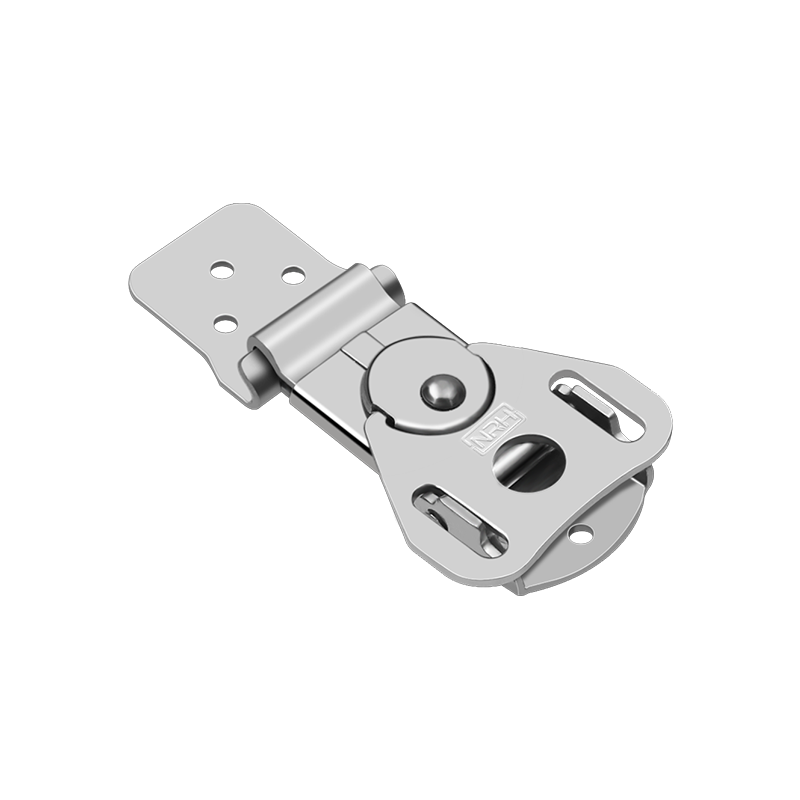
Fig. 3: Model 6324-74-3-S04-ZG butterfly latch in 304 stainless steel. The cam-action closure provides secure lid retention without transmitting impact shock to the carbon fiber shell.
Ten butterfly latches seal the lid-to-base joint. The 6324-74-3-S04-ZG is specified in 304 stainless steel because this case operates in coastal and high-humidity environments where 201 stainless or zinc-plated alternatives would develop surface corrosion within months.
Key specifications for the 6324-74-3-S04-ZG:
| Parameter | Specification |
|---|---|
| Model | 6324-74-3-S04-ZG |
| Material | 304 Stainless Steel |
| Finish | Vibratory Grinding |
| Product Weight | 101g |
| Tensile Load | 588N (approx. 60kg) |
| Overall Dimensions | 107.5 x 72.3 x 62mm |
| Mounting Hole Diameter | 6 x 3.4mm |
Butterfly latches suit carbon fiber cases for three engineering reasons. First, the cam-action mechanism provides consistent clamping force across the entire lid perimeter – critical for maintaining the environmental seal on gasketed carbon fiber enclosures. Second, the latch’s torsion spring absorbs vibration rather than transmitting it rigidly into the case wall. Third, the 74mm body length provides sufficient leverage for operators to open and close the latch while wearing tactical gloves.
Each latch is mounted through a 6324-74F-S01-ZG reinforcement plate. This plate spreads the latch’s clamping load – rated at 588N tensile strength – across a wider area of the carbon fiber panel. Without the plate, repeated latching would eventually crack the thin composite wall at the bolt holes.
Reinforcement Plates and Corner Brackets: The Hidden Structure
The 20 units of 6324-74F-S01-ZG reinforcement plates and 4 units of 4462-135F-1-S01-ZG corner brackets form the structural skeleton that makes this carbon fiber case viable for field deployment.
Reinforcement plates serve a function that most users overlook: they convert concentrated point loads into distributed area loads. Every handle pull, every latch closure, every impact to a corner creates force at a specific bolt location. Carbon fiber composite panels resist distributed loads well but fail unpredictably under concentrated point loads. The 201 stainless steel reinforcement plates – positioned at every hardware mounting point – bridge this gap.
The 6324-74F-S01-ZG plate mates directly with the 6324-74 butterfly latch, providing a 74mm load distribution zone. Key specifications:
| Parameter | Specification |
|---|---|
| Model | 6324-74F-S01-ZG |
| Material | 201 Stainless Steel |
| Finish | Vibratory Grinding |
| Product Weight | 4g |
| Dimensions | 30 x 18mm |
The 4462-135F-1-S01-ZG corner brackets are installed at the case’s primary handle positions. Key specifications:
| Parameter | Specification |
|---|---|
| Model | 4462-135F-1-S01-ZG |
| Material | 201 Stainless Steel |
| Finish | Vibratory Grinding |
| Product Weight | 25g |
| Dimensions | 100 x 84 x 50mm |
| Mounting Hole Diameter | 4 x 5.5mm |
These brackets provide both impact protection and mounting interface for the nylon handles. The 201 stainless construction offers a balance between corrosion resistance and cost – sufficient for most tactical environments while keeping per-unit cost below 304 stainless alternatives.
Installation Sequence for Carbon Fiber Cases
Critical note: Carbon fiber panels cannot be field-drilled for mounting. All mounting points must be pre-embedded or pre-drilled during the panel manufacturing process. The reinforcement plates (6324-74F and 4462-135F) are installed on the inside surface of the carbon fiber panel, sandwiching the composite material between the exterior hardware and interior reinforcement.
Correct installation order for carbon fiber enclosures with pre-embedded mounting points:
Step 1: Verify pre-embedded mounting points. Confirm all 38 mounting locations are pre-formed in the carbon fiber panel. These include positions for 10 latches (20 holes), 4 handles (16 holes), and 2 additional structural points.
Step 2: Position reinforcement plates on the inside surface. Place the 20 units of 6324-74F-S01-ZG plates behind each latch location. Place the 4 units of 4462-135F-1-S01-ZG corner brackets behind each handle position.
Step 3: Install exterior hardware. Mount the 10 units of 6324-74-3-S04-ZG butterfly latches through the pre-formed holes, securing with M6 stainless steel bolts. The bolts pass through the carbon fiber panel and thread into the reinforcement plates on the inside.
Step 4: Install handles. Mount the 4 units of 4462-135-ABS-BK lifting handles to the corner brackets using M6 bolts through the pre-formed holes. The corner brackets distribute the 40kg handle load across the carbon fiber panel.
Step 5: Final torque inspection. Apply 8-10 Nm torque to all fasteners. Check that reinforcement plates sit flat against the interior surface with no gaps.
This sequence ensures that every fastener passes through a reinforcement plate or corner bracket, preventing the concentrated stress that causes matrix cracking.
Selection Criteria: When to Choose This Configuration
This hardware combination – nylon handles, 304 stainless butterfly latches, 201 stainless reinforcement – is optimized for cases that meet these conditions:
- Shell material is carbon fiber, aramid, or other advanced composite with thin-wall construction (typically 2-5mm panel thickness)
- Case dimensions exceed 800mm in any direction, making single-point lifting impractical
- Mounting points are pre-formed during panel manufacturing (no field drilling permitted)
- Weight budget requires nylon handles rather than all-metal alternatives (162g vs 250g+ for metal)
- Load requirements demand 40kg handle capacity and 588N latch tensile strength
- Expected service life exceeds 5 years with regular field deployment
For smaller cases under 600mm, consider reducing the butterfly latch count to 6 and the reinforcement plates to 12. For cases operating exclusively in controlled indoor environments, 201 stainless butterfly latches can replace 304 stainless to reduce cost by approximately 35%.
What Happens If You Choose Wrong?
- Using metal handles directly on carbon fiber without nylon isolation: Galvanic corrosion attacks the epoxy matrix at the mounting points. Within 12-18 months in coastal environments, the handle bolts will loosen as the composite degrades around the fastener.
- Installing latches without reinforcement plates: The 588N latch tension concentrates at the bolt holes. Carbon fiber delamination occurs within 100-200 closure cycles, leading to latch loosening and eventual failure.
- Drilling mounting holes in the field: Carbon fibers are cut rather than displaced by drilling. The resulting stress concentrations cause micro-cracks that propagate under load, potentially leading to catastrophic panel failure.
- Using 201 stainless instead of 304 for exterior latches: In coastal or high-humidity environments, surface pitting begins within 6-12 months, compromising the latch mechanism and appearance.
- Using M4 instead of M6 fasteners: The reduced shear area and bearing surface increase the risk of fastener failure under the 40kg handle load and 588N latch tension.
Application Summary
The 1200mm carbon fiber military transit case demonstrates how properly specified hardware – nylon handles with reinforcement plates, 304 stainless butterfly latches, and 201 stainless corner brackets – creates a durable, field-ready enclosure that protects high-value equipment.
Key selection factors for this application included:
- Galvanic isolation: Nylon handle bodies (4462-135-ABS-BK) prevent corrosion at the carbon fiber interface
- Load distribution: Reinforcement plates (6324-74F and 4462-135F) convert point loads to area loads
- Corrosion resistance: 304 stainless latches (6324-74-3-S04-ZG) withstand coastal environments
- Pre-formed mounting: All holes embedded during panel manufacturing – no field drilling
- Capacity: 40kg handles and 588N latches provide ample safety margin for the 1200mm case
Recommended for similar applications: This hardware configuration is also well-suited for aerospace instrument cases, high-end camera equipment cases, drone transport cases, tactical medical equipment cases, and any carbon fiber or advanced composite enclosure requiring lightweight hardware with high load capacity.
Frequently Asked Questions
Q: Why use nylon handles instead of aluminum on carbon fiber cases?
Data answer: Nylon handles prevent galvanic corrosion at the handle-to-shell interface. Aluminum handles in direct contact with carbon fiber create a galvanic cell in humid conditions, which degrades the epoxy matrix around the mounting points. The 4462-135-ABS-BK uses nylon construction weighing 162g per unit with 40kg load capacity, eliminating the galvanic path while providing equivalent strength.
Q: How many butterfly latches does a 1200mm case need?
Data answer: Ten latches provides optimal clamping distribution for a case of this size. Each 6324-74-3-S04-ZG latch carries a 588N tensile rating. Ten latches provide 5,880N total clamping force, ensuring the lid remains sealed under transport vibration and impact.
Q: Can I use 201 stainless butterfly latches instead of 304?
Data answer: For indoor or dry-environment applications, 201 stainless provides adequate corrosion resistance at lower cost. However, for military, marine, or outdoor applications, 304 stainless is strongly recommended. The 6324-74-3-S04-ZG model’s 304 construction ensures the latch mechanism remains functional after exposure to humidity and salt spray that would cause 201 stainless to develop surface pitting.
Q: What is the purpose of the reinforcement plates?
Data answer: Reinforcement plates distribute concentrated hardware loads across the carbon fiber panel surface. Without them, bolt heads and latch mechanisms create point loads that exceed the interlaminar shear strength of the composite, leading to delamination. The 6324-74F-S01-ZG plates (30 x 18mm, 4g each) and 4462-135F corner brackets (100 x 84mm, 25g each) increase the effective bearing area compared to direct bolt mounting.
Q: Why can’t I drill mounting holes directly into carbon fiber?
Data answer: Carbon fiber panels require pre-formed or pre-embedded mounting points during manufacturing. Field drilling cuts through carbon fibers rather than displacing them, creating stress concentrations at the cut edge. These micro-cracks propagate under load, potentially leading to delamination and structural failure. All mounting points for this case were pre-embedded during panel fabrication.
Q: Are custom reinforcement plate sizes available?
Data answer: Yes. The 6324-74F-S01-ZG (30 x 18mm) and 4462-135F-1-S01-ZG (100 x 84mm) are standard sizes matched to specific hardware. For non-standard hardware configurations or larger mounting surfaces, NRH provides custom plate fabrication in 201 or 304 stainless steel with minimum order quantities starting at 100 pieces.
Q: What is the expected service life of this hardware configuration?
Data answer: With proper installation and pre-embedded mounting points, the 6324-74-3-S04-ZG butterfly latches exceed 10,000 open-close cycles at 588N tensile rating. The 4462-135-ABS-BK handles maintain structural integrity for 15+ years in normal field use. Reinforcement plates are non-wearing components that last the lifetime of the case unless subjected to impact damage beyond the case’s design specification.
Q: What torque should be applied to the mounting bolts?
Data answer: Apply 8-10 Nm torque to all M6 mounting bolts. Carbon fiber panels require consistent, moderate clamping force. Over-torquing can crush the composite panel around the pre-embedded mounting point. Under-torquing allows the hardware to loosen under vibration. Use a calibrated torque wrench for all fasteners.
Need help choosing? Contact our technical team to review your carbon fiber case specifications and recommend optimal hardware configurations for your application.
Contact Information:
- TEL and WhatsApp and WeChat: +86 180 1797 5137
- E-MAIL: nrh-gz@nrh.cn
- ADD: Room 1703-1704, Zhongji Mansion, 819 Yinxiang Road, Nanxiang Town, Jiading District, Shanghai, China