

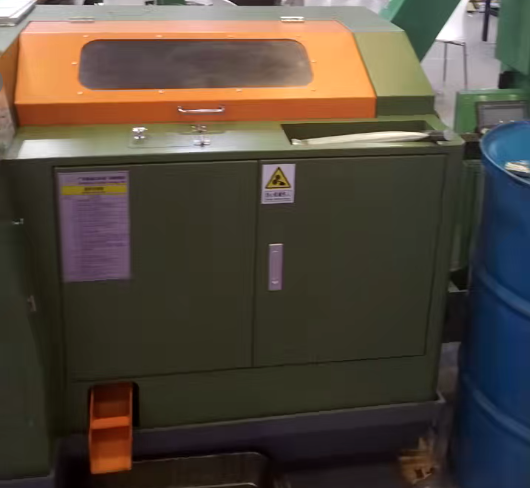
Stainless Steel Machine Guards Case: Hinges + Handles
A 304 stainless steel hinge for machine tool guard doors is more than just a piece of hardware – it is a critical component in any industrial protection system. Pair it with the right U-type pull handle, and you have a guard door that opens smoothly, closes securely, and lasts for years without maintenance headaches.
When it comes to machine tool guards – whether telescopic steel way covers, bellows covers, or sheet metal guard doors – the hardware you choose matters more than most engineers realize. A machine guard is only as reliable as its moving parts. The hinge that swings the door open, the handle operators pull on every shift – these are the points of failure that can bring production to a halt.
After 15+ years supplying industrial hardware to machine tool builders and sheet metal fabricators across Europe, Southeast Asia, and South America, we have seen the same pattern over and over: customers focus on guard panel material and sealing performance, but treat hinges and handles as afterthoughts. Six months later, they are dealing with rusted hinges on coolant-exposed machines, or handles that have worked loose from constant vibration.
This article breaks down two of our most requested hardware components for machine guard applications: a 304 stainless steel screw-on hinge and a U-type pull handle. We cover specifications, installation best practices, material selection logic, and what customers in different industrial regions tend to prioritize.
What Types of Machine Guards Do These Components Fit?
Machine guards come in many forms, and not every hinge or handle works for every application. Here is how the parts featured in this article map to real-world use cases:
- Telescopic steel way covers: Segmented metal covers that slide along guide ways on CNC mills, lathes, and grinders. Access doors and inspection panels built into the guard structure need reliable hinges. Screw-on hinges are standard because welding would warp thin guard plate.
- Fixed sheet metal guard doors: Full enclosure guards around laser cutters, press brakes, and robotic cells all have swing-out access doors. These need robust hinges that handle steel or aluminum panel weight, plus a handle operators can grip quickly – even with work gloves.
- Bellows and flexible covers with rigid frames: Accordion-style covers with metal end frames and access hatches also use stainless steel hardware, particularly where coolant and chip splash is a factor.
- Inspection and maintenance access panels: Smaller access points on larger guard assemblies benefit from compact hinges and mid-size handles. The parts featured here sit in the middle of our size range.
The common thread across all these applications is the need for corrosion resistance, reliable fastening, and hardware that does not require specialized tools to install. That is where screw-mount 304 stainless steel components win over weld-on hinges or plastic handles – especially for telescopic cover hardware and sheet metal cabinet hinge applications.
Stainless Steel Screw-On Hinge for Machine Guard Doors
For machine tool guard hinge applications, we consistently recommend our 304 stainless steel screw-on hinge over welded or press-fit alternatives. It is not that welded hinges are bad – they have their place – but for the vast majority of guard door installations, screw-mounting is simply the smarter choice.
Why screw-on rather than weld-on? Three practical factors drive this recommendation:
- No heat distortion: Most machine guard panels are 1.5mm to 3mm sheet steel or aluminum. Welding a hinge to thin plate causes warping, and the heat-affected zone becomes a corrosion point. Screw installation eliminates heat damage entirely.
- Field serviceability: If a hinge gets damaged – and in a factory, eventually something gets hit by a forklift or falling tool – you can unbolt and replace it in minutes. Welded hinges require grinding, re-welding, and repainting. That is hours of downtime vs. minutes.
- Mixed material compatibility: When you have an aluminum guard panel mated to a steel frame, welding is not straightforward. Screw-on hinges work across material combinations as long as you use the right fasteners.
Hinge Specifications
| Parameter | Specification |
|---|---|
| Model | 8262-37 |
| Material | 304 stainless steel |
| Surface finish | Vibration polished |
| Weight | 31g |
| Load capacity | 12kg per pair (vertical mounting) |
| Through holes | 4 x Phi5.5mm |
| Countersink holes | 4 x Phi8.2mm |
| Installation | Screw fixed |
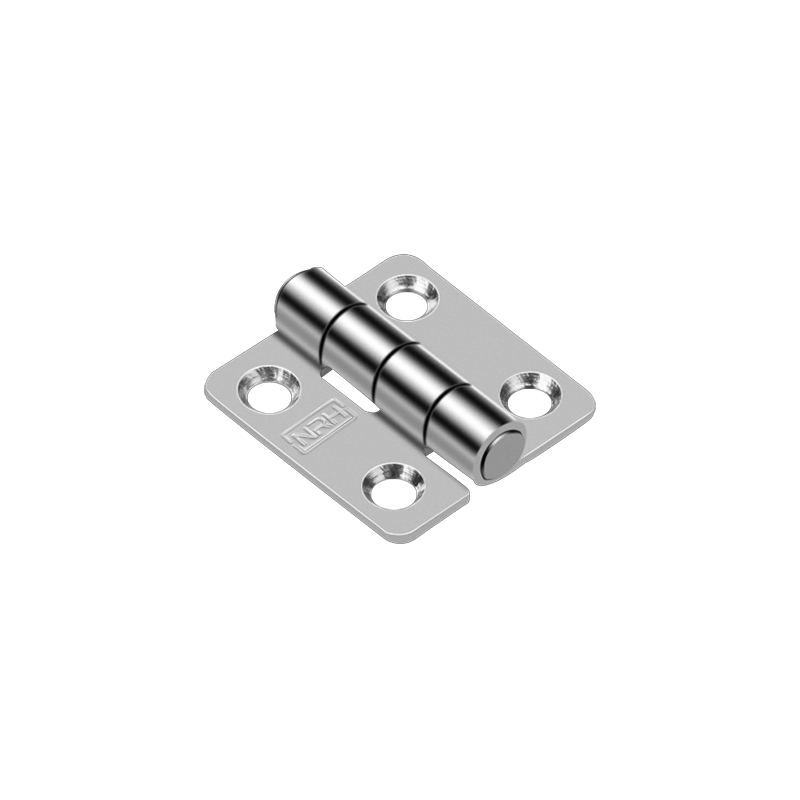 Model 8262-37 stainless steel screw-on hinge with countersunk mounting holes for flush installation on machine guard panels.
Why 304 Stainless Steel?
304 is the workhorse grade of stainless steel for industrial hardware. It offers a solid balance of corrosion resistance, mechanical strength, and cost-effectiveness that makes it the default for most indoor industrial environments.
For machine way cover and guard door applications specifically, 304 handles the typical challenges well:
- Coolant and oil resistance: Water-based cutting fluids, way lube, and hydraulic oil are constant around machine tools. 304 stainless resists the mild acids and alkaline compounds in metalworking fluids far better than zinc-plated steel, which shows red rust within a year of coolant exposure.
- Chip impact resistance: Flying metal chips are abrasive and hot. 304 stainless has the hardness to take chip impacts without gouging the way aluminum would.
- Easy to clean: Factories doing regular washdowns appreciate that 304 stainless stands up to most industrial cleaning chemicals without staining.
An honest caveat: 304 is not 316. If your application involves direct exposure to chlorinated chemicals, salt spray (coastal facilities), or highly acidic environments, step up to 316 grade. But for the vast majority of machine shop settings, 304 hits the right balance.
The vibration-polished finish is also a practical choice. It is smooth, uniform, and hides small scratches and handling marks better than a mirror finish. It looks clean, wipes down easily, and has fewer places for dirt and grime to catch.
U-Type Stainless Steel Pull Handle for Guard Doors
For machine guard doors, the U-type pull handle is the design we recommend most frequently. Machine guard doors are not office cabinet doors – they get opened and closed by people wearing work gloves, sometimes with greasy hands, often in a hurry. The handle needs to be easy to grip, sturdy enough for hard use, and simple to install correctly on sheet metal.
The U-type design checks all these boxes. Unlike a D-ring or bow handle with complex curves, the U-shape gives a straight horizontal gripping surface that is easy to find by feel and easy to pull even with heavy gloves. No sharp angles, no pinch points, and the load distributes straight into two mounting posts.
Handle Specifications
| Parameter | Specification |
|---|---|
| Model | 4636-100 |
| Material | 304 stainless steel |
| Surface finish | Polished |
| Weight | 123g |
| Load capacity | 35kg |
| Design | U-type pull handle |
| Installation | Hole mounting, screw fixed |
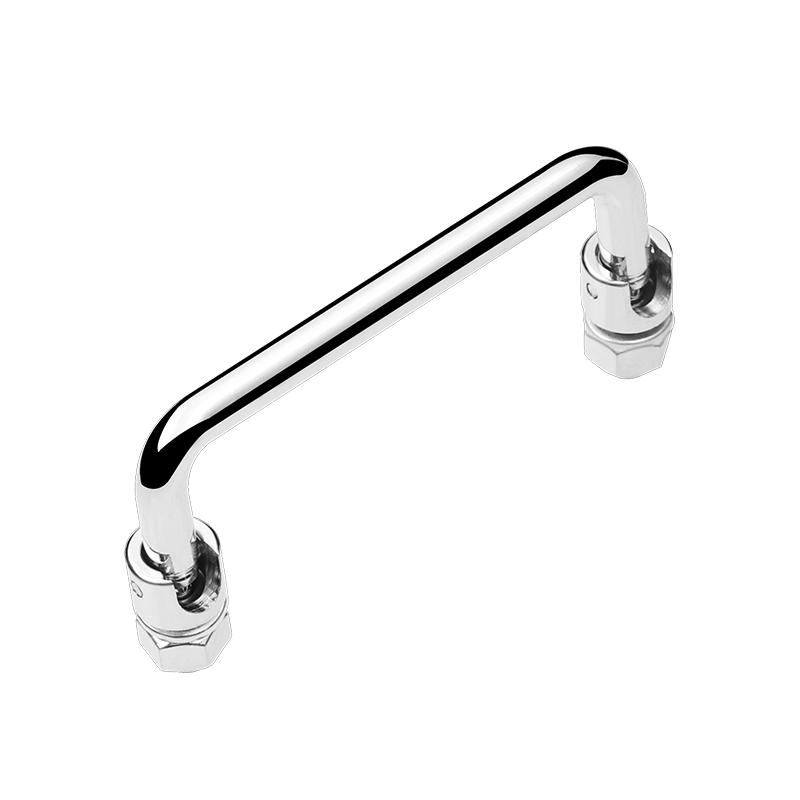 Model 4636-100 U-type 304 stainless steel pull handle for heavy-duty machine guard door and industrial equipment access panel applications.
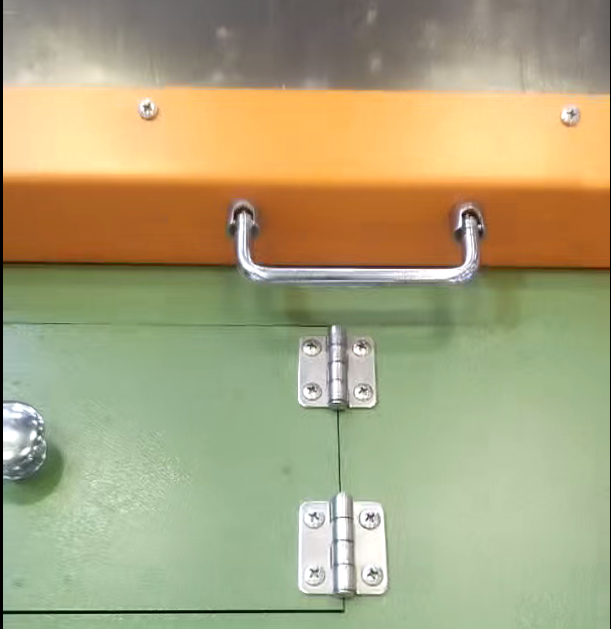 Stainless Steel Machine Guards Case: Hinges + Handles
Why Hole Mounting for Guard Door Handles?
Two common approaches exist for mounting pull handles on sheet metal doors: surface mounting with a base plate, and through-hole (stem) mounting. For stainless steel handle installations on guard doors, we prefer through-hole mounting for two key reasons.
Mechanical strength is the biggest factor. When you pull on a handle, fasteners experience a combination of shear and tension. Through-hole mounting puts the screw shank directly through the panel, so load distributes through the material thickness rather than relying entirely on screw pull-out strength in thin sheet metal. For doors that get pulled hard, kicked open, or bumped by pallet jacks, that difference in security is significant.
Tamper resistance is another benefit for safety guard applications. Fasteners are on the inside of the guard, so from the operator side you see a clean handle with no exposed screw heads. Nobody can loosen the handle from outside the guarded area.
Hole mounting does require more fabrication work upfront. You need to drill precise holes and have back-side access for fastening. For new construction or custom guard builds, this is a non-issue. For retrofitting existing guards, you will need to measure carefully and drill on-site. The extra 15 minutes of installation time buys a decade of reliable service.
Installation Guide: Getting It Right the First Time
We have seen too many installations fail not because the hardware was bad, but because it was installed incorrectly. Here is our practical guide.
Proper installation of U-type pull handles and screw-on hinges ensures long-term reliability on machine guard doors.
Installing the U-Type Pull Handle (Hole Mounting)
Step 1: Mark and measure. Hold the handle up to the door and mark the center-to-center distance of the mounting posts. Use a center punch to mark drill points. A misaligned hole means the handle goes in crooked – nobody wants that.
Step 2: Drill the holes. Use a drill bit sized for the handle stud diameter. We recommend a step drill bit for sheet metal – it gives a cleaner hole with less burr than a standard twist drill. Deburr both sides after drilling.
Step 3: Test fit. Insert the handle posts through the holes and make sure everything sits flat. If the handle rocks, you probably have a burr or off-center holes. Fix it now, not after adding thread locker.
Step 4: Add washers and fasten. On the back side, add a flat washer and lock washer (or nylon insert lock nut) before threading on the nut. For doors near stamp presses or forging hammers, add a drop of thread-locking compound. Vibration works fasteners loose faster than you think.
Step 5: Torque and test. Do not reef on the nut with an impact driver. 304 stainless fasteners can gall if over-tightened. Use a wrench and tighten to moderate torque – roughly 8-12 Nm. Give the handle a solid tug to confirm it is secure.
Installing the Screw-On Hinge
Hinge installation is simpler, but a few common mistakes are worth avoiding:
- Right screws for the material: Self-tapping sheet metal screws work for steel up to 3mm. For aluminum, use machine screws with Rivetnuts or threaded inserts – do not thread directly into aluminum, it will strip out over time.
- Spacing matters: For a typical guard door up to 1m tall, two hinges is standard. Position them roughly 150mm from top and bottom. For taller or heavier doors, add a third hinge in the middle.
- Drill pilot holes: Even self-tapping screws need a pilot hole in hard material. Skipping this is how you get broken screws inside hinge mounting holes – a real headache to fix.
- Check alignment first: Screw all hinges on loosely, close the door, check the gap, and adjust before driving screws home. Backing out a self-tapping screw and re-driving it weakens the connection.
What Buyers in Different Markets Prioritize
Having supplied machine guard hardware to customers across dozens of countries, we have noticed clear regional patterns. Every customer is different, but these trends hold broadly true.
Europe: Customers in Germany, Italy, Spain, and other European manufacturing hubs are the most technically detail-oriented. They want dimensioned drawings, material certificates (3.1 certificates are standard), and specific answers about load testing and surface finish. European buyers consistently choose stainless steel over zinc-plated alternatives – higher factory utilization and long-term reliability standards justify the premium.
Southeast Asia: Vietnam, Thailand, Malaysia, and Indonesia are fast-growing markets where lead time and price-performance ratio are top priorities. Many factories run high-mix, medium-volume production where hardware needs to ship fast. We also see a clear trend toward 304 stainless as electronics and automotive manufacturing expand in the region.
South America: Brazil, Argentina, and Chile have established manufacturing sectors with strong machine tool communities. Customers here prioritize mechanical robustness and ease of maintenance. Equipment runs hard, replacement parts can be hard to source locally, and downtime is expensive. Screw-on hinges that replace without welding and standard-size handles for spares are highly valued.
Mexico and Australia: Mexico’s automotive and aerospace sectors combine North American quality expectations with practical operational needs – documentation, fast delivery, and durability all matter. Australian buyers focus on standards compliance and corrosion resistance; for coastal facilities, 304 is the baseline and 316 is common for direct coastal exposure.
Quality Assurance and Custom Options
When you specify hardware for safety-critical applications like machine tool guards, you need confidence that what arrives matches the spec sheet. At NRH Box Hardware:
- Material verification: Every batch of stainless steel comes with a mill certificate, and we spot-check composition using XRF testing. The last thing you want is a “304” hinge that is actually 201 grade and starts rusting in six months.
- Dimensional inspection: Critical dimensions – hole spacing, mounting thread size, overall length – are checked against the drawing on every production batch.
- Load and corrosion testing: We physically test samples to verify rated load capacity with a safety margin, and run periodic salt spray tests to validate real-world corrosion performance.
Beyond standard catalog items, we regularly customize for specific applications. Common modifications include different sizes (both handles and hinges come in multiple dimensions), material upgrades (316 stainless), custom hole patterns to match existing designs, and branding/packaging options (laser marking, custom bags, kitting with fasteners) for OEM customers.
If you have a custom requirement, send us your drawing or a sketch with key dimensions. We will tell you upfront whether it is a simple modification or needs dedicated tooling. We would rather be honest about feasibility than waste your time.
Why Choose NRH Box Hardware
There is no shortage of hardware suppliers in the world. What customers consistently tell us is that they value the combination of product consistency, technical support, and reliable shipping from a specialized industrial hardware supplier rather than a general trading company.
We focus specifically on box hardware and industrial enclosure components – hinges, handles, latches, gaskets, and related accessories. This is not a side business; it is what we do every day. When you call with a question about hinge load calculations or handle mounting details, you talk to someone who has answered that same question dozens of times before.
We also maintain deep stock on standard items like the products in this article, so most orders ship within 3-5 business days. For customers who need faster turnaround or bulk quantities, we can discuss stock reservation programs or scheduled deliveries to match your production timeline.
Ready to Spec Your Guard Hardware?
If you are working on a machine tool guard project and need reliable stainless steel hinges and handles, we can help. Whether you need 50 pieces for a custom build or 5,000 pieces a year for OEM production, the process is straightforward: send us your application details and quantity requirements, and we will come back with product recommendations, pricing, and lead times.
We also provide samples for testing and fit evaluation before you commit to a production order. Most customers want to physically hold the hardware, test the feel of the handle, and check installation dimensions against their panel design.
Hardware is a small part of the machine, but specifying the wrong part is expensive to fix later. To get started, reach out to our sales team with your project details. We typically respond within one business day.
Frequently Asked Questions
Can these hinges and handles be used on outdoor machine guards?
Yes, with the right material choice. Our standard 304 stainless versions work well for covered or sheltered outdoor applications. For fully exposed outdoor installations, particularly coastal areas, we recommend upgrading to 316 stainless steel. We offer both models in 316 on request.
What type of screws should I use with the screw-on hinge?
It depends on the material. For steel guard panels up to 3mm, self-tapping sheet metal screws work well. For thicker steel or aluminum, use machine screws with threaded inserts or Rivetnuts for a more durable connection. Always use stainless steel screws to match the hinge material. The hinge has 4 x Phi5.5mm through holes with Phi8.2mm countersinks for flush mounting.
What is the maximum door weight for two hinges?
The rated working load for a pair of vertically mounted hinges is 12kg. This is a conservative working load rating, not an ultimate breaking load. For heavier doors, use three hinges (top, middle, bottom) or step up to a heavier-duty model. Send us your door dimensions, weight, and hinge spacing and we will help you calculate what you need.
Can the U-type handle be installed without back-side access to the panel?
The through-hole mounting style of the 4636-100 does require back-side access for the nuts. If the back of the guard panel is inaccessible – for example, a sealed telescopic cover – we have surface-mount handle alternatives that install from the front. The tradeoff is slightly lower pull strength. Let us know your constraint and we will recommend the right handle style.
Do you offer custom packaging or private labeling for OEM customers?
Yes, we offer both laser marking for branding (your logo and/or part number on the hardware) and custom packaging options including individual poly bags with labels, blister packs, or bulk packaging in project-specific boxes. Minimum order quantities apply. We also offer kitting services – bagging a hinge and handle set together with correct fasteners for a specific guard model.