

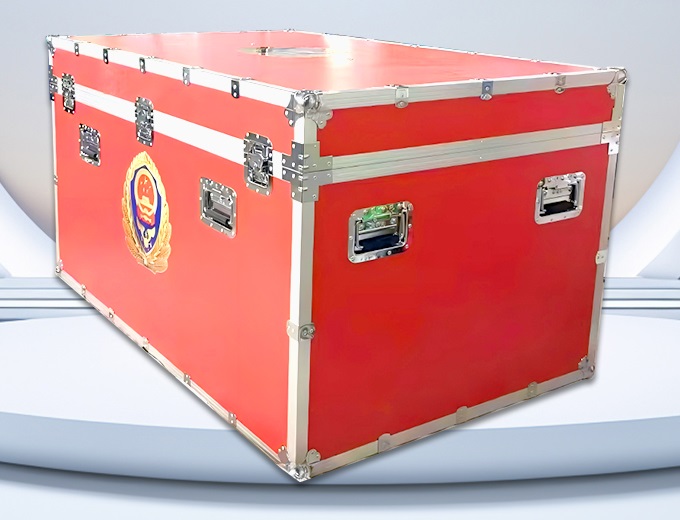
How to Select Aviation Case Hardware That Survives Air Transport
Applicable Buyers
Avionics equipment manufacturers, military logistics providers, stage lighting and audio equipment rental companies, medical device transporters, and custom case fabricators requiring hardware for flight cases and ATA-compliant shipping containers.
Key Finding
A 1200mm avionics case requires 8 butterfly locks to maintain lid seal integrity under vibration, while a 1050mm stage equipment case needs only 6 – the difference is lid surface area and flex, not case length. Both cases use iron chrome-plated hardware with one key difference: the smaller case specifies SUS304 butterfly locks for enhanced corrosion resistance on the locking mechanism.
What Happens If You Choose Wrong
A butterfly lock rated below 392N shears during turbulence, spilling a $50,000 avionics unit across the cargo hold. Protruding handles snag on cargo nets and shear off under stacking weight, compromising the entire pallet. Chrome-plated hardware specified for an outdoor loading dock develops red rust within 18 months, seizing latches and making cases unopenable.
A 40kg avionics unit sits inside a hardened transit case on a cargo pallet at 35,000 feet. The case has already survived a 1.2-meter impact onto concrete, 8 hours of random vibration at 5-500 Hz, and a 60-degree-Celsius temperature swing between the tarmac and the cargo hold. Through all of it, the latches stayed shut, the handles held firm, and the corner protectors absorbed impact without cracking. That is not luck – it is the result of choosing the right aviation case hardware for the job.
This guide examines two real aviation case configurations – a 1200mm avionics transport case and a 1050mm stage equipment case. Each uses the same four hardware categories: latches, handles, hinges, and corner protectors. The difference in hardware quantities reveals the engineering principle behind specifying hardware for flight cases: latch count scales with lid surface area, not case length.
Aviation Case Applications: Where Hardware Meets Reality
Aviation cases serve two primary categories of applications, each with distinct hardware demands:
Precision instrument and valuable equipment transport. Stage lighting consoles, medical imaging devices, LED display panels, military-grade electronics, and avionics units all require cases that absorb impact, resist vibration, and maintain environmental seals. These cases move between climate-controlled warehouses and outdoor tarmacs, experiencing rapid temperature swings and repeated handling. Hardware must survive thousands of open-close cycles while maintaining consistent clamping force.
Military and aerospace-grade equipment transport. Avionics test sets, field communication systems, airborne instrumentation, and logistical support equipment demand the highest level of durability. Cases must pass MIL-STD-810H vibration profiles and maintain function through extreme temperature ranges. Hardware failure in these applications is not an inconvenience – it is a mission-critical failure.
The two real case builds in this guide – an avionics/communications case and a stage lighting transport case – represent the spectrum of aviation case hardware requirements, from high-security keyed butterfly locks to durable recessed handles.
Understanding the Five Hardware Categories
Before examining the two case builds, here is a quick overview of the five hardware categories used in aviation cases:
Butterfly Lock (Butterfly Latch with Key Lock). The industry standard for cases requiring secure closure and controlled access. A rotating handle cams the hook to a catch, drawing the lid down with increasing force. The built-in key lock prevents unauthorized opening during transit.
Recessed Handle. Sits flush with the case surface when folded down, allowing cases to be stacked without interference. Protruding handles snag on cargo nets, can shear under stacking weight, and compromise pallet density. For any case that will be palletized or stacked, recessed handles are not optional – they are a functional requirement.
Butt Hinge. The traditional two-leaf hinge with a single pin. Simple, cost-effective, and available in a wide range of materials and finishes. In aviation cases, four hinges per lid provide sufficient support for large lids.
Corner Protectors. Fit over the intersection of aluminum extrusions at each case corner, distributing impact energy across the frame rather than concentrating it at the joint.
Edge Trim. Runs along aluminum extrusion seams around the case perimeter, protecting the joint between extrusion and panel against peeling, snagging, and moisture ingress.
Real-World Case Builds
The following two builds show how hardware choices change with case size and material specification.
Case 42: Avionics and Communications Transport Case (1200 x 1000 x 600mm)
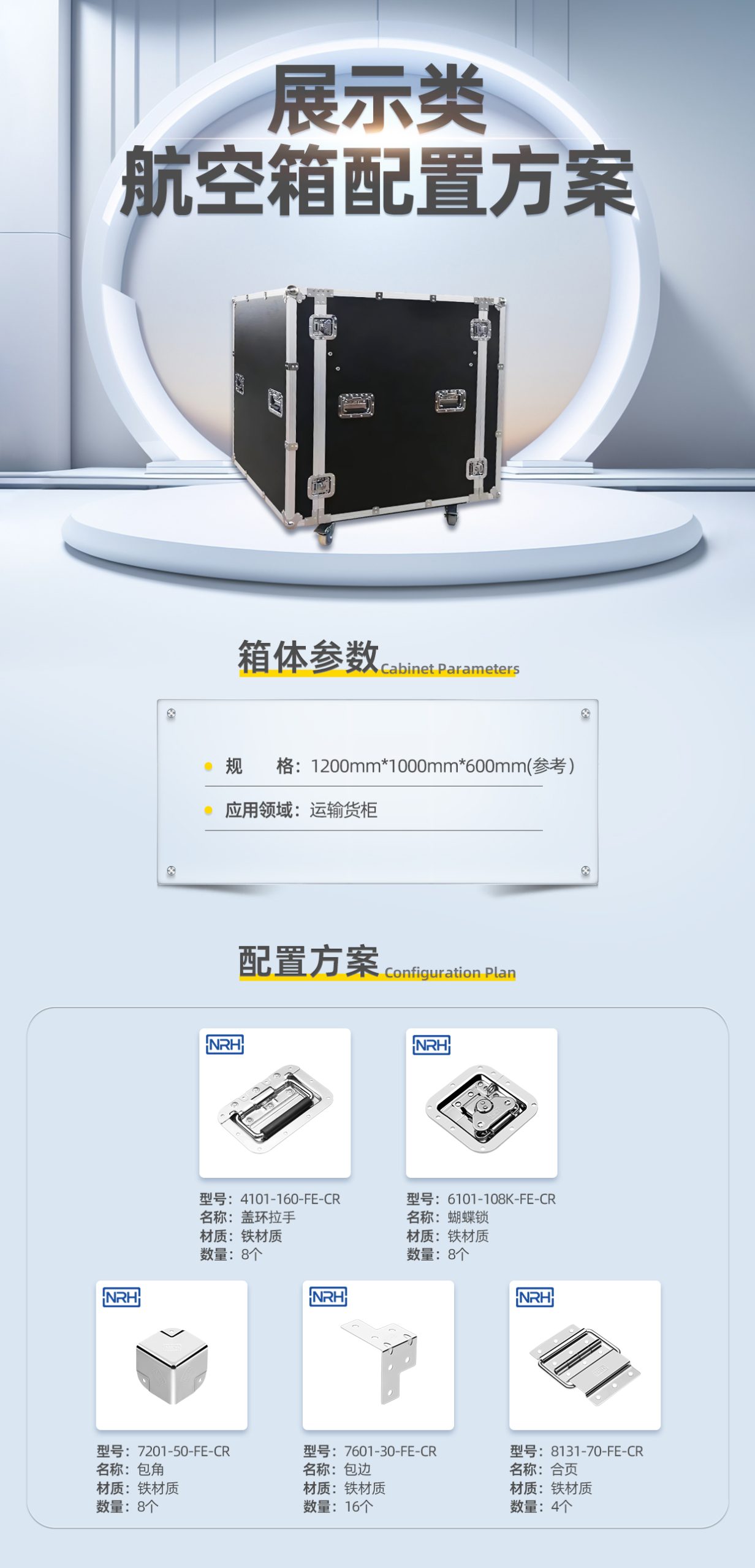
Case 42: Avionics and communications transport case (1200x1000x600mm) with 8 recessed handles, 8 butterfly locks, corner protectors, edge trim, and 4 butt hinges
This matte black case transports avionics test equipment and communication devices between aircraft maintenance facilities and field operations. The large lid surface (1200 x 1000mm) requires more locking points to maintain seal integrity under vibration. The case is stacked during cargo transport and opened daily during maintenance shifts. All hardware is iron chrome-plated – the case operates primarily in hangar and workshop environments with limited chloride exposure.
Hardware Configuration
| Component | Model | Material | Spec | Qty |
|---|---|---|---|---|
| Recessed handles | 4101-160-FE-CR | Iron Chrome-Plated | 371g, rated load 80kg | 8 |
| Butterfly locks | 6101-108K-FE-CR | Iron Chrome-Plated | 237g, tensile load 392N, key lock | 8 |
| Corner protectors | 7201-50-FE-CR | Iron Chrome-Plated | 45g | 8 |
| Edge trim | 7601-30-FE-CR | Iron Chrome-Plated | 28g | 16 |
| Butt hinges | 8131-70-FE-CR | Iron Chrome-Plated | 137g, rated load 10kg | 4 |
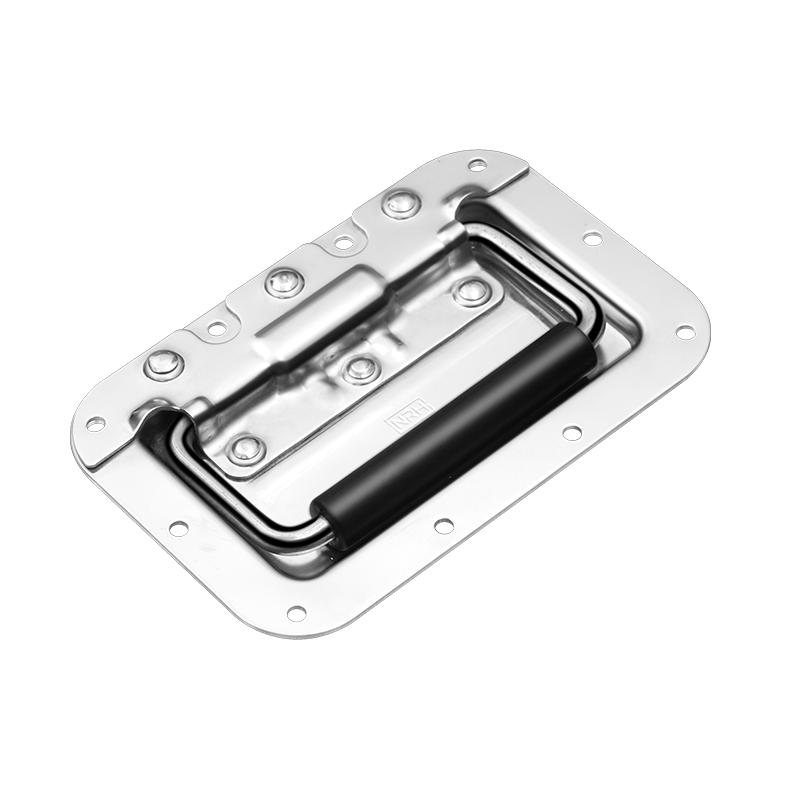
4101-160-FE-CR Recessed Handle – iron chrome-plated, 371g, 80kg load rating
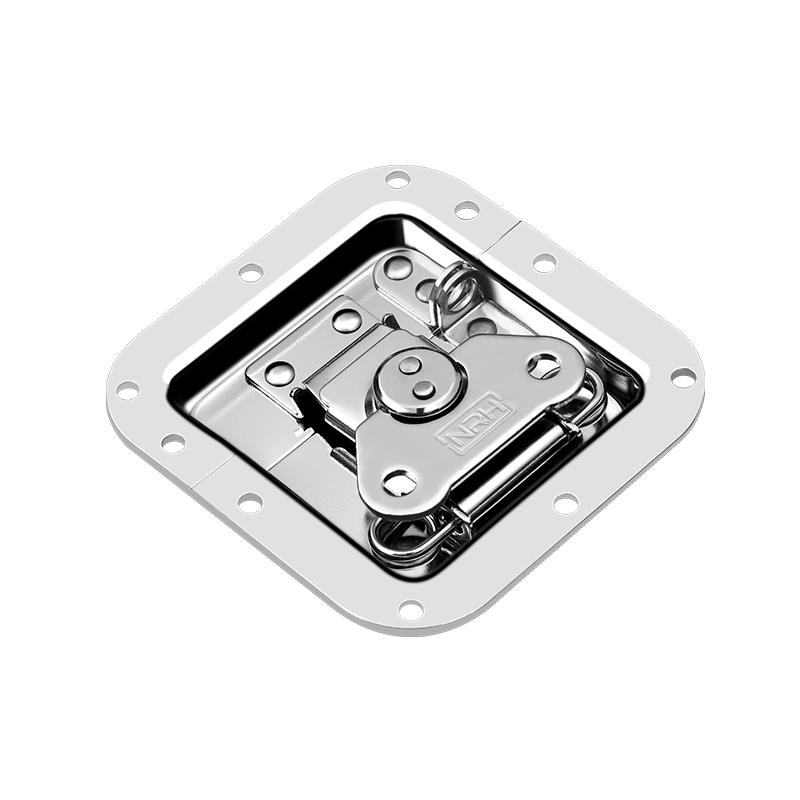
6101-108K-FE-CR Butterfly Lock – iron chrome-plated, 237g, 392N tensile load
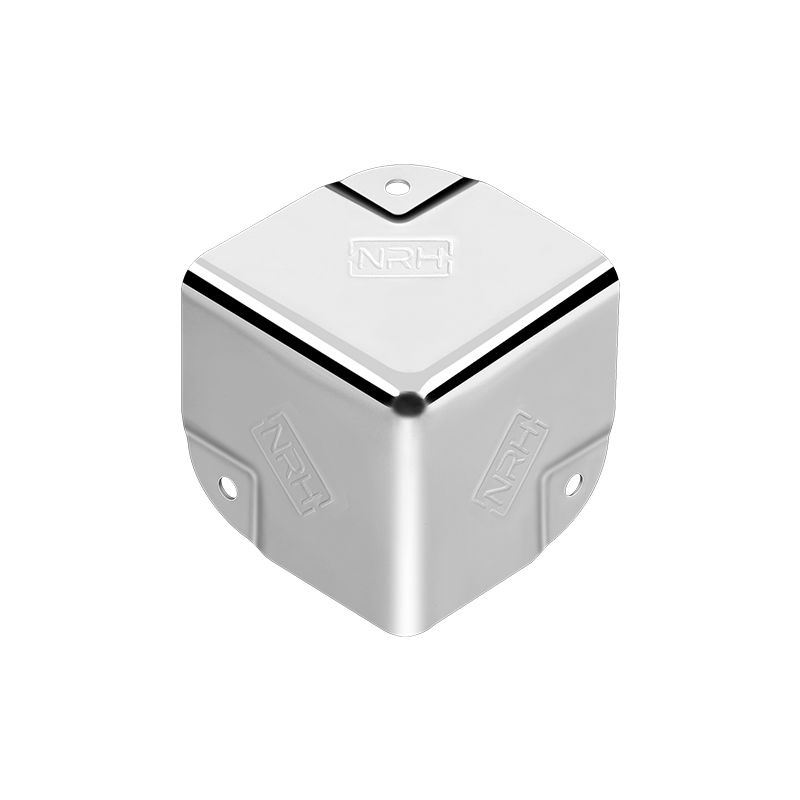
7201-50-FE-CR Corner Protector – iron chrome-plated, 45g
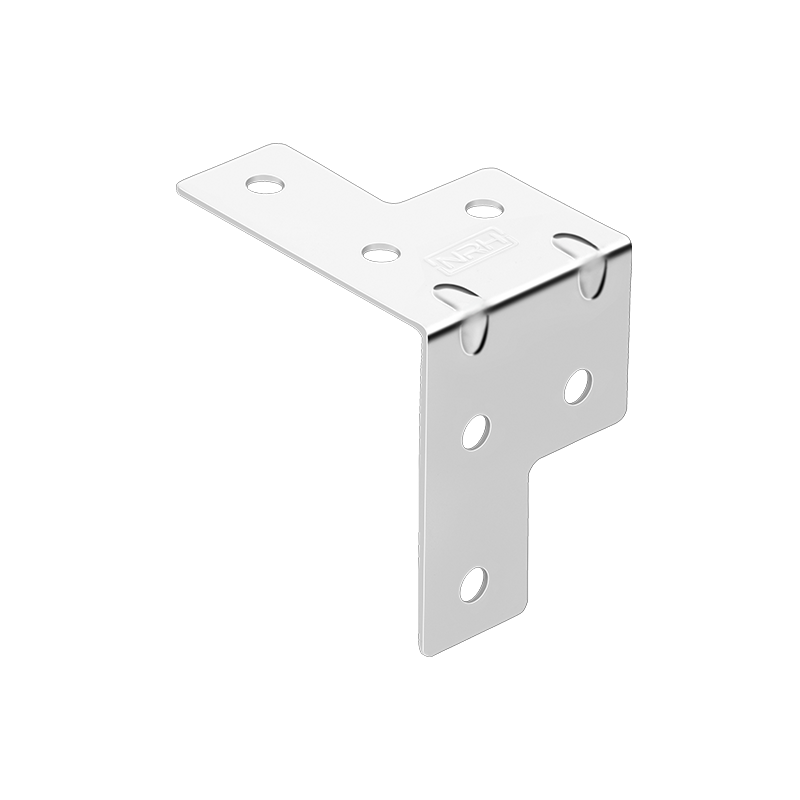
7601-30-FE-CR Edge Trim – iron chrome-plated, 28g
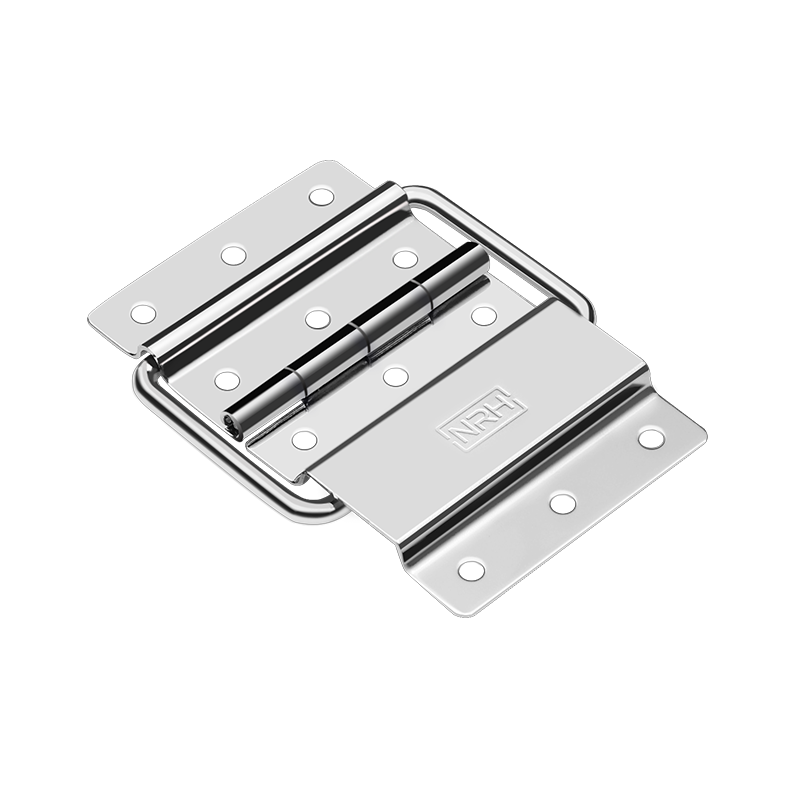
8131-70-FE-CR Butt Hinge – iron chrome-plated, 137g, 10kg load rating
Case 44: Stage Lighting and Audio Transport Case (1050 x 550 x 650mm)
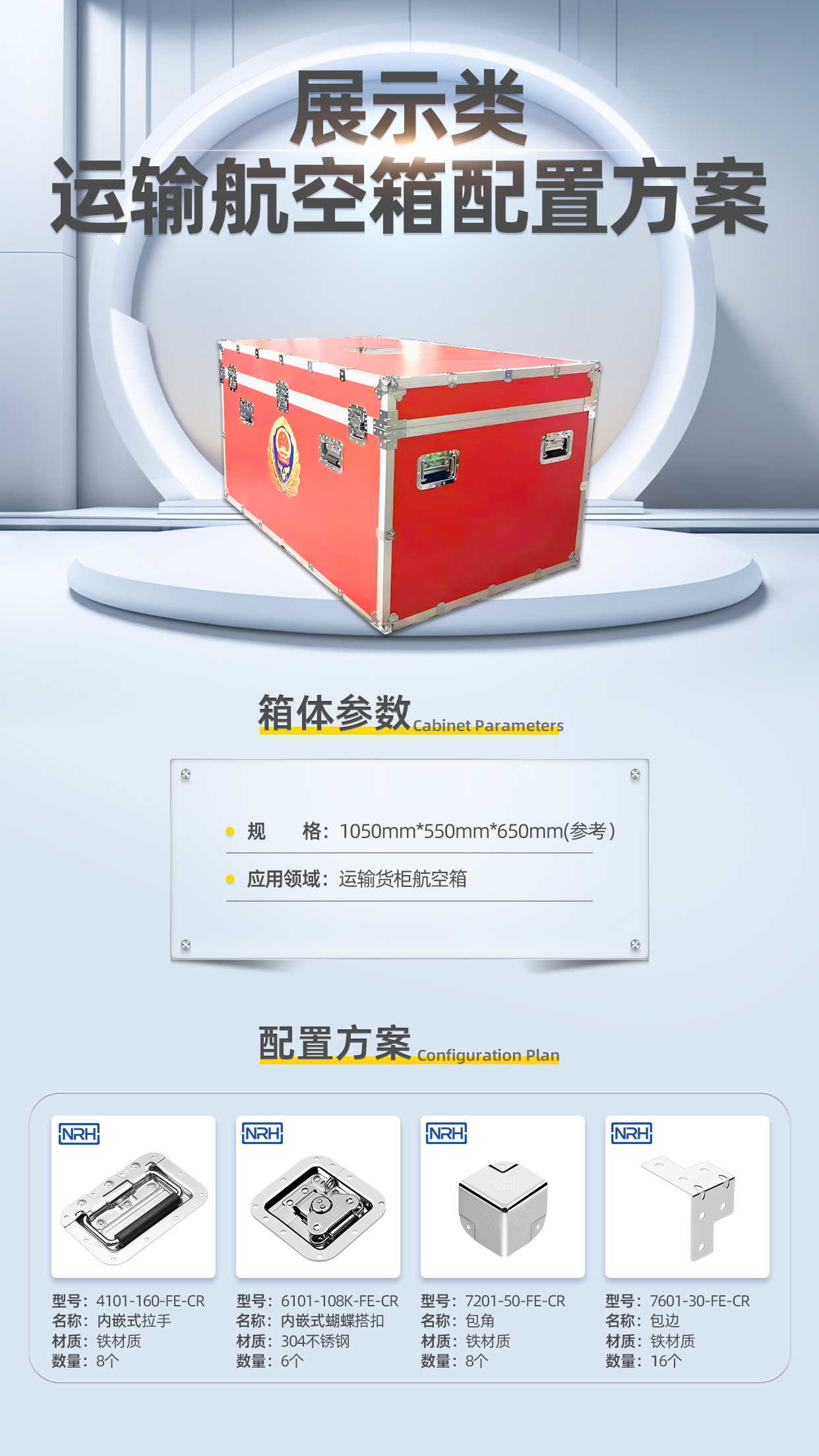
Case 44: Stage lighting transport case (1050x550x650mm) with 8 recessed handles, 6 butterfly locks, corner protectors, and edge trim
A smaller logistics case for touring stage lighting and audio equipment. The smaller lid (1050 x 550mm) is inherently stiffer, so 6 locks provide sufficient clamping force. The case moves between venues and trucks, stacked during transport and opened multiple times daily during load-in and strike.
This case uses a differentiated material strategy: most components are iron chrome-plated for cost efficiency, but the 6 butterfly locks are specified in SUS304 stainless steel for enhanced corrosion resistance on the locking mechanism – a common specification for touring cases that may encounter outdoor environments during load-in and load-out.
Hardware Configuration
| Component | Model | Material | Spec | Qty |
|---|---|---|---|---|
| Recessed handles | 4101-160-FE-CR | Iron Chrome-Plated | 371g, rated load 80kg | 8 |
| Butterfly locks | 6101-108K-S04 | SUS304 Stainless Steel | Tensile load 392N, key lock | 6 |
| Corner protectors | 7201-50-FE-CR | Iron Chrome-Plated | 45g | 8 |
| Edge trim | 7601-30-FE-CR | Iron Chrome-Plated | 28g | 16 |
Note: Unlike Case 42, Case 44 does not use butt hinges. The lid design incorporates a different attachment mechanism, eliminating the need for external hinges.
Comparative Analysis
Both cases use iron chrome-plated hardware for the majority of components, with one key difference: Case 44 specifies SUS304 butterfly locks for the locking mechanism, providing enhanced corrosion resistance for touring environments.
| Case 42 (1200mm) | Case 44 (1050mm) | |
|---|---|---|
| Recessed handles (4101-160-FE-CR) | 8 (FE-CR) | 8 (FE-CR) |
| Butterfly locks (6101-108K) | 8 (FE-CR) | 6 (SUS304) |
| Corner protectors (7201-50-FE-CR) | 8 | 8 |
| Edge trim (7601-30-FE-CR) | 16 | 16 |
| Butt hinges (8131-70-FE-CR) | 4 | – |
| Lid surface area | 1.2m² | 0.58m² |
| Lock-to-handle ratio | 1:1 | 0.75:1 |
Material Choice: Iron Chrome-Plated vs. Stainless Steel
Hardware material determines service life more than any other single factor. A latch that lasts 10 years in a climate-controlled hangar may fail in 18 months on a coastal loading dock.
| Property | Iron Chrome-Plated (FE-CR) | SUS304 Stainless Steel (S04) |
|---|---|---|
| Tensile Strength | 300-450 MPa (carbon steel substrate) | Over 520 MPa (JIS G 4305, annealed) |
| Corrosion Resistance | Depends on plating – chips expose bare iron | 18% Cr / 8% Ni self-healing passive layer |
| Salt Spray Life | Limited – plating dependent | Excellent – industry standard for humid environments |
| Cost | Baseline | Moderate premium |
| Best For | Indoor / controlled environment | Outdoor / humid / touring |
The critical difference is failure mode. Chrome plating is a coating – once it chips, bare steel is exposed and rust progresses at that point. Stainless steel’s corrosion resistance is inherent: the chromium forms a self-healing passive oxide layer that regenerates when scratched. For touring cases exposed to outdoor conditions during load-in and load-out, SUS304 is the correct choice for critical locking mechanisms.
Industry Standards Quick Reference
Three standards are most relevant when specifying aviation case hardware:
ATA Specification 300 – The air-transport industry’s standard for shipping container design and service life. It defines three categories: Category I containers must survive at least 100 round trips and pass impact testing; Category II containers must survive at least 10 round trips; Category III containers are single-use. Hardware choices directly affect which category a case can meet.
MIL-STD-810H Method 514.8 – This military standard defines vibration test profiles for equipment transported by ground and air. A typical profile covers 5-500 Hz random vibration simulating the combined environment of truck transport and aircraft cargo holds. Hardware must maintain function throughout the test duration without loosening, rattling, or failing to latch.
IP Rating (IEC 60529) – The Ingress Protection rating system classifies the degree of protection provided by enclosures. IP65 means dust-tight and protected against water jets; IP67 means dust-tight and protected against temporary immersion. Hardware components themselves are not IP-rated, but latch type and closing force directly determine whether a case can achieve and maintain its rated seal.
Product Specifications
4101-160-FE-CR – Recessed Handle
This recessed handle mounts flush with the case surface, allowing stackable transport without protrusion interference. Rated for 80kg per handle, it provides a secure grip for heavy equipment cases.
4101-160-FE-CR Recessed Handle – iron chrome-plated, 371g, 80kg load rating
| Parameter | Specification |
|---|---|
| Model | 4101-160-FE-CR |
| Type | Recessed Handle |
| Material | Iron Chrome-Plated (FE-CR) |
| Weight | 371g |
| Load Rating | 80kg (verified from NRH product specification drawings) |
| Application | Stackable transport cases, avionics cases, palletized freight |
6101-108K-FE-CR – Butterfly Lock with Key Lock
This key-locked butterfly latch provides high clamping force through cam action. The built-in key cylinder prevents unauthorized opening during transit. Iron chrome-plated construction offers durability for indoor and controlled environments.
6101-108K-FE-CR Butterfly Lock – iron chrome-plated, 237g, 392N tensile load
| Parameter | Specification |
|---|---|
| Model | 6101-108K-FE-CR |
| Type | Butterfly Lock with Key Lock |
| Material | Iron Chrome-Plated (FE-CR) |
| Weight | 237g |
| Tensile Load | 392N (verified from NRH product specification drawings) |
| Key Lock | Included |
| Application | Avionics cases, secure transport, military cases |
6101-108K-S04 – Butterfly Lock with Key Lock (SUS304)
This key-locked butterfly latch is identical to the FE-CR version but constructed from SUS304 stainless steel for enhanced corrosion resistance. The self-healing passive oxide layer provides long-term durability in outdoor and touring environments.
| Parameter | Specification |
|---|---|
| Model | 6101-108K-S04 |
| Type | Butterfly Lock with Key Lock |
| Material | SUS304 Stainless Steel |
| Weight | 237g |
| Tensile Load | 392N (verified from NRH product specification drawings) |
| Key Lock | Included |
| Application | Touring cases, outdoor transport, stage equipment |
7201-50-FE-CR – Corner Protector
Corner protectors fit over the intersection of aluminum extrusions at each case corner, distributing impact energy across the frame rather than concentrating it at the joint.
7201-50-FE-CR Corner Protector – iron chrome-plated, 45g
| Parameter | Specification |
|---|---|
| Model | 7201-50-FE-CR |
| Type | Corner Protector |
| Material | Iron Chrome-Plated (FE-CR) |
| Weight | 45g |
| Application | Aviation cases, transport cases, flight cases |
7601-30-FE-CR – Edge Trim
Edge trim runs along aluminum extrusion seams around the case perimeter, protecting the joint between extrusion and panel against peeling, snagging, and moisture ingress.
7601-30-FE-CR Edge Trim – iron chrome-plated, 28g
| Parameter | Specification |
|---|---|
| Model | 7601-30-FE-CR |
| Type | Edge Trim |
| Material | Iron Chrome-Plated (FE-CR) |
| Weight | 28g |
| Application | Aviation cases, transport cases, flight cases |
8131-70-FE-CR – Butt Hinge
This two-leaf butt hinge provides a simple, cost-effective lid connection for standard case configurations. Suitable for applications where a piano hinge is unnecessary.
8131-70-FE-CR Butt Hinge – iron chrome-plated, 137g, 10kg load rating
| Parameter | Specification |
|---|---|
| Model | 8131-70-FE-CR |
| Type | Butt Hinge |
| Material | Iron Chrome-Plated (FE-CR) |
| Weight | 137g |
| Load Rating | 10kg (verified from NRH product specification drawings) |
| Application | Standard lids, avionics cases, transport cases |
Frequently Asked Questions
What latch holding capacity do I need for an avionics case?
For a 15-25kg avionics case, each latch should be rated at least 392N tensile load (e.g., NRH 6101-108K-FE-CR, verified from NRH product specification drawings). Apply a 2.0-2.5x safety factor for vibration environments. Two latches minimum per lid; four is standard for cases over 20kg.
Should I choose iron chrome or SUS304 hardware?
Iron chrome-plated for indoor, budget-sensitive builds where the chrome coating remains intact. SUS304 for any outdoor, humid, or touring application – its 18% Cr / 8% Ni composition forms a self-healing passive oxide layer that outlasts any plating. If in doubt, specify SUS304; the moderate premium is cheaper than field replacement.
Why recessed handles on aviation cases?
Protruding handles snag on cargo nets, damage adjacent cases during palletized transport, and can shear off under stacking loads. Recessed handles sit flush with the case surface, remaining protected during both transport and stacking. For any case that will be palletized or stacked, recessed handles are not optional – they are a functional requirement.
How many locks does an aviation case need?
It depends on lid size and flex. A lid over 1000mm per side typically needs 6-8 locks to maintain even sealing pressure. A lid under 600mm may only need 2-4. The principle: enough clamping points to keep the lid sealed under vibration, with redundancy so that one unfastened or failed lock does not compromise the entire seal.
What is ATA 300 Category I and why does it matter?
ATA 300 Category I means the container is rated for at least 100 round trips. This is the standard for reusable air-freight containers. Hardware that fails before the container reaches 100 cycles stops the case maintaining its Category I rating, regardless of the shell’s condition.
Can I mix iron and stainless steel hardware on the same case?
Yes – Case 44 demonstrates this approach. The handles, corner protectors, and edge trim use iron chrome-plated hardware for cost efficiency, while the butterfly locks use SUS304 stainless steel for enhanced corrosion resistance on the locking mechanism. This differentiated material strategy optimizes both cost and performance.
What is the difference between a butterfly lock and a toggle latch?
A butterfly lock has a key-locked cam mechanism that provides both mechanical retention and controlled access. A toggle latch uses an over-center snap linkage that closes quickly without a key. Butterfly locks are for cases that need security; toggle latches are for cases that need speed.
Why does Case 42 use 8 locks while Case 44 uses only 6?
Case 42 has a lid surface area of 1.2m² (1200 x 1000mm) which flexes more under load, requiring 8 butterfly locks to maintain even sealing pressure. Case 44’s lid is only 0.58m² (1050 x 550mm) and is correspondingly stiffer, so 6 locks suffice. The principle is straightforward: larger lids need more clamping points.
Need Help Choosing?
Specifying the right hardware for aviation cases requires balancing case size, load weight, sealing requirements, stacking considerations, and environmental exposure. The two configurations examined here – the avionics case with 8 iron chrome-plated butterfly locks and the stage lighting case with 6 SUS304 locks – demonstrate that lock count scales with lid surface area, and material choice depends on exposure conditions.
NRH Box Hardware supplies a full range of case hardware in iron chrome-plated and SUS304 stainless steel, with ISO 9001:2015 and GJB9001C certifications. Material test reports are available for all stainless steel products.
Email: nrh-gz@nrh.cn
WhatsApp: +86 180 1797 5137
NRH Box Hardware
Room 1703-1704, Zhongji Building, No. 819 Yinxiang Road, Nanxiang Town, Jiading District, Shanghai, China