

What Is a Toggle Clamp? Hold-Down, Vertical & Latch Action Clamps Compared
Imagine you’re building a welding fixture. You need to hold a steel plate in position while you tack weld. With a C-clamp, you spin the handle, reposition, spin again. Each adjustment takes 15 seconds. Over a day, that adds up to hours of wasted motion. A toggle clamp changes that: push the handle forward, the clamp locks instantly. Pull it back, it releases just as fast. One second per cycle instead of fifteen.
That’s the value of a toggle clamp. It locks a workpiece in place using an over-center linkage that passes through a dead-center point. Once past that point, the clamp stays shut without any continued force from the operator. The NRH 3101-180 hold-down toggle clamp delivers 280 kg of clamping force at just 229 g unit weight. The 3102-140 pull-action clamp reaches 880 kg of holding force in SUS304 per manufacturer catalog data.
This guide explains how toggle clamps work, compares hold-down, vertical, and latch action types, breaks down load ratings and material options, and helps you pick the right clamp for your application.
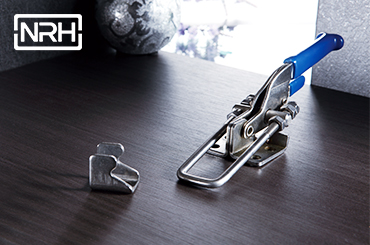
How a Toggle Clamp Works
A toggle clamp operates on the over-center principle. The linkage has three pivot points: the base pivot, the handle pivot, and the clamping arm pivot. Push the handle forward and the linkage passes through a straight-line alignment – the dead-center position. Once past dead center, the linkage cannot reverse without intentional handle movement. The clamp is mechanically locked.
Releasing the clamp is the reverse: pull the handle back past dead center and the linkage collapses. The clamping arm lifts off the workpiece. The entire cycle – clamp and release – takes about one second.
The over-center design does three things regular clamps cannot. It locks without external force. A C-clamp needs continuous thread tension; a toggle clamp needs none once past dead center. It provides instant engagement – one motion locks the part. And it gives a clear visual indicator – handle flat against the base means locked, handle raised means open.
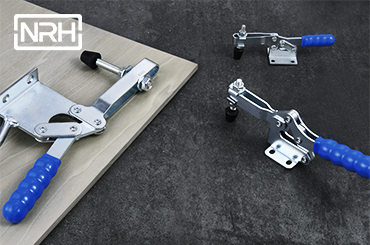
Toggle Clamp Types Compared
Toggle clamps fall into three main categories based on how the clamping arm moves and where the holding force directs. Each type suits different workholding and fastening tasks.
Hold-Down Toggle Clamp (3101 Series)
A hold-down clamp pushes straight down from above. The clamping arm extends horizontally from the base, and a contact pad presses the workpiece onto the fixture. This is the most common toggle clamp type for jigs, fixtures, and welding tables.
The NRH 3101 series covers hold-down clamps from 100 kg to 680 kg clamping force. The handle moves in a horizontal arc – push forward to clamp, pull back to release.
A common mistake we see: mounting a hold-down clamp on a flexible surface. Any flex in the base absorbs clamping force. Mount these clamps on a rigid steel plate, not thin sheet metal or wood.
| Model | Material | Finish | Weight | Clamping Force |
|---|---|---|---|---|
| 3101-115 | SUS304 | Vibratory (ZG) | 70 g | 100 kg |
| 3101-115S | SUS304 | Vibratory (ZG) | 78 g | 150 kg |
| 3101-180 | Iron (FE) | Zinc (ZL) | 229 g | 280 kg |
| 3101-180 (SUS304) | SUS304 | Vibratory (ZG) | 229 g | 300 kg |
| 3101-230 | Iron (FE) | Zinc (ZL) | 638 g | 650 kg |
| 3101-230S | Iron (FE) | Zinc (ZL) | 678 g | 680 kg |
The “S” suffix denotes short-arm variants. A short arm reduces the open height – useful when clamping thin workpieces or working in tight spaces. The trade-off is slightly less clamping travel distance.
Hold-down clamps with adjustable spindles let you set the clamping height to match workpiece thickness. The 3101-180 provides 162.5-188 mm adjustable clamping distance. The 3101-230 extends to 202-243.5 mm adjustable range per manufacturer catalog data.
Vertical Toggle Clamp (3208 Series)
A vertical toggle clamp has a handle that moves in a vertical plane – up to lock, down to release. The clamping arm swings down onto the workpiece from above, similar to a hold-down, but the handle motion is vertical rather than horizontal.
The NRH 3208-70-S04-ZG is the vertical toggle clamp in the product range. It uses SUS304 construction with vibratory finish, weighs 116 g, and delivers 100 kg of clamping force. The vertical handle design saves bench space because the handle does not swing out horizontally.
When to use vertical clamps: We see them used most often on multi-station rotary tables where fixtures sit close together. If you’ve ever had a horizontal handle hit an adjacent fixture, you know the frustration. Vertical clamps solve that problem entirely.
Latch Action Toggle Clamp (3103 Series)
A latch action clamp pulls two parts together. Instead of pressing down on a workpiece, the clamping arm hooks onto a catch plate and pulls it tight. This action works like a draw bolt but with the speed of a toggle clamp.
The NRH 3103 series provides latch action clamps from 130 mm to 267 mm arm lengths. All iron models deliver 650 kg of clamping force.
| Model | Material | Finish | Weight | Clamping Force |
|---|---|---|---|---|
| 3103-130 | Iron (FE) | Zinc (ZL) | 700 g | 650 kg |
| 3103-267S | Iron (FE) | Zinc (ZL) | 658 g | 650 kg |
Latch action clamps close mold halves, secure access doors on enclosures, and hold inspection covers shut. The hook arm engages a catch on the opposite side and pulls the two surfaces together. When the handle flips open, the hook disengages instantly.
Installation tip: The most common failure with latch action clamps is misalignment. If the hook arm doesn’t engage the catch squarely, the clamp loses holding force and wears unevenly. Always check engagement after the first 100 cycles.
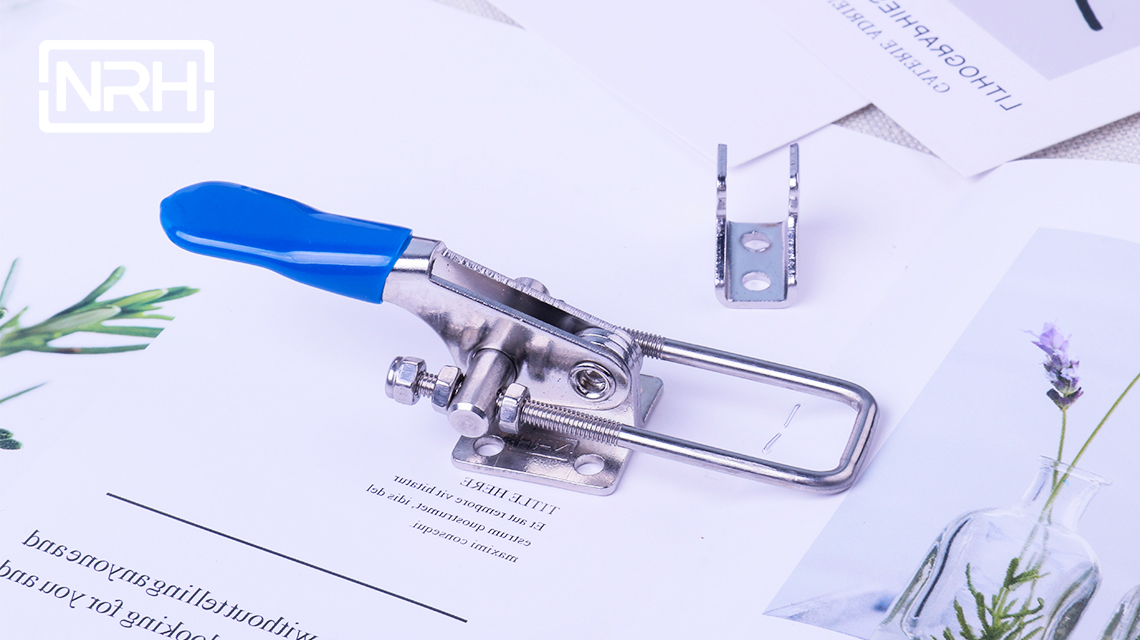
Hold-Down vs. Vertical vs. Latch Action: Quick Comparison
| Feature | Hold-Down (3101) | Vertical (3208) | Latch Action (3103) |
|---|---|---|---|
| Clamping direction | Down from above | Down from above | Pulls two parts together |
| Handle motion | Horizontal arc | Vertical plane | Horizontal arc |
| Force range | 100-680 kg | 100 kg | 650 kg |
| Weight range | 70-678 g | 116 g | 658-700 g |
| Best for | Workholding, jigs | Tight spaces | Doors, molds, covers |
| Side clearance needed | Yes (handle swing) | No | Yes (handle swing) |
| Adjustable height | Yes (spindle) | Yes (spindle) | Varies by arm length |
Pull-Action Toggle Clamps (3102 Series)
NRH also offers the 3102 series – pull-action toggle clamps. These clamps pull the arm rearward toward the base instead of pushing down. The 3102-125-FE-ZL delivers 650 kg of holding force at 281 g. The 3102-140-S04-ZG in SUS304 reaches 880 kg of clamping force at 589 g per manufacturer catalog data.
Pull-action clamps hold parts that need drawing into a fixture rather than pressing down. Common uses include holding workpieces against a backstop, pulling a sliding jaw closed, or drawing two flat surfaces together from the edge.
Material and Finish Selection
Iron with Zinc Plating (FE-ZL)
Iron with blue zinc plating is the standard for indoor and dry-environment applications. Zinc plating provides moderate corrosion resistance at low cost. Most 3101, 3102, and 3103 models offer iron-zinc variants at 40-60% less than stainless steel equivalents.
SUS304 Stainless Steel with Vibratory Finish (S04-ZG)
SUS304 is the right choice for humid, outdoor, marine, or washdown environments. The vibratory finish produces a uniform matte surface that resists corrosion and hides minor scratches. SUS304 rates 72-96 hours in neutral salt spray testing per ASTM B117.
Iron with Chrome Plating (FE-CR)
Chrome plating over iron offers a bright, decorative finish with moderate corrosion resistance. Chrome holds up well indoors but is not recommended for prolonged outdoor or marine exposure.
Applications: Where Each Type Performs Best
Workholding and Jig Fixtures (Hold-Down)
Hold-down toggle clamps dominate in woodworking, metalworking, and welding fixtures. A typical setup uses two to four 3101-180 clamps around a jig plate. The adjustable spindle lets you clamp parts of different thicknesses without changing the fixture. For heavy welding fixtures, the 3101-230 provides 650 kg of force to hold steel plates against heat distortion.
Assembly Stations with Limited Space (Vertical)
On packed assembly lines, horizontal handle swing is a problem. A vertical toggle clamp like the 3208-70 solves this – the handle moves up and down, not side to side. The clamp footprint stays within the base plate boundary. Install vertical clamps on multi-station rotary tables where fixtures sit close together.
Equipment Enclosures and Access Doors (Latch Action)
Latch action toggle clamps replace bolts and wing nuts on enclosure doors that need frequent access. The 3103-130 clamps an inspection cover shut with 650 kg of force and opens with one handle flip. No tools required. For larger doors, the 3103-267S offers a 267 mm arm reach to span wider openings.
Mold Closing and Die Holding (Latch Action and Pull-Action)
In low-pressure molding and die holding, latch action clamps pull the mold halves together. The 3103-130 and 3103-267S provide enough force for small to medium molds. For pulling a sliding die into position, the 3102-140-S04-ZG delivers 880 kg of pull force in stainless steel – suitable for cleanroom and food-grade molding.
Installation Guidelines
Mount the toggle clamp on a flat, rigid surface. Any flex in the mounting base absorbs clamping force. Use all mounting holes on the base plate – skipping any concentrates shear on the remaining fasteners.
Orient the clamp so the handle moves away from the operator when locking. For vertical clamps, mount with the handle moving upward to lock – gravity assists the over-center engagement.
Set the spindle height so the clamp locks just past dead center. If the handle stops before reaching flat against the base, shorten the spindle. If it overshoots and feels spongy, lengthen the spindle. The correct position produces a firm, positive stop with no spring-back.
For latch action clamps, align the hook arm and catch plate so they engage squarely. Misalignment causes uneven wear and reduces holding force. Check engagement after the first 100 cycles.
Selection Guide: Choosing the Right Toggle Clamp
| Question | Choose |
|---|---|
| Clamping a flat workpiece from above? | Hold-down (3101) |
| Working in tight spaces with no side clearance? | Vertical (3208) |
| Pulling a door, cover, or mold half shut? | Latch action (3103) |
| Drawing a workpiece into a fixture? | Pull-action (3102) |
| Wet or outdoor environment? | SUS304 model (S04-ZG) |
| Indoor, dry, cost-sensitive? | Iron zinc model (FE-ZL) |
| Need more than 650 kg force? | 3102-140-S04-ZG (880 kg) or use multiple clamps |
| Thin workpiece, tight open height? | Short-arm variant (S suffix) |
Frequently Asked Questions (FAQ)
What is a toggle clamp?
A toggle clamp is a mechanical workholding device that uses an over-center linkage to lock a workpiece in place. Once the handle passes the dead-center point, the clamp stays shut without continued force. Releasing the clamp requires only one motion – pull the handle back past dead center.
What are the main types of toggle clamps?
The three main types are hold-down, vertical, and latch action. Hold-down clamps press from above onto a flat surface. Vertical clamps use a handle that moves in a vertical plane to save side clearance. Latch action clamps pull two parts together with a hook arm. A fourth type – pull-action – draws a workpiece rearward into a fixture.
How much force can a toggle clamp apply?
NRH toggle clamps range from 100 kg to 880 kg clamping force. The 3101-115 delivers 100 kg. The 3101-230 reaches 650 kg. The 3102-140-S04-ZG tops the range at 880 kg.
What is the difference between a hold-down and a latch action toggle clamp?
A hold-down clamp pushes straight down onto a workpiece from above. A latch action clamp hooks onto a catch and pulls two parts together. Hold-down clamps are for workholding on flat surfaces. Latch action clamps are for closing doors, covers, and mold halves.
Should I choose iron or stainless steel toggle clamps?
Choose SUS304 stainless steel (S04-ZG finish) for wet, outdoor, or corrosive environments. SUS304 provides 72-96 hours of salt spray resistance. Choose iron with zinc plating (FE-ZL) for indoor dry applications where cost is the priority. Iron-zinc costs 40-60% less than stainless equivalents.
How do I set the correct clamping height on a toggle clamp?
Adjust the spindle so the handle locks flat against the base with firm resistance. If the handle stops before reaching the base, shorten the spindle. If the handle overshoots with no firm stop, lengthen the spindle. The correct position is just past the dead-center point with a positive mechanical stop.
Can toggle clamps replace bolts on enclosure doors?
Yes. Latch action toggle clamps (3103 series) provide up to 650 kg of holding force and open with one handle flip. No tools required. Use them on inspection covers, access panels, and equipment enclosure doors that need frequent opening.
What does the “S” suffix mean on NRH toggle clamp models?
The “S” suffix indicates a short-arm variant. Short-arm clamps have reduced open height, which suits thin workpieces and tight spaces. The clamping force is similar to the standard model, but the clamping travel distance is shorter. Example: the 3101-230S has 680 kg force versus 650 kg for the 3101-230.
Need help choosing? Contact NRH Box Hardware at nrh-gz@nrh.cn or call +86 180 1797 5137. The full product catalog is available at nrh.hk.