

Piano Hinge Guide: Continuous Hinge for Flight Cases and Transport Boxes
You’re building a 1.8-meter flight case. The lid weighs 8-10kg with hardware and fittings attached. Two butt hinges will work for the first few hundred opens. But on a tour bus, vibration and constant use take their toll – the center of the lid starts to sag, screws loosen, and the lid no longer seals. A piano hinge runs the full 1800mm length, spreads the load across dozens of screws instead of six, and keeps the lid aligned for the life of the case. Here’s how to choose the right one.
A piano hinge – also called a continuous hinge – runs the full length of the joined edge. Two equal-width leaves wrap around a single pin, distributing load across every inch instead of concentrating it at two or three screw points. The NRH 8001 series offers standard lengths from 1800mm to 2000mm in 201 stainless steel with a vibratory finish, making it the go-to choice for flight cases, tool chests, and instrument enclosures.
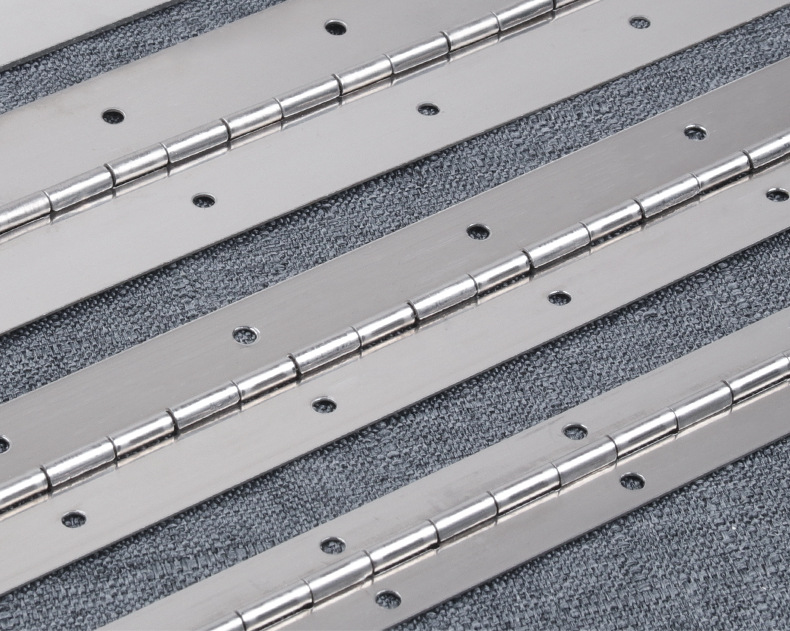
How a Piano Hinge Works
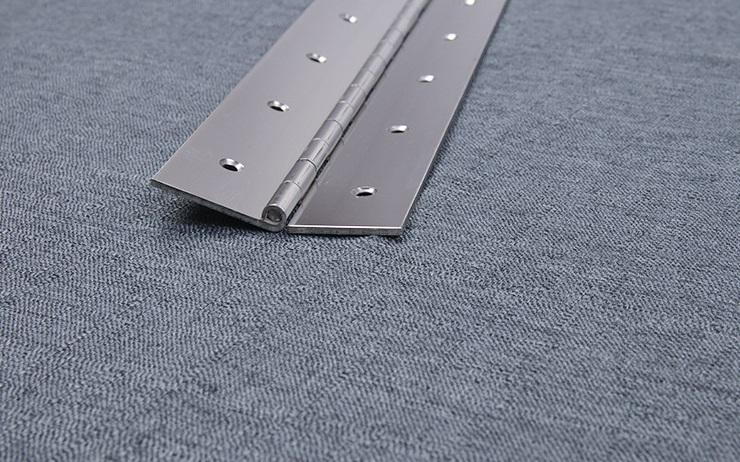
A piano hinge has three parts: two flat leaves and one central pin. The leaves roll at their inner edges to form interlocking knuckles. The pin passes through every knuckle from end to end. When the lid opens, the knuckles rotate around the pin. Because the knuckles run the full length, the hinge pivots smoothly along the entire edge with no gaps or binding.
This continuous construction gives piano hinges three critical advantages over butt hinges:
Even load distribution. A butt hinge concentrates shear on two or three screw points. A piano hinge spreads the same load across dozens of fasteners – lower stress per screw, less risk of tear-out on thin panels. For flight cases with 5-9mm plywood or composite panels, this is the difference between a hinge that stays put and one that pulls out after a few trips.
Gap-free alignment. Short hinges create misalignment between hinge points on long lids. A continuous hinge keeps the lid edge aligned across its full length. On an 1800mm case, that means consistent gap and gasket compression from one end to the other.
Structural reinforcement. The hinge acts as a stiffening rib along the joint. On thin aluminum, plywood, or composite panels, a piano hinge adds rigidity that butt hinges cannot match. The hinge becomes part of the case structure, not just a connection point.
Piano Hinge vs. Butt Hinge
| Factor | Piano Hinge | Butt Hinge |
|---|---|---|
| Length coverage | Full edge (continuous) | Point contacts (2-3 per hinge) |
| Load per screw | Low (distributed) | High (concentrated) |
| Panel stiffening | Yes | Minimal |
| Installation | More screws | Fewer screws |
| Best for | Long lids, thin panels | Short doors, thick frames |
NRH 8001 Series Piano Hinge: Key Specifications
Here’s what the 8001 series is made of – and why it matters for your case.
The NRH 8001 series is the core piano hinge product line, designed for flight cases, transport boxes, tool chests, and industrial enclosures. All models are manufactured from 201 stainless steel with a vibratory finish (ZG) and feature standard pre-drilled holes at approximately 50mm centers.
| Model | Material | Finish | Length | Width | Thickness |
|---|---|---|---|---|---|
| 8001-1800-25-0.5 | 201 Stainless | Vibratory (ZG) | 1800 mm | 25 mm | 0.5 mm |
| 8001-2000-50-0.5 | 201 Stainless | Vibratory (ZG) | 2000 mm | 50 mm | 0.5 mm |
| 8001-1800-38-0.8 | 201 Stainless | Vibratory (ZG) | 1800 mm | 38 mm | 0.8 mm |
| 8001-1800-50-0.7 | 201 Stainless | Vibratory (ZG) | 1800 mm | 50 mm | 0.7 mm |
Naming convention: 8001 – [Length] – [Width] – [Thickness]
All 8001 series models are stocked items with standard pre-drilled holes at approximately 50mm centers. The vibratory finish (ZG) provides a uniform matte surface that hides minor scratches and resists fingerprint marking – ideal for tour-grade equipment that sees frequent handling.
Material and Finish: 201 Stainless Steel with Vibratory Finish
Here’s what the 8001 series is made of – and why it matters for your case.
The 8001 series uses 201 stainless steel with a vibratory finish (ZG). This material choice balances cost, corrosion resistance, and formability for case hardware applications.
201 stainless steel is an austenitic chromium-nickel-manganese stainless steel. It offers good corrosion resistance for indoor and semi-protected environments at a lower cost than 304 stainless. The manganese content provides higher strength than some other grades while maintaining adequate workability for hinge forming and punching.
Vibratory finish (ZG) is produced by tumbling the hinges with abrasive media. This creates a uniform satin matte surface that:
- Hides minor scratches and wear from handling
- Resists fingerprint marking
- Provides a professional, consistent appearance across the entire hinge length
- Eliminates sharp edges from stamping and forming
For outdoor, marine, or highly corrosive environments, 201 stainless steel may not provide sufficient corrosion resistance. In these cases, consult the NRH engineering team for alternative material recommendations.
How to Choose the Right 8001 Series Hinge
Here’s how to match the right model to your case build.
You’ll notice the holes are close together. That’s intentional – every screw shares the load.
Width Selection
Hinge width determines how much surface area the hinge covers on the panel:
- 8001-1800-25-0.5 (25mm wide): Suitable for lightweight cases with 3-5mm panels, small instrument cases, and light-duty tool boxes.
- 8001-1800-38-0.8 (38mm wide): The most versatile size. Works with 5-9mm panels. Recommended for standard flight cases, audio equipment cases, and general transport boxes.
- 8001-2000-50-0.5 / 8001-1800-50-0.7 (50mm wide): For heavier cases and panels over 9mm thick. Provides maximum surface area for fasteners and the highest structural reinforcement.
Thickness Selection
- 0.5mm: Light-duty applications, instrument cases, small tool boxes
- 0.7mm: Medium-duty, standard flight cases, industrial enclosures
- 0.8mm: Heavy-duty, large transport cases, high-weight applications
Length and End Clearance
8001 series hinges are available in 1800mm and 2000mm standard lengths. For custom case sizes, the hinge can be cut to length on site.
End clearance: Leave 3-5mm clearance at each end of the hinge to prevent the knuckle from binding against the case corner. Hinge length = lid edge length – (2 x end clearance).
Example: A 1700mm lid edge with 4mm clearance at each end = 1700 – 8 = 1692mm hinge length. Order 1800mm and cut to 1692mm.
Cutting a Piano Hinge to Length
8001 series hinges are designed to be cut to length. Here’s the right way to do it:
- Use a fine-tooth hacksaw or cutoff wheel. Clamp the hinge securely in a vise.
- Cut through both leaves and the pin in one pass. Don’t cut one leaf first and then the other – this can misalign the knuckles.
- File the cut end smooth. Remove all burrs. Burrs will jam the knuckles and cause premature wear.
- Test rotation. Open and close the hinge several times. If the pin binds at the cut end, use a small punch to slightly flare the knuckle opening at the cut end.
- For stainless steel, use cutting fluid. This prevents work hardening from heat buildup.
Never use tin snips. They crush the knuckles and ruin the hinge.
Installation Tips
You’ll notice the holes are close together. That’s intentional.
Use every hole. Skip holes, and you concentrate load on the ones you used. On a vibrating flight case, that means screws work loose over time.
Choose the right fasteners. For plywood and wood cases, use pan-head or countersunk wood screws. For aluminum panels, use thread-forming screws. For steel panels, use machine screws with nuts. For composite panels, use rivet nuts. The pre-drilled hole size is designed for standard M4 or #8 screws.
Countersink for flush mounting. If using countersunk screws, countersink the hinge holes so the screw heads sit flush with the leaf surface, allowing the hinge to close flat.
Dry-fit before drilling. Align the hinge with the lid closed and mark hole positions. Fasten one leaf to the case body first, starting from the center holes outward to prevent distortion. Close the lid and fasten the other leaf. If the hinge binds, the leaves are not parallel – loosen and re-align.
Common Mistakes to Avoid
Even experienced case builders make these mistakes. Here’s what to watch for:
| Mistake | What Happens | Fix |
|---|---|---|
| Hinge too narrow for the panel | Screws too close to the panel edge; panel splits | Use 38mm or 50mm width for panels over 9mm |
| Not deburring after cutting | Hinge binds; knuckles jam; premature wear | Always file cut end smooth |
| Only using some of the screw holes | Stress concentration; screws pull out one by one | Use every hole |
| End clearance too large | Hinge ends unsupported; lid sags at corners | Keep clearance under 5mm per end |
Applications
Flight Cases and Transit Cases
Roto-molded and plywood flight cases use piano hinges almost exclusively. The long lid edge needs full-length support. A continuous hinge distributes the lid weight and attached hardware along the entire edge. The 8001 series is the standard choice for audio equipment cases, lighting rig cases, and touring production cases.
Tool Chests and Equipment Boxes
Steel tool chests rely on continuous hinges to carry the lid weight plus tools in lid-mounted trays. The 50mm width variants (8001-2000-50-0.5 and 8001-1800-50-0.7) provide maximum fastener coverage for heavy workshop tool storage.
Instrument and Medical Enclosures
Precision instruments need lids that align when closed to maintain seals. A piano hinge keeps the lid edge aligned across its full length, preserving gasket compression. The 201 stainless steel vibratory finish provides a clean, professional appearance suitable for medical and laboratory equipment cases.
Stage and Lighting Equipment Cases
Tour-grade lighting and sound equipment cases require durable hardware that withstands constant road travel. The 8001 series with vibratory finish hides scratches from handling and provides reliable performance through thousands of opens.
Frequently Asked Questions (FAQ)
What is a piano hinge?
A piano hinge – also called a continuous hinge – is a long hinge with two equal-width leaves and a single pin running the full length. The knuckles interlock continuously along the entire joint, distributing load evenly across the full edge. Named after its original use on piano lids.
Why use a piano hinge instead of a butt hinge?
A piano hinge spreads load across dozens of fasteners instead of concentrating it at two or three points. It keeps the lid edge aligned along its full length and stiffens thin panels. Use piano hinges on long lids, thin panels, and high-cycle applications. Use butt hinges on short doors and thick frames.
What are the standard sizes available for the 8001 series?
The 8001 series offers four standard sizes: 8001-1800-25-0.5 (1800mm x 25mm x 0.5mm), 8001-2000-50-0.5 (2000mm x 50mm x 0.5mm), 8001-1800-38-0.8 (1800mm x 38mm x 0.8mm), and 8001-1800-50-0.7 (1800mm x 50mm x 0.7mm). All are in 201 stainless steel with vibratory finish and are available from stock.
Can I cut a piano hinge to length?
Yes. 8001 series hinges can be cut to the required length using a fine-tooth hacksaw or cutoff wheel. Cut through both leaves and the pin in one pass. File the cut end smooth to remove burrs. The standard pre-drilled holes maintain consistent spacing after cutting.
What material is the 8001 series made from?
The 8001 series is manufactured from 201 stainless steel with a vibratory finish (ZG). This provides good corrosion resistance for indoor and semi-protected environments at a cost-effective price point.
Do I need to use every screw hole on a piano hinge?
Yes. Skipping holes concentrates shear on the remaining fasteners and can cause screw tear-out on thin panels. Under vibration, a partially fastened hinge will work loose. The 8001 series includes standard pre-drilled holes at approximately 50mm centers for consistent fastening.
Is the 8001 series available from stock?
Yes. All 8001 series models are stock items and available for immediate shipment. For custom lengths or non-standard hole patterns, contact the NRH sales team for lead times.
What is the difference between a fixed-pin and removable-pin piano hinge?
A fixed-pin hinge has the pin swaged at both ends – the lid cannot detach. A removable-pin hinge lets you slide the pin out and remove the lid. Removable-pin hinges cost more and need a retention feature to prevent pin walk-out under vibration. The 8001 series uses a fixed-pin design for maximum durability and tamper resistance.
Not sure which 8001 series hinge fits your case?
Send us your case dimensions and panel thickness – our engineering team will recommend the right width and thickness for your application. We can also advise on custom cutting and volume pricing.
Email: nrh-gz@nrh.cn | WhatsApp: +86 180 1797 5137
Need help choosing? Contact NRH Box Hardware at nrh-gz@nrh.cn or call +86 180 1797 5137. The full product catalog is available at nrh.hk.