

Support Hinge Guide: Stay-Arm Hardware for Tool Case Lids
Applicable Buyers
This guide is for product designers, engineers, and procurement professionals selecting hold-open hardware for tool cases, instrument boxes, equipment enclosures, and portable cases with flip-top lids. If you need a lid to stay open at a fixed 90-degree angle, this article explains how support hinges work, the physics that makes them effective, and how to choose the right model.
Key Finding: A support hinge combines pivot and stay functions in one unit. When a flip-top lid reaches 90 degrees, its center of gravity passes beyond the hinge pin axis. Gravity creates a torque that would continue rotating the lid downward (further past vertical). The stay arm provides a mechanical hard stop at 90 degrees, blocking this rotation and holding the lid securely open. The 8131-70 carries 10 kg per hinge. The 8131-70-1 SUS304 version carries 15 kg per pair (verified from NRH product specification drawings). For lids under 15 kg with a fixed 90-degree opening requirement, a mechanical support hinge is simpler, more reliable, and lower-cost than a gas strut.
A support hinge holds a lid open at a fixed angle – typically 90 degrees – without a separate gas strut, prop rod, or manual support. These hinges combine pivot and stay functions in one unit, making them a common choice for tool cases, equipment boxes, and portable enclosures where the lid must stay open during use.
This guide covers how support hinges work, the physical principle that makes them effective, how mechanical stay arms compare to gas struts, load rating guidelines, correct installation methods, and how to select the right support hinge for your box.
How a Support Hinge Works
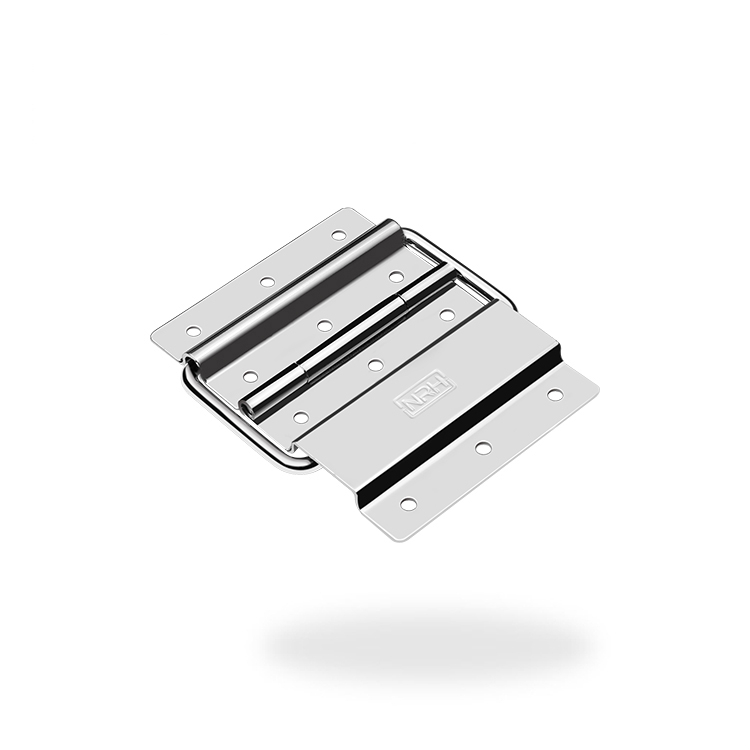
A support hinge has two leaves like a standard butt hinge, but adds a built-in stay arm – a rigid link that blocks further rotation when the lid reaches its designed open angle. At that point, the arm geometry prevents further rotation. The lid cannot swing past the stay angle.
The stay arm pivots on a pin at the hinge barrel and connects to a second pin on one leaf. When the lid opens, the arm rotates with it until it reaches its mechanical limit at the stay angle. The hinge is now both a pivot and a brace.
The Physics: Why the Stay Arm Works
When a flip-top lid is closed, its center of gravity is located directly above or slightly inside the hinge axis. As the lid opens, the center of gravity moves outward. At approximately 90 degrees of opening, the center of gravity passes beyond the vertical axis of the hinge pin. Once this happens, gravity creates a torque that would continue to rotate the lid downward – not toward closed, but further downward past 90 degrees. Without a stop mechanism, the lid would over-rotate and hang past vertical.
The support hinge’s stay arm provides the hard stop. At exactly 90 degrees, the stay arm hits its mechanical limit. It blocks further rotation, holding the lid in position against the gravitational torque. The stay arm is a hard stop, not a lock. It stops the lid from rotating further downward, but it does not clamp or latch. The lid stays open because the arm physically blocks further rotation, not because it grips or locks in place.
To close the lid, the user simply pushes it closed. No lifting, no release mechanism, no separate operation. Pushing the lid past the stay position disengages the arm, and the lid swings closed freely. The arm returns to its resting position, ready for the next open cycle.
Stay-Arm vs. Friction Stay
There are two common ways a support hinge holds position: mechanical stay-arm and friction.
Mechanical stay-arm hinges use a rigid arm that hits a hard stop. The 8131 series uses this design. The advantage is predictability – the lid always stops at the same angle, every time, regardless of weight (within the rated load). The disadvantage is a single fixed angle. If you need 70 degrees instead of 90 degrees, you need a different hinge.
Friction stay hinges use a tight pivot that resists rotation through friction. The lid stays wherever you leave it. The advantage is flexibility. The disadvantage is that friction degrades over time as the pivot surfaces wear. A friction hinge that holds 8 kg on day one may hold only 5 kg after many cycles.
For tool case lids and equipment box covers, mechanical stay-arm is the safer choice. The hard stop does not wear out. The hold angle never drifts. No lock mechanism to wear, no release operation to train operators on.
What Happens If You Choose the Wrong Hinge
Selecting the wrong hold-open hardware creates safety hazards, maintenance headaches, or product failures. Here are the most common failure patterns.
Pattern 1: Under-specifying the load rating. You install a hinge rated for 8 kg on a lid that weighs 12 kg. The hinge initially holds, but over time the stay arm deforms or the pivot pin shears. The lid no longer stops at 90 degrees – it continues rotating downward past vertical, creating a pinch hazard for users who expect it to stay open.
Pattern 2: Using a friction hinge on a high-cycle application. You choose a friction stay for a lid opened 20 times per day. Within 18 months, the friction surfaces wear and the lid no longer holds position. The lid drifts past 90 degrees and hangs open, forcing operators to prop it with improvised blocks.
Pattern 3: Choosing a gas strut when a mechanical hinge would work. You install a gas strut on a 10 kg lid that only needs a 90-degree stop. The gas strut loses pressure over time, the lid stops staying open, and you have to replace the strut. A mechanical support hinge would have done the same job with zero maintenance.
| Failure Scenario | Root Cause | Consequence |
|---|---|---|
| Lid continues rotating past 90 degrees | Under-specified load rating | Pinch hazard, user safety risk |
| Lid no longer stays open | Friction wear on friction hinge | Reduced productivity, field repairs |
| Gas strut fails prematurely | Using gas strut where mechanical hinge would suffice | Unplanned replacement cost, downtime |
8131 Support Hinge Series: Specs and Options
The NRH 8131 series covers support hinges from 5 kg to 15 kg rated load in iron and stainless steel. All models in this series use a 90-degree mechanical stay arm.
Key Models
| Model | Material | Finish | Weight | Rated Load | Stay Angle |
|---|---|---|---|---|---|
| 8131-70 | Iron (FE) | Chrome (CR) | 137 g | 10 kg | 90 degrees |
| 8131-70-1 | SUS304 | Vibratory (ZG) | 126 g | 15 kg (per pair) | 90 degrees |
| 8131-100 | Iron (FE) | Chrome (CR) | 265 g | 10 kg | 90 degrees |
| 8131-50 | Iron (FE) | Chrome (CR) | – | – | 90 degrees |
| 8131-48 | Iron (FE) | Chrome (CR) | – | – | 90 degrees |
| 8131-38 | Iron (FE) | Chrome (CR) | 35 g | 5 kg | 90 degrees |
| 8131-36 | Iron (FE) | Chrome (CR) | 26 g | 5 kg | 90 degrees |
Load ratings are per-hinge values for vertical mounting (verified from NRH product specification drawings). When calculating the total load, include the weight of the lid plus any equipment mounted inside the lid (such as foam, panels, or instruments). For horizontal mounting, the effective holding force is reduced due to the increased moment arm on the stay pin. When using two hinges per lid, allow a safety margin below the combined rating.
Material and Finish Trade-offs
Iron with chrome plating (FE-CR) is the default for indoor and controlled environments. Chrome plating provides corrosion resistance suitable for indoor applications. Cost is lower than stainless steel, making it the economical choice for dry, temperature-controlled spaces.
SUS304 with vibratory finish (S04-ZG) is the right choice for outdoor, humid, or washdown environments. SUS304 provides excellent corrosion resistance in challenging environments. The vibratory finish provides a uniform matte surface that hides minor scratches and does not show fingerprints. The 8131-70-1-S04-ZG is the stainless variant of the 8131-70, with a higher load rating of 15 kg per pair due to the stronger stay arm geometry in this variant.
Black finishes (BK2) are available on several models for dark-painted panels. Black oxide over iron offers limited corrosion protection – use it only in dry indoor applications where the coating is not subjected to abrasion.
Gas Strut vs. Mechanical Support Hinge
When designing a lid hold-open system, engineers often choose between gas struts and mechanical support hinges. Each has distinct strengths. The choice depends on lid weight, required opening angle, and lifecycle expectations.
Gas Strut (Gas Spring)
A gas strut is a sealed cylinder containing compressed nitrogen gas and a piston rod. It provides a constant pushing force that holds the lid open at any position within its travel range. Gas struts can handle large lids – 20 kg to 100+ kg. They allow variable opening angles and provide damped closing.
The downsides: gas struts lose pressure gradually over time. They are sensitive to temperature – force drops in cold and increases in heat. They add installation complexity: brackets, correct orientation, and force calculation for each application. They also cost more per unit than a support hinge.
Mechanical Support Hinge
A mechanical support hinge integrates the stay function into the hinge itself. No separate strut, no brackets, no force calculation. Install the hinge, and the lid stays open at 90 degrees. The mechanism does not degrade with temperature and has no sealed components to leak.
The limitations: fixed opening angle (90 degrees for the 8131 series), lower load capacity (5-15 kg per hinge), and no damping on closing.
Head-to-Head Comparison
| Factor | Gas Strut | Mechanical Support Hinge |
|---|---|---|
| Opening angle | Variable (0 to max travel) | Fixed (90 degrees) |
| Load range | 20-100+ kg | 5-15 kg per hinge |
| Force decay over time | Yes (gas leakage) | No |
| Temperature sensitivity | Significant | None |
| Damped closing | Yes (built-in) | No |
| Installation parts | Strut + two brackets + fasteners | Hinge only |
| Cost per unit | Higher | Lower |
| Maintenance requirement | Periodic replacement | None |
Bottom line: Use a mechanical support hinge for lids under 15 kg where a 90-degree opening angle is sufficient. Use gas struts for lids over 15 kg, for applications requiring variable opening angles, or for applications requiring damped closing.
Applications: Where Support Hinges Perform Best
Tool Cases and Equipment Boxes with Flip-Top Lids
Field-service tool cases, instrument boxes, and portable equipment enclosures have lids that open upward on hinges mounted along the rear edge of the box. The lid and the box body are a single assembly – the hinge connects the two, and the lid rotates around the hinge axis.
When the lid is opened to 90 degrees, the center of gravity of the lid passes beyond the vertical axis of the hinge pin. At this point, gravity creates a torque that would continue to rotate the lid downward (further past vertical), not pull it closed. The support hinge’s stay arm engages a mechanical hard stop at exactly 90 degrees, blocking this further rotation. The stay arm holds the lid in position against this gravitational torque.
Model 8131-70-FE-CR suits standard steel tool cases with lid weights up to 10 kg. For heavier lids, use two hinges, one on each side of the case. For stainless steel cases in marine or outdoor environments, the 8131-70-1-S04-ZG provides corrosion-resistant performance in SUS304.
Instrument Boxes and Compact Enclosures
Smaller cases – test instrument boxes, calibration standard cases, and portable electronic enclosures – often have lids weighing 3-5 kg. The compact 8131-38 (35 g, 5 kg) and 8131-36 (26 g, 5 kg) fit tight mounting spaces without adding significant weight. These are ideal for plastic or thin-wall metal cases where larger hinges would be visually disproportionate.
For these lighter lids, a single hinge mounted at the rear edge is often sufficient. The lid opens to 90 degrees, the stay arm engages, and the lid stays open for the user to access controls or read instrumentation.
Heavy-Duty Transit Cases with Reinforced Lids
Transit cases for sensitive equipment often have reinforced lids weighing 8-15 kg. For these applications, use two 8131-70 hinges (one on each side of the box, mounted at the rear edge) to distribute the load. The combined rating provides secure hold-open – at 90 degrees, both stay arms engage simultaneously, holding the lid against the gravitational torque that would otherwise continue to rotate it past 90 degrees.
The 8131-100 (265 g, 10 kg, iron chrome) is designed for larger cases with wider lid distribution, providing a broader mounting surface for heavy-duty plastic or composite case bodies.
Wall-Mounted Enclosures with Top-Hinged Covers
Small wall-mounted electrical enclosures, data distribution boxes, and control panels sometimes have top-hinged covers that open upward. When these covers are opened to 90 degrees, their center of gravity passes beyond the hinge axis. Without a stay mechanism, the cover would continue to rotate downward past 90 degrees. A support hinge provides the hard stop that arrests this rotation at 90 degrees.
The compact 8131-38 and 8131-36 are well-suited for these applications where mounting space inside the enclosure is limited. For larger wall-mounted enclosures with heavier covers, use the 8131-70 or 8131-100 as appropriate.
What Support Hinges Are NOT Designed For
Understanding the limitations is as important as understanding the capabilities. The 8131 series support hinges are not designed for the following applications:
- Lids that require variable opening angles. The 8131 series provides a fixed 90-degree stop. If you need the lid to hold at 45 degrees, 60 degrees, or any angle other than 90 degrees, use a friction hinge or gas strut.
- Lids that require damped closing. Support hinges provide no damping. The lid swings freely once the stay arm is disengaged. For applications requiring controlled closing speed, use a gas strut with integrated damping.
- Lids over 15 kg with a single hinge. The stay arm has a hard mechanical limit – exceeding the rated load will deform the arm or shear the pivot pin. Use two hinges or switch to a gas strut.
- Side-hinged doors that open horizontally. Support hinges are designed for vertical rotation of a lid around a horizontal hinge axis. They provide no hold-open function for side-hinged doors.
- Large industrial hatch covers exceeding 15 kg. These applications typically require gas struts or heavy-duty mechanical supports with higher load ratings.
Configuration Summary
The table below summarizes the key specifications of the 8131 series support hinges for box-and-lid applications.
| Application | Recommended Model | Load Rating | Environment |
|---|---|---|---|
| Small instrument box / light lid | 8131-36 or 8131-38 | 5 kg (single) | Indoor, dry |
| Standard tool case / equipment box | 8131-70-FE-CR | 10 kg (single) | Indoor, controlled |
| Outdoor / marine / washdown case | 8131-70-1-S04-ZG | 15 kg (per pair) | Outdoor, humid, corrosive |
| Large transit case / wide lid | 8131-100-FE-CR (two hinges) | 20 kg (per pair) | Indoor, dry |
Selection Guide: Choosing the Right Support Hinge
Answer these questions to narrow your choice for your box-and-lid application.
| Question | If Yes | If No |
|---|---|---|
| Is the lid heavier than 10 kg? | Use two hinges or consider gas strut | Single hinge may be sufficient |
| Is the lid width over 500 mm? | Use two hinges (one per side) for stability | Single hinge may be sufficient |
| Is the environment wet or salty? | SUS304 model (8131-70-1-S04-ZG) | Iron chrome is acceptable |
| Is the mounting space tight? | Compact models (8131-36, 8131-38) | Standard models (8131-70, 8131-100) |
| Is the case body made of plastic or thin-wall metal? | Compact lightweight models (8131-36, 8131-38) | Standard models for steel case bodies |
| Do you need the lid to hold at an angle other than 90 degrees? | Use a friction hinge or gas strut | 90-degree stay is fine – support hinge works |
| Do you need damped closing? | Use a gas strut with damping | Support hinge works (no damping) |
Installation Tips
- Mount the hinge so the stay arm points downward when the lid is open. This lets gravity assist the arm into its locked position. Reversing the orientation forces the arm to fight gravity, reducing effective holding force significantly.
- Use all screw holes on each leaf. Skipping any concentrates shear on the remaining screws. Under vibration or shock, a partially fastened hinge will tear out.
- For vertical mounting, orient the hinge barrel upward. The stay arm engages most reliably in this orientation.
- Mount hinges on opposite sides of the box at the rear edge – not both on the same side. This distributes the load evenly and prevents twisting.
- Test the stay engagement with the lid fully loaded before final installation. The rated load assumes a balanced lid with its center of gravity centered on the lid width. Off-center weights may require additional hinges.
- If using two hinges, ensure they are aligned on the same axis. Misaligned hinges will bind and may not engage simultaneously.
Need help selecting the right support hinge for your case?
Get a free consultation from our engineering team for your specific lid weight and environment.
Key Takeaways
- A support hinge combines pivot and stay functions in a single unit, eliminating the need for separate gas struts, prop rods, or brackets. This simplifies installation and reduces cost.
- The physics is specific: at 90 degrees, the lid’s center of gravity passes beyond the hinge axis. Gravity creates a torque that would rotate the lid downward past vertical. The stay arm’s hard stop blocks this rotation and holds the lid in position.
- The stay arm is a hard stop, not a lock. It blocks further downward rotation but does not clamp or latch. The lid closes by pushing directly back – no lifting or release operation required.
- Mechanical stay-arm hinges are more reliable than friction hinges for heavy lids because the hard stop does not wear out. Friction hinges lose holding force over time as pivot surfaces wear.
- The 8131 series covers loads from 5 kg to 15 kg at a fixed 90-degree opening angle. The 8131-70-1 SUS304 version offers 15 kg per pair with excellent corrosion resistance.
- Choose iron chrome for indoor applications and SUS304 for outdoor, marine, washdown, or chemically exposed environments.
- Use a gas strut when you need variable opening angles, damped closing, or loads above 15 kg. Use a support hinge for fixed 90-degree applications under 15 kg where simplicity and reliability are priorities.
- Support hinges are designed for flip-top lids on boxes and enclosures – not for side-hinged doors, large industrial hatches, or applications requiring variable angles.
Frequently Asked Questions
What is a support hinge?
A support hinge is a hinge with a built-in stay arm that holds a lid open at a fixed angle – typically 90 degrees. It combines the pivot function of a standard hinge with the hold-open function in a single unit. It is designed for flip-top lids on tool cases, instrument boxes, and equipment enclosures.
What is the difference between a stay-arm hinge and a friction hinge?
A stay-arm hinge uses a rigid mechanical arm that hits a hard stop at a fixed angle. A friction hinge relies on tight pivot friction to hold position at any angle. Stay-arm hinges are more reliable for heavier lids because the mechanical stop does not wear out. Friction hinges lose holding force over time as surfaces wear.
How much weight can a support hinge hold?
The 8131-70 iron chrome model holds 10 kg per hinge. The 8131-70-1 SUS304 model holds 15 kg per pair. Smaller models like the 8131-38 and 8131-36 hold 5 kg each. For lids over 10 kg, install two hinges and allow a safety margin below the combined rating.
Can I use a support hinge instead of a gas strut?
Yes, for lids under 15 kg where a fixed 90-degree opening angle is sufficient. A support hinge costs less, installs faster, and does not degrade over time. For lids over 15 kg or when you need variable opening angles or damped closing, a gas strut is the better choice.
What opening angle do support hinges provide?
The 8131 series provides a fixed 90-degree stay angle. This is the most common angle for tool case lids and access panels. If you need a different angle, contact the manufacturer for available options or consider a friction hinge for variable positioning.
Should I choose iron chrome or SUS304 stainless steel?
Choose SUS304 (model 8131-70-1-S04-ZG) for outdoor, humid, marine, or washdown environments. SUS304 provides excellent corrosion resistance in challenging conditions. Choose iron chrome (FE-CR) for indoor, dry environments where cost is the priority.
How many support hinges do I need per lid?
One hinge for lids under 5 kg. Two hinges for lids between 5 kg and 15 kg – mount them on opposite sides of the box near the rear edge. For lids wider than 500 mm, always use two hinges even if the weight is under 5 kg – a single hinge on a wide lid creates uneven stress that can twist the panel.
Does a support hinge provide damped closing?
No. Mechanical stay-arm hinges release the lid without damping. The lid swings shut under gravity. If damped closing is required for safety or noise reasons, add a separate damper or choose a gas strut with built-in damping.
Can I use a support hinge on a side-hinged door?
No. Support hinges are designed for vertical rotation of a lid around a horizontal hinge axis. They provide no hold-open function for side-hinged doors that swing horizontally. For side-hinged doors, use a standard butt hinge with a separate door stop or gas strut.
How do I calculate the total weight my lid will impose on the hinges?
Include the weight of the lid itself plus any equipment, foam, panels, or accessories mounted inside the lid. For a 10 kg lid with 3 kg of internal equipment, the total weight is 13 kg – exceeding the 10 kg single-hinge rating. Use two hinges for this application.
Need Help Choosing?
Contact the NRH Box Hardware team for application-specific guidance on support hinge selection:
TEL & WhatsApp & WeChat: +86 180 1797 5137
E-MAIL: nrh-gz@nrh.cn
ADD: Room 1703-1704, Zhongji Building, No. 819 Yinxiang Road, Nanxiang Town, Jiading District, Shanghai, China