

Recessed vs Surface-Mounted Spring Handles: Full Specs Guide
Quick Answer: A spring loaded handle is a self-retracting pull handle that uses an internal spring to automatically return the grip to its stowed position when released. NRH offers two mounting styles: the 4101 series (recessed) for flush, snag-free surfaces (45-80kg load capacity), and the 4201 series (surface-mounted) for quick installation without panel cutouts (25-60kg load capacity). Choose recessed for military cases and flight cases where zero protrusion is required; choose surface-mounted for retrofits and applications where panel cutting is not feasible.
Applicable Buyers
This guide is for case builders, product designers, engineers, and procurement professionals selecting spring loaded handles for flight cases, military containers, industrial enclosures, medical equipment cases, and transit cases. NRH offers two spring loaded handle series: the 4101 series (recessed, flush-mount) and the 4201 series (surface-mounted). This article covers specifications, load ratings, material comparisons, installation methods, and application-specific selection guidance.
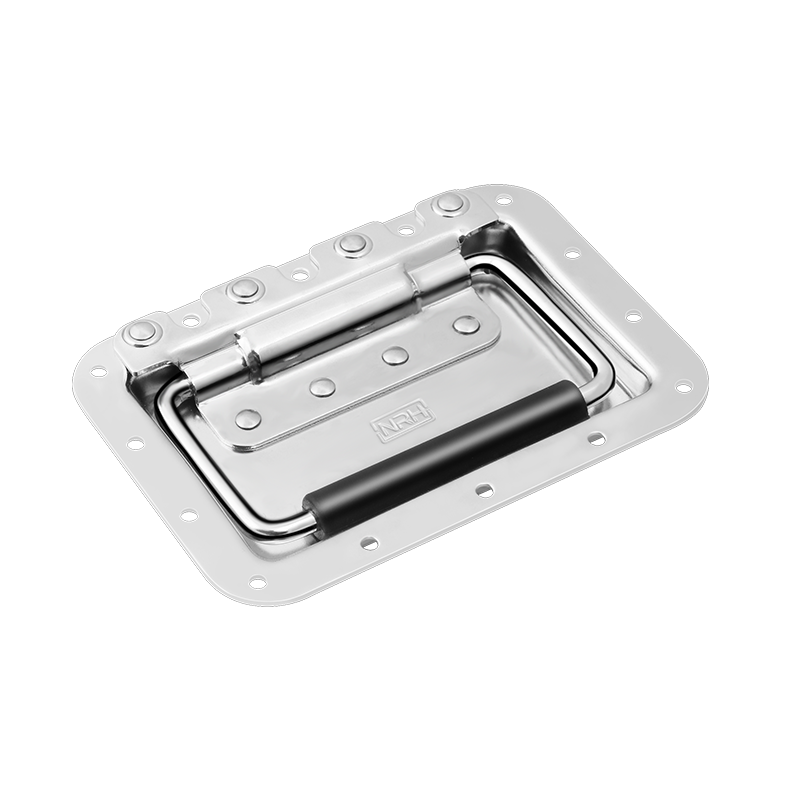
Figure 1: NRH 4101-178 recessed spring loaded handle with chrome-plated finish. The recessed design sits flush with the panel surface, eliminating snagging hazards. (Image source: NRH Box Hardware)
Key Finding: NRH offers two spring loaded handle families for case and enclosure applications. The 4101 series is a recessed (flush-mount) design that requires a panel cutout, providing a completely flush surface with no protruding parts – ideal for military cases, flight cases, and applications where snag-free stacking is critical. The 4201 series is a surface-mounted design that screws directly onto the panel surface without a large cutout – ideal for retrofits and applications where panel modification is not feasible. Load ratings range from 45kg to 80kg for the 4101 series and 25kg to 60kg for the 4201 series. Both series are available in steel and 304 stainless steel. Choose recessed (4101) for zero-protrusion applications; choose surface-mounted (4201) for quick installation and minimal panel modification.
A spring loaded handle is a self-retracting pull handle that uses an internal spring mechanism to automatically return the grip to its stowed position when released – eliminating the need to manually fold it back. This reduces snagging hazards and improves stackability during transport and storage. Unlike standard folding handles that require manual stowing, spring loaded handles are critical for flight cases, transit containers, and equipment enclosures in professional logistics and live-event environments. The mechanism is simple but proper selection demands attention to load capacity, panel compatibility, and installation constraints.
NRH 4101 Series – Recessed Spring Loaded Handles
Design concept: Fully recessed (flush-mount) installation – the handle sits inside a panel cutout, leaving a smooth, snag-free surface with no protruding parts.
Typical applications: Military cases, insulated containers, medical equipment cases, flight cases, heavy-duty transit cases, firefighting boxes, vehicle boot boxes, export packing cases, wooden crates, machinery, instrumentation, marine equipment, aviation gear, and monitoring equipment.
Material options: Steel (standard), 304 stainless steel (optional).
Mounting method: Rivets, screws, or spot welding – follow the hole pattern specified for each model.
Important: All dimensions shown on the product drawings are marked “for reference only – not for tooling/mould creation”. Always obtain official engineering drawings from NRH before production.
4101-110 Specifications
| Parameter | Steel / Chrome-plated | 304 SS / Bright | Custom: Steel / Electrophoretic black |
|---|---|---|---|
| Weight | 112 g | 127 g | 130 g |
| Load capacity | 45 kg | 45 kg | 45 kg |
| Overall length (L) | 110 mm | 110 mm | 110 mm |
| Cutout length (L1) | 100 mm | 100 mm | 100 mm |
| Cutout width (L2) | 84.5 mm | 83 mm | 83 mm |
| Overall height (H) | 92.5 mm | 91 mm | 92 mm |
| Cutout depth (H1) | 85 mm | 86.5 mm | 85.5 mm |
| Mounting hole OD | 4-OD6 | 4-OD4 | 4-OD4 |
| Corner radius (R) | 4-R4.5 | 4-R4.5 | 4-R9 |
Note: The custom electrophoretic black version has a larger corner radius (R9 vs. R4.5), which reduces stress concentration at the cutout corners – particularly beneficial for high-vibration or composite-panel applications.
4101-120 Specifications
| Parameter | Steel / Chrome-plated |
|---|---|
| Weight | 168 g |
| Load capacity | N/A (not specified on drawing) |
| Overall length (L) | 120 mm |
| Cutout length (L1) | 108.5 mm |
| Cutout width (L2) | 95 mm |
| Overall height (H) | 105 mm |
| Cutout depth (H1) | 95 mm |
| Mounting hole OD | 4-OD4.5 |
| Corner radius (R) | 2-R14 / 2-R16 (asymmetric) |
Note: The cutout uses asymmetric corner radii (R14 on one side, R16 on the other) – check the drawing orientation before machining.
4101-132 Specifications
| Parameter | Steel / Chrome-plated | 304 SS / Bright |
|---|---|---|
| Weight | 225 g | 215 g |
| Load capacity | 60 kg | 60 kg |
| Overall length (L) | 132.5 mm | 132.5 mm |
| Cutout length (L1) | 117 mm | 117 mm |
| Cutout width (L2) | 105 mm | 105.5 mm |
| Overall height (H) | 115 mm | 115 mm |
| Cutout depth (H1) | 100 mm | 100 mm |
| Corner radius (R) | R13.5 | R13.5 |
| Mounting hole OD | 4-OD3.9 | 4-OD4.1 |
4101-160 Specifications
| Parameter | Steel / Chrome-plated | Steel / Black powder-coated | 304 SS / Bright |
|---|---|---|---|
| Weight | 371 g | 376 g | 376 g |
| Load capacity | 80 kg | 80 kg | 80 kg |
| Overall length (L) | 161 mm | 162 mm | 162 mm |
| Cutout length (L1) | 148 mm | 147.8 mm | 147.8 mm |
| Cutout width (L2) | 123 mm | 122 mm | 122 mm |
| Overall height (H) | N/A | 93 mm | 93 mm |
| Cutout depth (H1) | 92 mm | N/A | N/A |
| Mounting hole pitch (P1/P2/P3) | 46 / 46 / 46 mm | 46 / 46 / 46 mm | 46 / 46 / 46 mm |
| Mounting hole OD (10 holes) | OD5 | OD5 | OD5 |
| Corner radius (R) | 4-R10 | 4-R4.5 | 4-R4.5 |
Key observations:
– 4101-160 offers the highest load capacity (80 kg) in the 4101 series.
– The chrome-plated steel version uses a larger corner radius (R10) than the other finishes (R4.5), which further reduces stress concentration.
– Dimensional consistency across material variants allows easy interchangeability.
4101-178 Specifications
| Parameter | Steel / Chrome-plated |
|---|---|
| Weight | 453 g |
| Load capacity | 80 kg |
| Overall length (L) | 178 mm |
| Cutout length (L1) | 141.5 mm |
| Cutout width (L2) | 136.5 mm |
| Mounting hole pitch (P1/P2) | 40.5 / 40.5 mm |
| Mounting hole pitch (P3/P4) | 36 / 36 mm |
| Mounting hole OD (14 holes) | OD5 |
| Corner radius (R) | R5.5 |
Note: 4101-178 has the largest panel cutout area (approx. 193 cm2) in the series and is explicitly marked as a “panel cutout dimension drawing” – ideal for large enclosures.
NRH 4201 Series – Surface-Mounted Spring Loaded Handles
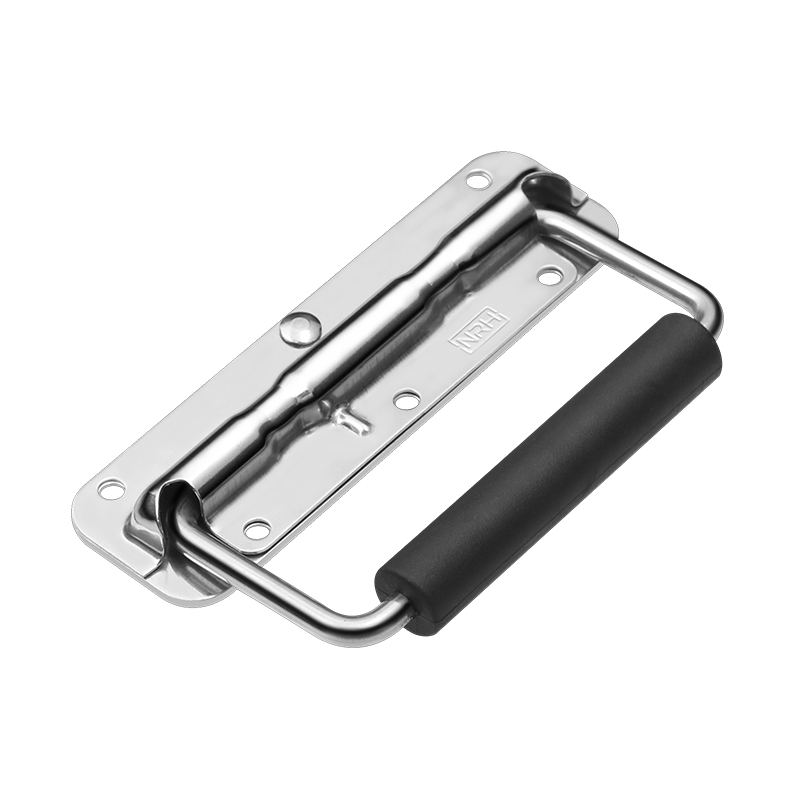
Figure 2: NRH 4201-140 surface-mounted spring loaded handle with vibratory ground finish. The surface-mounted design attaches directly to the panel without a large cutout. (Image source: NRH Box Hardware)
Design concept: Surface-mounted (no large cutout) – the handle is screwed directly onto the panel surface. It incorporates an internal spring and a soft-rubber overmoulded grip.
Typical applications: Flight cases, heavy-duty transit cases, firefighting boxes, vehicle boot boxes, export packing cases, wooden crates, machinery, instrumentation.
Material options: Steel (standard), 304 stainless steel (optional); 4201-160 also available in 201 stainless steel.
Surface finishes: Vibratory ground, chrome-plated, black painted, black oxide, electrophoretic black, brushed (only on 4201-160).
Mounting method: Screw-fix directly to the panel surface – only pilot holes are required.
Important: As with the 4100 series, all dimensions are for reference only – not for tooling/mould creation. Request official drawings before production.
4201-100 Specifications
| Parameter | Steel / Chrome-plated | 304 SS / Bright |
|---|---|---|
| Weight | 122 g | 122 g |
| Load capacity | 25 kg | 25 kg |
| Overall length (L) | 100 mm | 100 mm |
| Mounting hole pitch (L2) | 65 mm | 69 mm |
| Overall height (H) | N/A | 93 mm |
| Base height (H1) | N/A | 72.5 mm |
| Mounting hole pitch (P) | 50 mm | 50 mm |
| Mounting hole OD | 4-OD5.5 | 4-OD5 |
| Opening angle | ~90deg | ~90deg |
4201-110 Specifications
| Parameter | Steel / Chrome-plated | Steel / Black painted | 304 SS / Vibratory ground |
|---|---|---|---|
| Weight | 145 g | 147 g | 146 g |
| Load capacity | 30 kg | 30 kg | 30 kg |
| Overall length (L) | 110 mm | 110 mm | 110 mm |
| Mounting hole pitch (L2) | 62 mm | 61.5 mm | 62 mm |
| Overall height (H) | N/A | 96 mm | N/A |
| Base height (H1) | N/A | N/A | 76.5 mm |
| Mounting hole pitch (P) | 79 mm | 80 mm | N/A |
| Mounting hole OD | 12 mm | 11.9 mm | 12.5 mm |
| Pivot pin OD | 6 mm | N/A | 6 mm |
| Opening angle | ~90deg | ~90deg | ~90deg |
4201-120 Specifications
| Parameter | Steel / Chrome-plated | 304 SS / Vibratory ground |
|---|---|---|
| Weight | 167 g | 161 g |
| Load capacity | 35 kg | 35 kg |
| Overall length (L) | 122 mm | 122 mm |
| Mounting hole pitch (L2) | 63 mm | 63 mm |
| Base height (H1) | N/A | 83.5 mm |
| Mounting hole pitch (P) | 81.5 mm | N/A |
| Mounting hole OD | OD15.5 | OD16 |
| Opening angle | ~80deg | ~80deg |
4201-140 Specifications
| Parameter | Steel / Chrome-plated | Steel / Black painted | 304 SS / Vibratory ground | 304 SS / Black oxide |
|---|---|---|---|---|
| Weight | 201 g | 209 g | 209 g | 208 g |
| Load capacity | 40 kg | 40 kg | 50 kg | 40 kg |
| Overall length (L) | 140.5 mm | 140.6 mm | 140 mm | 140 mm |
| Mounting hole pitch (L2) | 90.5 mm | 91 mm | 89 mm | 88.5 mm |
| Mounting hole pitch (P1) | 46 mm | 46 mm | 46 mm | 46 mm |
| Mounting hole pitch (P2) | 46 mm | 46 mm | 46 mm | 46 mm |
| Mounting hole OD | OD16.5 | OD16.5 | OD16.5 | OD16.5 |
| Opening angle | ~90deg | ~90deg | ~90deg | ~75deg |
Notable differences:
– The 304 SS / vibratory ground version of 4201-140 delivers 50 kg capacity – significantly higher than the 40 kg of other finishes.
– The black-oxide version has a reduced opening angle (~75deg) compared to ~90deg on others – verify your clearance needs.
4201-160 Specifications
| Parameter | 201 Stainless steel / Brushed |
|---|---|
| Weight | 305 g |
| Load capacity | 60 kg |
| Overall length (L) | 156 mm |
| Mounting hole pitch (L1) | 142 mm |
| Mounting hole pitch (L2) | 107 mm |
| Mounting hole pitch (P1/P2) | 63.5 / 63.5 mm |
| Mounting hole OD (large) | OD17.5 |
| Mounting hole OD (small) | OD8 |
4101 vs 4201 – Key Differences at a Glance
| Aspect | 4101 Recessed | 4201 Surface-Mounted |
|---|---|---|
| Installation method | Panel cutout + flush fit | Surface screw-fix (no large cutout) |
| Final profile | Flush with panel | Protrudes from surface |
| Snag / impact risk | Very low (fully recessed) | Higher (handle exposed) |
| Panel preparation | Precise cutout required | Only pilot holes needed |
| Load capacity range | 45 kg – 80 kg | 25 kg – 60 kg |
| Material options | Steel, 304 SS | Steel, 304 SS, 201 SS (160 only) |
| Surface finishes (examples) | Chrome, bright, black powder, electrophoretic black | Vibratory ground, chrome, black paint, black oxide, electrophoretic black, brushed |
Selection guide:
– Choose 4101 when a flush, snag-free surface is critical and cutouts are acceptable.
– Choose 4201 when fast installation or minimal panel modification is needed, and slight protrusion is tolerable.
Material and Finish Options Overview
The table below summarises material and finish combinations per series – actual availability may vary by model (refer to the individual specification tables above).
| Series | Material Options | Surface Finishes (by model) |
|---|---|---|
| 4101 | Steel, 304 stainless steel | Chrome, bright, black powder, electrophoretic black (custom) |
| 4201 | Steel, 304 SS, 201 SS (160 only) | Vibratory ground, chrome, black paint, black oxide, electrophoretic black, brushed (160 only) |
Application Scenarios – Which Series for Which Use
The following applications are quoted directly from NRH product documentation for each series.
- 4101 Series is suitable for: Military cases, insulated containers, medical equipment cases, flight cases, heavy-duty transit cases, firefighting boxes, vehicle boot boxes, export packing cases, wooden crates, machinery, instrumentation, marine equipment, aviation gear, monitoring equipment.
- 4201 Series is suitable for: Flight cases, heavy-duty transit cases, firefighting boxes, vehicle boot boxes, export packing cases, wooden crates, machinery, instrumentation.
Selection Guide: Matching Handle to Application
| Application | Recommended Series | Recommended Model | Reason |
|---|---|---|---|
| Small case, lightweight lid (under 45kg) | 4101 | 4101-110 | Smallest recessed handle, 45kg capacity |
| Medium case, indoor use, quick installation | 4201 | 4201-110 or 4201-120 | Surface-mounted, 30-35kg capacity |
| Flight case, zero protrusion required | 4101 | 4101-132 or 4101-160 | Flush design, 60-80kg capacity |
| Heavy transit case (over 60kg load) | 4101 | 4101-160 or 4101-178 | 80kg capacity, largest handle sizes |
| Retrofit installation, existing panels | 4201 | 4201-140 or 4201-160 | No panel cutout required, 40-60kg capacity |
| Marine or high-humidity environment | 4101 or 4201 | 304 SS version of any model | 304 stainless steel corrosion resistance |
Installation Overview
Based on the official installation notes:
- For 4101: Cut a hole in the panel according to the specified cutout dimensions (see tables). Insert the handle and secure with rivets, screws, or spot welding using the provided hole pattern.
- For 4201: Only drill pilot holes for the mounting screws – no large cutout. Attach the handle directly onto the panel surface with screws.
Critical reminder: All product drawing dimensions are marked “for reference only – not for tooling/mould creation”. Always request the official engineering drawings from NRH before starting mass production or precision machining.
Frequently Asked Questions (FAQ)
What is a spring loaded handle?
A spring loaded handle is a self-retracting pull handle that uses an internal spring mechanism to automatically return the grip to its stowed position when released – eliminating the need to manually fold it back. This reduces snagging and improves stackability during transport.
What is the difference between recessed and surface-mounted spring handles?
Recessed handles (like the 4101 series) require a panel cutout and sit flush with the surface. Surface-mounted handles (like the 4201 series) are screwed directly onto the panel without a large cutout, but they protrude from the surface. Recessed offers better snag protection; surface-mounted is quicker to install.
What are the load capacities of the NRH 4101 series?
4101-110: 45 kg; 4101-132: 60 kg; 4101-160: 80 kg; 4101-178: 80 kg. The 4101-120 does not have a load capacity listed on the available drawing.
What are the load capacities of the NRH 4201 series?
4201-100: 25 kg; 4201-110: 30 kg; 4201-120: 35 kg; 4201-140: 40 kg (50 kg for the 304 SS / vibratory ground version); 4201-160: 60 kg.
Are NRH spring handles available in stainless steel?
Yes. Both 4101 and 4201 series offer 304 stainless steel as an option. The 4201-160 also comes in 201 stainless steel.
What surface finishes are offered on each series?
4101 series: chrome, bright, black powder, electrophoretic black (custom).
4201 series: vibratory ground, chrome, black paint, black oxide, electrophoretic black, brushed (only on 4201-160).
Can these handles be used on flight cases?
Yes. Flight cases are listed as a primary application for both series.
Do I need to cut a hole for recessed handles?
Yes. The 4101 series is a recessed design and requires a precise panel cutout. The required dimensions are provided in the specification tables above.
Do surface-mounted handles require panel cutouts?
No. The 4201 series is surface-mounted – only pilot holes for the mounting screws are needed.
Where can I get official engineering drawings?
Contact NRH directly to request formal CAD or engineering drawings. The images provided are marked “for reference only” and are not suitable for production tooling.
Key Takeaways
- Recessed spring handles (4101) require a panel cutout and sit completely flush with the surface – ideal for zero-protrusion applications like military cases and flight cases. Load ratings: 45kg to 80kg.
- Surface-mounted spring handles (4201) attach directly to the panel surface without a large cutout – ideal for retrofits and quick installations. Load ratings: 25kg to 60kg.
- Both series are available in steel and 304 stainless steel – choose 304 stainless for corrosion resistance in demanding environments.
- Load capacity varies by model – select based on your lid weight and application requirements. For the 4101 series, 4101-160 and 4101-178 offer the highest capacity (80kg). For the 4201 series, 4201-160 offers the highest capacity (60kg).
- Dimensional consistency across material variants allows easy interchangeability – the cutout dimensions for the same model number remain consistent regardless of material.
- Surface finish affects opening angle – the black-oxide version of 4201-140 has a reduced opening angle (~75deg) compared to the standard ~90deg, verify your clearance needs.
- Always request official engineering drawings before production – all dimensions provided are marked “for reference only” and are not suitable for tooling/mould creation.
About NRH
NRH is a brand of Shanghai Nahui Hardware Products Co., Ltd., established in 1996 and headquartered in Shanghai, China. The company specialises in R&D and production of high-quality hardware fittings for cases and boxes – including latches, handles, hinges, and corner protectors. NRH spring loaded handles feature a built-in welded steel spring and are widely used in military, industrial, aviation, and logistics applications worldwide.
For official engineering drawings, customisation enquiries, or bulk orders, please visit the NRH product pages or contact the sales team directly.