

The Ultimate Guide to Safety Latches: Dual-Locking Mechanisms for Secure Enclosures
Quick Answer: A safety latch adds a secondary retention mechanism on top of the primary toggle action. NRH offers three designs: padlock hole (5102-88K, 1000N tensile, 304 SS), keyed cylinder (6401-89K, 245N tensile, steel), and push-button safety lock (5808-98S, 441N tensile, 304 SS). Choose padlock hole for existing lock systems, keyed cylinder for controlled key distribution, and push-button safety for one-hand operation with accidental-opening prevention.
Have you ever opened a transit case and found the latch unlatched – without anyone touching it? That is the signature failure of a standard over-center toggle under vibration. The latch does not fail suddenly. It creeps open over thousands of micro-vibrations until the lid pops open during transit. A safety latch eliminates this single point of failure with a second, independent retention method. This guide explains the three safety latch designs, how they work, and how to select the right one for your application.
Applicable Buyers
This guide is for case builders, product designers, engineers, and procurement professionals selecting safety latches for flight cases, military containers, medical equipment enclosures, industrial cabinets, and any application where accidental opening or unauthorized access is a concern. Understanding the three safety latch designs – padlock hole, keyed cylinder, and push-button safety lock – is essential for reliable, secure enclosure design.
Key Finding: A standard toggle latch has a single point of failure – the over-center toggle. Under vibration, shock, or accidental contact, the toggle can disengage and the lid can open. A safety latch adds a second, independent retention method that must fail simultaneously for the enclosure to open. Three designs exist: padlock hole (user-supplied padlock), keyed cylinder (built-in key lock), and push-button safety lock (one-hand release with accidental-opening prevention). NRH offers all three designs with tensile loads from 245N to 1000N.
A standard toggle latch uses a single retention method: the over-center toggle. Press the handle past the dead-center point, and the mechanism locks. This works well under static conditions. Under vibration, shock, or accidental contact, the toggle can disengage. A safety latch solves this by adding a second, independent lock.
What Is a Safety Latch?
A safety latch is a toggle latch with a secondary retention mechanism on top of the primary over-center toggle. The secondary mechanism must be released before the handle can be opened, preventing accidental disengagement from vibration, impact, or unintended contact.
Safety latches are also known as:
- Dual-locking latches
- Lockable toggle latches
- Security latches
- Positive-locking latches
Unlike standard toggles that rely solely on the over-center geometry, safety latches provide redundant retention. If the primary toggle disengages from vibration, the secondary lock still holds the handle closed. The probability of both failing simultaneously is orders of magnitude lower than a single toggle disengaging.
Three Safety Latch Designs
NRH offers three distinct safety latch designs, each optimized for different security requirements, operational preferences, and environments.
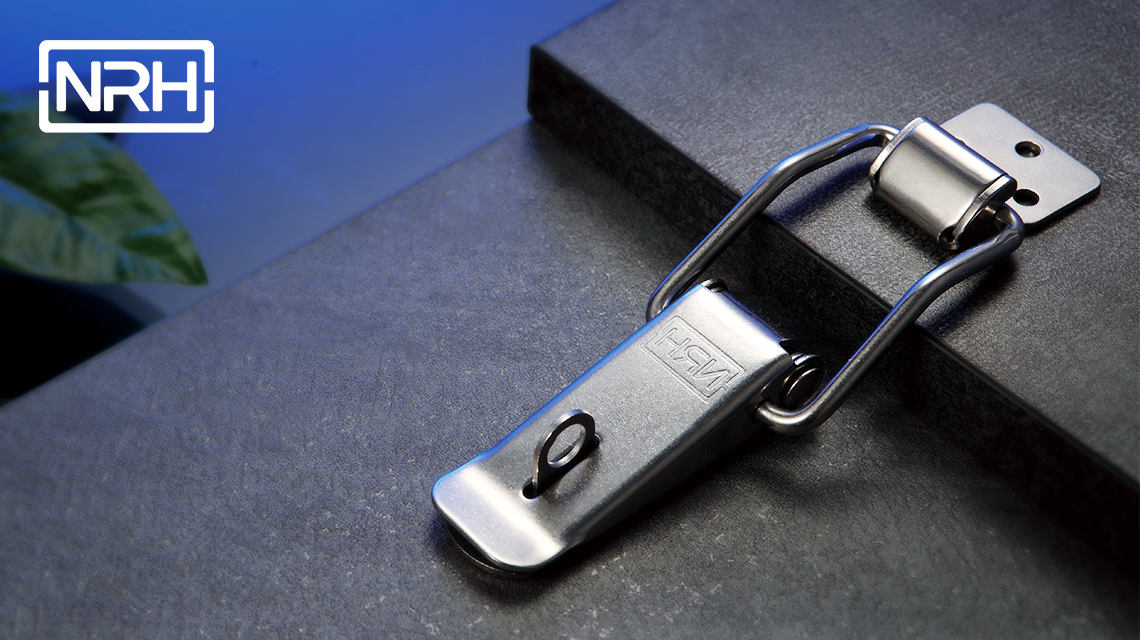
1. Padlock Hole Design – 5102-88K
A hole in the latch body aligns with a corresponding hole on the base when the latch is closed. Insert a padlock through both holes, and the handle cannot be lifted. The user supplies their own padlock – no key is built into the latch. This is the simplest and most cost-effective dual-locking option.
Best for: Facilities with existing padlock systems, cost-sensitive applications, and situations where key distribution is already managed through a centralized padlock system.
| Padlock Hole Design – 5102-88K | |||
|---|---|---|---|
| Parameter | Specification | Parameter | Specification |
| Model | 5102-88K | Lock Type | Padlock hole |
| Material | 304 stainless steel | Weight | 60 g |
| Surface finish | Vibratory ground | Tensile load | 1000 N |
| Overall length (L) | 88 mm | Mounting hole count | 4 holes |
2. Keyed Cylinder Design – 6401-89K
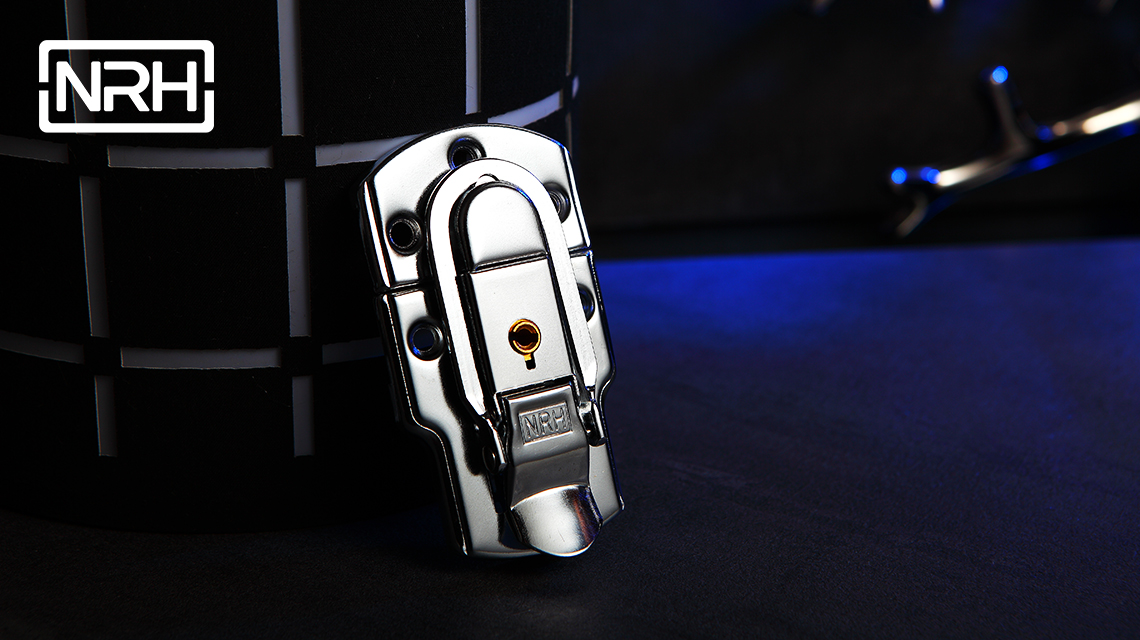
A built-in key cylinder locks the handle in the closed position. The user must insert and turn a key to release the handle before the toggle can be opened. This prevents both accidental opening and unauthorized access. No separate padlock is needed – the key is integrated into the latch body. This design is ideal for controlled access applications where key distribution is managed.
Best for: Medical equipment cases, electrical cabinets, telecom enclosures, and applications requiring controlled access with managed key distribution.
| Keyed Cylinder Design – 6401-89K | |||
|---|---|---|---|
| Parameter | Specification | Parameter | Specification |
| Model | 6401-89K | Lock Type | Keyed cylinder |
| Material | Zinc-plated steel | Weight | 68 g |
| Surface finish | Chrome-plated | Tensile load | 245 N |
| Overall length (L) | 89 mm | Mounting hole count | 6 holes |
3. Push-Button Safety Lock Design – 5808-98S
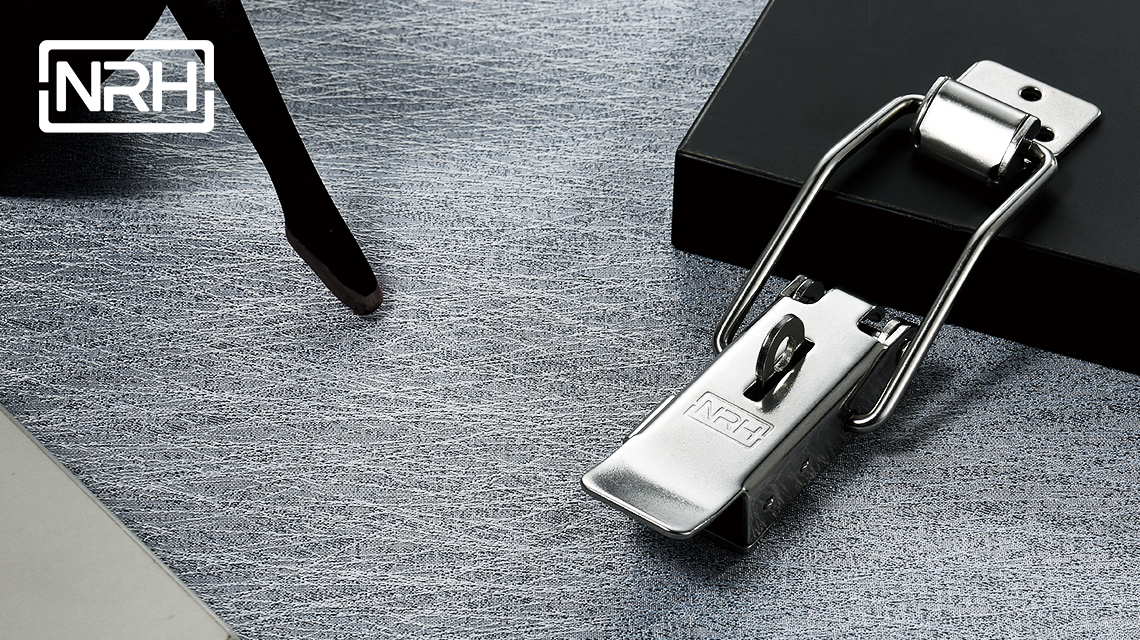
A spring-loaded push button engages a secondary locking mechanism when the latch is closed. To open the latch, the user presses the button (releasing the safety lock) while simultaneously lifting the handle. This design prevents accidental opening from vibration or impact while allowing one-hand operation for authorized users. No keys or padlocks are needed – the safety lock is mechanical and self-contained.
Best for: Transport cases, field equipment, and applications requiring quick one-hand operation with accidental-opening prevention – no keys or padlocks to lose.
| Push-Button Safety Lock Design – 5808-98S | |||
|---|---|---|---|
| Parameter | Specification | Parameter | Specification |
| Model | 5808-98S | Lock Type | Push-button safety lock |
| Material | 304 stainless steel | Weight | 65 g |
| Surface finish | Vibratory ground | Tensile load | 441 N |
| Overall length (L) | 110.6 mm | Mounting hole count | 4 holes |
Comparison at a Glance
| Feature | 5102-88K | 6401-89K | 5808-98S |
|---|---|---|---|
| Lock Type | Padlock hole | Keyed cylinder | Push-button safety |
| Material | 304 SS | Zinc-plated steel | 304 SS |
| Tensile Load | 1000 N | 245 N | 441 N |
| Weight | 60 g | 68 g | 65 g |
| Finish | Vibratory ground | Chrome-plated | Vibratory ground |
| Corrosion Resistance | Excellent | Good (indoor) | Excellent |
| Operation | Two-hand (padlock) | Two-hand (key) | One-hand (button) |
| Best Application | Existing padlock systems | Controlled access | Field equipment / transit |
Safety Latch vs. Standard Latch: When the Difference Matters
Not every enclosure needs a safety latch. A standard latch is fine when vibration is low, access control is not required, and an accidental opening causes no serious consequence. But several conditions make the dual-locking feature necessary:
- Vibration environments: Military transport cases, vehicle-mounted equipment, and industrial machinery generate sustained vibration. A standard toggle can creep past dead center and release over time. A safety latch physically blocks handle movement regardless of vibration amplitude.
- Security and access control: Medical equipment cases, electrical cabinets, and telecom enclosures often require controlled access. Only authorized personnel with a key or padlock can open the enclosure. A standard latch offers no access control – anyone can flip it open.
- Regulatory compliance: Certain industries mandate lockable enclosures. Electrical cabinets under IEC 60204 must prevent unauthorized access to live parts. Medical device enclosures may require lockable storage under local health codes. A safety latch with keyed lock satisfies these requirements directly.
- High-value or hazardous contents: Cases carrying calibrated instruments, classified electronics, or hazardous materials demand redundant retention. If the primary toggle fails, the secondary lock holds. The 5102-88K at 1000N tensile is designed for exactly this scenario.
Industry Standard Reference:
Lockable enclosures are required by IEC 60204-1 for electrical equipment and by MIL-STD-810 for transport case hardware in military applications. Safety latches with keyed cylinders or padlock holes help meet these requirements for access control and vibration resistance.
| Condition | Standard Latch | Safety Latch |
|---|---|---|
| Low vibration, no access control needed | Yes | Not required |
| Sustained vibration or shock | Risk of accidental opening | Recommended |
| Access control required | Cannot restrict access | Required |
| Regulatory lockable-enclosure mandate | Non-compliant | Required |
| High-value or hazardous contents | Single point of failure | Required |
Selection Guide: Choosing the Right Safety Latch
Use this step-by-step process to narrow your choice:
Step 1: Determine Your Locking Requirement
| Requirement | Recommended Design | Model |
|---|---|---|
| User supplies own padlock | Padlock hole | 5102-88K |
| Controlled key distribution | Keyed cylinder | 6401-89K |
| One-hand operation + accident prevention | Push-button safety | 5808-98S |
Step 2: Determine Your Load Requirement
Calculate the total force the latch must resist. For a lid weighing 15kg with 2 latches, each latch carries roughly 7.5kg. Add a safety factor of 2-3. Compare against the tensile load ratings:
- 5102-88K: 1000 N (approx. 102kgf) – highest capacity, suitable for heavy cases and high-vibration environments
- 6401-89K: 245 N (approx. 25kgf) – medium capacity, ideal for light to medium enclosures
- 5808-98S: 441 N (approx. 45kgf) – good balance of capacity and safety function
Engineering Note: The 5102-88K delivers 1000N tensile at just 60g – a strength-to-weight ratio of 16.7 N/g. This makes it the most efficient safety latch in the NRH range for high-load applications where weight is a constraint.
Step 3: Choose Material Based on Environment
- 304 stainless steel (5102-88K, 5808-98S): Required for marine, medical, food processing, and outdoor applications where corrosion resistance matters. The vibratory finish adds a smooth, burr-free surface.
- Zinc-plated steel with chrome finish (6401-89K): Adequate for indoor, dry environments. Lower cost, bright finish. No salt-spray resistance.
Step 4: Verify Mounting Dimensions
Check mounting hole spacing against your enclosure panel:
- 5102-88K: 4 mounting holes, 88mm overall length
- 6401-89K: 6 mounting holes, 89mm overall length
- 5808-98S: 4 mounting holes, 110.6mm overall length
Download the 2D/3D CAD files from the NRH product page to verify fit before ordering.
Frequently Asked Questions (FAQ)
What is a safety latch?
A safety latch is a toggle latch with a secondary retention mechanism on top of the primary over-center toggle. The secondary mechanism must be released before the handle can be opened, preventing accidental disengagement from vibration, impact, or unintended contact.
What is the difference between a padlock hole and a keyed cylinder?
A padlock hole (5102-88K) accepts a user-supplied padlock. No key is built into the latch. A keyed cylinder (6401-89K) has a built-in key lock. The user inserts and turns a key to release the handle. Keyed cylinders offer cleaner integration; padlock holes allow integration with existing facility padlock systems.
How does the push-button safety lock work on the 5808-98S?
The 5808-98S features a spring-loaded push button that engages a secondary locking mechanism when the latch is closed. To open the latch, the user presses the button to release the safety lock while simultaneously lifting the handle. This prevents accidental opening from vibration or impact while allowing one-hand operation.
What is the tensile load of NRH safety latches?
5102-88K: 1000 N (approx. 102kgf). 6401-89K: 245 N (approx. 25kgf). 5808-98S: 441 N (approx. 45kgf). Select based on your application load requirements with a 2x to 3x safety factor.
Are safety latches required for military enclosures?
Military transport cases typically require lockable latches per defense procurement specifications. The specific requirement depends on the contract and the sensitivity of the contents. The 5102-88K (1000N tensile, SUS304) or 5808-98S (441N tensile, SUS304) meet the functional requirements of most military-grade enclosure specs.
Can I retrofit a safety latch onto an existing enclosure?
In most cases, yes. Verify the mounting hole pattern against your existing latch footprint. All three models use standard mounting hole configurations. The 5102-88K and 5808-98S share similar mounting patterns to standard toggle latches. The 6401-89K has a specific footprint – check the drawing for compatibility.
Does a safety latch affect the IP rating of an enclosure?
All three safety latch designs maintain the same IP rating as their standard counterparts because the primary sealing mechanism is the gasket and compression force. The safety mechanism is integrated into the handle or body without compromising the seal around the latch base.
How many safety latches should I use per enclosure?
For small cases under 500mm per side, two latches (one on each side of the lid) are sufficient. For larger enclosures, use four latches – one per corner – to prevent warping and maintain even gasket compression. The total load rating of all latches combined should exceed the lid weight by at least 2x.
What maintenance do safety latches require?
For keyed cylinder models (6401-89K), lubricate the key cylinder with graphite or dry PTFE lubricant every 6-12 months. Avoid oil-based lubricants that attract dust. For padlock hole models (5102-88K), inspect the padlock hole for debris. For push-button models (5808-98S), check the button action for smooth operation. SUS304 models need no corrosion maintenance in normal indoor conditions.
Can I get custom key codes for keyed-lock latches?
NRH offers OEM/ODM services including custom key coding. For volume orders, keyed-alike (same key opens all latches) or keyed-different (unique key per latch) configurations are available. Contact NRH sales with your key system requirements.
Key Takeaways
- Three safety latch designs are available: padlock hole (5102-88K), keyed cylinder (6401-89K), and push-button safety lock (5808-98S).
- Padlock hole (5102-88K) accepts user-supplied padlocks, 1000N tensile load, 304 stainless steel – highest capacity in the range.
- Keyed cylinder (6401-89K) integrates a key lock, 245N tensile load, zinc-plated steel with chrome finish – ideal for controlled access.
- Push-button safety (5808-98S) offers one-hand operation with accidental-opening prevention, 441N tensile load, 304 stainless steel.
- Choose safety latches when vibration, access control, compliance, or high-value contents demand redundant retention.
- Material selection is critical – 304 stainless steel for outdoor/marine/medical environments; zinc-plated steel for indoor/dry environments.
- Mounting compatibility – all three models use standard mounting patterns; verify fit with the product drawing.
- Industry standards – IEC 60204-1 and MIL-STD-810 often require lockable enclosures for electrical and military applications.
- When in doubt, move up one size – the cost difference is minimal compared to the cost of failure.
About NRH
NRH is a brand of Shanghai Nahui Hardware Products Co., Ltd., established in 1996 and headquartered in Shanghai, China. The company specialises in R&D and production of high-quality hardware fittings for cases and boxes – including safety latches, toggle latches, handles, hinges, and corner protectors. NRH safety latches are manufactured in 304 stainless steel and zinc-plated steel with multiple finish options, serving military, medical, aviation, industrial, and logistics applications worldwide.
All NRH safety latch data presented in this guide is based on actual product specifications and marked “for reference only – not for tooling/mould creation”. For official engineering drawings, customisation enquiries, or bulk orders, please contact the NRH sales team directly.
For official engineering drawings, customisation enquiries, or bulk orders, please visit the NRH product pages or contact the sales team directly.