

SUS304 vs SUS316 Stainless Steel for Case Hardware: A Side-by-Side Comparison of the Same Product
Quick Answer: SUS304 and SUS316 are the two most widely used austenitic stainless steels in industrial case hardware. The defining difference is molybdenum: SUS316 contains 2-3% Mo, while SUS304 contains none. This single element gives SUS316 approximately 5x better resistance to chloride pitting, with a PREN of 24-28 vs. 18-20 for SUS304. Using the NRH 5101-96 butterfly latch as a case study – available in both grades with identical geometry – the SUS304 version delivers 392N tensile at 90g, while the SUS316 version delivers the same 392N tensile at 88g. This demonstrates the key takeaway: for identical mechanical performance, SUS316 offers superior corrosion resistance at virtually the same weight. The choice is not about strength – it is about matching corrosion resistance to your operating environment.
Have you ever specified SUS304 for a coastal application – and watched it pit within months? That is the signature mistake of treating these two grades as interchangeable. The 2-3% molybdenum in SUS316 is not a marginal improvement; it fundamentally changes how the material performs in chloride-rich environments. This guide provides the definitive data-driven comparison of SUS304 and SUS316 using the NRH 5101-96 – a butterfly latch available in both grades with identical geometry and identical tensile load – so you can make grade-selection decisions grounded in real test data rather than assumption. This is the only publicly available comparison of its kind.
Applicable Buyers
This guide is for case builders, product designers, engineers, and procurement professionals selecting stainless steel hardware for flight cases, industrial enclosures, military containers, medical equipment, and any application where corrosion resistance and material grade selection are critical to product lifecycle cost and reliability.
Key Finding: The difference between SUS304 and SUS316 is not about mechanical strength – both grades have comparable tensile strength (greater than or equal to 515 MPa) and yield strength (greater than or equal to 205 MPa). The difference is corrosion resistance. SUS316’s 2-3% molybdenum content delivers approximately 5x better resistance to chloride pitting, a PREN of 24-28 vs. 18-20 for SUS304, and a critical pitting temperature of approximately 45°C vs. approximately 15°C. The NRH 5101-96 case study below confirms that the two grades deliver identical mechanical performance, making the selection decision purely about corrosion resistance and lifecycle cost.
The Material Decision That Defines Hardware Longevity
In 2024, global stainless steel production surpassed 62 million metric tons, and yet one question continues to dominate procurement conversations across the industrial enclosure sector: SUS304 or SUS316? The answer is no longer a simple cost calculation. As equipment deployments expand toward coastal installations, offshore energy sites, and chemically aggressive manufacturing floors, the gap between these two austenitic grades – once considered marginal – has become a decisive factor in product lifecycle cost and compliance.
Both SUS304 and SUS316 belong to the austenitic stainless steel family and are the two most widely used grades in industrial applications. Both offer excellent general corrosion resistance, formability, and weldability. But the defining difference is molybdenum: SUS316 contains 2-3% Mo, which significantly improves resistance to pitting and crevice corrosion in chloride-containing environments. SUS304 contains no molybdenum.
What makes this comparison unique is the NRH 5101-96 butterfly latch – a product available in both SUS304 and SUS316 with identical geometry, identical surface finish, and identical tensile load. This provides the closest possible approximation of a laboratory-controlled experiment in real-world hardware. The data is unambiguous, and it enables a selection decision based on one factor alone: the operating environment.
Composition: The 2-3% That Changes Everything
Both SUS304 and SUS316 belong to the austenitic stainless steel family. The critical compositional difference is molybdenum: SUS316 contains 2-3% molybdenum, while SUS304 contains none. This single element fundamentally alters how each grade performs in chloride-rich environments.
| Element | SUS304 (Type 304) | SUS316 (Type 316) | Engineering Significance |
|---|---|---|---|
| Chromium (Cr) | 18.0-20.0% | 16.0-18.0% | Forms passive chromium-oxide film; baseline corrosion resistance |
| Nickel (Ni) | 8.0-10.5% | 10.0-14.0% | Stabilizes austenitic structure; improves formability |
| Molybdenum (Mo) | 0% | 2.0-3.0% | The decisive element for chloride resistance; reinforces passive film |
| Carbon (C) max | 0.08% | 0.08% | Controls intergranular corrosion sensitivity; lower carbon grades available |
Molybdenum acts as a pitting-corrosion inhibitor at the passive-film level. When chlorides attack the chromium-oxide layer on stainless steel, molybdenum reinforces the repassivation response, reducing the initiation rate of pit nucleation by approximately fivefold. In practical terms, SUS316 offers roughly 5x better resistance to chloride pitting compared with SUS304 – a figure confirmed by ASTM G48 pitting tests and real-world coastal exposure data alike.
The Pitting Resistance Equivalent Number (PREN) provides a single-value metric for comparing pitting-corrosion resistance across stainless grades, calculated as:
PREN = %Cr + 3.3 x %Mo + 16 x %N
- SUS304: PREN approximately 18-20
- SUS316: PREN approximately 24-28
The 3.3x multiplier on molybdenum makes a decisive difference. In practical specification work, a PREN below 22 is generally considered insufficient for coastal or marine-adjacent applications, placing SUS304 below the threshold and SUS316 comfortably above it.
The NRH 5101-96 Case Study: A True Side-by-Side Comparison
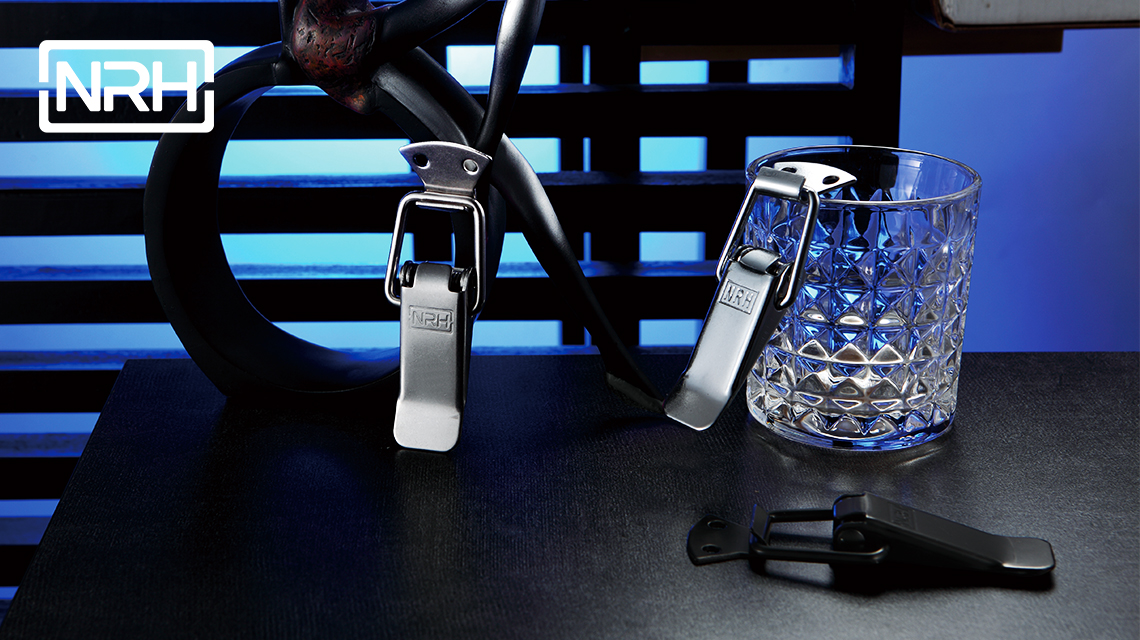
The most rigorous way to compare SUS304 and SUS316 is to examine the same product, manufactured to the same dimensions, with the only variable being the material grade. The NRH 5101-96 butterfly latch provides exactly this comparison – and the results are remarkable.
Direct Comparison: 5101-96 SUS304 vs SUS316
| Parameter | 5101-96 (SUS304) | 5101-96 (SUS316) | Difference / Interpretation |
|---|---|---|---|
| Material | 304 stainless steel | 316 stainless steel | The only variable |
| Surface finish | Vibratory ground | Vibratory ground | Identical |
| Weight | 90 g | 88 g | 316 is 2g lighter (-2.2%) |
| Tensile load | 392 N | 392 N | Identical – no strength trade-off |
| Overall length | 96 mm | 96 mm | Identical |
| Overall width | 119 mm | 119 mm | Identical |
| Mounting hole pitch | 73.5 mm | 73.5 mm | Interchangeable |
The Critical Finding:
The SUS304 and SUS316 versions of the NRH 5101-96 deliver identical tensile load – 392 N – with virtually identical weight (90g vs 88g). This means upgrading from SUS304 to SUS316 incurs no loss of mechanical performance and no significant weight penalty. The selection decision is driven entirely by corrosion resistance requirements and lifecycle cost – not by strength or weight trade-offs.
Corrosion Resistance: Where the Data Speaks
Corrosion resistance is the primary reason engineers specify one grade over the other, and the test data reveals a significant performance gap. The most widely referenced benchmark is the ASTM B117 salt spray test, which exposes samples to a 5% sodium chloride fog at 35°C and measures time-to-first-red-rust.
ASTM B117 Salt Spray Test Results
| Grade | Surface Condition | Hours to First Red Rust | Relative Performance |
|---|---|---|---|
| SUS304 | Unpassivated | 72-96 hours | Baseline |
| SUS304 | Passivated | 500+ hours | 5-7x improvement |
| SUS316 | Unpassivated | 480-1,000+ hours | 5-10x improvement over unpassivated 304 |
| SUS316 | Passivated | 1,000+ hours | 10-14x improvement over unpassivated 304 |
Several observations deserve attention. First, passivation dramatically extends the salt-spray endurance of both grades – by roughly 5-7x for SUS304 (72-96 hours to 500+ hours) and 2x or more for SUS316. Passivation removes free-iron particles from the surface and thickens the chromium-oxide passive layer, and it is a step that should never be skipped for hardware intended for outdoor or humid service.
Second, even in the unpassivated condition, SUS316 outperforms passivated SUS304. An unpassivated SUS316 sample at 480-1,000+ hours equals or exceeds a passivated SUS304 sample at 500+ hours. This is not a marginal difference; it means that a SUS316 component with minimal surface treatment can match or beat a SUS304 component that has undergone an additional processing step.
Third, in high-salt environments, the gap widens further. Some test data shows SUS304 developing white rust at 500-1,000 hours and red rust at 1,500 hours, while SUS316 can reach 2,000-3,000 hours without red rust.
The Science Behind the Difference: Molybdenum and Passive Film Repair
The corrosion resistance advantage of SUS316 over SUS304 can be explained at the electrochemical level. When chlorides penetrate the chromium-oxide passive film, they create local breakdown sites where the underlying metal begins to dissolve. This is the initiation stage of pitting corrosion. Molybdenum enhances the repassivation kinetics – the rate at which the passive film reforms after being disrupted. In practice, this means a pit that would grow continuously in SUS304 is arrested in SUS316 before it can propagate beyond the surface.
This is why SUS316’s PREN value of 24-28 vs. SUS304’s 18-20 is not just a number – it translates directly into field performance. In the coastal guardrail study cited earlier, SUS304 developed widespread pitting after 3 years, while SUS316 showed only slight edge discoloration. For case hardware, where crevices and mechanical wear points are common, the molybdenum advantage is even more pronounced.
Critical Pitting Temperature (CPT)
Critical Pitting Temperature indicates the lowest temperature at which pitting corrosion initiates in a standard 6% FeCl3 solution (ASTM G48 Method C):
- SUS304: CPT approximately 15°C
- SUS316: CPT approximately 45°C
This 30°C difference is substantial. It means that SUS304 begins to pit at temperatures as low as 15°C (59°F) – well within the range of ambient conditions in tropical, subtropical, and even many temperate coastal locations. SUS316, by contrast, resists pitting initiation up to approximately 45°C (113°F), covering virtually all normal service temperatures for enclosure hardware.
Real-World Coastal Performance
Laboratory data is instructive, but field performance is what ultimately validates or disproves grade selection. Field studies confirm the performance gap: 316 stainless steel consistently outperforms 304 in marine environments.
A three-year coastal exposure study tells the story plainly: SUS304 guardrails developed widespread pitting corrosion after 36 months, while SUS316 guardrails in the identical environment showed only slight edge discoloration. Pits were concentrated at weld heat-affected zones and horizontal surfaces where salt deposits accumulated. 316 stainless steel’s corrosion products were similar, but the pitting depth was significantly shallower.
For case hardware – which often features crevices (hinge knuckles, latch mechanisms), exposed threads, and mechanical wear points – the implications are even more pronounced. Crevice corrosion accelerates pitting by trapping chlorides in confined spaces where oxygen cannot reach the surface to maintain the passive film. Toggle latches, recessed handles, and hinge assemblies are particularly susceptible because their moving parts create micro-gaps that concentrate chloride ions. SUS316’s molybdenum content mitigates this mechanism, while SUS304 is significantly more vulnerable to crevice-initiated pitting in these hardware-specific geometries.
In high-humidity or salt-laden environments, 316/316L enclosures resist pitting and crevice corrosion more effectively than 304. They also remain non-magnetic after fabrication, whereas 304 may become partially magnetic.
Mechanical Properties: Comparable on Paper, Different in Practice
In terms of baseline mechanical properties, SUS304 and SUS316 are broadly similar. Both exhibit tensile strength greater than or equal to 515 MPa and yield strength greater than or equal to 205 MPa in the annealed condition (per ASTM A240 / JIS G 4305). Hardness values overlap, and both grades are readily formable and weldable.
| Property | SUS304 | SUS316 |
|---|---|---|
| Tensile Strength (min) | 515 MPa | 515 MPa |
| Yield Strength (min) | 205 MPa | 205 MPa |
| Elongation | 40-60% | 45-60% |
| Young’s Modulus | 200 GPa | 200 GPa |
| Density | approximately 8.0 g/cm³ | approximately 8.0 g/cm³ |
However, two practical distinctions matter for case hardware:
- Work hardening rate: SUS304 work-hardens slightly faster than SUS316. This can be advantageous for cold-formed components like toggle latch hooks that benefit from surface hardening during stamping. Conversely, SUS316’s lower work-hardening rate makes it slightly easier to deep-draw for complex handle profiles. The NRH 5101-96 data confirms that these differences do not affect the final tensile load of the finished part – both versions achieve 392N.
- Post-weld corrosion: SUS304 is more susceptible to sensitization in the heat-affected zone, leading to intergranular corrosion in chloride environments. SUS316’s molybdenum content provides additional protection, making it the preferred grade for welded hardware assemblies intended for corrosive service.
Cost Analysis: Price Premium vs. Lifecycle Savings
The cost difference between SUS304 and SUS316 raw material fluctuates with molybdenum market pricing, but the historical premium for SUS316 spans 15% to 40% over SUS304 on a per-kilogram basis. For a single 5101-96 latch, this premium translates to a modest per-unit increase. For a large case outfitted with multiple hardware items, the cumulative difference becomes more noticeable.
However, cost comparison must extend beyond unit price:
- Replacement cost: If SUS304 hardware pits and requires field replacement after 3 years in a coastal installation, the replacement cost (parts + labor + downtime) often exceeds the original SUS316 premium multiple times over.
- Passivation cost: While both grades benefit from passivation, the urgency is higher for SUS304. Skipping passivation on SUS316 is far less consequential than skipping it on SUS304, which may reduce processing steps.
- Warranty and liability: Hardware failures due to corrosion in safety-critical applications (medical transport cases, military enclosures, offshore control panels) can trigger warranty claims, regulatory scrutiny, and reputational damage far exceeding the material cost difference.
In environments with chloride exposure – coastal, marine, de-icing salt, or chemical processing – the total cost of ownership for SUS316 hardware is typically lower than SUS304 over a 5-10 year service horizon, despite the higher initial price. For budget-sensitive indoor applications, SUS304 remains the pragmatic choice, but specifiers should resist the temptation to apply indoor-grade economics to outdoor or marine-adjacent deployments.
Application Matrix: Which Grade for Which Scenario?
The decision between SUS304 and SUS316 is ultimately driven by the operating environment and the consequence of failure. The following matrix provides guidance based on corrosion-resistance data and field experience.
Choose SUS304 When:
- Indoor installations with controlled humidity and no chloride exposure
- Enclosures in dry or mildly humid climates more than 10 km inland from coastline
- Cleanroom and laboratory environments where aesthetic corrosion (staining) is the primary concern rather than structural degradation
- Applications where hardware is inspected and maintained on a regular cycle, allowing early detection of surface corrosion
- Budget-constrained projects where the environment is benign and the hardware lifecycle is short (less than 5 years)
- General chemical processing where chlorides are absent or minimal
Choose SUS316 When:
- Coastal or marine environments within 5 km of saltwater (and especially within 1 km)
- Offshore platforms, port facilities, and shipboard installations
- Chemical processing plants with chloride-containing atmospheres
- Medical and pharmaceutical transport cases subject to frequent disinfection with chlorine-based agents
- Food processing environments with regular exposure to saline washdowns
- Safety-critical enclosures where hardware failure poses operational or regulatory risk
- Any application where service life exceeding 10 years is expected without hardware replacement
- Environments where chloride concentrations exceed approximately 200 ppm
The Passivation Factor: A Process That Cannot Be Overlooked
Regardless of grade selection, passivation is a critical process for stainless steel case hardware. The ASTM B117 data demonstrates the dramatic improvement passivation provides:
- SUS304 improves from 72-96 hours to 500+ hours (approximately 5-7x improvement)
- SUS316 improves from 480-1,000+ hours to 1,000+ hours (2x or greater improvement)
Passivation per ASTM A967 or AMS 2700 removes free-iron contamination arising from machining, stamping, and forming operations, then promotes the formation of a uniform chromium-oxide passive layer. For hardware with complex geometries – hinge knuckle interfaces, latch pawl recesses, handle mounting pockets – passivation is especially important because these crevice locations are precisely where chlorides concentrate and pitting initiates.
Some procurement specifications explicitly mandate passivation; others leave it as a supplier decision. Given the performance data, specifying passivation for all stainless steel case hardware is a best practice, and it is non-negotiable for SUS304 components in any environment with humidity above 60% or chloride exposure. For SUS316, passivation provides an additional safety margin that is well worth the modest processing cost, particularly for hardware with complex geometries or welded joints.
Specification Checklist for Procurement Teams
To ensure that grade selection translates to real-world performance, procurement teams should verify the following with their hardware suppliers:
- Grade certification: Request mill test certificates (MTC) per EN 10204 Type 3.1 confirming material composition, including molybdenum content for SUS316.
- Passivation status: Confirm whether hardware is passivated per ASTM A967 or AMS 2700, and specify the method (nitric acid immersion, citric acid, or electropolishing).
- Surface finish: Specify the surface finish (e.g., vibratory ground, #4 brushed, #8 mirror, BA) because smoother finishes resist corrosion initiation more effectively than rough surfaces.
- Salt spray test data: Request ASTM B117 test results for the specific product and surface treatment combination, not just the raw material.
- Load ratings: Verify that published mechanical ratings (tensile load, rated load) reflect the specific grade and surface condition of the hardware as supplied – the NRH 5101-96 data shows that SUS304 and SUS316 versions deliver identical tensile loads.
- Environmental rating: Confirm that the grade and surface treatment combination is suitable for the intended operating environment, including temperature range, humidity, and chloride concentration.
NRH Box Hardware provides mill test certificates and salt spray test data for its SUS304 and SUS316 product lines upon request.
Frequently Asked Questions (FAQ)
What is the difference between SUS304 and SUS316 stainless steel?
The defining difference is molybdenum: SUS316 contains 2-3% molybdenum, while SUS304 contains none. Molybdenum significantly improves resistance to pitting and crevice corrosion in chloride-containing environments. SUS304 is the standard 18/8 austenitic grade (18% chromium, 8% nickel); SUS316 adds 2-3% molybdenum to the composition.
Can SUS304 be used in coastal environments?
No, SUS304 is not recommended for coastal environments. It has a PREN of only 18-20 and a critical pitting temperature of approximately 15°C. Field studies show SUS304 developing widespread pitting after just 3 years in coastal service. SUS316 is the appropriate grade for these conditions.
Which is stronger: SUS304 or SUS316?
In the annealed condition, both grades have comparable tensile strength (greater than or equal to 515 MPa) and yield strength (greater than or equal to 205 MPa). The NRH 5101-96 case study confirms this – both the SUS304 and SUS316 versions deliver identical tensile load of 392 N. The primary advantage of SUS316 is corrosion resistance, not mechanical strength.
How much more expensive is SUS316 than SUS304?
The raw material premium for SUS316 typically spans 15% to 40% over SUS304, driven by molybdenum content. However, in corrosive environments, the total cost of ownership for SUS316 is often lower than SUS304 over a 5-10 year period because SUS304 may require replacement after 3 years.
Is passivation necessary for SUS316 hardware?
Passivation is strongly recommended for both grades but is less critical for SUS316 than for SUS304. Unpassivated SUS316 (480-1,000+ hours in ASTM B117) already matches or exceeds passivated SUS304 (500+ hours). However, passivation further extends SUS316 performance to 1,000+ hours and is considered a best practice.
What is the Critical Pitting Temperature difference between SUS304 and SUS316?
SUS304 has a critical pitting temperature (CPT) of approximately 15°C, while SUS316 has a CPT of approximately 45°C – a 30°C advantage. This means SUS304 can begin pitting at ambient temperatures common in tropical and subtropical coastal areas, whereas SUS316 resists pitting up to temperatures far above normal service conditions.
Can SUS304 hardware be upgraded to SUS316 without design changes?
In most cases, yes. SUS304 and SUS316 share comparable densities (both approximately 8.0 g/cm³) and dimensional tolerances in standard hardware formats. The NRH 5101-96 is available in both grades with virtually identical dimensions. Direct-swap replacement is typically possible, though slight differences in work-hardening behavior may affect forming parameters during manufacturing.
How long does SUS304 case hardware last in indoor applications?
In controlled indoor environments with low humidity and no chloride exposure, SUS304 case hardware can last indefinitely – corrosion is not a significant concern under these conditions. The service life is limited by mechanical wear rather than environmental degradation, making SUS304 an economical and fully adequate choice for indoor use.
What is the NRH 5101-96, and why is it used for this comparison?
The NRH 5101-96 is a butterfly latch available in both SUS304 and SUS316 with identical geometry, identical surface finish, and identical tensile load (392 N). The SUS304 version weighs 90g; the SUS316 version weighs 88g. This provides the closest possible approximation of a controlled experiment – the only variable is the material grade, making the comparison scientifically rigorous.
Key Takeaways
- SUS304 and SUS316 are both austenitic stainless steels with comparable baseline mechanical properties – tensile strength greater than or equal to 515 MPa and yield strength greater than or equal to 205 MPa.
- The defining difference is molybdenum: SUS316 contains 2-3% Mo; SUS304 contains none. This gives SUS316 approximately 5x better resistance to chloride pitting.
- PREN values tell the story: SUS304 approximately 18-20; SUS316 approximately 24-28. A PREN below 22 is insufficient for coastal applications.
- ASTM B117 salt spray results: unpassivated SUS304: 72-96 hours; unpassivated SUS316: 480-1,000+ hours; passivated SUS316: 1,000+ hours.
- Critical Pitting Temperature: SUS304 approximately 15°C; SUS316 approximately 45°C – a 30°C advantage that matters in tropical and subtropical climates.
- The NRH 5101-96 case study is the definitive comparison: both grades deliver identical tensile load (392 N) with virtually identical weight (90g vs 88g) – meaning the selection decision is purely about corrosion resistance.
- Choose SUS304 for indoor, dry environments with no chloride exposure.
- Choose SUS316 for coastal, marine, and chemically aggressive environments.
- Passivation is critical – it extends salt spray endurance by 5-7x for SUS304 and 2x or more for SUS316.
- Total cost of ownership in corrosive environments favors SUS316 despite the 15-40% material premium.
About NRH
NRH is a brand of Shanghai Nahui Hardware Products Co., Ltd., established in 1996 and headquartered in Shanghai, China. The company specialises in R&D and production of high-quality hardware fittings for cases and boxes – including toggle latches, handles, hinges, and corner protectors. NRH offers both SUS304 and SUS316 versions of key hardware products, including the 5101-96 butterfly latch featured in this definitive comparison, serving military, medical, aviation, industrial, and logistics applications worldwide.
All NRH product data presented in this guide is based on actual product specifications and marked “for reference only – not for tooling/mould creation”. For official engineering drawings, customisation enquiries, or bulk orders, please contact the NRH sales team directly.
For official engineering drawings, customisation enquiries, or bulk orders, please visit the NRH product pages or contact the sales team directly.