

How to Evaluate a Case Hardware Supplier: 5 Key Metrics That Matter
Selecting the right case hardware supplier is often more critical than selecting the right product. A poor supplier decision can lead to delayed shipments, inconsistent quality, hidden costs, and damaged customer relationships. This guide provides a practical framework for evaluating hardware suppliers across five key dimensions.
For procurement professionals and engineers, choosing a supplier is a balance of multiple factors: quality, cost, delivery, and service. Understanding how to assess each dimension – and what questions to ask – makes the difference between a successful long-term partnership and a costly mistake.

Why Supplier Selection Matters More Than You Think
Hardware components – latches, handles, hinges, corner protectors, and locks – are the touchpoints of any case or enclosure. Users interact with them every time they open, close, or carry a case. A latch that fails, a handle that corrodes, or a hinge that binds reflects poorly on the entire product.
Yet many procurement decisions focus narrowly on unit price. This approach overlooks the full cost of a supplier relationship: quality defects that require rework, delivery delays that disrupt production schedules, and poor communication that wastes engineering time. A supplier who charges slightly more but delivers significantly fewer problems is almost always the better choice.
5 Key Metrics for Evaluating Hardware Suppliers
1. Quality Management Systems
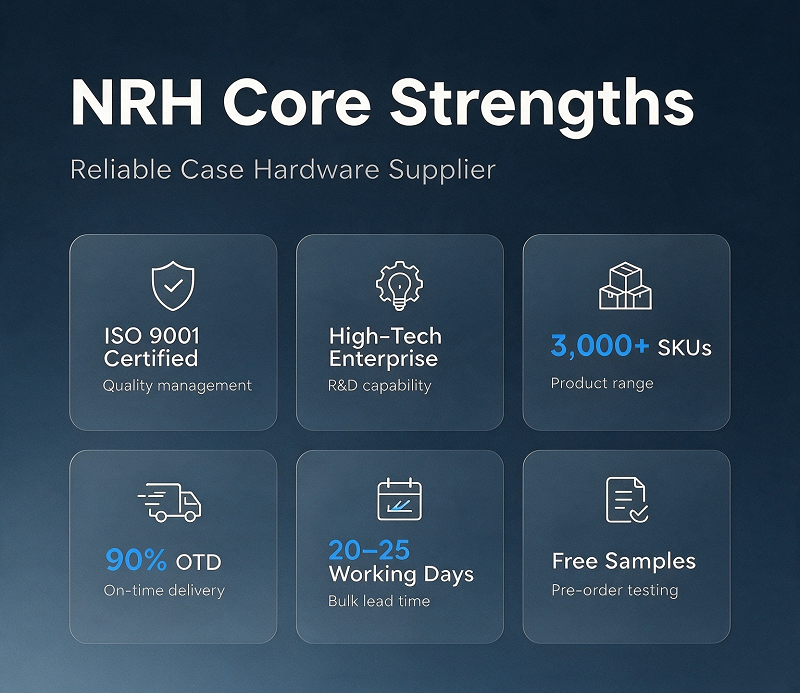
The foundation of any reliable supplier is a documented quality management system. ISO 9001 certification is the baseline standard for quality management. It demonstrates that the supplier has established processes for consistent quality, continuous improvement, and customer satisfaction.
Beyond certification, look for evidence of:
- Incoming material inspection – Does the supplier test raw materials before production?
- In-process quality checks – Are parts inspected during production, not just at the end?
- Final inspection and testing – What tests are performed before shipment?
- Traceability systems – Can the supplier trace a finished part back to its raw material batch?
For suppliers serving international markets, high-tech enterprise status indicates R&D capability and technological innovation. This designation, granted by national authorities, confirms that the supplier invests in product development, process improvement, and advanced manufacturing capabilities.
2. Production and Technical Capabilities
A supplier’s equipment, processes, and technical expertise determine what they can make – and how well. Key questions to ask:
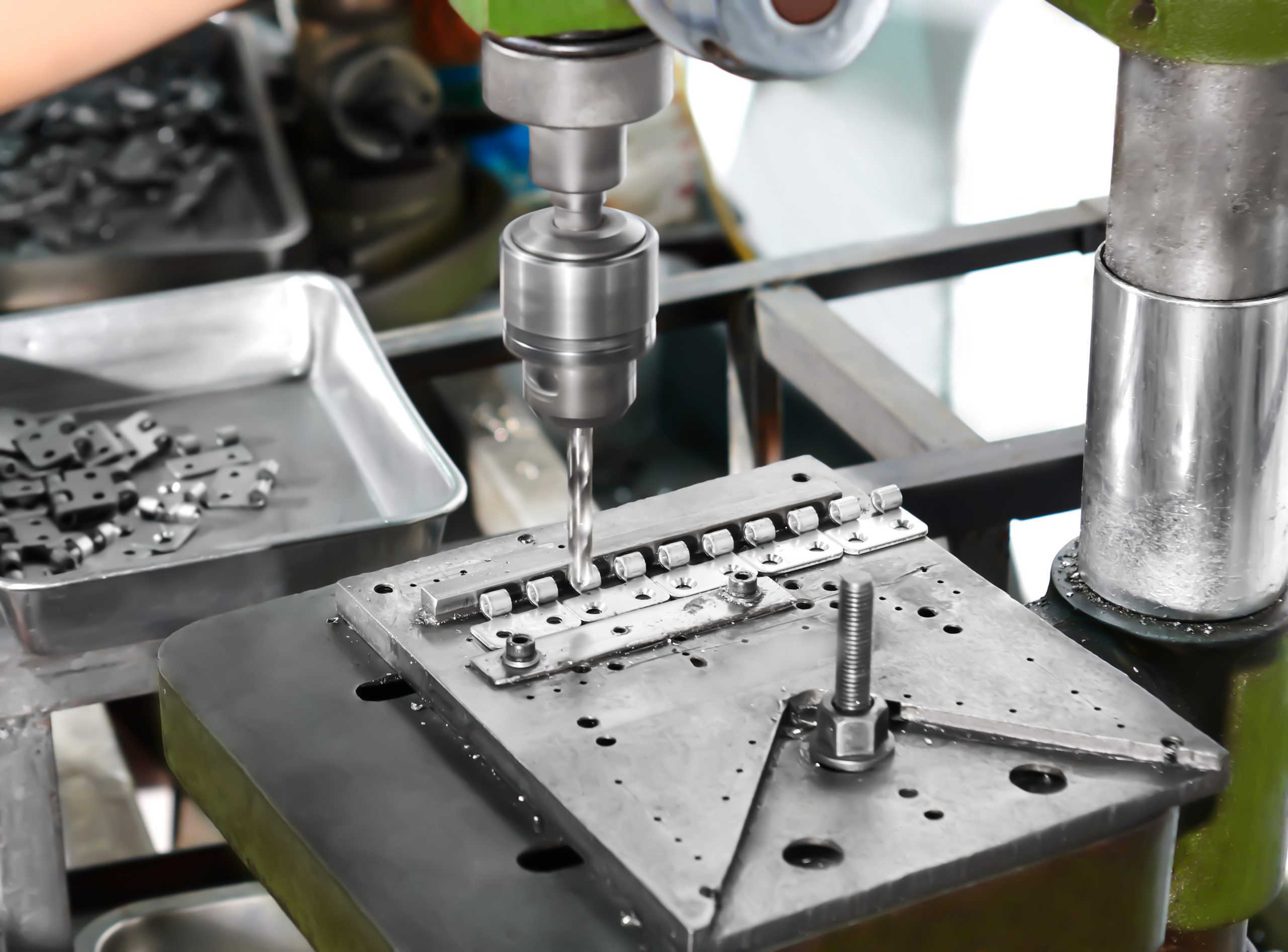
- What manufacturing processes are in-house? Stamping, die-casting, CNC machining, and assembly all require different equipment and expertise. Suppliers who control more processes in-house generally deliver better quality and shorter lead times.
- What is the product range? A supplier with a wide product range – ideally over 3,000 SKUs – demonstrates manufacturing versatility and the ability to meet diverse requirements across industries.
- Does the supplier support custom tooling? If you need custom dimensions, hole patterns, or designs, the supplier must have tooling and engineering capabilities. Ask about their experience with custom projects and typical development timelines.
- What surface treatment options are available? Hardware often requires plating, coating, or finishing. Common options include zinc plating, chrome plating, nickel plating, and vibratory finishing. A supplier with controlled surface treatment capabilities delivers more consistent results.
Custom hardware development follows a structured timeline. The process from drawing review to sample delivery typically takes 15 to 45 days, depending on design complexity, material availability, and tooling requirements. Simple modifications to existing tooling fall at the shorter end; completely new designs requiring custom dies fall at the longer end.
3. Delivery Reliability
On-time delivery (OTD) is one of the most important performance metrics for any supplier. OTD measures the percentage of orders delivered on the promised date. Industry data shows that the average OTD rate for metal product suppliers is around 82%. A supplier achieving 90% or higher is performing well above average.
When evaluating a supplier, ask for their OTD data for the past 12 months. A supplier who cannot provide this data – or whose OTD falls below 85% – should be treated with caution. Low OTD rates directly impact your production schedules and customer commitments.
Also consider the supplier’s responsiveness to urgent orders. Can they expedite production when needed? Do they communicate proactively about potential delays? A supplier who communicates early about problems is far more valuable than one who ships late without warning.
For bulk production orders, standard lead times are another critical factor. Typical lead times for catalog items range from 20 to 25 working days from order confirmation to shipment. This timeline assumes standard catalog items with existing tooling. Custom orders may require additional time for tooling preparation and sample approval.
4. Surface Treatment and Quality Control
Surface treatment is often the most overlooked aspect of hardware quality – and the most common source of problems. Plating thickness, adhesion, and corrosion resistance directly affect product lifespan and appearance.
Key verification points:
- Plating adhesion – The cross-hatch tape test confirms that plating bonds properly to the substrate. Poor adhesion leads to peeling and premature failure.
- Batch-to-batch consistency – Ask about color and thickness variation between production runs. A reliable supplier maintains tight process controls to ensure that every batch matches the sample.
- Material test reports (MTRs) – These documents verify the chemical composition of raw materials and plating chemistry. For SUS304 stainless steel, for example, the MTR should confirm the correct chromium and nickel content.
A supplier with in-house or tightly managed surface treatment capabilities delivers more consistent results than one that outsources finishing to third-party vendors.
5. After-Sales Service and Responsiveness
Even the best suppliers occasionally have issues. What matters is how they respond. Evaluate the supplier’s communication style during the sales process – do they respond to inquiries promptly? Do they answer technical questions clearly? Do they provide samples for testing?
Key indicators of good after-sales service:
- Sample availability – Do they provide samples for testing before you commit to a full order? Some suppliers, including NRH, offer free samples with the customer covering shipping costs.
- Technical support – Can their engineers help with installation questions or design modifications?
- Problem resolution – How do they handle quality complaints? Do they replace defective parts promptly?
- Small-batch support – Can you order small quantities for prototyping or maintenance without paying a premium?
Common Procurement Pitfalls to Avoid
Even experienced buyers make mistakes. Here are the most common pitfalls in hardware procurement:
Pitfall 1: Focusing only on unit price. A lower unit price often comes with hidden costs – longer lead times, higher defect rates, and poor communication. Calculate the total cost of ownership, not just the purchase price.
Pitfall 2: Ignoring surface treatment quality. Plating defects may not be visible on the surface. Always request documentation and test reports. Never accept a supplier’s verbal assurance without evidence.
Pitfall 3: Not verifying the supplier’s credentials. Some suppliers present themselves as manufacturers but are actually trading companies that source from multiple factories. Trading companies add markup and reduce your control over quality. Always verify the supplier’s manufacturing capabilities and certifications.
Pitfall 4: Skipping the sample phase. Samples are not optional. Always test samples in your actual application before placing a production order. Fit, function, and finish can only be verified with physical parts.
Pitfall 5: Not checking references or credentials. Ask the supplier for their certifications. ISO 9001, high-tech enterprise status, and industry-specific credentials provide independent validation of capability.
How NRH Measures Up
NRH Box Hardware has been manufacturing case hardware since 1996. Over more than two decades, the company has built a reputation for quality, reliability, and service across military, medical, aviation, transportation, and industrial equipment sectors.
Here is how NRH addresses each of the five evaluation criteria:
| Criteria | How NRH Delivers |
|---|---|
| Quality Management | ISO 9001 certified. 2023 National High-Tech Enterprise designation. Robust incoming inspection, in-process checks, and final testing. ERP system operational since 2010 for full traceability. |
| Production Capability | 3,000+ SKUs across toggle latches, draw latches, compression latches, recessed handles, folding handles, hinges, corner protectors, case locks, and toggle clamps. In-house stamping, die-casting, and assembly. Custom tooling supported with 15-45 day development cycle. |
| Delivery Reliability | 90% on-time delivery rate. Bulk orders: 20-25 working days. Regional warehouses in Shanghai and Zhengzhou for reduced domestic transit times. |
| Surface Treatment | Zinc plating, chrome plating, nickel plating, and vibratory finishing options. Controlled processes ensure batch-to-batch consistency. |
| After-Sales Service | Free samples available (customer covers shipping). Dedicated sales and technical support. Five strategic locations: Beijing, Guangzhou, Zhengzhou, and Chongqing. |
Summary: What to Look for in a Hardware Supplier
When evaluating case hardware suppliers, prioritize these five indicators of reliability:
- Certified quality systems – ISO 9001 certification and recognized industry credentials such as high-tech enterprise status.
- Own production facilities – Not a trading company. Verify the supplier owns and operates their factory.
- Track record of delivery – OTD rate of 90% or higher. Standard lead times of 20-25 working days for bulk orders.
- Controlled surface treatment – In-house or tightly managed plating with documented process controls.
- Responsive service – Quick responses, free samples, and a willingness to support custom requirements.
A supplier who meets all five criteria is worth paying attention to. The cost of a poor supplier – rework, delays, and lost customers – far exceeds any savings from a lower unit price.
Frequently Asked Questions (FAQ)
What are the most important criteria for evaluating a case hardware supplier?
The five most important criteria are: quality management systems (ISO 9001 certification, high-tech enterprise status), production and technical capabilities (equipment, 3,000+ SKU range, custom tooling), delivery reliability (on-time delivery rate of 90% or higher), surface treatment and quality control (plating options, batch consistency), and after-sales service (free samples, responsive support).
What is a good on-time delivery (OTD) rate for a hardware supplier?
The industry average for hardware suppliers is around 82%. An OTD rate of 90% is considered good, while top-tier suppliers consistently achieve 95% or above. NRH maintains a 90% OTD rate across all production orders.
How long does custom hardware sample development take?
The full cycle from drawing review to sample delivery typically ranges from 15 to 45 days, depending on design complexity, material availability, and tooling requirements. Simple modifications to existing tooling fall at the shorter end; completely new designs requiring custom dies fall at the longer end.
What is the difference between a manufacturer and a trading company?
A manufacturer owns and operates production facilities, giving them direct control over quality, lead times, and costs. A trading company sources from multiple factories and acts as an intermediary, which can add markup and introduce quality inconsistency. For critical hardware applications, manufacturers are generally more reliable.
What should I look for in a hardware supplier’s quality credentials?
Look for ISO 9001 certification as the baseline. High-tech enterprise status indicates R&D capability and innovation. For suppliers serving sensitive industries, additional credentials may apply. Always request documentation and verify certifications directly with the issuing bodies.
What is the typical lead time for bulk production orders?
Bulk production orders typically require 20-25 working days from order confirmation to shipment. This timeline assumes standard catalog items with existing tooling. Custom orders may require additional time for tooling preparation and sample approval.
Ready to evaluate NRH as your hardware supplier? Request a sample kit, download the product catalog, or schedule a factory visit. Contact us at nrh-gz@nrh.cn or WhatsApp at +86 180 1797 5137. The full product catalog is available at nrh.hk.